
Voter Sentiment Analysis Techniques: Strategic Intelligence for 2026 Campaigns
- lionelleach
- Aug 12
- 11 min read

In the high-stakes environment of the 2026 election cycle, a traditional poll is no longer a compass. It is a rearview mirror that leaves your campaign vulnerable to shifts you didn't see coming. Identifying the true pulse of the electorate requires more than just standard sampling. It demands advanced voter sentiment analysis techniques that can cut through the digital noise to reveal genuine intent before your opponent even registers a change in the atmosphere.
You understand that the relentless speed of modern media makes it difficult to translate raw data into winning messages before the window of opportunity closes. We will provide the strategic intelligence needed to bridge this gap. This article explores how elite consultants utilize AI-driven predictive analytics and first-party data to maintain a real-time advantage. You'll learn to navigate the complex patchwork of new privacy regulations while maximizing the ROI of your digital and mobile advertising spend. We are moving beyond simple observation into a new era of data-backed messaging pivots that define the path to victory.
Table of Contents
The Evolution of Electorate Intelligence: From Snapshots to Real-Time Streams
Advanced Techniques for Decoding the Electorate: NLP and Machine Learning
The Hybrid Model: Integrating Data Science with Strategic Insider Intuition
Hyper-Local Execution: Analyzing Voter Sentiment in Newark and New Jersey
Turning Sentiment into Victory: From Data Points to Tactical Deployment
The Evolution of Electorate Intelligence: From Snapshots to Real-Time Streams
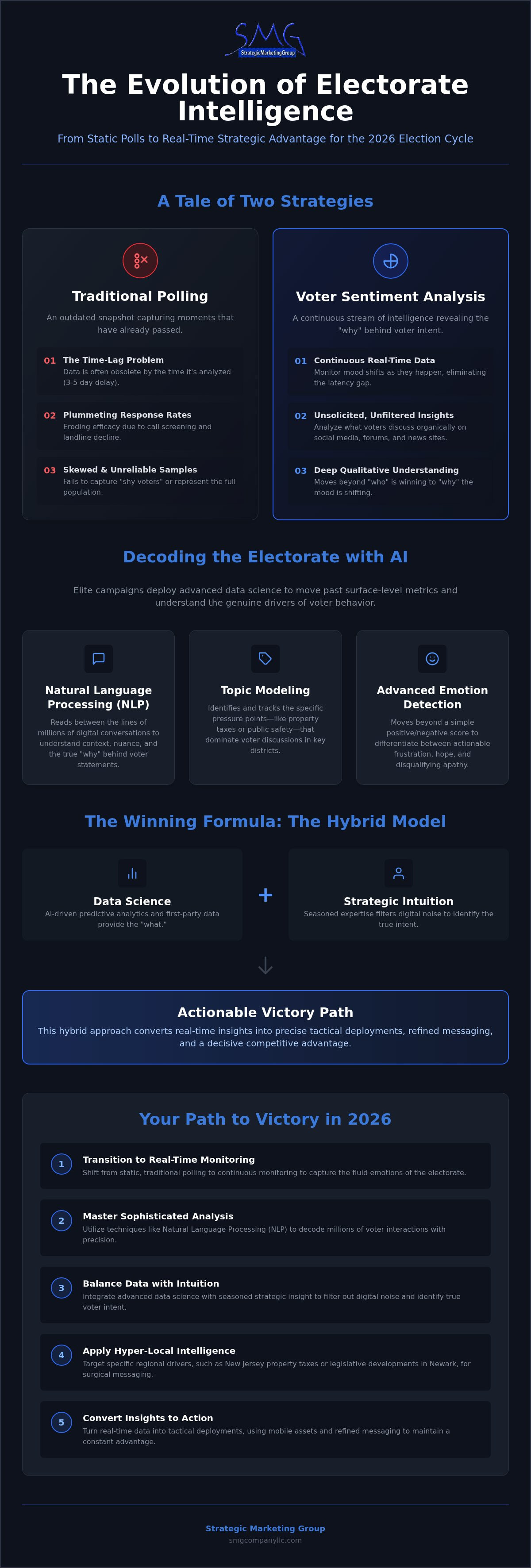
Voter sentiment analysis is the continuous, systematic monitoring of public emotion and opinion. It moves beyond the static numbers of traditional surveys to capture the underlying feelings that drive political action. In previous cycles, campaigns relied on periodic reports to gauge their standing. Today, sophisticated voter sentiment analysis techniques allow for a constant stream of intelligence that reflects the electorate’s mood as it shifts in response to the news cycle.
Traditional polls act as a snapshot, capturing a single moment in time that often expires before the data is even processed. Digital sentiment, conversely, represents a continuous flow of information. For campaigns preparing for 2026, this real-time data is a strategic necessity. Mastering electorate analysis serves as the strategic foundation for every move a candidate makes, ensuring that resources are never wasted on outdated assumptions.
To better understand the practical application of these data streams, watch this helpful video demonstrating how digital interactions are translated into actionable insights:
The Limitations of Traditional Polling in 2026
The efficacy of traditional polling has eroded as landline response rates continue to plummet. Many voters now refuse to answer calls from unknown numbers, leading to skewed samples that fail to represent the broader population. We also face the challenge of "shy voter" syndromes, where individuals provide socially acceptable answers to live callers rather than their true intentions. The most critical failure, however, is the time-lag problem. A poll that takes three days to conduct and two days to analyze is an eternity in a 24-hour news environment. This creates a latency gap, which is the delay between a shift in public opinion and a campaign's ability to recognize it. This gap often leads to delayed pivots that can cost an election.
The Rise of Digital Sentiment Streams
Digital sentiment streams utilize unsolicited data from social media, forums, and news comments to provide a raw, unfiltered look at voter priorities. Unlike surveys that ask specific questions, these voter sentiment analysis techniques observe what voters discuss when they believe no one is watching. This reveals whether anger, hope, or apathy is the dominant driver in a specific district. The transition from quantitative counting to qualitative understanding allows campaigns to move beyond knowing who is winning to understanding why the mood is shifting. This deep intelligence enables candidates to address the root causes of voter concern with surgical precision.
Advanced Techniques for Decoding the Electorate: NLP and Machine Learning
Decoding the electorate in 2026 requires more than just counting mentions or tracking hashtags. It involves deploying Natural Language Processing (NLP) to read between the lines of millions of voter interactions. These voter sentiment analysis techniques allow a campaign to move past surface-level metrics and understand the "why" behind the data. By using Topic Modeling, we identify the specific pressure points, such as property taxes or public safety, that are currently driving the conversation in key districts. This level of granularity ensures that messaging isn't just loud, but relevant.
Advanced Emotion Detection identifies the specific register of the voter's voice, moving beyond simple positive or negative binary scores. We differentiate between constructive frustration and total apathy. While digital streams provide the "what," we often recommend integrating these findings with public opinion polling services to validate these trends through direct voter contact. This hybrid approach ensures that digital noise doesn't lead a campaign astray, providing a check against the loudest voices in the room. If you want to build a data-driven path to victory, consulting with a strategic insider can help you navigate these complex systems.
Natural Language Processing (NLP) in Political Contexts
Generic sentiment tools often fail because they don't understand the nuances of political discourse. Advanced NLP models, such as BERT and other transformer architectures, allow us to identify sarcasm, regional slang, and subtle political dog-whistles that standard software misses. These models understand the context of a voter's post by looking at the entire sentence structure rather than individual keywords. In a practical sense, NLP categorizes voter frustration as a mobilizable asset while identifying voter apathy as a risk requiring immediate intervention. It's the difference between hearing a crowd and understanding what they're actually demanding.
Machine Learning for Predictive Modeling
Machine learning takes existing data and turns it into a predictive weapon. By analyzing historical reactions to policy announcements, we can forecast how specific demographics will respond to new platform planks before they are even released. Tools like VotLocaDetect provide location-aware analysis, ensuring that messaging is tailored for hyper-local concerns. SMG leverages these voter sentiment analysis techniques to anticipate opposition moves before they materialize. This foresight allows a candidate to seize the narrative and pivot their strategy before the competition can react. Data is only as valuable as the victory it produces.
The Hybrid Model: Integrating Data Science with Strategic Insider Intuition
Raw data is a tool, not a solution. Even the most advanced voter sentiment analysis techniques can be derailed by the "Loudest Voice Bias." This phenomenon occurs when a highly active but statistically insignificant group dominates digital platforms, creating an illusion of widespread consensus or outrage. Relying solely on automated dashboards risks chasing shadows while ignoring the silent majority. To find the true center of gravity in an election, we integrate digital streams with traditional focus groups and qualitative interviews. This hybrid approach allows us to hear the voices that don't post but definitely vote.
Filtering Digital Noise from Electorate Reality
Automated systems often struggle to distinguish between organic voter sentiment and coordinated bot activity or misinformation campaigns designed to skew data. Strategic Marketing Group (SMG) identifies these skewing factors by weighting digital data against benchmark political polls. This verification process ensures that a campaign doesn't overreact to a temporary "Twitter storm" that has no resonance with the actual electorate. We look for the signal in the noise, focusing on genuine shifts in voter behavior rather than manufactured trends. By identifying these anomalies early, we prevent campaigns from pivoting based on artificial data that doesn't translate to the ballot box.
Strategic Synthesis: The Human Element
Algorithms provide patterns, but they don't understand the gravity of a local crisis or the nuance of community leadership. A seasoned strategist like Lionel Leach is essential to interpret ambiguous sentiment that machines might mislabel. There are moments when voter sentiment analysis techniques suggest a candidate should retreat from a controversial topic, yet strategic intuition dictates a "double down" approach to project strength. Strategic Synthesis is the intersection of algorithmic output and political experience. It's the point where data science meets the art of the win. As a strategic architect, SMG synthesizes these disparate data points into a cohesive path to victory. We ensure that every digital insight is tempered by professional judgment and a deep understanding of local engagement.
Hyper-Local Execution: Analyzing Voter Sentiment in Newark and New Jersey
New Jersey’s political landscape is defined by its deep-seated complexity and hyper-local machines. Generic voter sentiment analysis techniques often fail to account for the specific nuances of the Garden State. In Newark and across the region, public opinion is driven by tangible, high-stakes issues like property taxes, labor relations, and the rapid pace of urban development. Understanding these drivers requires more than just broad data collection; it requires a strategic presence on the ground. We look beyond the surface to see how these factors intersect with daily life in New Jersey's most influential corridors.
Legislative monitoring in Newark provides a critical feedback loop for corporate public affairs and campaign strategy alike. By tracking how local ordinances or state-level bills impact community mood, we can predict shifts in support before they manifest at the ballot box. This level of precision is essential for effective NJ public affairs, where shaping voter perception is a matter of navigating established power structures and emerging social trends. To secure your position in this competitive environment, leverage SMG’s government relations strategy to turn local sentiment into a legislative advantage.
Newark Electorate Dynamics
Newark’s five wards each possess distinct demographic profiles and political histories. Analyzing sentiment across these diverse groups requires a granular approach. We utilize geofencing to isolate and capture sentiment within specific Newark wards or NJ legislative districts. This allows a campaign to identify where labor leadership is successfully driving voter reengagement and where apathy is beginning to take hold. SMG uses these local insights to navigate Newark’s complex political environment, ensuring that messaging is tailored to the specific concerns of the Ironbound just as effectively as those in the South Ward. We don't just see Newark as a single entity; we see it as a collection of unique, powerful communities that demand individualized attention.
State-Level Sentiment and Legislative Advocacy
State-level policy changes in Trenton often cause immediate ripples in voter sentiment that can be tracked in real-time. We use this sentiment data to brief lobbyists and government relations teams, providing them with the empirical evidence needed to advocate for or against specific measures. This data-backed approach replaces guesswork with strategic certainty. There's a direct and measurable correlation between Newark resident sentiment and state-wide policy influence, making the city a bellwether for the rest of New Jersey. When you understand the mood in Newark, you possess a roadmap for the entire state’s political future. This foresight allows our partners to act decisively while others are still waiting for the next round of traditional polling results.
Turning Sentiment into Victory: From Data Points to Tactical Deployment
Data is the fuel, but strategy is the engine. Converting digital insights into a ballot box victory requires a seamless transition from the analytical to the tactical. We don't just provide reports; we provide a roadmap for immediate engagement. By utilizing advanced voter sentiment analysis techniques, we identify the precise language and emotional triggers that resonate with the electorate. This intelligence directly informs our political messaging services, ensuring that every speech, ad, and social post mirrors the authentic concerns of the community. It's about speaking with the voters, not at them.
Message Development and Pivot Strategy
Effective messaging isn't static. It requires a constant feedback loop where narratives are tested and refined in real-time. We use sentiment data to conduct rapid A/B testing of political narratives, identifying which arguments gain traction and which fall flat before significant budget is committed. This is particularly critical during a crisis. When a candidate's reputation is at risk, understanding the specific nature of public frustration allows for a surgical response that addresses the core issue rather than offering generic platitudes. By adopting the vocabulary used by voters in high-sentiment clusters, we build a bridge of trust that traditional, top-down messaging cannot achieve.
Tactical Deployment: The SMG Video Truck and Beyond
Strategic Marketing Group (SMG) takes response beyond the digital screen. When our voter sentiment analysis techniques show a shift in sentiment in a specific neighborhood, we deploy the SMG Video Truck to that exact location. This mobile asset delivers hyper-targeted video ads to the streets where specific issues are trending, creating a physical presence that reinforces the digital message. We complement this with voice and text broadcasting to reengage voters who show signs of apathy or confusion in the data. These tools allow us to address specific concerns identified by AI with a personal, direct touch that cuts through the noise of the 24-hour news cycle.
Deciding the path to victory requires an expert who understands the hidden mechanics of influence and knows how to build a path where others see obstacles. We have led campaigns in over 40 states, providing the strategic intelligence needed to win in high-stakes environments. If you are ready to move beyond guesswork and into a new era of precision politics, Partner with SMG for Strategic Electorate Analysis today.
Master the Electorate to Define the Future
The shift from static polling to dynamic intelligence is no longer optional. It's the baseline for victory in 2026. By integrating advanced voter sentiment analysis techniques with seasoned strategic judgment, campaigns can move beyond reacting to the news cycle and start shaping it. We've explored how Natural Language Processing and hyper-local geofencing allow for surgical messaging pivots that resonate in Newark wards and across the state. Success in high-stakes environments requires a partner who understands both the data and the ground game.
Strategic Marketing Group offers full-service management from public opinion polling to ground-game execution. Our team of veteran NJ political operatives provides the strategic counsel necessary to interpret complex sentiment and navigate local power structures. With innovative assets like the SMG Video Truck, we ensure your message reaches the right neighborhoods at the precise moment it matters most. The path to victory is built on precision and the courage to challenge the status quo. Secure Your Strategic Advantage with SMG Electorate Analysis and lead your campaign with confidence. Your path to the winner's circle begins with the right intelligence.
Frequently Asked Questions
How does voter sentiment analysis differ from traditional polling?
Voter sentiment analysis provides a continuous, qualitative flow of data rather than a quantitative snapshot. While polling asks specific questions to a limited sample, sentiment analysis monitors unsolicited public discourse across digital platforms. This approach captures the emotional register of the electorate in real-time. It allows campaigns to identify shifts in mood before they appear in traditional survey results, providing a more fluid understanding of voter intent.
Is AI-driven sentiment analysis accurate enough for local Newark elections?
Yes, provided the models are calibrated for local nuances and regional dialects. Accuracy in Newark depends on identifying the unique political language of the city's five wards. When combined with strategic insider intuition, AI-driven voter sentiment analysis techniques offer a high degree of precision. This combination is essential for tracking community concerns like urban development or labor relations that define the local political landscape.
What are the most effective tools for real-time voter tracking in 2026?
The most effective tools integrate Natural Language Processing (NLP) with location-aware data analytics. Platforms like Brandwatch or Sprout Social provide the raw data, but the real power lies in custom predictive models that filter for political context. These tools allow campaigns to monitor first-party data and social streams to maintain a constant pulse on the electorate's priorities throughout the high-stakes 2026 election cycle.
How does SMG handle the ethical considerations of data mining and voter privacy?
We prioritize strict compliance with the evolving patchwork of state-level privacy laws, including new 2026 regulations in Indiana and Kentucky. Our methodology focuses on aggregate public data and first-party information collected with consent. We maintain a formal, mission-driven approach to data usage. This ensures that our strategic architecture respects civic duty and the legal boundaries governing voter privacy and data security across all jurisdictions.
Can sentiment analysis predict the outcome of a swing-district race in New Jersey?
It serves as a powerful predictive indicator rather than a guaranteed crystal ball. By identifying shifts in the "silent majority" and tracking the intensity of voter frustration, sentiment analysis highlights which way a district is leaning. In New Jersey's swing districts, this data helps strategists decide whether to pivot messaging or double down on specific policy platforms. It provides the evidence needed to make high-stakes campaign decisions.
How much does it cost to implement professional sentiment analysis for a campaign?
Costs vary significantly based on the scope of the race and the depth of the data required. Factors include the number of districts monitored, the frequency of reporting, and the integration of mobile assets. Campaigns should evaluate their budget against the potential ROI of data-backed messaging pivots. For specific investment details, it's best to consult directly with a strategic partner to build a custom, scalable plan.
What is the role of Natural Language Processing in political strategy?
NLP acts as the engine that decodes the complexity of human speech into actionable data points. It identifies the "context" of voter interactions, distinguishing between genuine support and sarcastic opposition. This technology is essential for voter sentiment analysis techniques because it allows strategists to categorize millions of comments into specific issue clusters. It identifies drivers like property taxes or public safety with speed and efficiency.
How does SMG integrate sentiment data with the SMG Video Truck advertising?
We use real-time sentiment shifts to trigger the physical deployment of mobile assets. When data shows a specific issue is trending in a Newark neighborhood, the SMG Video Truck is dispatched to that area with tailored creative content. This creates a disruptive, physical reinforcement of the digital campaign. It ensures that the message is seen by voters exactly when their interest in a specific topic is at its highest point.
Comments