
SMS Voter Outreach: A Strategic Guide to High-Stakes Engagement in 2026
- lionelleach
- Aug 12
- 11 min read

A 2026 study in Political Behavior confirmed that mobile messaging can increase voter turnout by 14.4 percent, yet most campaigns squander this potential by treating their outreach as a digital megaphone rather than a surgical tool. You understand the mounting pressure of breaking through the inbox clutter while facing the technical hurdles of 10DLC registration and the reality of voter text fatigue. It’s a delicate balance between persistent engagement and the risk of high opt-out rates that can jeopardize your entire communication infrastructure.
This article serves as your strategic blueprint to master sms voter outreach, transforming a basic broadcast channel into a high-stakes engine for electorate mobilization. We provide the seasoned perspective needed to navigate the complex landscape of 2026, including the nuances of carrier surcharges from Verizon and T-Mobile and the latest FCC consent revocation mandates. You’ll learn how to integrate data-driven insights with compliant messaging to maximize every dollar of your campaign budget. We will preview the essential frameworks for brand vetting, the shift toward conversational peer-to-peer models, and the methods for maintaining high deliverability in an increasingly regulated environment.
Table of Contents
Beyond the Broadcast: Why SMS Voter Outreach is Critical in 2026
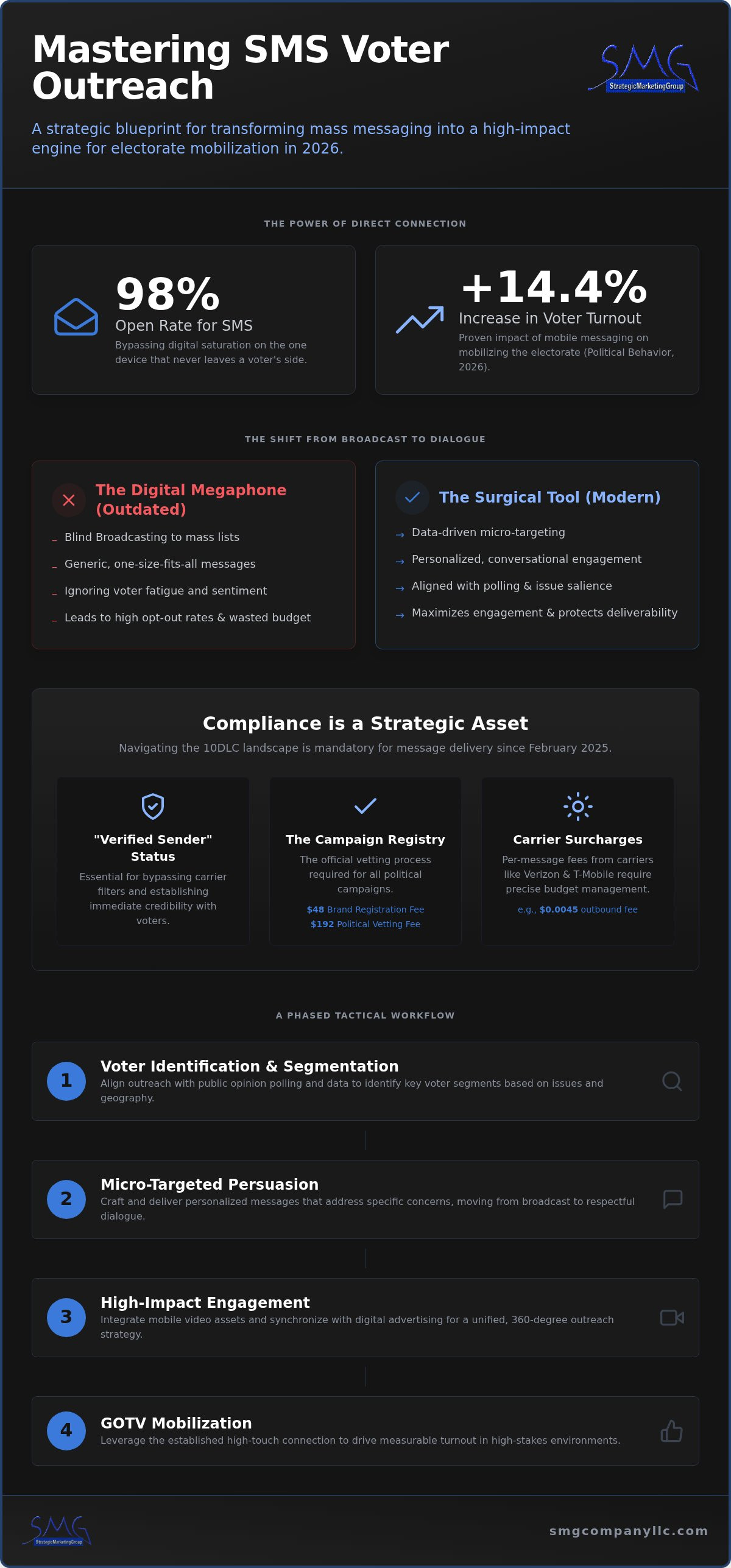
SMS voter outreach isn't a modern convenience; it's the primary conduit for political influence in an era defined by digital saturation. While email engagement continues its steady decline and social media algorithms restrict organic reach, text messaging maintains a staggering 98 percent open rate. This isn't just about volume. It's about the precision of reaching a voter on the one device that never leaves their side. For campaigns operating in 2026, the mobile screen is the most valuable real estate in the political landscape.
We define this approach as a high-touch, mobile-first engagement strategy that prioritizes direct connection over broad-spectrum noise. In the context of sophisticated electorate analysis, SMS serves as a live feedback loop. It allows campaigns to gauge sentiment in real-time and adjust narratives before the opposition can react. This shift toward mobile-first consumption is particularly evident among diverse demographics and younger voters who have abandoned traditional news cycles in favor of immediate, bite-sized information delivered directly to their pockets.
The Psychology of the Text Message
The psychology of the text message rests on its perceived status as a personal communication channel. Unlike a billboard or a pre-roll ad, a text message arrives in a space usually reserved for family and colleagues. This proximity creates an immediate sense of urgency that traditional media cannot replicate. It breaks through the digital noise by demanding attention in a way that passive advertising simply can't match. Understanding the history of political text messaging reveals how this tool evolved from a novelty into a strategic necessity for modern governance. To succeed, campaigns must bridge the intimacy gap where SMS provides a direct human connection that social media platforms have systematically commodified and diluted.
Data-Driven Engagement vs. Blind Broadcasting
Blind broadcasting is a relic of the past that leads to high opt-out rates and wasted resources. Effective campaigns now utilize granular polling data to inform every text-based narrative they deploy. At SMG, we treat SMS as a bridge between high-level public opinion research and tactical field operations. This precision-guided sms voter outreach ensures that every interaction is relevant, respectful, and results-oriented. It allows for the re-engagement of voters who have effectively tuned out traditional media through ad-blockers or cord-cutting. We move away from the "mass blast" mentality. Instead, we favor targeted, conversational outreach that addresses specific voter concerns, geographic priorities, and past behavioral triggers. This transition from broadcast to dialogue is what drives measurable turnout in high-stakes environments.
Navigating the 10DLC Landscape: Compliance as a Strategic Asset
Compliance is no longer a back-office administrative task; it's the foundation of a successful ground game. Since February 2025, major U.S. carriers have implemented a total block on all unregistered 10DLC traffic. For a campaign, this means that failing to navigate the registration process isn't just a risk. It's a guarantee that your message will never reach the voter. We view 10DLC (10-Digit Long Code) registration as a strategic asset that separates professional operations from amateur attempts. By securing "Verified Sender" status, your campaign gains a significant advantage in deliverability and trust that unregistered entities simply cannot match.
The financial and operational stakes are high. Political campaign verification requires a specific vetting process through The Campaign Registry, involving brand registration fees of approximately $48 and a political vetting fee of $192. Beyond these initial costs, carriers like Verizon and T-Mobile apply per-message surcharges, such as the $0.0045 outbound fee effective in 2026. Managing these variables requires precision. Our team at SMG treats these requirements as a roadmap to high-stakes engagement, ensuring that your sms voter outreach remains uninterrupted by carrier filters or regulatory scrutiny. To maintain this momentum, it's vital to stay informed on the latest FCC rules for political texts, particularly regarding the Telephone Consumer Protection Act (TCPA).
The Registration Roadmap for Campaigns
Effective registration begins with clearly identifying your Brand and Campaign use cases for carrier approval. For campaigns in New Jersey and other high-density regions, early filing is critical. Vetting timelines can fluctuate as election cycles intensify, and a delay in registration can silence your outreach during the most vital weeks of the race. We specialize in crafting content that adheres to strict carrier rules for political senders, avoiding the "spam" triggers that lead to immediate blocking. This proactive approach ensures your infrastructure is robust before the first message is sent. If you need assistance navigating these technical hurdles, our team can help you develop a comprehensive campaign management strategy that prioritizes deliverability.
Carrier Transparency and Voter Trust
Transparency is the antidote to voter "text fatigue." 10DLC registration provides a level of carrier-level transparency that reduces the likelihood of your messages being flagged as unsolicited. This system requires clear opt-in and opt-out mechanisms. As of April 2025, FCC regulations require campaigns to honor opt-out requests within 10 business days across any reasonable channel. Adhering to these standards doesn't just prevent TCPA fines, which can range from $500 to $1,500 per message. It also signals to the voter that your campaign respects their digital boundaries. Strict adherence to compliance protocols serves as a shield for the candidate’s long-term reputation and prevents the brand from being associated with intrusive or predatory communication tactics.
Segmentation and Micro-Targeting: Crafting the Narrative
Effective sms voter outreach requires a departure from generic messaging in favor of surgical precision. In a high-stakes environment, the intelligence behind the text is as critical as the delivery itself. By integrating public opinion polling services with your mobile database, you transform a simple contact list into a dynamic strategic map. This data-driven approach allows campaigns to segment the electorate by issue salience, geography, and past behavioral triggers. We use these insights to develop political messaging services specifically optimized for the small screen, where brevity and impact must coexist. SMS also serves as a low-cost laboratory for message testing. By analyzing response rates and sentiment in small cohorts, campaigns can refine their narrative before committing significant resources to large-scale media buys.
The Newark Strategy: Localized Outreach
Hyper-local targeting is the cornerstone of municipal and legislative victory. In Newark’s diverse wards, a message that resonates in the Ironbound may not hold weight in the West Ward. We address specific community pain points, ranging from localized infrastructure concerns to labor rights, through mobile-based advocacy. This segmentation logic ensures that your campaign speaks the language of the community. It builds a narrative that feels rooted in local reality rather than a distant headquarters. Success in these contests is often won in the margins, and localized mobile engagement provides the necessary edge.
Re-Engaging the "Unreachable" Voter
Traditional outreach often misses the mobile-only households and younger demographics that have largely abandoned landlines and linear television. With 97 percent of Americans owning a cell phone, SMS is the most effective bridge between polling insights and actual field operations. The choice between peer-to-peer (P2P) and broadcast messaging is a strategic one. While broadcast is efficient for mass updates, P2P allows for the personalized, conversational outreach that 2026 voters demand. This method turns a passive recipient into an engaged participant, fostering a sense of direct access to the campaign that traditional advertising cannot replicate. By focusing on these "unreachable" blocks, we ensure that no segment of your potential base is left to the opposition's influence.
From Persuasion to GOTV: Tactical SMS Workflows
A tactical workflow transforms sms voter outreach from a series of isolated messages into a chronological engine of victory. This process begins with Phase 1: Awareness and Identification. During this stage, we deploy initial surveys to tag voter sentiment and identify supporters, undecideds, and opposition. Phase 2 shifts to persuasion. Here, we integrate strategic narratives with high-impact visual assets, such as coordinates for an SMG Video Truck appearance, to create a multi-sensory campaign presence. Phase 3 is the critical mobilization and Get Out The Vote (GOTV) countdown, where the focus moves from changing minds to moving feet. Finally, Phase 4 ensures post-election re-engagement, transitioning campaign momentum into a long-term government relations strategy that maintains influence well beyond election night.
If you're ready to deploy a high-precision ground game that captures every available vote, explore our integrated campaign management services.
The GOTV Countdown: A 72-Hour Blueprint
The final three days of a campaign are where elections are won or lost. Our blueprint prioritizes clarity and urgency to maximize turnout. On Day 3, we send the "Plan to Vote" prompt; this involves identifying the voter's specific polling place and confirming their intended time of arrival. Research suggests that visualizing the act of voting significantly increases the likelihood of follow-through. Day 2 focuses on addressing final objections and deploying crisis communications to counter last-minute opposition narratives. On Day 1, the tone shifts to "Last Chance" urgency. We utilize high-frequency reminders and volunteer recruitment calls to ensure every identified supporter reaches the ballot box before polls close.
Measuring Success: Metrics That Matter
Sophisticated campaigns look beyond vanity metrics like open rates. We track click-through rates on digital assets and perform sentiment analysis on inbound responses to gauge the real-time health of the campaign. The most critical metric is the correlation between SMS volume and physical turnout in targeted precincts. By analyzing this data, we can refine the political campaign management model mid-stream, shifting resources to areas where engagement is lagging. This data-driven approach ensures that your sms voter outreach is not just active, but effective. We turn mobile data into a predictive tool that informs future legislative priorities and community engagement efforts.
The SMG Advantage: Scaling Your Ground Game
Success in modern politics requires more than just a delivery platform; it demands a strategic architect who understands the hidden mechanics of influence. At SMG, we don't just facilitate sms voter outreach; we engineer a comprehensive infrastructure designed for high-stakes victory. Our methodology moves beyond the siloed approach of traditional firms. We combine digital advertising for campaigns with mobile broadcasting to create a unified 360-degree ecosystem. This ensures that every text message is reinforced by a broader digital presence, creating a cohesive narrative that follows the voter across every touchpoint.
The SMG Video Truck serves as a physical anchor for these digital efforts. By deploying mobile LED displays in high-traffic urban centers, we amplify text-based calls to action with a visual presence that cannot be ignored. This integration of digital and physical assets turns a simple notification into a community event. It reinforces the idea that your campaign is mission-driven and deeply rooted in the local pulse. We pride ourselves on being a disruptive force that challenges the status quo, utilizing data and social trends to build a path to victory where others see obstacles.
Full-Service Campaign Integration
Effective SMS operations don't exist in a vacuum. They work best when supported by rigorous polling and a sophisticated government relations strategy. Our integrated approach ensures that the messages sent to your database are informed by the latest electorate analysis. With experience in over 40 states and a deep-rooted history in high-stakes New Jersey contests, we understand the nuances of local engagement and labor leadership. We invite community leaders and candidates to partner with SMG to secure a data-driven victory built on precision and professional integrity.
Next Steps: Launching Your Strategic Outreach
The transition from planning to execution requires immediate action on technical compliance. You can begin the 10DLC registration process today to ensure your campaign is vetted and ready before the election cycle reaches its peak intensity. Our team is prepared to guide you through the complexities of carrier approval and narrative development. Schedule a consultation for a comprehensive electorate analysis and messaging strategy to see how we can optimize your outreach. Partner with SMG for your 2026 campaign success and take command of your mobile ground game.
The Future of Electorate Mobilization
The shift toward mobile-first consumption has transformed the cell phone into the most critical instrument for political influence. A successful strategy requires more than just sending messages. It demands a rigorous commitment to 10DLC compliance and a deep integration of public opinion data. By moving from generic broadcasts to surgical, data-driven segmentation, your sms voter outreach can break through the noise and foster genuine voter engagement.
SMG brings a history of high-stakes success in over 40 states, led by seasoned political operatives like Lionel Leach. Our team of data-driven electorate analysis experts ensures your narrative is grounded in real-time sentiment, providing the precision needed for victory. This integrated approach turns digital noise into measurable turnout. Secure Your Strategic Advantage with SMG Outreach. The path to victory is built on precision and professional integrity. We're ready to help you lead your community toward a successful 2026.
Frequently Asked Questions
Is SMS voter outreach legal under current FCC regulations?
SMS outreach is legal provided campaigns strictly adhere to the Telephone Consumer Protection Act and the latest FCC mandates. Marketing messages require prior express written consent, while informational texts have different requirements. As of April 2025, you must also honor opt-out requests made through any reasonable channel within 10 business days. Failure to comply can result in significant fines ranging from $500 to $1,500 per message.
How much does an SMS voter outreach campaign typically cost?
Campaign costs involve several layers of industry fees and carrier surcharges. Standard brand registration with The Campaign Registry costs approximately $48, while political vetting requires an additional $192 fee. Beyond these setup costs, carriers like T-Mobile and Verizon charge per-message surcharges, such as the $0.0045 outbound fee effective in 2026. Total investment depends on your message volume and the specific carrier mix within your voter database.
What is the difference between P2P texting and broadcast SMS for campaigns?
Peer-to-peer (P2P) texting involves individuals manually sending messages to foster two-way, personal conversations with voters. Broadcast SMS, or A2P, is an automated system designed for mass distribution of alerts and updates. While broadcast is highly efficient for rapid mobilization, P2P is often the preferred choice for persuasion. It provides a level of human connection that automated systems cannot replicate in high-stakes environments.
How long does the 10DLC registration process take for political brands?
The registration process typically takes several weeks from initial submission to final carrier approval. This timeline includes brand verification, political vetting, and specific campaign use-case review. We recommend starting this process at least two months before your primary outreach window. Early filing is a strategic necessity to avoid the inevitable bottlenecks that occur as the 2026 election cycle reaches its peak intensity.
Can I use SMS for voter registration drives in New Jersey?
SMS is a highly effective tool for driving voter registration in New Jersey. You can distribute direct links to the state's online registration portal or provide critical information regarding deadlines and eligibility. This mobile-first approach is particularly successful in reaching diverse urban demographics who may not engage with traditional mail. It turns a passive information session into an immediate, actionable opportunity for the voter.
What happens if a voter opts out of my SMS campaign?
You must immediately cease all messaging to that individual and update your records. Under current FCC rules, campaigns must process opt-out requests made through any channel, not just "STOP" replies, within 10 business days. Maintaining rigorous opt-out compliance is essential for your sms voter outreach to protect your sender reputation. Neglecting these requests can lead to carrier-level blocking and severe legal penalties that jeopardize your entire operation.
How do I ensure my campaign texts aren’t blocked by carriers?
The most effective way to prevent blocking is to secure "Verified Sender" status through full 10DLC registration. Since February 2025, major carriers have implemented 100 percent blocking of all unregistered traffic. You must also avoid using shortened URLs from public domains and ensure your content doesn't trigger spam filters. Consistent monitoring of deliverability metrics allows you to identify and resolve potential filtering issues before they silence your message.
Can SMS outreach be integrated with my existing voter file?
SMS platforms should be fully integrated with your voter file to maximize strategic impact. This synchronization allows you to use historical voting data and demographic insights to inform your sms voter outreach segments. By linking these datasets, you can track which voters are engaging with your texts and adjust your field operations in real-time. This creates a powerful feedback loop that enhances the precision of your mobilization efforts.
Comments