
Using Polling Data for 2026 Campaign Messaging
- lionelleach
- Aug 10
- 12 min read

A spreadsheet full of cross-tabs isn't a strategy; it's a liability if you can't translate those numbers into a narrative that moves the needle. With congressional candidates having raised $2.1 billion as of March 2026, the margin for error in this cycle has vanished. Many strategists find themselves buried under information overload, struggling to understand how to use polling data for campaign messaging that actually resonates with persuadable voter segments. You've likely felt the frustration of watching high-priced data result in generic slogans that fail to capture the public's imagination or shift the electorate in your favor.
We understand that true leadership requires more than just reading the room; it requires the strategic confidence to reshape it. This guide provides a clear framework to transform raw public opinion into a winning narrative that secures victory and optimizes your digital and mobile advertising spend. We'll explore how to identify the psychological drivers behind voter behavior, navigate the new landscape of coordinated spending following the June 2026 Supreme Court ruling, and deploy disruptive messaging that turns raw data into institutional influence.
Table of Contents
The Strategic Intersection of Public Opinion and Campaign Narrative
Polling isn't a mirror; it's a microscope. Many campaigns treat data as a simple feedback loop, reacting to every minor fluctuation in the numbers. This reactive posture is a recipe for a generic, uninspired campaign that lacks a core identity. Instead, seasoned strategists view polling as a diagnostic tool. It reveals the underlying health of a candidate's standing and the structural weaknesses of the opposition. In the 2026 cycle, where congressional candidates have already spent over $1.3 billion as of March 2026, the cost of misinterpretation is catastrophic.
Raw data is inert. It requires a strategic architect to interpret social trends and convert complex cross-tabs into a path to victory. Understanding an opinion polling overview helps distinguish between a fleeting headline and a fundamental shift in public sentiment. We must move beyond what voters think to why they hold those views. Sentiment is driven by emotion, trust, and deep-seated values, not just policy checklists. This shift in perspective is vital for anyone learning how to use polling data for campaign messaging effectively.
Data vs. Intelligence: Why Most Campaigns Fail at Messaging
Chasing numbers leads to a loss of candidate authenticity. If you change your message every time a survey result drops, voters sense the lack of conviction and the desperation of the campaign. Strategic intelligence differs from simple survey results because it accounts for the broader mission and the psychological drivers of the electorate. Strategic messaging is the bridge between voter needs and candidate vision. By focusing on intelligence over raw data, campaigns maintain a steady, authoritative presence that survives the daily news cycle.
The Electorate Analysis Foundation
Before you speak, you must map the terrain. Effective campaigns rely on electorate analysis to identify the hidden mechanics of influence within diverse demographics. This baseline data is essential. Without it, you're launching a messaging offensive into a vacuum. In a fragmented media environment, precision is the only way to ensure your voice isn't drowned out by the noise. Establishing a firm data foundation allows a campaign to act as a disruptive force, challenging the status quo with confidence. Understanding how to use polling data for campaign messaging begins with this rigorous analysis of the political landscape.
Identifying Persuadable Segments Through Advanced Cross-Tabulation
Winning a high-stakes election requires looking past the aggregate percentages. Top-line numbers provide a snapshot of the current state, but they offer no guidance on how to change it. Following the June 30, 2026, Supreme Court ruling that overturned limits on coordinated spending between parties and candidates, the ability to deploy a unified, data-backed message is more powerful than ever. To secure victory, strategists must dive into advanced cross-tabulation to find the "swing" hidden within the data. This process involves isolating "soft" supporters who might be prone to defection and undecided voters who are still weighing their options. By understanding the specific pressures these groups face, a campaign can tailor its outreach with surgical precision.
The 2026 electorate is increasingly defined by psychographics rather than simple demographics. While age and zip code matter, shared values and lifestyle priorities often dictate voter behavior more accurately. By identifying wedge issues that resonate with the opposition's base, a campaign can disrupt their opponent's foundation and force them into a defensive posture. Success depends on evaluating polling data quality to ensure these insights are built on a representative and reliable sample. This rigorous approach is the cornerstone of how to use polling data for campaign messaging that actually converts.
Decoding Voter Sentiment in Complex Environments
Voter sentiment varies wildly between urban centers like Newark and the suburban districts of New Jersey. A message that inspires in an urban core might fall flat in the suburbs if it doesn't account for local nuances or specific economic anxieties. Strategists use intensity scores to measure the depth of a voter's commitment. A "somewhat support" response is a primary target for the opposition; a "strongly support" response represents a reliable vote. Identifying silent trends-shifts in sentiment that haven't yet reached a boiling point in the media-allows a campaign to address concerns before they become liabilities.
The Power of Persuasion Polling
Persuasion polling moves beyond tracking to active experimentation. It tests specific message frames to determine which narratives move the needle among undecided segments. Some voters respond to specific policy-based arguments, while others are moved by character-driven stories. Utilizing public opinion polling services to simulate opposition attacks helps a campaign build a resilient defense. This proactive testing ensures your message is battle-hardened before the 90-day coordinated communications period begins on August 5, 2026. It's the most effective way to learn how to use polling data for campaign messaging that withstands high-pressure environments. If you want to refine your strategy, consider partnering with a firm that specializes in campaign management and data-driven narrative building.
Crafting the Narrative: From Data Points to Strategic Communications
Data points are the raw materials of a campaign, but they don't win elections on their own. Victory requires a narrative that synthesizes these findings into a mission-driven theme. To master how to use polling data for campaign messaging, you must move beyond the numbers and find the human story they tell. We use a journalistic approach to provide context, ensuring the message feels rooted in the community's history and future. This narrative must challenge the status quo while reflecting a deep commitment to civic duty and leadership.
The 'Rule of Three' is a vital tool for any strategic architect. Voters are overwhelmed by information. A campaign that tries to be everything to everyone ends up being nothing to anyone. We distill complex survey results into three core pillars. These pillars act as the structural support for the entire campaign, providing a clear path for voters to follow. This methodical approach ensures that even the most complex data remains accessible and persuasive to the segments that matter most.
Building the Message House
A message house provides the structural integrity needed for a multi-channel offensive. The roof represents the overarching campaign vision or 'The Big Ask.' It's the primary reason the candidate is running. The pillars are the data-backed issues that resonate most with persuadable segments identified in your initial analysis. Finally, the foundation is the candidate's biography and core values. This foundation ensures the candidate remains authentic even when the political winds shift. Without a solid foundation, the entire narrative risks collapse under the weight of opposition scrutiny.
Speech Writing and Messaging Precision
Translating a statistic, like 60% approval on a specific economic issue, into a compelling stump speech is an art form. You don't just state the number. You describe the impact of that policy on the lives of families in districts like Essex or Camden. We favor movement-oriented language over high-level terminology to create a sense of progress and urgency. Leveraging political messaging services ensures narrative consistency across every platform, from the SMG Video Truck to mobile advertisements. This precision prevents the message from becoming diluted or generic, maintaining its disruptive force throughout the election cycle.
Deploying the Message: A Multi-Channel Strategic Offensive
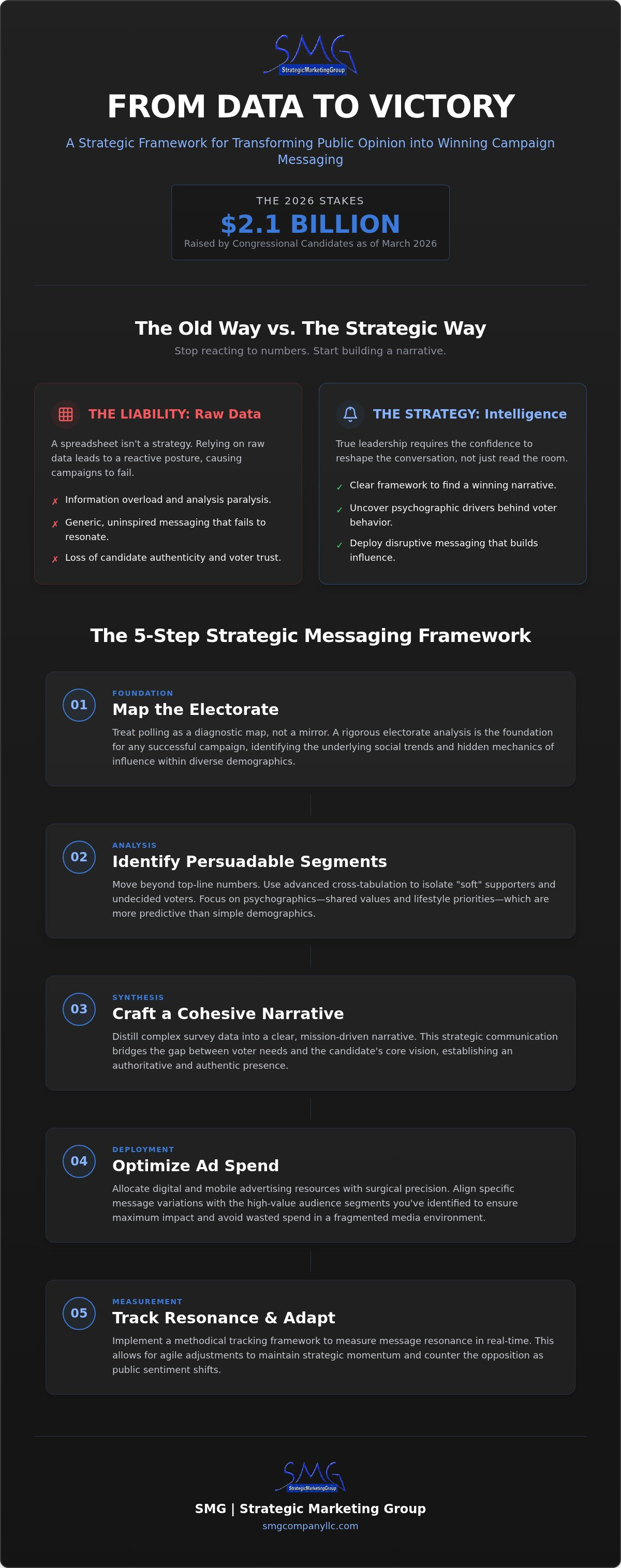
Deployment is the phase where strategic confidence translates into institutional influence. It's the execution of a methodical plan to reach voters through every available channel, ensuring the core narrative remains a disruptive force in the 2026 cycle. Mastering how to use polling data for campaign messaging involves a high-level transition from the spreadsheet to the street. This offensive requires a five-step approach: aligning message variations with digital segments, utilizing mobile advertising for direct contact, deploying physical assets like the SMG Video Truck, monitoring real-time feedback, and executing a relentless GOTV push. Precision is not optional.
Digital and Mobile Advertising Strategy
Voters interact with information primarily through their mobile devices. Utilizing digital advertising for campaigns allows a strategic architect to micro-target persuadable voters with specific message frames. Video content conveys authority and strategic confidence more effectively than static text. During the 90-day coordinated communications period, which begins August 5, 2026, the speed of deployment is critical. Text-based communication serves as a disruptive tool for reengagement, providing a direct line to voters who may have missed broader broadcast messages. This digital layer ensures the campaign vision remains present and persuasive where voters live and work.
Innovative Outreach: The SMG Video Truck
Physical presence creates a sense of place and local commitment that digital ads cannot replicate alone. The SMG Video Truck acts as a mobile billboard, reinforcing the core campaign narrative in high-density polling clusters. We geofence the truck's route based on data, ensuring it appears in the neighborhoods where persuadable segments are most concentrated. This localized visual messaging provides a grounded, respectful focus on community leadership while maintaining a high-level strategic outlook. It's an efficient allocation of resources that turns public sentiment into visible momentum. To execute a deployment strategy that leaves nothing to chance, consider partnering with a firm that understands the intersection of data and mobile advertising.
Monitoring real-time feedback allows the campaign to adjust the narrative mid-stream. If tracking data shows a shift in sentiment or a new opposition maneuver, the messaging must adapt without losing its foundation. The final GOTV push is the culmination of this effort, driven by polling that identifies exactly who hasn't voted yet. This relentless focus on data-backed execution ensures that the $1.3 billion already spent by congressional candidates this cycle results in a path to victory rather than a collection of missed opportunities.
Measuring Impact and Navigating the 2026 Political Environment
The final phase of a high-stakes campaign isn't about static messaging; it's about agility. A strategic architect understands that the narrative must evolve as the electorate responds to the shifting environment. Tracking polls are essential for measuring message resonance over time. They provide the empirical evidence needed to determine if your story remains the dominant force in the conversation. Without this continuous measurement, a campaign risks flying blind during the most critical weeks of the cycle. Maintaining a steady, professional demeanor in the face of fluctuating data is the hallmark of deep-rooted expertise.
The Feedback Loop: Tracking and Iteration
Success requires a methodical rhythm for data review and message adjustment. We don't recommend knee-jerk reactions to single-day outliers. Instead, we look for sustained trends that indicate a message has reached saturation or is beginning to lose its edge. Recognizing the difference between statistical noise and a genuine shift in the electorate is what separates seasoned insiders from amateurs. Understanding how to use polling data for campaign messaging involves knowing when to lean into a winning theme and when to introduce a fresh angle to maintain engagement. This iterative process ensures that the campaign's voice remains clear and authoritative even as opposition maneuvers attempt to disrupt your momentum.
From Victory to Governance
The end of the election is only the beginning of institutional influence. Effective political campaign management integrates polling into daily operations to ensure every action aligns with the ultimate goal of victory. However, the true value of this data extends beyond the ballot box. Campaign insights serve as a vital foundation for a long-term government relations strategy. The same voters who supported the candidate now form the constituency that will judge their performance in office. The data reveals their ongoing priorities and expectations.
Maintaining a continuous presence in state and local government structures requires a transition from campaign rhetoric to policy-driven leadership. By using the electorate analysis developed during the campaign, a leader can navigate complex legislative systems with precision. This ensures that the promises made on the trail are translated into measurable progress for the community. The strategic architect's role is to build a path to lasting leadership, turning a single victory into a sustained period of civic influence. This long-term outlook respects the gravity of public service while ensuring the candidate's vision becomes a permanent part of the political landscape.
Building a Path to Institutional Influence
The 2026 political cycle demands more than just awareness; it requires a surgical approach to influence that prioritizes strategic intelligence over raw data. We have explored how a campaign's narrative must be rooted in deep electorate analysis rather than fleeting survey results. By identifying the psychographic drivers of persuadable voters and deploying those insights through high-impact channels like the SMG Video Truck, a campaign can transform public sentiment into a mandate for leadership. This methodical process ensures your message remains a disruptive force from the initial baseline poll to the final GOTV push.
Mastering how to use polling data for campaign messaging is the difference between reacting to the news and creating it. Our team brings deep-rooted expertise from over 40 states, with a specialized focus on the unique legislative landscape of New Jersey. As strategic architects and seasoned insiders, we understand the hidden mechanics of influence required to navigate multifaceted challenges with precision. Secure your strategic foundation with SMG's polling and messaging services. Take the first step toward a path to victory where others only see obstacles. Your mission-driven leadership deserves a narrative that resonates and endures.
Strategic Intelligence: Frequently Asked Questions
How often should a campaign conduct polling to update its messaging?
A campaign should establish a baseline with a benchmark poll at the outset and transition to a regular tracking rhythm as the election nears. During the final months, weekly or bi-weekly surveys are necessary to capture shifts in sentiment. This methodical approach ensures your narrative remains relevant. It prevents the message from becoming stagnant while allowing the campaign to react with strategic confidence to external pressures and opposition maneuvers.
Can polling data help identify which digital platforms are most effective for my message?
Polling data identifies voter media habits by asking specific questions about where different demographics consume information. This allows a strategic architect to determine whether a message should prioritize mobile advertising, digital platforms, or physical assets like the SMG Video Truck. By aligning your message with the platforms your target segments actually use, you optimize your digital spend and ensure your campaign vision reaches the right ears at the right time.
What is the difference between a benchmark poll and a tracking poll for messaging?
A benchmark poll serves as the diagnostic foundation that maps the political terrain and identifies core voter priorities at the start of a cycle. In contrast, a tracking poll measures the ongoing resonance of your message and monitors fluctuations in the electorate over time. While the benchmark informs the initial strategy, tracking polls provide the real-time feedback necessary for mid-campaign adjustments. Both are essential for anyone learning how to use polling data for campaign messaging effectively.
How do I use polling to craft a response to a political crisis?
Utilize rapid response polling to test specific message frames before addressing a crisis publicly. This data reveals which explanations resonate with your base and which arguments effectively neutralize opposition attacks. By measuring the intensity of voter reaction, a campaign can craft a response that maintains authority and strategic confidence. It allows you to address the issue directly without inadvertently amplifying the damage or appearing reactive and unprepared for the challenge.
Is it possible to use polling data to reach diverse demographics in New Jersey?
Reaching diverse demographics in New Jersey requires oversampling specific communities to ensure statistically significant data. Polling allows you to uncover localized nuances in urban centers like Newark versus suburban districts. This precision helps in tailoring a narrative that respects community leadership while addressing the unique economic or social anxieties of each group. It turns raw public opinion into a disruptive force that challenges the status quo across the state's multifaceted political landscape.
How does electorate analysis differ from standard public opinion polling?
Electorate analysis goes beyond standard polling by examining the structural mechanics of influence and long-term social trends. While public opinion polling provides a snapshot of current sentiment, electorate analysis acts as a strategic blueprint for the entire campaign. It identifies the hidden drivers of voter behavior and maps out a path to victory based on deep-rooted data. This comprehensive approach ensures that every communication is purposeful and aligned with the campaign's broader mission.
What role does the 'margin of error' play in determining campaign message safety?
The margin of error defines the statistical boundaries within which a campaign can safely claim a lead or a specific sentiment. If a candidate leads by 3% but the margin of error is 4%, the race is effectively a dead heat. Understanding these limits is crucial for maintaining strategic confidence. It prevents a campaign from over-relying on soft data and ensures that messaging decisions are based on statistically significant shifts in the electorate.
Can I use polling data for speech writing and debate preparation?
Polling data is invaluable for speech writing and debate preparation because it identifies the specific arguments that move undecided voters. By testing killer lines and policy frames in advance, you can ensure your performance resonates with the target audience. This data-driven approach is a core part of how to use polling data for campaign messaging. It allows a candidate to speak with authority, knowing their words are backed by the actual priorities of the community.
Comments