
Voter Segmentation Analysis: A Strategic Guide to Electorate Intelligence in 2026

Updated: Jun 18
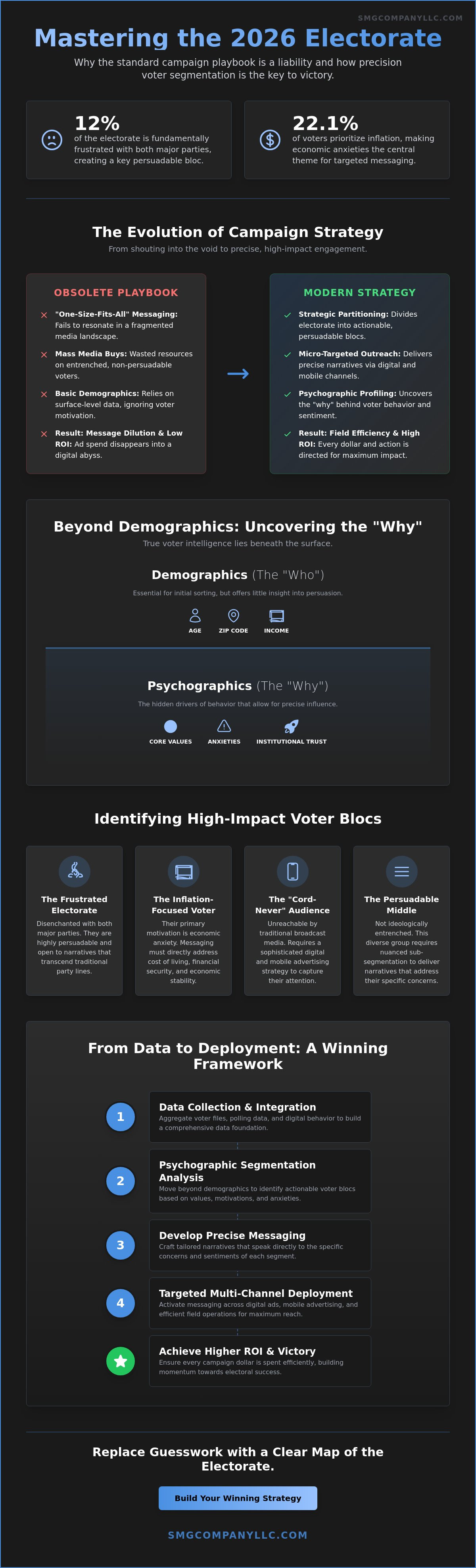
If 12% of the electorate is fundamentally frustrated with both major parties, your standard campaign playbook isn't just outdated; it's a liability. In an era where 22.1% of voters prioritize inflation over all other concerns, a sophisticated voter segmentation analysis is the only way to avoid shouting into the void. You've likely felt the frustration of watching ad spend disappear into a digital abyss, reaching voters who've already made up their minds or who simply aren't listening to generic party lines. Raw data is plentiful, yet actionable intelligence remains scarce.
We understand that modern victory requires more than broad-based appeals. This guide will show you how to master the art of dividing the electorate into actionable blocs to drive precise messaging and secure electoral victory. You'll learn to move beyond basic demographics to map the psychological landscape of the 2026 voter. We'll examine how to identify the "Frustrated Swing Democrat," reach the growing "cord never" audience through targeted digital and mobile advertising, and build a narrative that speaks directly to the anxieties of the persuadable middle. It's time to replace guesswork with a clear map of the electorate and achieve a higher ROI on your field operations.
Key Takeaways
Abandon "one-size-fits-all" messaging in favor of strategic partitioning to meet the demands of a fragmented digital era.
Utilize psychographic profiling to look beyond simple demographics and understand the underlying motivations driving public sentiment.
Implement a rigorous voter segmentation analysis to optimize your media mix and ensure digital advertising reaches high-impact audience blocs.
Distinguish between various swing voter sub-groups to deliver narratives that address specific economic and social anxieties.
Leverage localized insights into institutional influence, such as labor unions, to navigate the unique complexities of the New Jersey electorate.
Table of Contents
Defining Voter Segmentation Analysis in the 2026 Electorate
Voter segmentation analysis is the strategic partitioning of the electorate into distinct, actionable sub-groups. In the 2026 political landscape, treating the voting public as a monolithic block is a tactical error. The "one-size-fits-all" messaging of previous decades is a relic of the pre-digital era. It fails to account for the extreme fragmentation of media consumption and the nuanced psychological drivers of the modern voter. Success requires a sophisticated electorate analysis that identifies not just who a person is, but the specific institutional disruptions that trigger their engagement.
Modern strategy has shifted from demographic-only models to robust behavioral and psychographic frameworks. We don't view a demographic like "voters over 50" as a single entity anymore. Instead, we identify segments based on their reaction to economic volatility or their trust in local leadership. By Defining Voter Segments through this lens, campaigns can move beyond surface-level outreach. This methodology allows us to engage the hidden mechanics of influence that traditional polling often misses.
To better understand how these perceptions are measured and improved in the current cycle, watch this helpful video:
The Evolution of Electorate Intelligence
The 20th-century model relied on broad-reach polling and mass media buys to capture a majority. Today, that approach is obsolete. The decline of party loyalty as a primary segment identifier has forced a move toward precision. In 2026, micro-targeting is the standard for any campaign seeking a path to victory. We use data to isolate specific groups, such as the 12% of voters currently frustrated with both major parties. This allows for a mission-driven focus on individuals who are actually persuadable, rather than wasting resources on entrenched partisan bases.
Why Precision Segmentation Determines ROI
Generic outreach is a drain on campaign resources. When messaging is too broad, it suffers from message dilution, failing to resonate with any specific group. Precision segmentation ensures that every dollar spent on digital and mobile advertising is directed toward a high-impact audience. This intelligence is the prerequisite for field operation efficiency. It allows canvassers to enter a neighborhood with a narrative that speaks directly to the anxieties of that specific community. By avoiding non-persuadable voters, campaigns achieve a significantly higher return on investment and maintain a steady, purposeful momentum toward election day.
The Methodology: Beyond Demographics to Psychographic Profiling
Effective voter segmentation analysis requires the mindset of a strategic architect. We don't just collect data points; we look for the hidden mechanics of influence that drive human behavior. Traditional models often stall at the surface, categorizing voters by rigid, static traits. Our approach moves deeper into the psychological undercurrents of the electorate. By conducting a sophisticated voter data analysis, we uncover the underlying motivations that determine how a message is received, processed, and acted upon.
Demographics vs. Psychographics: A Strategic Comparison
Demographics provide the "Who" of a campaign. They tell us a voter's age, zip code, and income level. These are essential for initial sorting but offer little insight into persuasion. Psychographics provide the "Why." This layer explores a voter's core values, their specific anxieties regarding institutional change, and their level of trust in local governance. Understanding these drivers is what allows a campaign to transition from broad outreach to precise influence.
Behavioral Segmentation: Tracking Electorate Action
Action is the ultimate validator of data. We analyze past voting frequency not just as a statistic, but as a predictor for future engagement. This includes identifying segments by their "Information Consumption" habits. For instance, the rise of "cord-nevers" in New Jersey shows that a significant portion of the electorate no longer engages with linear television. We utilize in-depth voter data analysis to map these digital footprints. This allows us to deploy digital and mobile advertising that meets voters where they actually spend their time.
Our process culminates in the creation of an "issue-sensitivity" matrix. With 22.1% of the national electorate currently focused on inflation and the economy, we map how this specific anxiety interacts with other concerns like government waste. This matrix ensures that your campaign management strategy remains agile. It prevents message dilution by ensuring that every segment receives a narrative tailored to their specific priorities, rather than a generic party platform. This level of precision is what separates a standard campaign from a successful one.
Identifying and Activating the High-Impact Swing Voter
The concept of a monolithic "swing voter" is a tactical myth that often leads to wasted resources. In the 2026 cycle, victory depends on recognizing that the middle is not a single block, but a collection of distinct segments with conflicting anxieties. A rigorous voter segmentation analysis reveals that "Frustrated Swing Democrats" and "Soft Republicans" require entirely different engagement strategies. While some campaigns chase every undecided voter, the strategic insider identifies persuadable individuals in unlikely places by analyzing institutional friction and shifting community loyalties.
A common objection from campaign purists is the desire to focus exclusively on the base. While base mobilization is critical, the margin-of-victory math rarely supports a narrow approach. Winning high-stakes elections requires capturing segments of the 12% of voters who are currently frustrated with both parties. By utilizing data from the Election Administration and Voting Survey (EAVS), we can map participation history against current sentiment to find where the base ends and the persuadable electorate begins. For a deeper dive into these sub-groups, consult our guide on understanding swing voters.
The Three Tiers of Persuadability
Tier 1: The Hard Base. These voters are already aligned. The strategy here is pure mobilization and turnout, ensuring they have the logistics needed to cast their ballots.
Tier 2: The Persuadable Middle. This is where voter segmentation analysis provides the highest return. These voters are open to a narrative but skeptical of generic partisan rhetoric.
Tier 3: The Opposing Base. These voters are non-persuadable. Strategic neglect or neutralization is often the most efficient use of resources here.
Activation Strategies for Targeted Segments
Activation isn't about repeating slogans; it's about delivering a unique value proposition. We don't guess what will resonate with a specific segment. Instead, we use political campaign focus groups to test segment-specific messaging before a single ad is placed. This ensures the narrative addresses the specific economic or social anxieties of the target bloc.
Validation messengers play a pivotal role in this process. A message delivered by a trusted community leader or a respected local figure often carries more weight than a direct campaign appeal. By identifying these influencers within specific segments, we can activate skeptical voters who have tuned out traditional political advertising. This methodical approach ensures that your campaign speaks with authority to the people who will actually decide the outcome of the election.
From Data to Deployment: Integrating Segmentation into Digital Outreach
Data serves as the strategic blueprint, but deployment is the construction of victory. Integrating a comprehensive voter segmentation analysis into your media mix transforms raw intelligence into a tactical advantage. This transition requires a precise roadmap for syncing voter files with digital ad platforms. By mapping segments directly to digital IDs, we ensure that messaging reaches the intended audience with surgical precision, bypassing the waste of traditional broad-market buys. This process is essential for reaching the 40% of New Jersey voters who are now streaming-only viewers and no longer consume live television.
Segment-specific geofencing disrupts the traditional advertising model by allowing for hyper-local message delivery. We don't just broadcast; we narrowcast to the specific digital footprints of persuadable blocs. This ensures that a voter in a specific district receives a narrative that addresses their unique economic anxieties, rather than a generic party platform. To maximize the impact of your outreach, consider how our digital and mobile advertising strategies can be tailored to your specific electorate map.
Mobile and Social Media Targeting
Custom audiences are built on the foundations of psychographic and behavioral data. We don't just target by age or income; we target by institutional trust levels and specific issue sensitivity. This allows for real-time A/B testing where different narratives are deployed to different segments simultaneously. If a specific message fails to resonate with "Frustrated Swing Democrats" in a key district, we pivot the creative instantly. This level of agility ensures that every dollar in the budget is optimized for persuasion. We maintain a formal register in all digital voter outreach, ensuring compliance and transparency while navigating complex social media algorithms.
The SMG Video Truck: Hyper-Local Segment Engagement
The SMG Video Truck represents the fusion of digital intelligence and physical presence. We use segmentation data to determine high-traffic routes within very specific neighborhoods. This isn't a random drive-by; it's a calculated deployment based on where high-impact segments live and work. Visual content is tailored to the specific community being traversed, addressing local concerns identified during the analysis phase. This hyper-local engagement re-engages voters who may have tuned out digital screens, providing a tangible reinforcement of the campaign narrative. Measuring the offline impact of these mobile-based assets allows us to refine the strategy for future field operations, ensuring a steady, purposeful momentum toward election day.
Navigating the Complexities of New Jersey Electorate Analysis
New Jersey serves as a unique case study for sophisticated voter segmentation analysis. The state's political landscape is defined by a dense network of institutional influences that traditional demographic models often fail to capture. In Newark, for instance, the role of labor unions and community leadership is central to segment formation. These organizations act as primary validation messengers, shaping public sentiment long before a candidate's narrative reaches a voter's screen. Effective strategy here requires constant monitoring of state-level legislative shifts in Trenton and understanding how those decisions ripple through the diverse neighborhoods of North Jersey. We look at these social trends through a lens that identifies institutional disruption as a primary driver of voter behavior.
Positioning a campaign for success in this environment requires a strategic architect who understands the hidden mechanics of local influence. National firms frequently overlook the nuanced friction between different voting blocs, resulting in generic messaging that fails to land. We prioritize a mission-driven approach that balances high-level data with a grounded respect for local engagement. This ensures that every campaign we manage is built on a foundation of reality rather than abstract statistics. By integrating regional intelligence with our strategic outlook, SMG creates a clear path to victory where others see only obstacles.
New Jersey’s Evolving Demographic Blocs
The 2026 cycle highlights a significant shift in suburban versus urban voting patterns across the state. In North Jersey, we distinguish between the "Commuter Class" and the "Local Workforce" as two distinct segments with conflicting economic priorities. While the commuter class may prioritize transportation infrastructure and regional tax policy, the local workforce is often more sensitive to municipal governance and immediate economic waste. Newark’s institutional history further complicates these segments, as multi-generational community ties often outweigh standard partisan leanings. Understanding these evolving blocs is essential for any campaign that hopes to achieve a higher ROI on its digital and field operations.
The Strategic Advantage of Local Expertise
National firms often miss the subtle undercurrents that drive New Jersey politics because they rely on top-down data. We believe that "boots-on-the-ground" intelligence is the only way to validate digital segments effectively. With approximately 25% of New Jersey voters reporting TikTok usage and one-third utilizing YouTube as a social platform, the digital footprint is vast but fragmented. We use localized data to ensure your message appears where your specific audience actually spends its time. To secure the intelligence needed for high-stakes victory, partner with SMG for public opinion polling services that win. Our firm provides the precision and authority required to navigate the most complex electoral systems in the country.
Mastering the Electorate for 2026 and Beyond
Winning in the 2026 cycle requires a shift from broad assumptions to granular intelligence. A sophisticated voter segmentation analysis allows you to identify the specific institutional disruptions and economic anxieties that drive the modern voter. It's about precision. By integrating psychographic profiling with tools like the SMG Video Truck, your campaign maintains a purposeful momentum. We've proven this methodology in over 40 states and across all levels of government.
Led by prominent New Jersey political strategist Lionel Leach, our firm understands the hidden mechanics of influence that national agencies miss. We provide a roadmap for community leadership. Our innovative mobile-based voter reengagement strategies ensure your message is heard where it matters most. Success isn't found in generic appeals; it's built on a foundation of strategic confidence and deep-rooted expertise.
Secure your strategic path to victory with SMG’s electorate analysis.
The path to electoral success is built on precision, and we're ready to help you lead the way.
Frequently Asked Questions
What is the primary goal of voter segmentation analysis?
The primary goal of voter segmentation analysis is to transform a broad, unmanageable electorate into distinct, actionable subgroups. This allows a campaign to move beyond generic messaging and address the specific institutional disruptions that motivate different voters. By identifying these unique drivers, campaigns can allocate resources more efficiently. It ensures that outreach efforts focus on persuadable individuals rather than non-responsive partisan bases.
How does psychographic profiling differ from traditional voter demographics?
Traditional demographics focus on the "who" by analyzing static traits like age, income, and geography. Psychographic profiling dives into the "why" by exploring a voter's core values, anxieties, and levels of institutional trust. While demographics help determine reach, psychographics are essential for actual persuasion. Understanding a voter's psychological landscape is what allows a strategic architect to build a narrative that resonates on a personal level.
Can voter segmentation be used for small, local municipal elections?
Voter segmentation is highly effective for local municipal elections where margins of victory are often slim. At the local level, segments are frequently defined by hyper-local issues such as zoning, school board decisions, or municipal spending. Applying this analysis allows local candidates to identify specific pockets of support and address community-specific concerns that national or state-level data might overlook. It's a critical tool for localized victory.
How often should a campaign update its voter segmentation data?
Campaigns should update their voter segmentation data continuously to reflect the evolving political environment. Major economic shifts, such as the 22.1% of voters prioritizing inflation in 2026, can rapidly alter segment priorities. Regular updates ensure that messaging remains relevant and that digital and mobile advertising spend is optimized based on the most current electorate intelligence available. Static data is a liability in a fast-moving cycle.
What is the role of "micro-targeting" in modern voter segmentation?
Micro-targeting serves as the tactical execution of voter segmentation analysis. It involves delivering highly specific narratives to small groups or individuals based on their segment profile. In 2026, this often takes the form of targeted digital and mobile advertising. By narrowcasting messages to specific digital IDs, campaigns can ensure their value proposition reaches the right person at the right time with surgical precision.
How do you measure the effectiveness of a segmented messaging strategy?
Effectiveness is measured through a combination of tracking polls, digital engagement metrics, and field data. We analyze how specific segments respond to A/B tested narratives in real time. High engagement rates on digital platforms and positive feedback from field operations indicate that the messaging is resonating. This data allows for constant refinement of the campaign's strategic outlook and ensures a steady, purposeful momentum toward election day.
Is voter segmentation analysis compliant with current data privacy laws?
Voter segmentation analysis is fully compliant with current data privacy laws when handled through professional voter files and aggregated data sets. We prioritize transparency and follow established legal frameworks for digital voter outreach. Campaigns should always verify that their data partners adhere to state and federal regulations regarding the use of personally identifiable information in political advertising. Maintaining institutional trust is paramount in every campaign we manage.
What tools does SMG use to conduct electorate analysis in New Jersey?
SMG utilizes a suite of sophisticated tools including Public Opinion Polling and Digital & Mobile Advertising analytics. We integrate these with localized insights from our Government Relations Strategy. In New Jersey, the SMG Video Truck also provides a unique method for field validation. This allows us to test and measure the impact of localized messaging in high-traffic areas. These tools provide the deep-rooted expertise required for high-stakes success.
Comments