
Political Advertising on Social Media: A Strategic Checklist for 2026 Campaigns

Updated: Jun 18
In the 2022 midterms, nearly 20% of programmatic political campaigns leveraged geopolitical targeting to reach voters in specific congressional and state senate districts. This shift proves that political advertising on social media is no longer about broad awareness. It's a high-precision tool for electorate reengagement that requires a synthesis of polling data and algorithmic agility. You likely recognize that the digital ground shifts every election cycle. The constant threat of platform bans or wasting precious budget on non-voters keeps even the most seasoned strategists awake at night.
We understand that navigating these complex mechanics requires more than just a creative eye; it demands a sophisticated grasp of governance and data analysis. This guide provides an authoritative roadmap to master the digital landscape, ensuring your campaign remains both impactful and bulletproof. You'll learn how to navigate Meta's mandatory AI disclosures, the seven-day pre-election ad blackout, and the strict record-keeping requirements in states like Washington. We also examine the growth of Connected TV and streaming audio as essential channels for reaching voters where they are most attentive.
Key Takeaways
Understand why 2026 marks the end of "set-it-and-forget-it" strategies as political advertising on social media evolves into a precision instrument for voter persuasion.
Learn to integrate sophisticated public opinion polling with digital ad sets to eliminate budget waste and reach high-intent voter segments.
Develop a creative strategy that utilizes declarative, authoritative messaging to combat voter fatigue and establish strategic credibility.
Execute a comprehensive pre-launch audit of platform-specific "Paid for by" disclaimers and tracking pixels to ensure total regulatory compliance.
Sync your digital advertising schedules with ground-level get out the vote services to create a unified and efficient path to victory.
Table of Contents
Defining the 2026 Social Media Political Landscape
The days of treating social platforms as simple digital billboards are over. In 2026, political advertising on social media has transitioned into a surgical instrument for voter persuasion. For campaigns in Newark or statewide New Jersey races, this means moving beyond broad demographic targeting. Success now relies on electorate reengagement. This is the ability to identify and activate specific voter blocks amidst an unprecedented volume of digital noise. Modern strategy requires a deep understanding of social media use in politics to ensure every impression serves a strategic purpose.
To better understand the strategic maneuvers and ethical challenges inherent in this field, watch this case study on platform policy:
The "set-it-and-forget-it" model of digital buying is dead. Static campaigns fail because algorithms and voter sentiments shift in real time. In New Jersey, where local issues in cities like Newark can diverge sharply from suburban concerns, campaigns must use high-level data analysis to pivot messaging instantly. You don't want to find your campaign sidelined by a compliance error or an outdated creative strategy.
The 2026 Regulatory Environment: FEC and NJ State Rules
Federal and state authorities have increased scrutiny on digital spend. The 2026 AI Disclosure Act now mandates that any political creative using synthetic voices or AI-generated imagery must include clear disclosures. In New Jersey, state rules for online advocacy demand higher levels of donor transparency for digital communications. Compliance is now a foundational element of campaign management. These rules are designed to restore trust in a landscape where misinformation is increasingly sophisticated.
Platform-Specific Political Ad Policies
Platform policies are more fragmented than ever. Meta continues its policy of blocking new political ads during the final seven days before Election Day 2026. While X permits political advocacy with certification, TikTok maintains a total ban on paid political content. Google and YouTube also require rigorous identity verification and AI disclosures. Managing these disparate rules is a core component of effective political advertising on social media. Each platform has its own verification protocols that must be completed weeks before a single ad goes live.
Data-First Targeting: The Strategic Foundation
Relying on generic demographic targeting is the fastest way to burn a campaign budget. It's a blunt instrument. In the 2022 midterms, data showed that 32% of programmatic ads used state senate district targeting, a clear indicator that the industry is moving toward hyper-locality. Effective political advertising on social media now requires integrating public opinion polling services directly into your digital ad sets. This move shifts your campaign from broad awareness to strategic intelligence.
This "insider" approach relies on deep electorate analysis to build custom audiences that reflect real-world sentiment. We don't just look for "likely voters." We identify the specific persuasion blocks that will decide the margin of victory. This level of precision is increasingly critical as Generative AI in Political Advertising changes how content is produced and consumed, making high-intent voter persuasion more complex than ever before.
Voter File Integration and Custom Audiences
Securely uploading encrypted voter files allows platforms to match digital profiles with confirmed registration data. This enables the creation of lookalike audiences that mirror your core supporters' characteristics. Crucially, it also allows you to exclude "safe" voters. There's no strategic value in spending your budget on voters who are already guaranteed to turn out for you. Redirect those resources toward swing demographics where the impact is highest. A disciplined campaign knows that every dollar spent on a non-voter is a dollar gifted to the opposition.
Geofencing and Hyper-Local Newark Targeting
Geographic precision is vital for municipal races. Geofencing allows us to serve ads to individuals at specific community events, transit hubs, or polling places. Layering this with mobile advertising for voters ensures your message reaches the Newark electorate exactly where they live and work. Neighborhood-specific messaging in Newark's wards converts digital impressions into physical action. If your current strategy lacks this level of local nuance, it's time to reevaluate your digital advertising for campaigns to ensure you aren't leaving votes on the table.
Creative Strategy: Crafting a Narrative that Disrupts
By 2026, the average voter has developed a sophisticated cognitive filter against digital noise. Breathless hype and alarmist headlines no longer command attention; they invite immediate dismissal. Effective political advertising on social media now demands a pivot toward declarative authority. Voters respect a candidate who provides a steady hand and a clear path forward. This clarity is achieved through professionally refined political messaging services that prioritize substance over slogans. You must move beyond the "set-it-and-forget-it" creative model to maintain a narrative that actually moves the needle.
The psychology of the 2026 voter is defined by "political fatigue." They've seen the same tropes for years. To disrupt this, your creative must feel both inevitable and essential. We favor a functional approach where every statement of capability is followed by a broader statement of impact. This builds a sense of momentum. It suggests a campaign that's constantly active and engaged, mirroring the steady rhythm of a seasoned insider who knows how to navigate complex systems.
Video Content that Converts
The first three seconds of any digital ad determine its survival in a scrolling feed. This is the "thumb-stopper" window. We utilize a strict Problem-Solution-Action framework for all high-stakes digital ads. High-production video establishes credibility and institutional influence, while mobile-first snippets provide the raw transparency voters crave. For example, high-resolution assets captured for the SMG Video Truck can be repurposed into punchy social media snippets. This creates a unified visual language between the physical streets of Newark and the digital feeds of New Jersey voters.
Fighting Misinformation and AI Deepfakes
Protecting a candidate's digital identity requires more than just passive monitoring. It demands a rapid response protocol. When opposition attacks or AI-generated misinformation surfaces, the response must be immediate and authoritative. We use watermarked content and verified digital trails to establish a baseline of truth that voters can rely on. This isn't just about defense. It's about ethical disruption. By challenging the status quo and correcting the record with precision, you reinforce your position as a trusted leader. Campaigns that fail to watermark their high-level creative are leaving themselves vulnerable to sophisticated digital tampering.
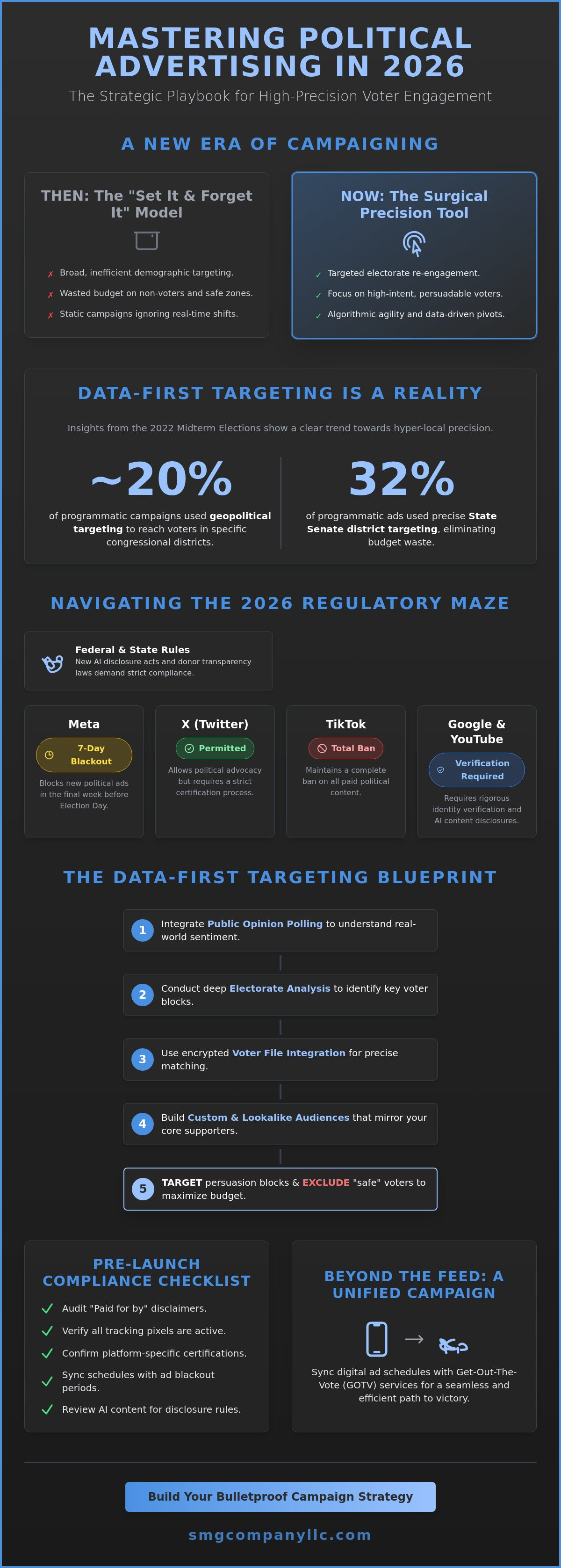
The Ultimate Pre-Launch Compliance & Strategy Checklist
Strategy is only as effective as its execution. In the high-stakes environment of 2026, the final transition from planning to deployment requires a rigorous audit. You cannot rely on a "vibe" check when the stakes involve federal compliance and significant budget allocations. Political advertising on social media demands a level of precision that mirrors the complexity of the legislative process itself. This checklist serves as your final barrier against operational failure and public scrutiny.
Before any ad goes live, we stress-test the budget allocation against the key districts identified during your initial polling phases. We ensure that every dollar is moving toward high-intent voter blocks rather than disappearing into broad, unoptimized demographics. This is the moment where your strategic architecture meets the reality of the digital marketplace. A single oversight in tracking or a missing disclaimer can derail weeks of momentum. We treat these final steps with the gravity they deserve.
The Compliance Audit
Compliance is a foundational pillar of institutional influence. You must verify that every image and video contains a clear and conspicuous disclaimer. In 2026, Meta and Google require explicit AI disclosure tags for any media that utilizes synthetic voices or significantly altered footage. We confirm that all "Paid for by" text is legible on mobile devices, where most voters will consume your content. Furthermore, we cross-reference all creative against the latest New Jersey State Election Law Enforcement Commission (ELEC) rules. These regulations are strict regarding online advocacy and donor transparency. Don't risk a platform-level ban or legal penalties because of a font size error.
The Technical & Tracking Audit
Your digital campaign's nervous system is its tracking data. We verify that all platform pixels and Google Analytics 4 events are firing correctly. This ensures that you aren't flying blind once the campaign launches. We also test every "Get Out the Vote" link to confirm it directs voters to their specific polling location finders. If your political advertising on social media integrates with voice and text broadcasting, you must verify that all opt-in flows are seamless and legally compliant. A broken link or a faulty opt-in flow represents more than just a technical glitch; it represents a lost opportunity to engage a voter.
Precision in deployment is what separates winning campaigns from the rest. For professional oversight on your next digital deployment, secure our Campaign Management services to ensure your strategy is executed with total accuracy.
Beyond the Feed: Integrating Social with Ground Operations
Digital visibility is insufficient if it remains trapped behind a screen. Strategic architects view political advertising on social media as just one foundational pillar of a broader strategy for digital advertising for campaigns. A campaign's digital footprint must directly inform its physical presence. If your social data shows high engagement in a specific Newark ward, your field team should be on those doorsteps within 48 hours. This creates a feedback loop where digital metrics refine field canvassing. It ensures resources aren't wasted on cold leads.
Timing is everything. You must sync your social media ad schedules with professional get out the vote services. This synchronization is critical during the final week of the 2026 cycle. Since Meta blocks new political ads during the last seven days before Election Day, your digital strategy must pivot to reengagement and mobilization of existing audiences. This is the moment where digital momentum converts into physical ballots. We position your campaign as a stable, continuous presence in the community that doesn't just appear on a feed but shows up at the door.
Digital-to-Field Synergy
Engagement data provides a roadmap for your ground game. We analyze which voter segments watched at least 50% of a video or clicked a specific issue-based ad to prioritize door-knocking lists. These high-intent individuals are then retargeted with SMS and voice broadcasting to move them toward the finish line. Consistency is vital. The tone established in your social media creative must match the candidate's stump speeches. Our expertise in speech writing ensures that your digital and physical voices remain unified. This avoids the cognitive dissonance that often erodes voter trust during the final stretch of a campaign.
The SMG Advantage: A Holistic Path to Victory
Strategic Marketing Group bridges the gap between sophisticated data analysis and boots-on-the-ground execution. We don't just buy ad space; we build paths to victory. Our approach leverages Newark-specific insights to drive statewide impact, recognizing that local sentiment often predicts broader trends. We understand the hidden mechanics of influence and how to navigate the complex regulatory environment of 2026 with precision.
Victory isn't achieved on a single platform. It's built through a continuous, stable presence in the community, both online and off. The seasoned architect knows that political advertising on social media is most powerful when it serves as the vanguard for a total campaign effort. By integrating every digital impression with a physical action, we ensure your message doesn't just reach the voter; it moves them to the polls.
Securing the Margin of Victory in 2026
The 2026 electoral cycle will reward those who treat data as a strategic asset rather than a generic line item. Success requires a synthesis of public opinion polling and high-precision digital execution. Navigating the shifting rules of political advertising on social media demands a partner who understands the mechanics of influence and the gravity of compliance. From mandatory AI disclosures to geofenced voter reengagement, every digital impression must serve a documented purpose in your path to victory. You must move beyond awareness to achieve genuine electorate reengagement.
Strategic Marketing Group brings a history of high-stakes success to your organization. With experience in over 40 states and deep strategic leadership rooted in New Jersey, we provide full-service integration from initial polling to final digital deployment. We don't just manage budgets; we architect paths to victory. Partner with the Strategic Architects at SMG for Your 2026 Digital Campaign to ensure your message resonates with precision. Your campaign deserves the stability and expertise required to navigate a complex electorate with confidence. We stand ready to help you lead with authority and purpose.
Frequently Asked Questions
What are the current FEC rules for political advertising on social media in 2026?
Federal Election Commission regulations in 2026 mandate that all digital political communications include a clear "Paid for by" disclaimer. These ads must also be archived in a publicly accessible database for transparency. Campaigns are required to register their ad accounts as political entities. This process involves verifying the identity of the person managing the account and the legitimacy of the sponsoring organization.
Do social media ads actually increase voter turnout in local elections?
Strategic digital campaigns increase turnout by reducing the friction between a voter's intent and their action. Digital ads are particularly effective when they provide logistical information, such as polling location finders or early voting deadlines. While broad awareness has its place, the highest impact on turnout comes from targeted mobilization efforts that remind specific voter blocks of their civic duty during the final 72 hours of an election.
How much should a New Jersey campaign budget for social media advertising?
Budgeting for a New Jersey campaign depends on the size of your target electorate and the competitive nature of your district. You should evaluate the cost-per-thousand impressions in the Philadelphia or New York media markets, which often influence local digital rates. A professional approach involves allocating funds based on the reach required to touch your persuasion universe multiple times before Election Day. Consult with a campaign manager to align spending with polling data.
Are there specific disclosure requirements for AI-generated political ads?
Specific disclosure requirements now exist for any political creative that utilizes generative AI or synthetic media. Platforms like Meta and Google require advertisers to check a disclosure box during the ad setup process if the content features realistic depictions of people or events that didn't happen. These labels are visible to the public. Failure to comply can lead to the immediate rejection of your political advertising on social media and permanent account restrictions.
Can political campaigns still use micro-targeting on Facebook and Instagram?
Micro-targeting has evolved into a more disciplined practice of custom audience management. While platforms have restricted targeting based on certain sensitive interests, you can still reach specific groups through the secure upload of voter files. This allows you to match digital profiles with confirmed registration data. Geographic targeting remains a powerful tool for municipal races, enabling you to focus on specific wards or neighborhoods with high precision.
What happens if my political ad account gets banned mid-campaign?
If an account is banned, your first step is to initiate a formal appeal through the platform's internal review system. However, a seasoned strategist never relies on a single point of failure. You should maintain verified backup accounts and distribute your political advertising on social media across multiple platforms. This diversification ensures that your message continues to reach the electorate even if one channel experiences technical or regulatory disruptions.
How do I verify a political organization on TikTok or X for 2026?
Verification on X requires a multi-step certification process that includes providing a government-issued ID and proof of your organization's legal status. TikTok maintains a strict ban on paid political advertising, though it allows organic content from verified accounts. For platforms that permit ads, you must complete the authorization weeks in advance. This lead time is necessary to navigate the manual review processes that platforms employ during high-stakes election cycles.
What is the best way to track the ROI of a digital political ad?
The best way to track ROI is by focusing on high-intent conversion metrics rather than vanity engagement. You should monitor specific actions such as voter registration clicks, volunteer signups, or donation page completions. By utilizing tracking pixels and UTM parameters, you can identify which creative assets and targeting segments are delivering the highest return. This data allows you to reallocate budget in real-time toward the most effective persuasion tools.
Comments