
Voter Reengagement Strategies: Reconnect with Disengaged Voters in 2026

Repeated outreach won’t reconnect disengaged voters if it never addresses why they stepped away. Effective voter reengagement strategies start with evidence, not assumptions: a missed election may reflect a packed schedule, limited trust, inaccessible information, or a belief that participation won’t make a difference.
Campaigns and civic organizations have to earn attention while working with limited resources and serving communities with different needs. The practical challenge is to make each contact relevant and useful without letting repeated messages feel generic or intrusive.
This guide lays out a research-led plan for reconnecting with voters in 2026. You’ll learn how to distinguish causes of disengagement, use polling, surveys, and focus groups to shape audience-aware messages, choose suitable digital, mobile, voice, and text channels, and reduce practical barriers to participation. It also explains how to measure more than delivery by tracking whether outreach leads to meaningful engagement and participation.
Reengagement works best as a coordinated process: listen first, communicate with purpose, and make the next step clear. That discipline helps direct limited resources toward barriers voters actually face and create credible paths back to civic participation.
Table of Contents
Voter Reengagement Strategies Start by Understanding Why People Disengage
A voter who doesn’t respond to a campaign message hasn’t necessarily lost interest in civic life. They may have missed the message, changed phone numbers, questioned the sender’s credibility, or faced a practical barrier to participating. Treating every quiet voter as the same audience can lead to more outreach without addressing the real obstacle.
What voter reengagement means in a campaign context
Voter reengagement is the process of renewing meaningful contact with eligible voters who have become less responsive or involved. It differs from first-time voter registration and election-day turnout operations. Reengagement starts with a practical question: what would make participation more relevant, trusted, accessible, or manageable for this audience?
The answer should shape the goal. For one group, it may mean sharing clear information about an issue. For another, it may mean rebuilding confidence through credible messengers. For someone facing logistical friction, it may mean making participation steps easier to understand. The aim isn’t to send more messages. It’s to restore a useful connection.
How to identify different forms of voter disengagement
Start with distinct working hypotheses rather than a single label. Nonresponse may reflect a poor contact channel or timing. Low political interest can signal that campaign messages feel irrelevant, or that voters are experiencing voter fatigue. Access barriers may make it harder to find or act on participation information. Distrust can reduce willingness to engage, while changed contact details may mean the intended voter never received outreach.
Test those possibilities with public opinion polling, focus groups, and available campaign data. Ask voters what makes participation difficult or worthwhile, then compare their answers with observable signals such as delivery failures, event attendance, responses, or changes in interaction over time. Treat each signal as a clue, not a diagnosis. Silence alone can’t establish why someone disengaged, and campaign records may not capture the full picture.
Look for patterns across groups, not assumptions about individuals. If a message gets little response, check whether it reached people, addressed their concerns, and made the requested next step clear. This diagnostic approach makes voter reengagement strategies more precise and helps prevent a channel problem from being mistaken for apathy.
For a deeper framework for understanding audience segments and their distinct priorities, explore electorate analysis. A stronger diagnosis helps outreach respond to an actual barrier instead of repeating a message voters have already ignored.
Use Voter Research to Find the Barriers Behind Disengagement
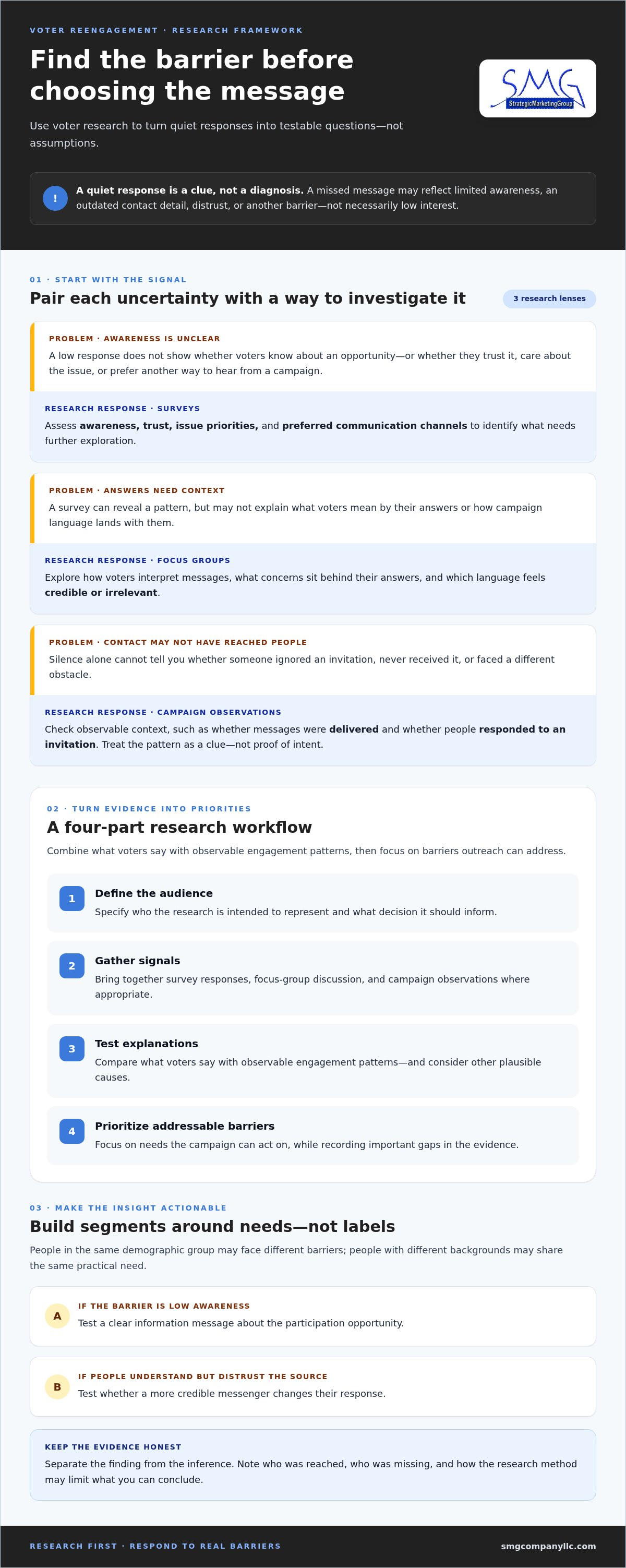
Once you define the audience, research can show which barriers deserve attention first. Move from broad signals to explanations you can test, then use the strongest findings to set outreach priorities. This helps prevent a campaign from mistaking a quiet response for a clear reason.
Which research methods reveal why voters disengage?
Use each method to answer a different question. Surveys can assess awareness, trust, issue priorities, and preferred communication channels. Focus groups help explain how voters interpret campaign language, what concerns sit behind their answers, and which messages feel credible or irrelevant. Campaign observations add context, such as whether messages were delivered or people responded to an invitation.
These sources are most useful together. A survey may show low awareness of a participation opportunity; a focus group can explore whether the information was hard to understand or simply didn’t feel relevant. Response patterns can suggest a question, but they don’t prove intent. A missed message, for example, might reflect an outdated number rather than disinterest.
How to turn voter insights into useful segments
Build segments around actionable needs, not broad demographic labels alone. Two voters in the same age group may face different barriers, while voters with different backgrounds may share a need for clearer information or a more trusted messenger. Pair each segment with a defined objective and a hypothesis you can test.
Define the audience: Specify who the research is intended to represent and what decision it should inform.
Gather signals: Combine survey responses, focus-group discussion, and campaign observations where appropriate.
Test explanations: Compare what voters say with observable engagement patterns, and consider other plausible causes.
Prioritize barriers: Focus on needs the campaign can address, while recording important gaps in the evidence.
For example, if research indicates that a group is unaware of a participation opportunity, test a clear information message. If people understand the information but distrust its source, test whether a more credible messenger changes their response. In both cases, separate the finding from the inference: note who was reached, who was missing, and how the research method may limit what you can conclude.
Voter research turns assumptions into testable engagement priorities by showing which barriers have evidence behind them and which still need validation. Structured public opinion polling can help assess sentiment systematically. SMG connects research to messaging and campaign planning, giving teams a clearer basis for selecting and refining voter reengagement strategies. Learn more about SMG’s polling and campaign capabilities.
Choose Voter Reengagement Channels Around Audience Needs
Choose a channel for the job it needs to do, not simply because it’s familiar or easy to deploy. A short reminder may suit a direct message, while a concern that requires conversation calls for another approach. Effective voter reengagement strategies coordinate channels around audience preference, the information being shared, and the action voters are being asked to take.
How to match outreach channels to reengagement goals
Match the format to the purpose. Email can provide fuller explanations and links to practical resources. Text or voice outreach can deliver timely reminders or a concise next step when the audience is appropriate for that channel. Social platforms and mobile advertising can reinforce a message across digital touchpoints. Community-facing activities are useful when the objective is dialogue, listening, or relationship-building.
These channels serve different functions:
Information delivery: Use a clear, direct format to share verified details or explain where to find them.
Dialogue: Make space for questions and feedback through channels that support two-way communication.
Persuasion: Use relevant, audience-aware messaging that addresses a concern without assuming every voter shares it.
Participation prompts: State the next step plainly and make the route to action easy to follow.
Sequence outreach with care. A social or mobile message can build recognition, while a direct follow-up can provide practical details. Repetition across channels should reinforce the same accurate information, not create message fatigue. No channel guarantees a response or participation.
How to make outreach accessible and credible
A message only works if people can receive, understand, and act on it. Use concise language, readable formatting, and a specific next step. Consider accessibility needs, language preferences, timing, and whether a voter has indicated a preferred channel. Adapt the format based on evidence and feedback, not stereotypes about a community.
Keep election information accurate. Direct voters to authoritative election sources for details that may vary by location, and don’t present uncertain information as settled. If the message asks someone to act, make the requested step easy to identify. Clear, consistent communication supports credibility; pressure or unnecessary repetition can weaken it.
Plan channels as a coordinated system. Digital and mobile advertising can support broader message reach, while voice and text broadcasting can deliver direct communications. The appropriate mix depends on the audience and objective. For more on aligning digital placements with campaign goals, see this guide to digital advertising for campaigns.
Build a Measurable Voter Reengagement Plan and Improve It
A reengagement plan needs a defined objective before outreach begins. Decide what meaningful progress looks like for the audience, then map the steps that can move them toward it. Without that sequence, a campaign may report high message volume without knowing whether voters noticed, responded, or took a useful next step.
Build the plan in stages:
Set the objective: Choose a specific outcome, such as more information requests or participation in a community event.
Define the audience: Identify who the outreach is intended to reach and the barrier it aims to address.
Develop and test the message: Check that the language is clear, relevant, and aligned with the intended action.
Deploy and monitor: Record delivery, responses, and feedback that signals confusion or friction.
Review and refine: Compare results with the objective, adjust the approach, and document what the team learns.
Which metrics show whether reengagement is working?
Measure outputs and outcomes separately. Messages sent, calls attempted, and ads served describe outreach activity. They don’t establish reengagement. Responses, requests for information, event participation, or verified participation where available provide stronger evidence of a meaningful next step. Choose indicators that match the objective instead of relying on a single headline number.
Outreach volume shows how much a campaign sent; evidence of reengagement shows whether voters responded or participated. Track delivery and response indicators alongside the outcome you set. If comparing time periods or testing different messages, use a design that supports a fair comparison. Record limitations such as missing data, uncertain attribution, or changes in the election context, so the team doesn’t claim more than the evidence supports.
How to refine outreach without overwhelming voters
Set a follow-up cadence based on the message’s purpose and audience response. A practical information update may warrant a different schedule from an invitation to a conversation. If voters report confusion, stop repeating the same message and clarify it. If responses decline or feedback suggests the channel is unwelcome, pause, adapt the content, or choose another appropriate route.
Review performance throughout the effort, not only at the end. Document which messages and channels supported the intended outcome, where the evidence is weak, and what should change next time. Carry those findings into future campaign planning and post-election civic engagement. This learning cycle makes voter reengagement strategies more accountable and helps preserve attention for communication that offers genuine value.
SMG connects polling, messaging, and campaign execution to support a measurable outreach plan. Build a research-led voter reengagement plan grounded in clear objectives and meaningful outcomes.
How SMG Connects Voter Research, Messaging, and Outreach
Research creates value when it informs what a campaign says and how it reaches people. SMG connects public opinion polling and electorate analysis with message development and outreach planning, helping teams move from audience insight to coordinated execution. The firm’s experience spans more than 40 states, bringing broad campaign and public affairs experience to local voter engagement challenges.
From voter insights to a coherent engagement strategy
Polling, surveys, and focus groups can help clarify voter concerns, priorities, and communication preferences. Electorate analysis can organize those findings into useful audience insights. Those insights guide message development: what to emphasize, which concerns to address, and what next step to make clear. The goal isn’t to assume a message will work, but to make its purpose and audience fit explicit.
Channel planning follows the same logic. Digital and mobile advertising can reinforce campaign messages, while voice or text broadcasting can deliver direct outreach. Each channel should serve a defined purpose and align with audience needs. As responses and circumstances change, campaign teams can revisit the message or channel mix rather than treating the initial plan as fixed.
What a strategic campaign partnership can coordinate
Polling, campaign management, and communications are more effective when they work toward shared objectives. SMG coordinates research findings with speech writing and messaging, digital and mobile advertising, and voice and text broadcasting as components of a campaign approach. This connects strategic direction with execution while keeping outreach grounded in evidence rather than habit.
Disciplined coordination also makes it easier to learn. Teams can review available response and participation indicators, distinguish observed results from assumptions, and adjust the approach when feedback points to a need for change. That process can support more relevant voter reengagement strategies, but it can’t guarantee turnout or any election outcome.
For campaigns seeking to reconnect with voters, start with a clear understanding of the audience and the participation barriers the outreach is intended to address. SMG brings research, messaging, and campaign execution together to help build that plan. Discuss voter engagement strategy with SMG.
Turn Voter Insight into Meaningful Participation
Effective voter reengagement starts by understanding why people have stepped back. Research can distinguish access barriers, low interest, and distrust, while careful measurement shows whether outreach leads to a response or meaningful next step. The strongest voter reengagement strategies connect those findings to relevant messages and channels, then adapt as audience needs and campaign conditions evolve.
That work requires coordination. SMG brings public opinion polling, campaign management, messaging, and digital and mobile advertising together to support research-led outreach. With experience across more than 40 states, SMG helps campaigns build a disciplined approach grounded in voter sentiment, without promising outcomes no strategy can guarantee.
Make your next outreach decision with evidence.Discuss a research-led voter reengagement strategy with SMG and develop a clearer path from voter insight to participation.
Frequently Asked Questions
What are voter reengagement strategies?
Voter reengagement strategies are planned efforts to renew meaningful contact with eligible voters who have become less responsive or involved. They address a specific need, such as making participation information clearer, rebuilding trust, or reducing practical friction. Unlike first-time registration or election-day turnout operations, reengagement starts by understanding why a voter may have stepped back, then matches communication and next steps to that need.
How can a campaign identify why voters have disengaged?
A campaign can investigate disengagement by combining voter surveys, focus groups, and available outreach records. Surveys can identify patterns in awareness, trust, and concerns; focus groups can reveal how voters interpret messages and explain their experiences. Compare what participants report with response and delivery signals, but don’t treat silence as proof of disinterest. Document who the research reached and where gaps limit the conclusions.
Which communication channels work best for reconnecting with voters?
No single channel works best for every audience or objective. Email can carry detailed information, while text or voice outreach can convey concise reminders. Social platforms and mobile advertising can reinforce messages across digital touchpoints, and community-facing contact can support dialogue. Select channels based on audience preferences, accessibility, timing, and the purpose of the message. A channel can support engagement, but it can’t guarantee a response or participation.
Can voter surveys help improve reengagement efforts?
Yes. Voter surveys can help campaigns assess awareness, issue priorities, trust, and communication preferences before choosing messages or channels. For example, a survey may reveal that people need clearer participation information, while follow-up discussion can help explain what’s confusing. Survey findings reflect the people reached and the questions asked, so interpret them with care. Use results to shape and test an approach, not to assume every voter in a group thinks alike.
How do campaigns measure voter reengagement?
Measure outcomes that match the campaign’s objective. Track delivery and outreach volume, but distinguish those outputs from evidence such as replies, requests for information, event participation, or verified participation where available. Messages sent show activity, while an information request indicates a response. Note data gaps and attribution limits, and use comparisons only when the evaluation design supports them. Review results over time to identify whether engagement is sustained.
When should voter reengagement outreach begin?
Begin once a campaign has identified an audience and a plausible barrier to address, allowing time to research, develop, and refine its approach. Waiting until the final days can leave little opportunity to learn whether messages are clear or channels are reaching people. Reengagement can also continue beyond a single election moment, with follow-up shaped by voter needs and the campaign’s civic engagement objectives.
How can campaigns make voter outreach more accessible and relevant?
Use concise language, readable formats, accurate information, and a clear next step. Consider accessibility needs, language preferences, channel choice, and timing, using audience research rather than assumptions. Link people to authoritative election information when details vary by location. Make it easy to ask questions or share feedback, then adapt messages when voters indicate confusion or friction. Relevant outreach respects attention and avoids repeated contacts that add no new value.
Comments