
New Jersey Legislative Process for Lobbyists: Pay and Filing Rules

The decisive line in the New Jersey legislative process for lobbyists is not simply whether someone speaks to lawmakers: a person paid or receiving anything of value to influence state legislation, administrative rules, or governmental processes must register as a governmental affairs agent when reimbursed expenses exceed $100 in any three-month period. Registration must come before communicating with or providing a benefit to covered state officials. Compensation, time spent preparing communications, and the nature of the contact all matter when determining whether ELEC oversight applies.
New Jersey’s legislative process for lobbyists can be difficult to navigate because state lobbying requirements intersect with federal and local advocacy, and routine government contacts may be treated differently from efforts to influence policy. This article explains when compensation and time can trigger registration, what annual and quarterly disclosures involve, and how ELEC oversees the process. It also identifies when legal counsel can help organizations assess their obligations, so advocacy decisions are grounded in a clear understanding of the reporting framework.
Table of Contents
Advocacy before federal, state, and local lawmakers
In New Jersey, paid efforts to influence state legislation, administrative rules, or governmental processes can trigger registration. A person receiving anything of value must register as a governmental affairs agent when reimbursed expenses exceed $100 in any three-month period. Registration must occur before communicating with or providing a benefit to covered state officials. The type of government decision, compensation, and expenses all shape the analysis.
Advocacy can involve federal, state, and local officials, but New Jersey’s state registration rule concerns state governmental processes. Don’t assume that a state filing resolves obligations involving federal or local advocacy. For example, an organization seeking a state legislative change and a municipal permit may need to assess each activity under the relevant rules. The New Jersey Legislature has a 40-member Senate and an 80-member General Assembly, organized across forty legislative districts.
For context on how bills move through the state Legislature, watch this overview from NJ Spotlight News:
Legislative advocacy follows proposals as they move through committees and the two legislative chambers. A bill’s status can affect when an organization communicates with lawmakers or takes part in public discussion. The Legislature convenes annually on the second Tuesday of January, and each two-year legislative term consists of two annual sessions. Legislators may file bills and resolutions before a session begins.
Advocacy can extend beyond bills. Someone seeking to influence an administrative rule or government process may fall within the state framework, even without focusing on a specific bill. By contrast, a request about a local matter is not automatically state lobbying. Identify the decision-maker, level of government, subject, and whether compensation or reimbursed expenses are involved.
Separate political activity can create different filing questions. New Jersey organizations have additional state registration, reporting, and disclosure requirements if they raise or expend $1900 or more for one election to promote the passage or defeat of a public question. That threshold concerns public-question election activity, not a general measure of every advocacy effort. Keep the activity’s purpose and election connection distinct from communications aimed at legislation.
Before contacting covered state officials, assess whether registration is required and when it must occur. Don’t wait until advocacy is underway. Keep records of who communicated, the subject, reimbursed expenses, and any benefit provided. These details help distinguish legislative advocacy from local contacts or election efforts. When lobbying restrictions or reporting obligations may apply to interactions with state or local governments, consult legal counsel.
Annual financial disclosures
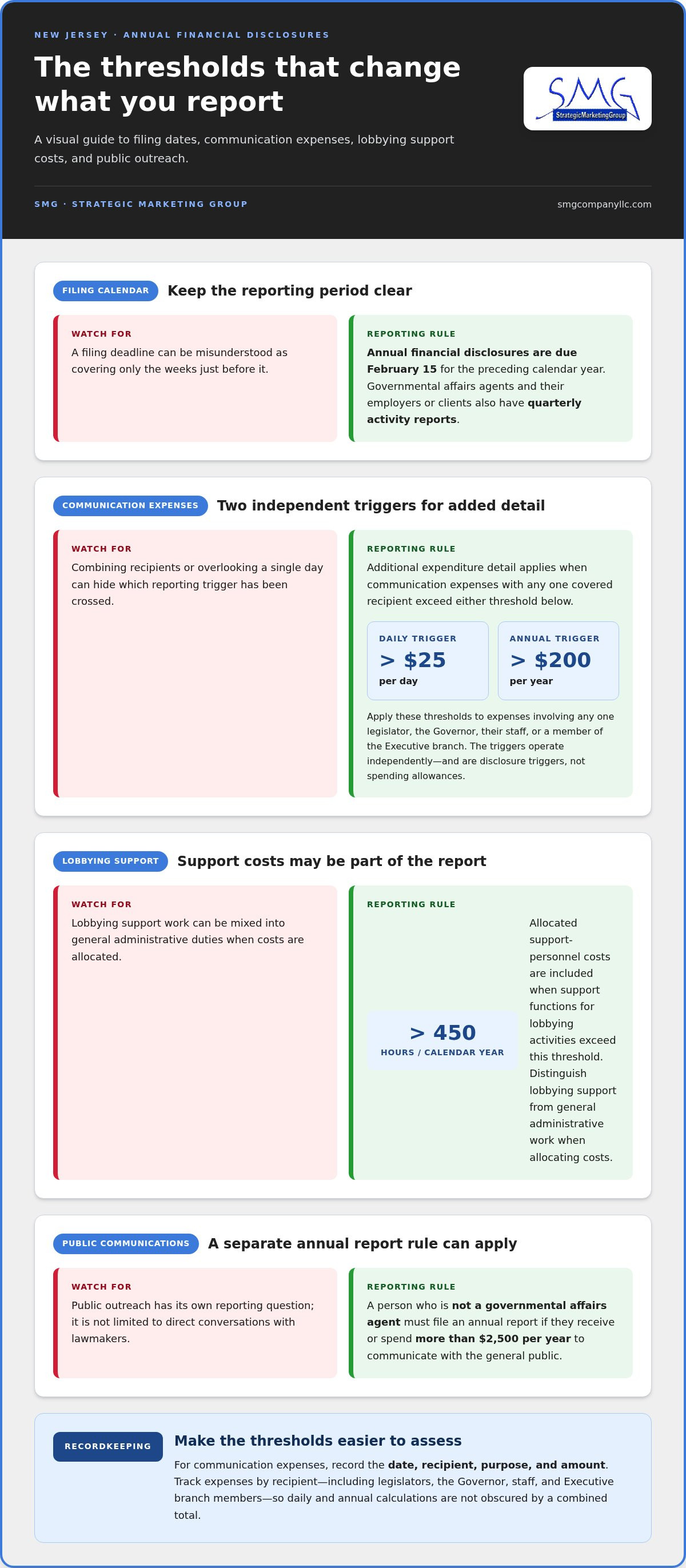
New Jersey governmental affairs agents and their employers or clients must file annual financial disclosures by February 15 for the preceding calendar year. Additional reporting detail applies when specified communication expenses cross daily or annual thresholds; these are disclosure triggers, not spending allowances.
The filing deadline ties each report to the calendar year just completed. For example, a disclosure due February 15 covers the preceding calendar year, rather than only activity from the weeks before filing. Agents, employers, and clients should organize records across the full reporting period so expenses and activity can be attributed correctly. Quarterly activity reports are also required for governmental affairs agents and their employers or clients.
Annual expenditure reporting calls for added detail when communication expenses with any one legislator, the Governor, their staff, or a member of the Executive branch exceed $25 per day. A separate annual threshold applies: additional detail is required when those expenses exceed $200 per year. The thresholds operate independently. An expense may cross the daily trigger even when the annual total remains below the yearly trigger.
For example, if an organization incurs a communication-related expense involving a legislator, record the date, recipient, purpose, and amount. These details help determine whether the daily threshold was crossed and inform the annual calculation. Track expenses by recipient for communications involving the Governor, staff, or Executive branch members, too. A combined total for all government contacts can hide which threshold applies.
Support costs can also enter the expenditure report. New Jersey reporting includes allocated support-personnel costs when support functions for lobbying activities exceed 450 hours per calendar year. The relevant question is whether support work serves lobbying activities and crosses the stated time threshold. Organizations should distinguish that work from general administrative duties when allocating costs.
Disclosure duties can extend beyond registered governmental affairs agents. A person who is not an agent must file an annual report if they receive or spend more than $2500 per year to communicate with the general public. This rule concerns public communications, not simply direct conversations with lawmakers. An organization promoting a policy position through public outreach should therefore track both its audience and related receipts or expenses.
These filing rules focus on reporting, not a single overall spending cap. Federal limits for public charities that elect that approach are governed by sections 501(h) and 4911 of the Internal Revenue Code. Keep federal lobbying calculations separate from New Jersey’s annual disclosures, recipient-based expense details, and public-communication reporting. Clear records by year, recipient, activity, and purpose make those distinct obligations easier to assess.
Compensation and time thresholds
Understanding the New Jersey legislative process for lobbyists requires assessing both compensation and time. A person paid or receiving anything of value to influence state legislation, administrative rules, or governmental processes must register if reimbursed expenses exceed $100 in any three-month period. This expense trigger and the employee time consideration are separate parts of the analysis. The nature of the work and the person’s role also matter.
Employee lobbying activity is considered isolated, exceptional, or infrequent when it totals under 20 hours per calendar year. That description helps distinguish occasional advocacy from recurring work, but the hour count alone doesn’t resolve every registration question. Compensation, reimbursed expenses, communication subjects, and the employee’s role remain relevant. An occasional policy call differs from duties that repeatedly involve influencing state decisions.
Track preparation time as well as time spent speaking with an official. New Jersey counts time spent preparing communications when determining whether a person has crossed the governmental-affairs-agent communication-hours threshold. Drafting talking points, reviewing a bill, and preparing questions for a state official may count alongside the meeting or call. The New Jersey Election Law Enforcement Commission (ELEC) includes time spent preparing for communications when determining whether a person has crossed the governmental-affairs-agent communication-hours threshold.
A practical time record separates work into identifiable activities:
Preparation, such as reviewing a proposal or drafting advocacy materials.
Direct communication with a covered official or government staff member.
Follow-up work tied to the communication or policy request.
For example, an employee might review a proposed administrative rule, prepare a position, and discuss it with a state official. Each activity helps explain the work’s purpose and scope. Recording dates, tasks, and the related government matter gives an organization a clearer basis for assessing the annual total. Use the calendar year consistently when measuring whether activity remains under 20 hours.
Compensation also requires distinguishing payment for work from expense reimbursement. The rule covers a person paid or receiving anything of value to influence governmental processes, while the stated registration trigger refers to reimbursed expenses exceeding $100 in any three-month period. Track both categories separately. This helps show what was received, what was reimbursed, and which activity each amount supported.
Review the threshold as activity develops, rather than waiting for year-end totals. A calendar-year log can show whether employee advocacy remains under 20 hours, while a separate three-month expense review can identify when reimbursed expenses exceed $100. Within the New Jersey legislative process for lobbyists, changes in preparation, communication, or follow-up work can affect the assessment. Update the record as duties evolve, rather than relying on a job title or one meeting to characterize the work.
Legal advice on lobbying compliance
Legal counsel can help assess New Jersey lobbying obligations when planned contacts involve state or local government restrictions. The analysis should distinguish efforts to influence policy from routine administrative exchanges, and consider the speaker’s role, the communication’s purpose, compensation, and any benefit offered. These details can affect registration, reporting, and gift questions.
New Jersey’s lobbying regulations are cited as N.J.A.C. 19:25-20.1 et seq. The rules provide exemptions for certain routine, ministerial matters and participation in a task force, advisory board, or working group. The label alone doesn’t resolve the issue. Counsel can assess what the person communicated, the setting, and whether the activity fits an exemption.
Routine or ministerial communications may include scheduling a meeting, requesting the status of an administrative matter, or asking about procedures or forms. Requesting a form differs from urging an official to change a rule. If a communication does not match ELEC’s listed examples, ELEC may assess case by case whether it is routine and ministerial. Keep the request and response to document the purpose.
Participation in a task force or advisory board also requires attention to the details. A person’s role, compensation, and statements during a meeting can help distinguish participation from efforts to influence a government decision. The meeting’s title does not determine how it is treated. Document the agenda, the participant’s capacity, and whether they advocated for a particular outcome.
Public testimony may raise a separate exemption question. New Jersey’s lobbying-law exemptions include qualifying testimony before a legislative committee, commission, or similar public hearing when the person is both uncompensated and nonprofit. Both conditions matter. Before relying on this exemption, counsel can review the speaker’s status, whether compensation is involved, and the nature of the hearing.
Gift rules deserve separate review before an organization provides meals, items, or another benefit to covered officials. New Jersey generally prohibits a lobbyist or governmental affairs agent from providing gifts or anything of value in excess of $250 per year. Assess the recipient, value, and purpose of a proposed benefit. A compliance review should also account for related reporting obligations.
Filing fees have a specific exemption: New Jersey law exempts groups exempt from state sales tax under N.J.S.A. 54:32B-9(b) from annual governmental affairs agent filing fees. This concerns the filing fee, not a general exemption from lobbying requirements. Counsel can help determine whether the group meets that statutory condition and whether other obligations still apply. Early review is especially useful when routine contacts, public testimony, or official benefits intersect in one advocacy effort.
New Jersey lobbying law and ELEC oversight
New Jersey’s lobbying framework centers on governmental affairs agents, their employers or clients, and ELEC oversight. These distinctions matter because registration, reporting, and enforcement depend on the activity and the relationships involved.
State and Federal Lobbying Requirements
New Jersey regulates state governmental affairs agents, while federal rules can impose separate obligations. Public charities that elect the federal approach have lobbying expenditure limits governed by sections 501(h) and 4911 of the Internal Revenue Code. Organizations working across government levels should assess each activity under its applicable framework.
A New Jersey bill moves through legislative consideration, including committee review, before reaching the Governor’s desk. Advocacy may focus on a bill’s provisions, committee action, or its next stage in the Legislature. Tracking its progress helps organizations connect communications to the public decision under consideration.
Registration Deadlines and Fees
New Jersey governmental affairs agents must register with ELEC before communicating with or providing a benefit to covered state officials. This makes registration a pre-contact requirement, not a filing to postpone until an annual report. New Jersey law exempts groups exempt from state sales tax under N.J.S.A. 54:32B-9(b) from annual governmental affairs agent filing fees. The exemption concerns those fees, not every reporting duty.
Reportable Lobbying Activities
Reporting covers lobbying activity and related expenditures, with governmental affairs agents and their employers or clients required to file quarterly activity reports. Annual financial disclosures are also due by February 15 for the preceding calendar year. Reportable matters include covered advocacy communications and qualifying expenses, including allocated support-personnel costs when lobbying support exceeds 450 hours per calendar year.
New Jersey’s regulatory terms distinguish the parties: the “lobbyist” is the governmental affairs agent’s employer or client, while the person seeking to influence government is the agent. This distinction helps organizations identify filing responsibilities. Records should link the agent, employer or client, communication, and expenditure.
Penalties for Violations
The consequences of violating New Jersey lobbying laws depend on the conduct and the applicable enforcement determination. Registration before covered communications, quarterly activity reports, and annual disclosures are separate compliance points. Organizations should identify missed or inaccurate filings, preserve relevant records, and discuss the specific issue with legal counsel instead of treating every lapse alike.
ELEC oversight also affects how organizations structure advocacy. For a strategy informed by public sentiment and government relations priorities, develop a data-informed advocacy strategy.
SMG (Strategic Marketing Group): Public Opinion Polling
SMG (Strategic Marketing Group) helps organizations connect advocacy priorities with public sentiment through Public Opinion Polling. When a policy issue is evolving or community priorities are unclear, polling can inform message development and strategic decisions. Government Relations Strategy can complement those insights by helping shape an approach to engaging decision-makers. For wider public outreach, Digital & Mobile Advertising can support campaign communications, while Campaign Management can coordinate campaign strategy and execution.
These services support advocacy planning, but they do not replace legal advice on registration, disclosures, or ELEC requirements. Ground compliance decisions in the rules discussed above, and use public opinion insights to sharpen the strategy. Contact SMG to discuss how polling and public affairs strategy can support your organization’s goals.
Build the Next Phase of Your Advocacy Strategy
The next step is to connect policy priorities with a clear understanding of the people and communities affected. A disciplined approach to New Jersey’s legislative process for lobbyists accounts for compliance while keeping public priorities central to advocacy planning.
SMG (Strategic Marketing Group) supports this planning through Public Opinion Polling, Government Relations Strategy, and Campaign Management. Polling can clarify which concerns matter to the audiences an organization seeks to reach. Government relations strategy and campaign management can then help shape coordinated engagement around those priorities.
Strong advocacy depends on more than understanding filing requirements. It also requires a deliberate message, informed decisions, and sustained attention to public concerns. If your organization is preparing its next advocacy effort, contact SMG to discuss a strategy aligned with your goals. A thoughtful plan can help your organization engage with purpose and contribute meaningfully to the public decisions that shape its work.
Frequently Asked Questions
How can lobbyists register in New Jersey, and who must register?
A person paid or receiving anything of value to influence state legislation, administrative rules, or governmental processes must register with ELEC when reimbursed expenses exceed $100 in any three-month period. Registration must precede covered communications or benefits to state officials. New Jersey distinguishes the governmental affairs agent, the person influencing government, from the “lobbyist,” meaning that agent’s employer or client. Organizations should identify both roles when preparing for advocacy.
How often must New Jersey lobbyists file reports, and what are the deadlines?
Governmental affairs agents and their employers or clients file quarterly activity reports, plus annual financial disclosures due February 15 for the preceding calendar year. Keep a reporting calendar that assigns each filing to a responsible person and reconciles activity records before submission. For example, match communication logs with expense records and identify the applicable reporting period. This helps prevent quarterly activity from being overlooked during annual disclosure preparation.
What ethics rules and restrictions apply to lobbyists in New Jersey?
New Jersey generally prohibits a lobbyist or governmental affairs agent from providing gifts or anything of value in excess of $250 per year. Some communications, including qualifying routine administrative contacts, may be exempt from lobbying requirements. Uncompensated, nonprofit testimony before a legislative committee, commission, or similar public hearing is also covered by an exemption. Before offering a benefit or relying on an exemption, assess the recipient, purpose, setting, and participant’s role.
How do lobbyists contact New Jersey legislators and participate in committee hearings?
Advocates can communicate with legislators about bills and policy positions, subject to applicable registration and reporting requirements. To attend a committee session, visitors may request access to New Jersey legislative committee rooms 24 hours in advance. For effective participation, identify the relevant bill or issue, prepare concise remarks, and connect each point to the committee’s consideration. Qualifying uncompensated testimony by a nonprofit may fall within a specific lobbying-law exemption.
How does a bill become law in New Jersey?
Bills move through committees and the two legislative chambers, the Senate and General Assembly. This article does not detail further steps for a bill to become law.
Comments