
Managing a Political Campaign Team: Roles, Coordination, and Strategy

The fastest way to stall a campaign is to let every urgent task belong to everyone. When responsibilities overlap, decisions slow down. When no one owns critical work, even a capable team can lose momentum. Managing a political campaign team means making ownership visible before the calendar fills and pressure rises.
As a campaign gets busier, communication can fragment across departments, and voter insight can remain in reports instead of informing daily decisions. Clear roles, regular coordination, and shared priorities help address these challenges.
This guide explains how to structure campaign responsibilities, establish effective communication rhythms, and connect voter research to coordinated action. You’ll learn how campaign leaders can clarify decision-making, align staff around priorities, and adjust operations as voter concerns and feedback emerge. The goal is a team that knows who is responsible, what needs to happen next, and how its work advances the campaign.
Table of Contents
Why Managing a Political Campaign Team Starts With Clear Ownership
A campaign rarely pauses while its team gets organized. Voter concerns shift, public events create new demands, and decisions in one area can affect communications or outreach elsewhere. Under that pressure, effort alone isn’t enough. If two people assume the other owns a task, or several people make the same decision independently, work can be duplicated while essential responsibilities go unattended.
Campaign-team management means assigning clear ownership, setting decision paths, and aligning people’s work around shared campaign priorities. It gives staff a practical way to coordinate leadership, communications, polling, and voter outreach as conditions change. For broader context on campaign roles and activities, see this overview of Political Campaign Organization.
For a concise overview of the campaign manager’s coordinating role, watch:
What does a campaign team manager need to keep aligned?
Start with the connection between a campaign priority and the people responsible for advancing it. Leadership sets direction, communications develops and distributes messages, polling provides insight into public opinion, and voter outreach brings the campaign into direct contact with the electorate. The manager helps these functions share relevant information and work toward the same priorities without prescribing every activity.
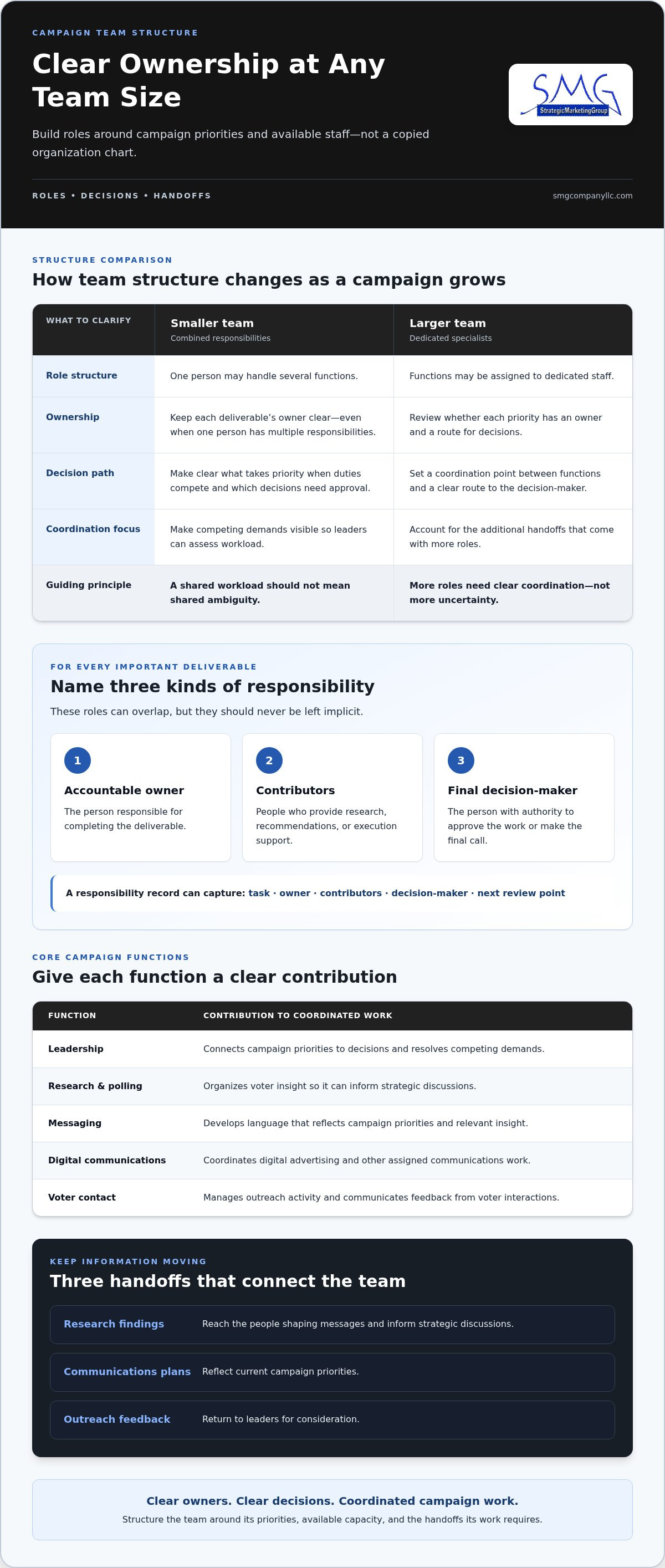
For each priority, name an accountable owner and identify who has final decision authority. Contributors can supply research, recommendations, or execution support, but approval should never be ambiguous. A simple responsibility record can list the task, owner, contributors, decision-maker, and next review point.
Leadership doesn’t mean personally writing the campaign plan, setting the budget, or running field operations. Those responsibilities may sit with different people or be shared according to the campaign’s capacity. The manager’s central task is to connect plans, resources, and day-to-day work, and to route questions to the right decision-maker.
How does team structure change with campaign size?
On a smaller team, one person may handle several functions. Combining responsibilities works when the limits are explicit: who owns each deliverable, what takes priority when duties compete, and which decisions require approval. A shared workload shouldn’t mean shared ambiguity.
Larger teams can assign specialist functions to dedicated staff, but more roles create more handoffs. Set a clear coordination point between functions, then review whether each priority has an owner and a route for decisions. Build the structure around available capacity and campaign needs, not a presumed organization chart. That is the operating discipline at the heart of managing a political campaign team.
Assign Campaign Team Roles Without Creating Silos
A useful campaign structure isn’t a standard chart copied from another race. It reflects the campaign’s priorities and the people available to carry them forward. A small team may combine several functions; a larger operation may assign each to a specialist. Either way, responsibilities should be clear enough for work to move between people without losing context or authority.
For every important deliverable, distinguish three roles: the person accountable for completing it, the people who contribute, and the person with final decision authority. These roles can overlap, but they shouldn’t be left implicit. For example, a staff member might draft a message and consult polling insights while a designated decision-maker approves the final version.
Leadership: Connects campaign priorities to decisions and resolves competing demands.
Research and polling: Organizes voter insight so it can inform strategic discussions.
Messaging: Develops language that reflects campaign priorities and relevant insight.
Digital communications: Coordinates digital advertising and other assigned communications work.
Voter contact: Manages outreach activity and communicates feedback from voter interactions.
These functions rely on handoffs as well as individual performance. Research findings need to reach the people shaping messages, communications plans should reflect current priorities, and outreach feedback should return to leaders for consideration. A political campaign management blueprint can help connect these assignments to broader campaign planning. Agree on what information passes between functions, who reviews it, and how the team communicates a decision once it’s made.
Which responsibilities need a clearly named owner?
Assign each function an outcome, not just a list of activities. Define who turns polling into a briefing for decision-makers, who owns message development, and who coordinates a voter-contact effort. Then record the person’s authority: can they approve the work, recommend a course, or carry out a decision made by someone else? This clarity helps the team spot gaps when priorities or staffing change.
How can a team combine roles without losing accountability?
On a small campaign, one person might coordinate digital communications while also supporting messaging. Keep those responsibilities distinct in the team’s records, even if the same name appears beside both. That makes competing demands visible and helps leaders assess workload instead of assuming every task is covered.
Set an escalation route for conflicts and time-sensitive questions. Staff should know who resolves a clash between urgent assignments and who can approve a decision when the usual lead is unavailable. This keeps collaboration from becoming a bottleneck.
Strong role design lets people contribute across functions while preserving clear accountability. SMG provides integrated campaign management support across campaign management, polling, and communications, helping connect these workstreams.
Build a Campaign Team Communication Rhythm That Supports Decisions
A campaign team needs more than frequent updates. It needs a reliable way to surface changes, make decisions at the right level, and turn those decisions into work. A brief operational check-in can keep immediate tasks moving, but it shouldn’t replace deeper discussion about strategy. A deliberate rhythm helps prevent missed handoffs and meetings that consume time without resolving anything.
Choose a cadence that fits the campaign’s pace, then use a consistent sequence to move from priorities to action:
Set the focus. Revisit current priorities and identify work that depends on coordination across functions.
Surface changes. Share new information, obstacles, and developments that affect another team member or campaign direction.
Resolve decisions. Separate issues that can be handled operationally from questions that require strategic judgment.
Confirm next steps. Name an owner, the action required, and when the team will review progress.
What belongs in a useful campaign team check-in?
Keep the operational check-in focused on priority work, new information, unresolved decisions, and next actions. Ask each person to report what has changed, what is blocked, and what another function needs to know. Routine updates that don’t affect shared work can go in the team’s written record. Close by confirming each follow-up action and its owner, so the discussion produces a clear handoff.
Reserve strategic discussion for questions that need context and judgment, such as whether new information should change a campaign priority or how functions coordinate. Share relevant information in advance where possible. This gives participants time to assess options and keeps a quick status meeting from turning into an unfocused debate.
How should campaign leaders handle disagreement and escalation?
Debate about options can sharpen a decision; disagreement about who has authority can stop work. Set the escalation path before pressure builds: identify who resolves operational conflicts, who makes strategic decisions, and how urgent questions reach them. Once a decision is made, record it and communicate its implications to affected functions, including any changes to timing, messaging, or assigned work.
Maintain one shared decision record rather than relying on scattered messages or individual recollection. For each entry, capture the decision, the reason or relevant information, the person accountable for the next action, and the follow-up point. Mark unresolved questions clearly and identify who will settle them. This makes it easier to see what has been decided and where work is waiting.
Clear communication links decisions to accountable action. It also gives leaders a practical basis for reviewing follow-through. If a task is stalled, the record can show whether the issue is a missing decision, a blocked handoff, or a need to reset priorities. This discipline supports managing a political campaign team without requiring every person to attend every conversation. Keep the loop tight: share what affects the work, discuss issues that need judgment, and document what happens next.
Use Voter Insight to Review and Adjust Team Priorities
Voter insight is most useful when it informs a decision, not when it sits apart from the team’s work. Polling and electorate analysis can help campaign leaders identify which assumptions deserve another look, what questions need discussion, and whether existing priorities still fit the strategic context. The goal isn’t to let one data point dictate the campaign. It’s to give the team a shared evidence base for deciding what to keep, refine, or reconsider.
Assign someone to translate relevant findings into a concise recommendation for the team. The summary should explain what the insight suggests, what remains uncertain, and which teams or decisions may be affected. Leaders can then discuss the implications with communications, outreach, and other relevant functions rather than leaving each to interpret the same finding in isolation. For a deeper look at how voter patterns inform planning, explore electorate analysis and public opinion polling services.
How can polling inform a team’s next decision?
Bring research into team discussion with a clear question. For example, does current voter feedback support the message the campaign is using, or should the team examine another emphasis? A finding can focus discussion and help staff identify which assumptions to test further. It shouldn’t be treated as a guaranteed forecast or a definitive instruction, especially on its own.
To make insight actionable, the team member responsible for research or strategy can outline a recommendation, name the supporting evidence, and state what decision is needed. The decision-maker can weigh that recommendation alongside campaign priorities and relevant context. This keeps analysis connected to action while preserving clear authority.
When should campaign leaders revisit team priorities?
Review priorities at agreed points and when meaningful new information changes the strategic context. A priority may remain important but need a different approach; another may no longer be actionable with the people or time available. Distinguish those cases from ordinary fluctuations that don’t warrant an immediate shift. A deliberate review prevents the team from reacting to every new signal.
Compare a stable priority with one that may need revision. If voter insight continues to support a central campaign message, keep that work in place and communicate why it remains a focus. If emerging evidence raises questions about a secondary message, assign a review, gather relevant perspectives, and decide whether to adjust it. Then tell affected team members what stops, what starts, and what stays unchanged.
This disciplined cycle strengthens managing a political campaign team by making adaptation a shared process rather than a series of disconnected reactions. To connect research with coordinated campaign management, explore integrated campaign support.
When to Bring in Integrated Campaign Management Support
Integrated support can help when a campaign’s priorities are clear but coordination across functions remains difficult. Polling insights may not be reaching the people shaping messages, or digital advertising and voter-facing communications may be moving ahead without a shared strategic frame. The issue isn’t simply workload. It’s whether the team has the capacity and coordination to connect its work.
Integrated support can bring campaign management, polling, digital advertising, and communications into a more connected strategic effort. It is relevant when leaders need to assess how those functions relate, identify coordination gaps, or decide what support fits the campaign’s immediate needs. It doesn’t replace campaign leadership or guarantee an electoral outcome. It gives the campaign another way to organize strategic support around its priorities.
What can an integrated campaign partner bring together?
Campaign Management can work alongside Polling and Digital Advertising, connecting operational oversight with voter insight and campaign communications. Speech/OP-ED Writing, Mobile LED Marketing, and Voice/Text Messaging are also part of SMG’s services and can support campaign communications. An integrated approach lets the team consider these functions together rather than treating each as unrelated activity.
SMG is a full-service public-affairs firm founded in 2002, with election experience in over 40 states. Its work spans campaign management, polling, and communications. The right scope depends on the campaign’s needs; integration should support defined priorities, not add complexity for its own sake.
How can a campaign move from team assessment to action?
Begin with a specific coordination challenge. Identify what isn’t moving smoothly, which functions it affects, and what decision or work is delayed. Then define the support that would address the issue. A short written brief can make the discussion concrete:
The challenge: Describe the coordination issue the team needs to address.
The functions involved: Identify the parts of the operation affected, such as management, polling, digital advertising, or messaging.
The desired support: State what the team wants to coordinate or clarify, and what remains under campaign leadership.
The priority: Explain how addressing the challenge supports the campaign’s current direction.
This preparation helps leaders move from a general concern to a focused conversation about campaign management support. It also gives both sides a clear basis for discussing scope without presuming a particular staffing model or result. For teams seeking stronger coordination, managing a political campaign team includes recognizing when added strategic support could connect important functions.
Connect with SMG to discuss campaign management support and the coordination needs your team has identified.
Put Your Campaign’s Next Priority in Motion
A campaign’s structure should serve the work ahead, not become an end in itself. As priorities shift, identify where coordination could be stronger and make one practical improvement: clarify a decision path, reconnect a handoff, or bring voter insight into a discussion that needs it. Small, deliberate adjustments help keep the team focused while leaving room to respond to the community.
Managing a political campaign team is an ongoing discipline of aligning people, decisions, and priorities. The right support can connect campaign management with polling and communications when the team needs a broader strategic view. Start by naming the challenge your campaign wants to address and the functions it touches, then take the next step with a focused conversation.
Connect with SMG to discuss campaign management support and identify a path forward for your campaign. With clear priorities and coordinated effort, your team can move ahead with purpose. Call 917-913-5505 or email info@smgcompanyllc.com.
Frequently Asked Questions
What does a campaign manager do when leading a political campaign team?
A campaign manager turns the candidate’s priorities into coordinated work and keeps key decisions moving. In practice, that may mean resolving a scheduling conflict between a public event and a communications deadline, or clarifying who approves a response to a new development. Managing a political campaign team also means keeping the candidate informed about decisions that need their input while allowing assigned staff to carry out agreed work.
How can a small political campaign team divide responsibilities effectively?
A small team can combine functions, but should record each responsibility separately. For example, one person may coordinate both messaging and digital communications, while a volunteer handles event logistics. Define the expected outcome for each duty, note which decisions need approval, and identify what takes priority if tasks collide. Review assignments as the workload changes, so an expanded role doesn’t quietly leave another essential task uncovered.
How often should a political campaign team meet?
Set meetings according to the decisions and handoffs the team needs, rather than following a fixed schedule by default. A campaign might hold a regular planning meeting to review upcoming commitments, with shorter check-ins when a deadline or new development requires coordination. If updates don’t affect another person’s work, share them in writing. Revisit the cadence when meetings stop resolving issues or important decisions arrive too late.
How can campaign teams improve communication between departments?
Make cross-team handoffs explicit. If polling informs a message, for instance, agree on who shares the finding, who drafts the language, and who approves it before it reaches the public. Use one shared place for current priorities, deadlines, and decisions, and ask each function to flag changes that affect others. This reduces reliance on informal conversations and gives staff a consistent reference when work crosses departmental lines.
How should campaign leaders handle disagreement within the team?
First identify whether the disagreement concerns the best option or who has authority to decide. Invite relevant staff to present their reasoning and supporting information, then make the decision at the appropriate level. If responsibilities or approval rights are unclear, resolve that issue directly rather than allowing debate to continue without direction. Afterward, communicate the decision and any resulting changes to the people whose work is affected.
How can polling help a campaign team set priorities?
Polling can help a team examine assumptions about voter concerns and identify questions that deserve strategic attention. For example, if leaders are deciding which of two issues should guide an upcoming message, research can inform the discussion alongside campaign goals and other relevant context. Assign someone to summarize what the findings suggest and what they don’t establish. Treat polling as an input to judgment, not an automatic instruction.
When should a campaign consider outside campaign management support?
Consider outside support when internal coordination problems are limiting the team’s ability to act on its priorities, or when several functions need to work in closer alignment. Identify the specific challenge, the functions it affects, and the support the campaign is seeking. SMG provides Campaign Management alongside services such as Polling, Digital Advertising, and Speech/OP-ED Writing. A focused discussion can clarify how that support fits the campaign’s needs.
Comments