
Signs Your Political Campaign Is Failing and Losing Trust

A campaign can lose trust before it loses votes. The clearest signs your political campaign is failing include a message voters can’t repeat, weakening responses to outreach, declining grassroots participation, and attack ads that make the campaign look defensive or out of touch. One rough event isn’t proof of failure, but a pattern across these areas calls for a closer strategic review.
It’s natural to focus on poll movement or fundraising, but those numbers don’t tell the whole story. A campaign also needs to know whether its message speaks to the voters it must persuade, whether supporters feel engaged, and whether its tactics are building credibility. This article explains how inconsistent messaging, voter response, grassroots activity, and negative advertising can reveal trouble, and why these signals matter together. You’ll learn to distinguish a temporary setback from a deeper problem with the campaign’s direction and connection to voters.
Table of Contents
Effects on centrist and undecided voters
Centrist and undecided voters can show whether a campaign’s message reaches beyond its strongest supporters. Their response matters because campaigns need to persuade voters, not simply reinforce the candidate’s own views.
To see how advertising choices shape voter judgments, watch this video:
Centrist and Undecided Voter Responses
Some voters may still be weighing their choices between candidates or parties. Their reactions help campaigns judge whether their priorities and language connect beyond the base. A message aimed at them should address the concerns shaping their choices, rather than focus on the candidate’s biography alone. Compare responses across issues and outreach channels: a polite reaction isn’t the same as strong intent to vote.
Divisive Messaging and Voter Trust
Divisive messaging frames political disagreement as a conflict between opposing groups rather than a debate about solutions. It may energize committed supporters while leaving persuadable voters unsure whether a candidate understands their concerns. Separate policy contrasts from personal attacks. If voters respond to a proposal but reject its combative framing, adjust the language without abandoning the issue.
Voter registration and election rules also shape campaign communications. Requirements and deadlines vary by jurisdiction, so use accurate information from the relevant election authority. Confusing or inaccurate registration messages can distract voters from the campaign’s case. Keep instructions clear, and time reminders around the applicable registration period and election date.
Compare fundraising results with the campaign’s own forecast and resource needs, not an invented universal benchmark. Election type, district competitiveness, donor networks, and the candidate’s fundraising capacity all affect what’s attainable. A shortfall matters most when it forces the campaign to cut priority voter contact or organizing.
Temporary setbacks are usually isolated; serious problems persist across outreach, feedback, and campaign activity. Compare responses over time and across voter groups. One poorly attended event may reflect bad timing, while repeated weak engagement alongside declining volunteer participation points to a deeper problem.
Warning signs vary by election type. A local campaign may depend heavily on direct voter contact, while state and national campaigns must coordinate outreach to broader audiences. In every case, assess district history, competitiveness, and the voters the campaign needs to persuade.
To address poor performance, identify the weak point first: message clarity, targeting, timing, or voter contact. Then revise the relevant part of the plan and measure whether responses improve. Change strategy when several indicators point to the same problem; change messaging when voters misunderstand it. Consider staff changes if decision-making or execution repeatedly blocks the campaign’s priorities.
Clear and consistent campaign messaging
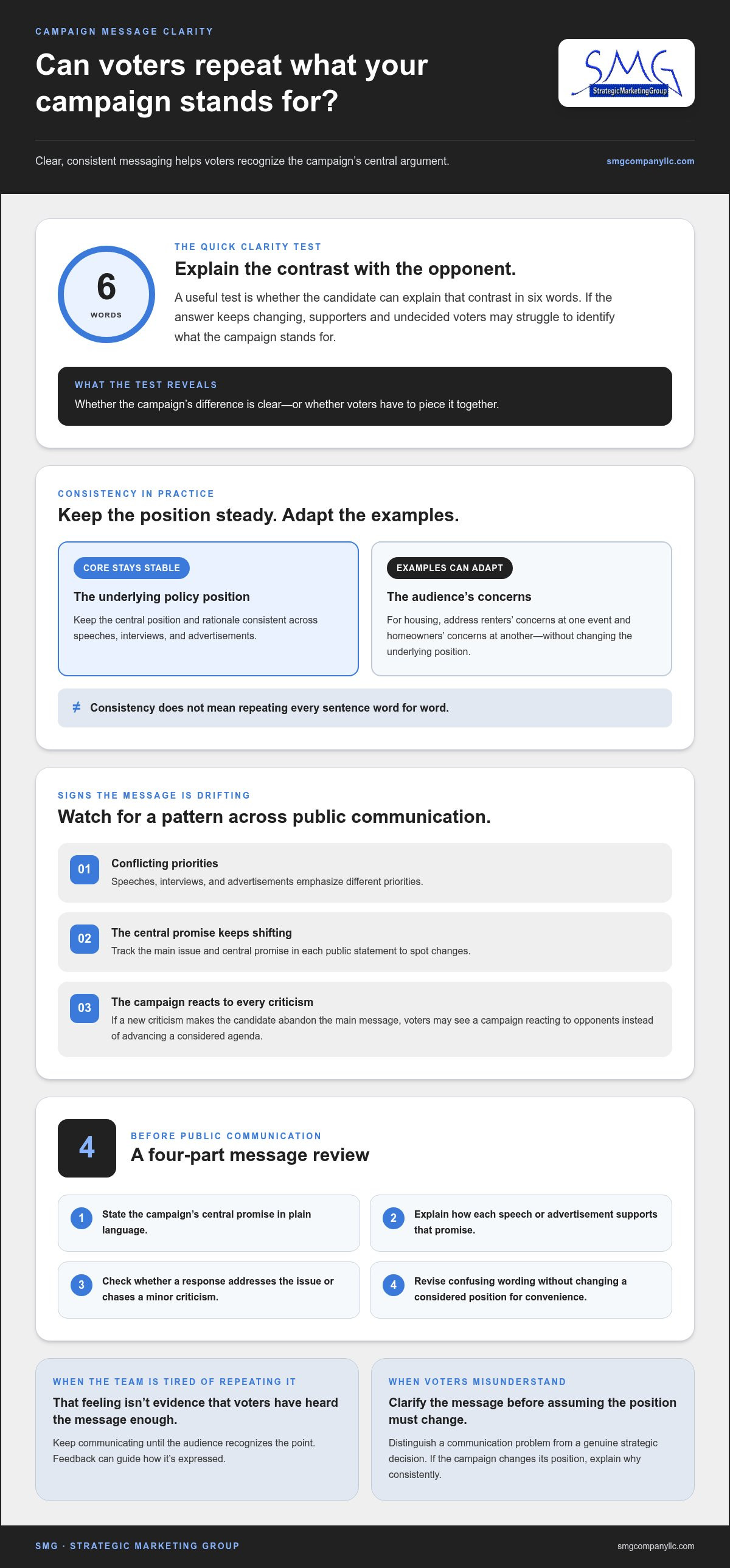
A campaign’s message should make its difference clear, not force voters to piece it together. A useful test is whether the candidate can explain the contrast with an opponent in six words. If that answer keeps changing, supporters and undecided voters may struggle to identify what the campaign stands for.
Consistency doesn’t mean repeating every sentence word for word. It means keeping the central position stable while tailoring examples to different audiences. A candidate discussing housing, for example, can address renters’ concerns at one event and homeowners’ at another while maintaining the same underlying policy position. The audience changes; the campaign’s rationale does not.
When the message starts to drift
A campaign may be losing clarity when speeches, interviews, and advertisements emphasize conflicting priorities. Track the main issue and central promise in each public statement. If a new criticism makes the candidate abandon that message, voters may see a campaign reacting to opponents instead of advancing a considered agenda.
Repetition can feel tedious to candidates and staff. That feeling isn’t evidence that voters have heard the message enough. Don’t change the central message merely because the team is tired of repeating it. Keep communicating until the audience recognizes the point. Feedback can guide how it’s expressed, but it doesn’t automatically mean the message should change.
Pressure can also distort a campaign’s positions. Major contributors or poll responses may prompt calls to shift an issue stance, but changing direction to satisfy each new pressure can undermine credibility. Distinguish a communication problem from a genuine strategic decision. If voters misunderstand a position, clarify it. If the campaign changes the position itself, explain why consistently.
Keep the core argument intact
Michael Dukakis’s clinical answer about the death penalty during a 1988 debate is a reminder that delivery shapes how voters interpret a position. The issue itself may be clear to the candidate, but a response that ignores the emotional context of a question can make the candidate seem detached. Prepare examples that connect policy to people’s concerns without abandoning the campaign’s principles.
Use a simple message review before public communication:
State the campaign’s central promise in plain language.
Explain how each speech or advertisement supports that promise.
Check whether a response addresses the issue or chases a minor criticism.
Revise confusing wording without changing a considered position for convenience.
Emphasize the issues that motivate core supporters, while making the case understandable to voters who need persuading. A focused campaign messaging review can help identify gaps between the intended argument and its public expression. The goal is disciplined communication: one recognizable case, supported by relevant examples and delivered across the campaign.
Negative advertising and attack-ad backlash
Negative advertising can draw attention to an opponent’s record, but an attack can also redirect scrutiny toward the campaign that made it. The key distinction is whether an ad presents a relevant issue-based contrast or a personal attack. If voters focus more on the campaign’s tone than its argument, the tactic may be weakening trust instead of advancing its case.
U.S. campaign history shows why the distinction matters. In 1988, the Willie Horton ad against Michael Dukakis became a prominent example of negative campaigning. Lyndon Johnson’s 1964 “Daisy” ad used a stark contrast about Barry Goldwater. These examples differ in approach, but each shows how an ad can make the opponent, the sponsoring campaign, and the campaign’s values part of the same public conversation.
Research on negative versus positive campaigning has found mixed results; some studies find no difference between the approaches. An attack ad isn’t automatically harmful, and a positive ad isn’t automatically persuasive. Results can depend on the attacker’s personality, media environment, contest competitiveness, poll rank, election type, and party system. Judge performance in context rather than assuming a tactic will work everywhere.
Recognizing backlash and defensive drift
The 2008 U.S. Senate race between Elizabeth Dole and Kay Hagan offers a direct warning. Dole’s negative ad against Hagan sharply reduced Dole’s support, and Hagan defeated Dole. For a campaign, the useful signal is not simply that an ad drew attention. Examine whether voters discuss the policy contrast or instead question the candidate’s judgment and fairness.
A campaign can also lose ground by spending too much time on the defensive. If every attack prompts a new response, the candidate’s own priorities may disappear from public view. Review campaign statements, interviews, and advertising together. Is the candidate explaining a position or mostly rebutting the opponent? Do supporters repeat the campaign’s case or only the latest accusation?
Before approving an attack ad, test its strategic purpose against these points:
Identify the specific policy or record contrast the ad makes.
Separate verifiable criticism from personal ridicule.
Consider how the message may sound to voters outside the campaign’s base.
Check whether the candidate can return to the campaign’s own priorities afterward.
If an ad triggers a sustained defensive cycle, reconsider its framing and placement rather than answering each response with another attack. Digital and mobile advertising can distribute campaign messages, but every message still needs a clear purpose. Keep the contrast focused on the election’s issues and leave room for the candidate’s own agenda.
What signs show a political campaign is running out of money?
A campaign may be short on money when planned voter contact is repeatedly cut, bills remain unpaid, or fundraising falls behind its own budget. The clearest warning is operational: the campaign can no longer fund priority activities on schedule. Candidates can lose because they cannot raise enough, regardless of effort or skill.
Compare available funds with the campaign plan, not a universal benchmark. Election type, district competitiveness, donor networks, and voter-contact strategy all shape a campaign’s needs. A local race may rely on personal outreach, while a broader contest may require more coordinated communications. Costs such as yard signs should fit the budget and support campaign priorities.
Fundraising pressure and budget choices
Fundraising requires direct involvement from the candidate. In small races, candidates should seek donations from people they know and make time to call prospective donors themselves. If the candidate stays at headquarters while staff handle fundraising alone, the campaign may miss personal requests that could support its plan.
First-time candidates should expect fundraising to take twice as much time and effort as they anticipate. One practical working-budget method is to halve the fundraising figure they estimate, then halve it again. This more conservative plan can reveal a funding gap before the campaign commits to discretionary spending.
Look for a pattern of trade-offs. If the campaign keeps cutting organizing while preserving low-priority purchases, spending may not match its vote goal. Too much paid media or polling and too little investment in people who participate in campaign activities can weaken the ground operation. Consultants who consume too much of the budget can create similar pressure.
Compare each planned expense with the campaign’s strategy and timetable.
Prioritize voter contact, fundraising, and organizing before optional purchases.
Review commitments against funds available and expected contributions.
Keep financial records carefully, meet filing deadlines, and photocopy each check before depositing it.
Don’t accept cash, even where the law permits it.
A comprehensive campaign plan needs a realistic budget and timetable. If contributions lag, revise spending priorities early instead of allowing unpaid obligations to accumulate. Fundraising is a core campaign responsibility because resources support voter contact and other planned work. Campaign Management can help align those responsibilities with the campaign’s objectives, budget, and schedule.
What are signs a campaign's message is not resonating with voters?
A message isn’t resonating when voters misunderstand its purpose, repeat different priorities, or can’t connect it to their concerns. These signals matter more than whether the candidate and staff feel the message is clear. Compare what the campaign intends to communicate with what voters actually recall.
Start with a simple test: ask voters to describe the candidate’s central case in their own words. If answers focus on unrelated issues, the campaign may be communicating too many competing themes. If voters recognize the slogan but can’t explain its meaning, the phrase may be memorable without persuading them.
Separate message problems from strategy changes
A campaign can learn from polling without treating every result as an instruction to change positions. Use objective research to test assumptions and understand which issues voters consider important. Polling can also help candidates decide which of their personal issue positions to emphasize while leaving considered positions intact.
Watch for a gap between attention and motivation. A voter may recognize a candidate’s name yet show little interest in the campaign’s priorities. Ask whether people can explain why an issue matters to them, not just whether they support a position. Intensity of preference can influence political action, so measure enthusiasm separately from preference.
Friends can offer useful encouragement, but they may share the candidate’s views or hesitate to risk a friendship by offering criticism. Seek feedback from people who represent the voters the campaign needs to reach, then compare their reactions with the candidate’s assumptions. A message that works in a familiar circle may fail with less committed voters.
Diagnose the signal before revising the message
Use these checks to identify where communication is breaking down:
Ask voters to summarize the campaign’s main argument without prompting.
Compare responses across core supporters, undecided voters, and other target audiences.
Identify whether confusion concerns the wording, the issue, or the proposed solution.
Review whether campaign communications answer a real concern or chase minor criticism.
Then adjust the delivery before discarding the strategy. Clarify unfamiliar terms, use a concrete example, or connect the position to a voter concern. Keep the campaign’s considered issue message steady. Candidates shouldn’t change positions simply because a poll or major contributor applies pressure, or abandon a message merely because repetition feels tiring.
Consistency gives voters a fair chance to understand the case. Keep communicating it until people recognize the point, then refine examples based on meaningful feedback. If your campaign needs a structured review of its message and voter response, request a campaign strategy review.
SMG (Strategic Marketing Group): Public Opinion Polling
SMG (Strategic Marketing Group) offers Public Opinion Polling to help campaigns assess voter priorities, test assumptions, and understand how messages are landing. Turn to polling when supporters’ feedback conflicts with broader voter responses, or when the campaign needs clearer evidence before adjusting its approach.
Polling insights can inform which issues to emphasize and where outreach needs refinement. Campaign Management can connect those findings to campaign priorities and execution. The value is a stronger basis for decisions, not a substitute for listening to voters and interpreting results in context.
For a strategic discussion about voter research and campaign direction, contact SMG (Strategic Marketing Group).
Turn voter signals into a deliberate next move
Recognizing signs your political campaign is failing is useful only if it leads to clearer decisions. Decide what evidence would change your strategy, who needs to act on it, and how the campaign will judge whether its response is working. That discipline keeps short-term pressure from dictating long-term direction.
SMG (Strategic Marketing Group) offers Public Opinion Polling, Campaign Management, and Government Relations Strategy. These services can support campaigns seeking a clearer read on public sentiment, more coordinated execution, or strategic guidance through complex political environments. The right starting point depends on the decision your campaign needs to make.
Contact SMG (Strategic Marketing Group) to discuss your campaign’s priorities. A focused next step can help your team move forward with greater clarity and purpose.
Frequently Asked Questions
What are the common signs a political campaign is failing?
Common signs your political campaign is failing include a weakening connection between its public message and voter priorities. Look for supporters who can’t explain the campaign’s central case, events that attract interest but little follow-through, and outreach that prompts attention without meaningful participation. Evaluate these signals together: one quiet event may reflect scheduling, while recurring patterns across audiences point to strategic problems that need attention.
Which campaign metrics indicate declining voter support or engagement?
Useful indicators include changes in stated vote preference, responses to voter contact, event attendance, completed volunteer shifts, and follow-through after supporters express interest. Track each measure by audience and over time, rather than relying on one overall total. For example, rising event registrations alongside falling attendance may reveal friction between initial interest and actual participation. Pair quantitative measures with feedback about why voters or volunteers disengage.
How can poll trends reveal a campaign is losing momentum?
Poll trends can signal lost momentum when comparable measurements show weakening support, declining enthusiasm, or fewer voters moving from uncertainty toward a choice. Compare surveys that ask similar questions of similar voter groups; differences in wording or audience can distort apparent movement. Distinguish name recognition from preference, too. A candidate becoming better known doesn’t necessarily mean more voters are prepared to support them.
How can low volunteer recruitment and canvassing activity signal campaign problems?
Low recruitment can mean supporters don’t understand how to participate, lack confidence in the campaign’s direction, or face practical barriers to showing up. Examine the path from a volunteer’s first inquiry to completed canvassing shifts. If people sign up but don’t attend, improve orientation, scheduling, or role clarity. If few inquire in the first place, assess whether campaign outreach gives supporters a compelling reason to get involved.
What warning signs indicate a campaign's digital outreach is ineffective?
Digital outreach may be underperforming when people see campaign content but rarely respond, click through, share it, or complete the intended action. Review engagement by message and audience, not just total reach. For example, repeated views without event registrations may suggest that content attracts attention but lacks a clear next step. Compare formats and calls to action, refine the weakest element, and assess the response.
Comments