
Voice Broadcasting for Campaigns: 2026 Buying Guide

What if a campaign voice message did more than reach a list and instead reinforced what voters hear across every channel? The value of voice broadcasting services for campaigns isn’t simply the number of calls sent. It depends on whether outreach fits the campaign’s goals, audience, and broader communications strategy.
Campaign teams already know voice can deliver a candidate introduction or timely election information. The harder question is whether to use a managed service or a standalone platform, and how to keep each message connected to the campaign’s wider work. A call that feels separate from the rest of the outreach may miss its strategic purpose.
This guide offers a practical framework for evaluating campaign voice broadcasting, from audience insight and message development to coordination with other channels. It also explains how voice and text messaging can work alongside polling, digital advertising, and campaign management. SMG brings these capabilities together through an integrated public-affairs approach shaped by campaign activity spanning over 40 states. The goal is to help you assess where voice belongs in your strategy and what a more coordinated approach can make possible.
Table of Contents
What Campaign Voice Broadcasting Can, and Cannot, Do for Outreach
Campaign voice broadcasting is the phone-based delivery of a campaign message to an intended audience. It describes how a message is distributed, not why the campaign is communicating or what outcome it should pursue. The broader concept of voice broadcasting includes mass communication by phone, while campaign strategy determines the audience, message, and role of each outreach effort.
That distinction matters. A broadcast can carry an announcement, a voter reminder, or a public-affairs message, but it cannot decide which issue matters to a community or develop the campaign’s position. Those choices depend on audience insight, message development, and campaign priorities. Voice is one channel in that work, not a strategy in itself. Nor should a broadcast automatically replace digital communication, field outreach, or direct conversations. Each channel can serve a different purpose and create a different kind of engagement.
When does voice outreach make sense for a campaign?
Start with the objective. A direct voice message may suit communication that benefits from a spoken delivery, such as announcing a campaign development, encouraging voter engagement, or reminding people about a relevant event. The channel can put a message in a recipient’s hands by phone, but that alone doesn’t make it the right choice. If the goal requires ongoing dialogue, detailed information, or a personal exchange, another channel or a coordinated combination may be more appropriate.
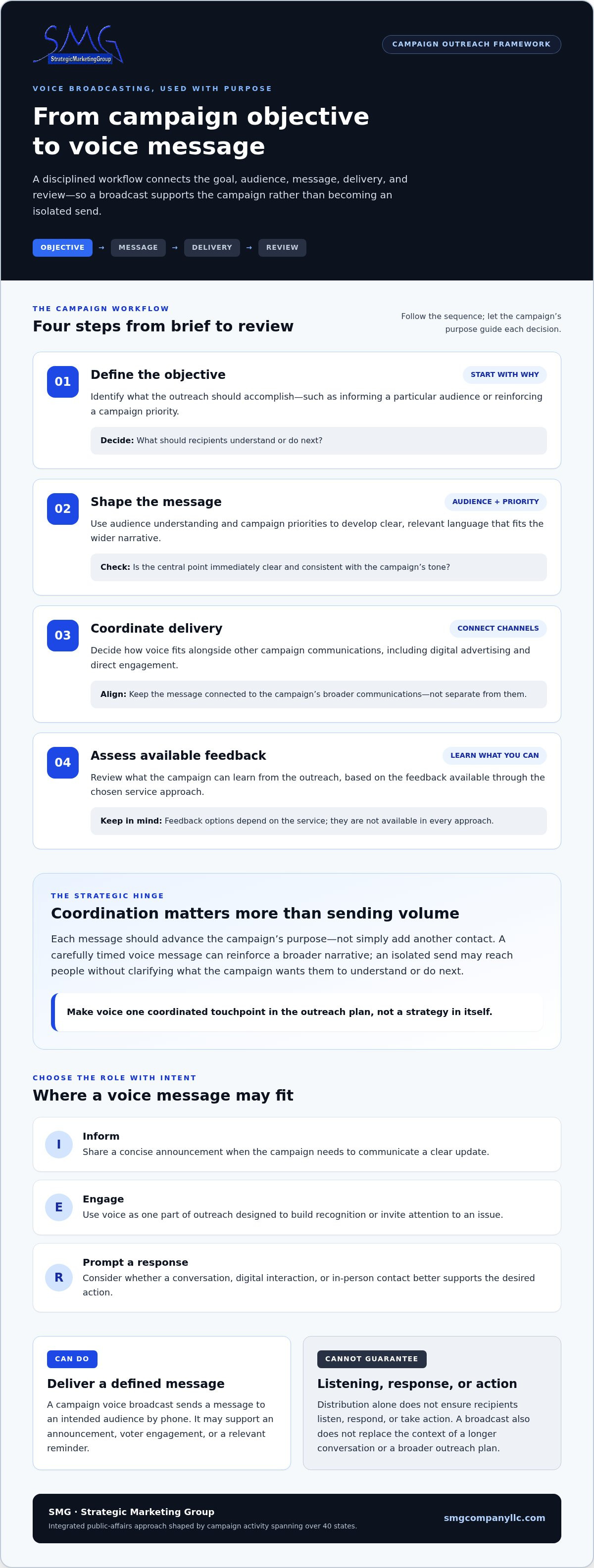
Inform: Share a concise announcement when the campaign needs to communicate a clear update.
Engage: Use voice as one part of outreach designed to build recognition or invite attention to an issue.
Prompt a response: Consider whether the desired action is better supported by a conversation, digital interaction, or in-person contact.
The test is strategic fit, not reach alone. Before planning a voice message, identify what recipients should understand or do next, then consider whether a call supports that objective alongside the campaign’s other communications.
What should campaign teams expect from the channel?
A voice broadcast delivers a message to recipients by phone according to the selected service approach. Some platforms offer prerecorded messages; some also provide recipient response options, such as an interactive menu or recorded reply. Those are examples of functions found in the category, not assumptions about every service. The campaign should understand the intended communication flow and keep any response path aligned with its objective.
Voice broadcasting services for campaigns can distribute a message, but distribution does not guarantee that recipients will listen, respond, or take action. A call also won’t, by itself, provide the context of a longer conversation or the continuity of a broader outreach plan. Treat the broadcast as a defined communication touchpoint: establish its purpose, connect it to the campaign’s wider messaging, and decide how the team will interpret any available feedback. This keeps the channel in service of the campaign, rather than allowing the mechanics of sending calls to set the strategy.
How Campaign Voice Broadcasting Fits into a Broader Outreach Strategy
A campaign broadcast should follow a communications decision, not stand in for one. A disciplined workflow connects the campaign’s objective to audience insight, message development, channel selection, and review. The exact delivery and feedback process depends on the service approach, so distinguish strategic steps every campaign can take from functions that only some services may provide.
Define the objective. Identify what the outreach should accomplish, such as informing a particular audience or reinforcing a campaign priority.
Shape the message. Use audience understanding and campaign priorities to develop a clear, relevant message.
Coordinate delivery. Decide how voice fits alongside other campaign communications, including digital advertising and direct engagement.
Assess available feedback. Review what the campaign can learn from the outreach, based on the feedback the chosen approach makes available.
Coordination is the strategic hinge. Channel coordination matters more than sending volume because each message should advance the campaign’s purpose, not simply add another contact. A carefully timed voice message can reinforce a broader narrative; an isolated send may reach people without clarifying what the campaign wants them to understand or do next.
From campaign objective to voice message
Before drafting, define the intended audience and the communication purpose. Then use concise, audience-relevant language that fits the campaign’s wider narrative. If a campaign is discussing a local issue across several channels, the voice message should reinforce the same priority and tone rather than introduce a disconnected argument. This alignment helps keep public-facing communications coherent, even when each channel serves a distinct role.
Message development also benefits from disciplined review. Campaign teams can consider whether the central point is immediately clear, whether the language reflects the audience’s concerns, and whether the requested next step fits the objective. These are strategic checks, not platform features. A delivery service carries the message; campaign planning establishes what the message should say and how it relates to the wider effort.
Where audience insight and follow-up fit
Public opinion polling can help campaigns gauge public sentiment and inform message decisions. It can provide context for choosing which concerns to address and assessing how a message may resonate. Polling informs the strategy; it doesn’t guarantee a particular response or determine the best wording without campaign judgment. Voice messaging, in turn, is one possible way to deliver a message shaped by that broader understanding.
Responses may provide another input when the selected service supports a response mechanism. Don’t assume that every broadcast includes a way to reply, routes responses, or produces a particular report. Instead, decide how any available feedback will be considered and whether another communication channel is needed for follow-up. For political outreach, campaign teams can consult the FCC guidance on political robocalls and texts as they plan communications.
SMG’s Voice and Text Broadcasting can be considered alongside its distinct capabilities in Campaign Management, Public Opinion Polling, and Digital & Mobile Advertising. Polling can inform audience and message decisions, campaign management can situate outreach within campaign priorities, and digital advertising can serve a separate role in the communications mix. To explore how these disciplines can fit together, review SMG’s campaign communications approach.
How to Evaluate Voice Broadcasting Services for Campaigns
Compare services by how well they support campaign decisions, not by a feature list alone. The right fit depends on the team’s capacity, the strategic guidance it needs, and how voice outreach relates to other communications. Use the framework below to assess voice broadcasting services for campaigns without assuming every service offers the same workflow or feedback.
Strategic input: Does the approach help connect the broadcast to a defined campaign objective and audience, or is the team responsible for that planning?
Campaign integration: Can voice outreach sit alongside the campaign’s broader work, including polling, campaign management, and digital advertising?
Message development: Is message strategy part of the support, or does the campaign bring a finished script for delivery?
Available feedback: What, if anything, can the campaign learn from the outreach? Response options and reporting vary by service, so don’t assume they’re included.
Which service model fits your campaign?
Managed campaign support generally means a service provider supports the delivery effort, while a software-led model may give a team tools to configure or manage broadcasts itself. Neither model is automatically the better choice. Consider the campaign’s internal capacity, the level of strategic involvement it wants, and whether it needs help coordinating voice with other campaign priorities. A team with established messaging and staff to manage execution may prefer more direct control; another may value broader support.
Keep the distinction clear: software handles activities through its platform, while managed support involves a provider in the campaign delivery process. The precise division of responsibilities varies. Evaluate the model against the work your campaign needs done, rather than assuming a platform includes strategic advice or a managed service includes particular technical features.
What strategic questions should buyers answer?
Begin with the message and its purpose. Is the intended audience clear? Does the communication advance a defined objective? Will the voice message reinforce the campaign’s other public-facing communications, or could it feel disconnected? These questions help distinguish a useful campaign service from a channel selected simply because it can send calls.
Audience and objective: Can the team explain who the message is for and what it should help accomplish?
Message alignment: Does the voice content fit the campaign’s wider narrative and other outreach?
Strategic support: Would polling or campaign-management expertise strengthen the plan around the broadcast?
Feedback expectations: Is the campaign clear about what feedback it needs, and what the selected service actually makes available?
These are planning criteria, not promises about any platform’s capabilities. SMG brings Voice and Text Broadcasting together in its broader public-affairs offering with distinct capabilities in Public Opinion Polling, Campaign Management, Digital & Mobile Advertising, and Speech Writing & Messaging. That combination gives campaigns a way to consider voice alongside audience insight, message development, and campaign priorities, rather than evaluating delivery in isolation.
How to Plan a Campaign Voice Broadcast from Brief to Review
A useful broadcast begins with a campaign brief, not a delivery schedule. A clear plan connects the intended outcome to the audience, message, channel mix, and learning the team hopes to gain. This sequence helps campaign teams discuss voice broadcasting services for campaigns in strategic terms without assuming every service has the same delivery or reporting capabilities.
Set the objective, audience, and message
Define the communication’s purpose first. Is it intended to inform, reinforce a campaign priority, or encourage a specific response? Next, identify the audience in relation to the campaign’s electoral or public-affairs priorities. Draft a clear message that speaks to that audience and stays consistent with the campaign’s broader narrative. The voice message should support the campaign’s position, not introduce a disconnected one.
Use this planning sequence to keep decisions focused:
Set the objective. State what the communication is meant to support and what the audience should understand.
Define the audience. Describe who the message is for and why the communication is relevant to them.
Develop the message. Establish the central point, supporting context, and any intended next step.
Coordinate delivery. Place voice outreach in relation to campaign messaging, digital advertising, and other planned communications.
Review learning. Decide what the campaign will assess afterward, based on the feedback or reporting available through the selected service.
Coordinate delivery and assess what follows
Timing and channel coordination should serve the campaign’s priorities. For example, a voice message might reinforce a message already present in digital advertising, while the campaign’s other communications provide additional context. The exact sequence will depend on the campaign plan. Related campaign messaging and digital advertising guidance can help teams consider how message development and channel selection fit together.
Before delivery, establish what information the team expects to review afterward. Response collection and reporting depend on the chosen service’s capabilities; don’t assume a broadcast will collect replies or provide a particular report. If feedback is available, determine who will review it and how it may inform subsequent messaging. Treat the review as a source of learning, not a promise of a particular outcome.
Pre-project checklist
The campaign objective is specific and understood by the team.
The intended audience is defined in relation to campaign priorities.
The message is clear, relevant, and consistent with other public-facing communications.
The role of voice outreach alongside digital advertising and other channels is established.
The team knows what feedback or reporting the chosen service makes available.
There is a plan for considering what the campaign learns after delivery.
A focused brief gives campaign leaders and communications partners a common basis for planning. To discuss a campaign voice and messaging project with SMG, connect with SMG about campaign outreach.
Work with SMG on Campaign Voice and Text Messaging
Campaign voice and text messaging work best when they’re planned in the context of the campaign’s broader objectives. SMG’s Voice/Text Messaging service sits within a public-affairs offering that also includes Campaign Management, Public Opinion Polling, and Digital & Mobile Advertising. That range gives campaign teams a basis for considering how outreach, audience insight, and campaign priorities relate, rather than treating a message as an isolated activity.
SMG was founded in 2002 and has been instrumental in elections across over 40 states. That experience provides context for the firm’s campaign work, without suggesting that any service can guarantee a particular result. The role of voice and text messaging depends on the campaign’s objective, intended audience, and communications plan.
Why an integrated campaign partner can matter
A message is one part of a larger effort. Polling can inform a campaign’s understanding of public opinion, while Speech Writing & Messaging supports the development of campaign communications. Campaign Management and Digital & Mobile Advertising serve distinct roles in coordinating and delivering campaign work. Considering these capabilities together can help a team align its outreach choices with its priorities and the concerns it wants to address.
SMG’s full-service public-affairs approach brings together its listed services, including Voice/Text Messaging, Campaign Management, Public Opinion Polling, Digital & Mobile Advertising, Government Relations Strategy, Speech Writing & Messaging, and the SMG Video Truck. Each serves a different function. The value of considering them in combination is strategic: campaign teams can discuss how voice and text fit alongside other parts of their communications and public-affairs work.
That perspective reflects SMG’s mission: “We are here to help you drive change.” It places the campaign’s purpose and community context at the center of planning, while keeping each communication channel in its appropriate role.
Prepare for a campaign conversation with SMG
A focused conversation starts with the campaign’s needs, not a preset message or channel. Before discussing voice broadcasting services for campaigns, outline the objective, the audience, and the role you want voice and text to play in the wider outreach effort. It can also help to identify the campaign priorities that should shape the message and how polling, campaign management, or digital advertising may relate.
Objective: What should the communication support?
Audience: Who is the intended audience, and why is the message relevant to them?
Channel role: How should voice and text messaging fit alongside the campaign’s other communications?
Broader needs: Would audience insight, messaging support, campaign management, or digital advertising inform the wider plan?
These details give the discussion a practical starting point while leaving room to shape the approach around the campaign. Campaign teams can discuss their outreach objectives with SMG and explore a tailored role for voice and text messaging within their broader campaign work.
Make Your Next Outreach Decision Count
The next campaign communication is an opportunity to bring greater discipline to how your message reaches the public. Before selecting voice broadcasting services for campaigns, decide what role the channel should play in the campaign’s broader priorities. That clarity can help your team shape outreach that feels deliberate and connected, rather than adding another message without a clear purpose.
Effective campaign work depends on choices made before delivery: what the audience needs to hear, how the message reflects the campaign’s direction, and where voice fits alongside other communications. A partner with a broader public-affairs perspective can help your team consider those decisions together and build an approach suited to its goals.
SMG’s campaign experience and Voice/Text Messaging service are part of a wider campaign offering. Take the next step toward aligning your outreach with your priorities. Explore a coordinated campaign approach with SMG, and move forward with purpose.
Frequently Asked Questions
What are voice broadcasting services for campaigns?
Voice broadcasting services for campaigns deliver campaign messages by phone to an intended audience. Teams may use this channel to share an announcement, remind people about an event, or support engagement around a public issue. The call is a delivery tactic, not the campaign plan itself. Teams still need to determine whom they want to reach, what the message should accomplish, and how it fits the campaign’s broader communications.
How does a voice broadcast campaign work?
A voice broadcast campaign generally involves preparing a message, arranging its delivery to selected phone numbers, and reviewing any feedback or reporting available afterward. For example, a team might prepare an event announcement for a defined audience, then assess whatever information the selected service provides. The precise workflow varies by service. Functions such as response collection or reporting shouldn’t be assumed unless they’re part of that service’s capabilities.
Can people respond to a campaign voice broadcast?
Some services let recipients respond through touch-tone menu options or recorded audio, but response features depend on the service used. Those are general market examples, not a description of SMG’s offering. SMG lists Voice/Text Messaging as a service; specific response functions shouldn’t be inferred from that listing. Before planning around recipient replies, campaign teams should establish whether the chosen approach supports them and how any available feedback will inform communications.
What campaign messages can voice broadcasting support?
Campaigns may use voice broadcasts for announcements, reminders, event invitations, voter engagement, or volunteer coordination. For instance, a team could consider a call to remind an intended audience about a campaign event, while using other channels for additional context. The right use depends on the objective and audience. These are examples of how the channel may be used, not predefined packages or feature claims about SMG’s Voice/Text Messaging service.
How should campaigns evaluate a voice broadcasting service?
Assess whether the service fits the campaign’s objective, reaches an audience relevant to its priorities, and supports clear message development. Consider how voice activity relates to other campaign communications and what feedback, if any, the service makes available. A managed service may involve provider support with delivery, while software-led tools may leave more configuration and oversight to the campaign team. Choose based on the team’s capacity and desired strategic involvement.
How can voice broadcasting fit with other campaign outreach?
Voice messaging can be planned alongside campaign management, polling, and digital advertising, with each serving a distinct role. For example, polling may help a team understand public opinion, while voice or digital advertising carries campaign communications to an intended audience. Begin with a shared campaign objective and keep the central message consistent across relevant channels. Coordination helps organize outreach, but it doesn’t guarantee greater engagement or a particular electoral outcome.
Comments