
Understanding Swing Voters: Strategic Insights for the 2026 Electorate
- lionelleach
- May 14
- 12 min read

Updated: May 16
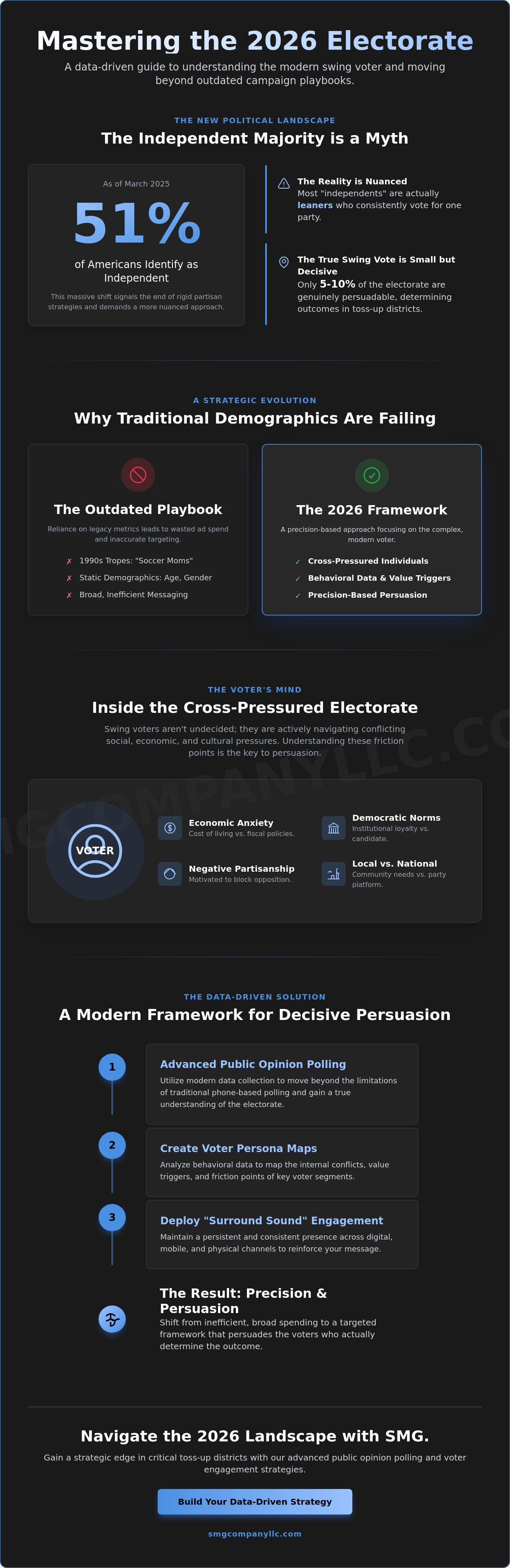
As of March 2025, 51% of Americans identify as independent, yet many campaigns still exhaust their budgets on rigid partisan playbooks that ignore this growing majority. This shift represents a fundamental disruption in the political environment. Understanding swing voters in the 2026 cycle requires moving beyond the outdated concept of the undecided moderate. These individuals are often strategically cross-pressured, balancing specific economic concerns with shifting institutional loyalties.
You recognize the frustration of seeing inaccurate polling data lead to wasted ad spend in critical toss-up districts. It's a common failure in modern strategy that relies on legacy metrics. We provide a clear framework for voter segmentation that resolves these internal conflicts and drives higher persuasion rates. This article explores the data-driven tactics required to master the psychology of the 2026 electorate. You will learn how to allocate campaign resources with precision, ensuring every message reaches the voters who actually determine the outcome.
Key Takeaways
Move beyond outdated 1990s tropes to identify the cross-pressured individuals who define the 2026 electorate.
Gain a strategic edge in understanding swing voters by analyzing how economic anxiety and social values compete within the modern mind.
Utilize advanced public opinion polling to create Voter Persona maps that overcome the limitations of traditional phone-based data collection.
Deploy a "Surround Sound" engagement strategy to maintain a persistent presence across digital, mobile, and physical channels.
Shift campaign focus from broad, inefficient spending toward a precision-based framework designed for decisive persuasion in toss-up districts.
Table of Contents
Defining the Modern Swing Voter in 2026
The political landscape has shifted. The 1990s tropes of "soccer moms" or "Reagan Democrats" no longer provide a reliable roadmap for victory. In the 2026 cycle, the electorate is defined by deep fragmentation and strategic cross-pressures. Success in modern campaigns requires a sophisticated approach to understanding swing voters that moves beyond these surface-level labels. These individuals aren't just "undecided" in the traditional sense. Many have already decided they are dissatisfied with the status quo. The strategic challenge lies in determining if they are "persuadable" enough to choose your candidate or if they are simply looking for a reason to stay home. In high-stakes races, these voters act as the final arbiter, determining the margin of victory in districts where polarization has already locked in the base.
The Myth of the Pure Independent
While 51% of Americans identified as independent as of March 2025, the reality is more nuanced than a simple three-way split. Most of these individuals are "leaners" who consistently side with one party when pushed. The true Swing vote consists of a narrow 5-10% of the electorate that genuinely shifts between cycles based on performance and pragmatic solutions. In 2026, the presence of third-party candidates further complicates this math. These candidates don't just "steal" votes. They provide an exit ramp for voters who feel alienated by both major platforms. Identifying the small segment that will actually move between the two main parties is the core of modern campaign management.
Why Traditional Demographics Are Failing
Relying on age or gender as primary predictors is a strategic error. In 2026, a voter's zip code or biological profile matters less than their lifestyle and value-based triggers. A 25-year-old in a suburban district might share more behavioral data points with a 50-year-old professional than with their own peers. This shift demands a move toward understanding swing voters through the lens of behavioral psychology rather than census data. The modern swing voter is a dynamic data-cluster of cross-pressured interests, economic anxieties, and media consumption habits rather than a static demographic category.
This fragmentation means that the decisive voters in 2026 are harder to find but easier to influence if you have the right data. They are the individuals who feel the weight of the cost of living but remain concerned about democratic norms. They don't respond to broad, generic messaging. They require precision. By treating the swing voter as a complex individual rather than a trope, campaigns can move the needle in even the most contested "toss-up" districts.
The Psychology of the Cross-Pressured Electorate
The concept of the swing voter is often oversimplified as a lack of political conviction. In reality, these individuals are frequently the most engaged, precisely because they are navigating a state of intense cross-pressure. This theory suggests that a voter’s various social, economic, and cultural identities are in direct conflict. For instance, a voter might align with a candidate’s fiscal policies but find their social stances incompatible with personal values. Understanding swing voters requires identifying these internal friction points. In the 2026 environment, economic anxiety, specifically the rising cost of living, often acts as the primary weight. However, it doesn't exist in a vacuum. It competes with concerns over democratic norms and local governance.
Negative partisanship plays a decisive role here. Many voters aren't motivated by an affinity for a candidate. They are driven by a desire to block the opposition. When identities clash, the voter must decide which "pressure point" is the most urgent. This resolution of conflict is rarely logical; it's a prioritization of the most immediate threat. If you want to refine your approach to these high-stakes decisions, our public opinion polling services provide the granular data necessary to see which issues are winning the internal tug-of-war.
Cognitive Dissonance in the Voting Booth
The psychology of the swing voter is a study in cognitive dissonance. To maintain a consistent self-image, voters must justify why they are shifting their loyalty. They often separate local needs from national narratives. A voter might disapprove of a party’s national leadership but support a local candidate who demonstrates pragmatic community leadership. This mental gymnastics allows them to vote across party lines without feeling they've betrayed their core principles. Polling helps identify which specific local issue, be it property taxes in New Jersey or regional infrastructure, provides the strongest "permission structure" for this shift.
The Emotional Arc of a Swing Voter
The journey of a persuadable voter is rarely a straight line. It moves from deep skepticism to a period of intense information gathering. This often culminates in the "Last 72 Hours" phenomenon. While partisans decide months in advance, swing segments often finalize their choice just days before the election. This late-stage movement is driven by a final surge of emotional resonance or a perceived breaking point in the opposition’s messaging. Strategic Marketing Group (SMG) utilizes advanced sentiment analysis to track this emotional shift in real-time, allowing campaigns to pivot their messaging when the pressure is highest. This methodical tracking ensures that resources aren't wasted on static assumptions made at the start of the cycle.
Data-Driven Identification: Moving Beyond the Surface
Traditional phone polling has become a relic in an era where mobile devices act as the primary filter for information. Relying on landline data or surface-level registration files is a recipe for failure in high-stakes environments. A robust strategy for understanding swing voters requires a transition toward multi-channel data collection. This involves creating a "Voter Persona" map that accounts for the complex motivations identified in previous sections. As noted in this scholarly analysis of swing voters, the conditions under which these individuals exercise power are highly specific and data-dependent. We don't just look at who they are; we look at what they do.
Predictive modeling allows us to forecast 2026 outcomes by analyzing past behavior across diverse electoral cycles. It's not enough to know a voter's party. You must understand their likelihood of turnout and their specific triggers for persuasion. Micro-targeting takes this a step further, reaching voters at the precinct and even the household level. In a state like New Jersey, where local dynamics can shift from one block to the next, this granular approach is the difference between a wasted budget and a surgical strike.
The SMG Approach to Electorate Analysis
Strategic Marketing Group (SMG) leverages a proprietary data warehouse spanning over 40 states to identify hidden patterns that others miss. We integrate deep consumer data with traditional political registration files to build a three-dimensional view of the electorate. This process begins with Benchmark polls. These aren't just snapshots in time; they're the foundation of a long-term strategy. They allow us to establish a baseline of public sentiment before the first ad even airs. By looking at data and social trends through a lens that challenges the status quo, we find opportunities in districts others have labeled as unreachable.
Advanced Metrics for Persuasion
Winning Newark-level races requires a sophisticated voter segmentation analysis that goes beyond candidate favorability. We prioritize "issue salience," measuring which specific topics actually drive a voter to the polls versus what they simply find interesting. Tracking "voter reengagement" metrics throughout the cycle ensures that our messaging evolves as the voter moves through their emotional arc. If a persuadable voter stops interacting with digital content, we know it's time to shift tactics before the "Last 72 Hours" window closes. This constant feedback loop ensures campaign resources are always directed toward the most impact-heavy segments, providing a sense of stability and continuous presence in a fast-moving environment.
Strategic Engagement: How to Reach the Unreachable
Traditional media buys are increasingly inefficient for reaching the modern persuadable segment. Linear television and static billboards lack the precision required for understanding swing voters who have shifted their attention to mobile-first environments. These voters don't just consume information; they filter it. Breaking through this apathy requires a "Surround Sound" strategy that integrates digital, mobile, and physical touchpoints into a unified narrative. This isn't about volume. It's about presence. We ensure that a candidate’s message appears where the voter is most receptive, whether they are scrolling through local news or attending a community event.
Message discipline remains the cornerstone of this approach. Tailoring a narrative to specific data clusters doesn't mean changing the core platform. It means highlighting the specific facet of that platform that resonates with a voter's primary pressure point. If you need a partner to architect this level of precision, explore our campaign management solutions to see how we turn data into victory.
Digital and Mobile Geofencing
Mobile advertising provides the surgical accuracy that traditional media lacks. We utilize geofencing to create a virtual "persuasion zone" around specific geographic areas, such as high-traffic transit hubs or local business districts. When a voter enters these zones, they receive targeted digital content that reflects their immediate environment and concerns. This is supplemented by voice and text broadcasting, which serves as a critical tool for last-minute persuasion. SMS outreach, in particular, achieves open rates that far exceed email or traditional mail, making it indispensable for the "Last 72 Hours" window discussed previously.
High-Impact Physical Presence
Digital outreach is most effective when mirrored by a high-impact physical presence. The SMG Video Truck acts as a mobile command center and billboard, bringing the campaign’s message directly to the community pulse. In diverse urban environments where static signage is often ignored, a mobile, high-definition video presence is disruptive. It commands attention and reinforces the digital narrative. Integrating these field operations with digital outreach ensures a seamless ground game. A voter might see a video truck in the morning, receive a geofenced ad in the afternoon, and get a text reminder in the evening. This repetition creates a sense of momentum and stability that traditional, fragmented campaigns cannot match.
Navigating the 2026 Landscape with SMG
The 2026 election cycle demands more than just tactical execution; it requires a strategic architect who understands the hidden mechanics of influence. Strategic Marketing Group (SMG) has established itself as this force, guiding candidates from local mayoral offices to the halls of Congress. In a volatile political environment, having a full-service public affairs partner ensures that your message isn't just heard, but that it actually moves the needle in the districts that matter most. We pride ourselves on looking at data and social trends through a lens that challenges the status quo, providing our clients with a distinct competitive advantage. This isn't just theory; it's a proven history of high-stakes success.
Our firm operates with a steady, professional demeanor that suggests deep-rooted expertise. We don't rely on the breathless hype often found in political marketing. Instead, we focus on a mission-driven approach that balances high-level strategy with a grounded respect for civic duty and community leadership. By choosing a partner that understands the intersection of public sentiment and institutional influence, you ensure that your campaign resources are allocated with maximum efficiency.
A Seasoned Insider's Perspective
Our team, led by Lionel Leach, brings a unique combination of deep New Jersey roots and extensive national political expertise. This dual perspective is essential for understanding swing voters in regions where local grievances often intersect with broader national trends. We navigate complex institutional systems with the precision of a seasoned insider, ensuring that our clients are always positioned for maximum impact. Retainer-based strategic counsel is vital here. It provides the stability needed for long-term legislative influence, allowing for a continuous presence rather than a frantic, last-minute surge. This methodical approach ensures you remain connected to the pulse of the community throughout the entire cycle.
Taking the First Step Toward Victory
Victory begins with a clear-eyed assessment of the electoral landscape. SMG initiates every partnership with a comprehensive electorate analysis, moving past surface-level assumptions to find the data-driven path to success. We customize our campaign management strategies for the specific nuances of local and state-level contests, recognizing that a Newark race requires a different touch than a suburban township campaign. By integrating public opinion polling with innovative technology like geofencing and mobile broadcasting, we build a path to victory that respects the gravity of the field. Understanding swing voters isn't a one-time task; it's a continuous process of refinement and engagement. Contact SMG today to start your data-driven path to victory.
Securing Victory in the 2026 Cycle
Success in the upcoming elections depends on your ability to move past traditional metrics. Understanding swing voters is no longer a matter of guesswork. It's a rigorous application of behavioral data and psychological mapping. By resolving the internal conflicts of the cross-pressured electorate and deploying surgical engagement tactics, you can secure margins that others find impossible. These voters are looking for pragmatic solutions and steady leadership. They respond to clarity and consistency, whether in the political arena or when seeking professional support from firms like Massingill Attorneys & Counselors at Law for their business and estate planning needs.
Strategic Marketing Group (SMG) provides the seasoned authority required to navigate these complexities. With experience spanning over 40 states and the leadership of NJ strategist Lionel Leach, we offer the tools necessary for a path to victory. Our firm utilizes disruptive technology like the SMG Video Truck alongside precision mobile geofencing to ensure your message resonates where it matters most. We don't just manage campaigns. We architect influence.
Partner with SMG for Expert Electorate Analysis and Campaign Victory
The path to leadership is built on data and discipline. We are ready to help you navigate the road ahead with confidence.
Frequently Asked Questions
What is the difference between a swing voter and an independent voter?
An independent voter is defined by their lack of formal party registration, while a swing voter is defined by their behavioral willingness to switch between candidates. Many independents are "leaners" who consistently support one party in every cycle. True swing segments are cross-pressured individuals who may vote for different parties across different elections based on candidate performance or specific policy platforms.
How do political consultants identify swing voters in a specific district?
Consultants identify these voters by overlaying historic precinct-level results with individual consumer data and voting frequency. We look for households that demonstrate ticket-splitting behavior or inconsistent turnout patterns. This allows us to move beyond static registration lists and target the small percentage of the electorate that genuinely moves between parties based on the political climate.
Are swing voters still relevant in highly polarized elections?
Swing voters remain the decisive factor in toss-up districts because they act as the final arbiter when partisan bases are locked. In a polarized environment, the margin of victory is often exceptionally narrow. Persuading a small percentage of the middle is frequently more efficient than attempting to convert a staunch partisan or relying solely on base turnout to carry a race.
What issues are most likely to influence swing voters in 2026?
The cost of living is the dominant concern for the 2026 electorate, followed by democratic values and local infrastructure. Understanding swing voters in this cycle requires recognizing that economic anxiety often competes with social values. Voters prioritize the "pressure point" they perceive as the most immediate threat to their daily stability or their community’s long-term well-being.
How much of a campaign budget should be allocated to swing voter persuasion?
Allocation depends on the district's baseline partisan lean, but campaigns typically reserve 20% to 40% of their persuasion budget for swing segments. This ensures sufficient frequency to break through modern media noise. Strategic resource management prioritizes these voters during the final weeks of the cycle when their decision-making process reaches its peak intensity and skepticism begins to wane.
Can digital advertising effectively reach voters who are skeptical of politics?
Digital advertising is highly effective for reaching skeptical voters when it utilizes non-partisan, issue-focused messaging delivered through mobile platforms. Geofencing and mobile ads allow for a "Surround Sound" presence that feels less like a traditional intrusion and more like a relevant community update. This approach builds credibility with individuals who tend to tune out standard television broadcasts or partisan rhetoric.
What role does public opinion polling play in understanding swing voter behavior?
Public opinion polling provides the empirical foundation for all segmentation and messaging strategies. It allows us to measure issue salience and identify which arguments will actually move a voter from skepticism to engagement. Without this data, campaigns are essentially guessing which pressure points will resonate with the cross-pressured segments of the electorate that understanding swing voters requires identifying.
How does SMG's electorate analysis differ from standard polling companies?
SMG’s electorate analysis functions as a strategic roadmap rather than a simple data report. We integrate polling with deep consumer insights and historic behavior to predict future outcomes with precision. While standard firms provide snapshots, we act as architects who use this data to drive campaign management, digital advertising, and high-impact physical outreach through tools like our proprietary video trucks.
Comments