
Underdog Campaign Strategy: 2026 Strategic Blueprint

Updated: Aug 3
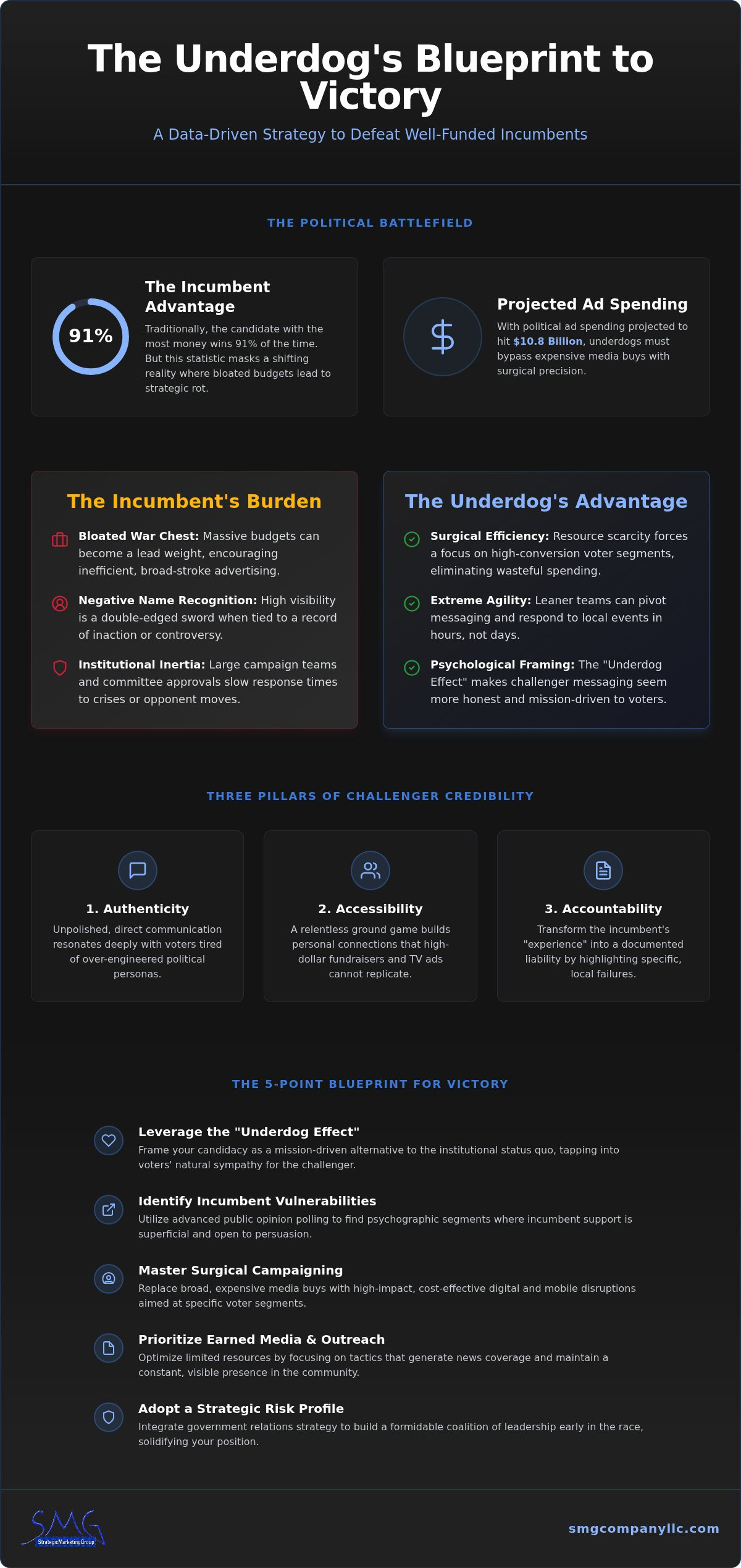
In an era where political ad spending is projected to hit 10.8 billion dollars, traditional wisdom suggests the candidate with the most money wins 91 percent of the time. However, that statistic masks a shifting reality where bloated budgets often lead to strategic rot and message dilution. For the modern challenger, a massive bank account can be a lead weight rather than a life jacket.
You likely feel the daily pressure of the fundraising gap and the daunting name recognition of a career incumbent. It's a heavy burden to manage limited staff while your opponent commands institutional influence and a deep war chest. This blueprint provides a sophisticated campaign strategy for underdog candidates designed to bypass these traditional barriers through data-driven precision and psychological framing. You'll learn how to defeat well-funded incumbents by leveraging their own size against them.
We'll explore how to utilize cost-effective tools like Connected TV and electorate analysis to build a path to victory that remains intellectually formidable and socially rooted. By the end of this guide, you'll have the tactical framework to turn resource scarcity into a filter for surgical efficiency.
Table of Contents
The Challenger's Dilemma: Defining the Underdog Strategy
Effective political positioning begins with a fundamental shift in perspective. An underdog strategy isn't merely a response to a lack of funds. It's a deliberate, tactical choice to frame the election as a choice between the community and a stagnant establishment. While incumbents often rely on high name recognition, this visibility frequently acts as a double-edged sword. If that recognition is tethered to high negatives or a record of institutional inaction, the incumbent becomes a static target rather than a formidable leader.
This dynamic creates The Challenger's Dilemma, where the underdog must decide between playing the incumbent's game or changing the rules entirely. Executing a campaign strategy for underdog candidates requires a focus on the Efficiency Factor. Smaller, leaner teams can pivot messaging and respond to local crises in hours. Bloated frontrunner campaigns often require days of committee approvals. Establishing a clear Path to Victory (PTV) requires deep electorate analysis to identify exactly where the incumbent's foundation is cracked.
Resource Scarcity as a Strategic Asset
Scarcity mandates a focus on high-conversion voter segments rather than vanity metrics like expensive billboards or general awareness ads that don't move the needle. This lean approach allows for extreme agility. When an incumbent makes a misstep, the underdog is already on the ground with a counter-message. A successful campaign strategy for underdog candidates defines the Delta, the specific percentage of voters needed to flip the result, and ignores the noise of the broader, unpersuadable electorate.
The Three Pillars of Challenger Credibility
Building trust requires a commitment to three specific areas that incumbents often neglect as they become comfortable in office:
Authenticity: Voters are increasingly weary of over-engineered political personas. An unpolished, direct communication style often resonates more deeply than the consultant-driven scripts used by the establishment.
Accessibility: While the opponent sits in high-dollar fundraisers, the underdog wins by out-touching them in key wards. A relentless ground game builds a personal connection that expensive television buys cannot replicate.
Accountability: The challenger must frame the incumbent's tenure as a history of missed opportunities. By highlighting specific, local failures, you transform the opponent's "experience" into a documented liability.
The Psychology of Underdog Labeling: Why Voters Root for the Challenger
The human brain is naturally wired to find meaning in the struggle against overwhelming odds. This psychological phenomenon, often called the "Underdog Effect," suggests that voters instinctively sympathize with the disadvantaged party in a high-stakes conflict. In a political context, this sympathy translates into a significant advantage in ad credibility. Research indicates that voters perceive challenger messaging as inherently more honest and less manipulative than the polished, high-budget propaganda associated with established frontrunners. A successful campaign strategy for underdog candidates leverages this perceived sincerity to bridge the resource gap.
Exploiting "incumbent fatigue" is a primary objective for any challenger. After years in office, even effective leaders accumulate political baggage and a sense of predictability that voters eventually find stagnant. We utilize targeted public opinion polling services to identify the precise areas where the electorate feels the current leadership has become out of touch. This data allows a campaign to press on specific vulnerabilities that the incumbent, bound by their own record, cannot easily defend. Strategic architects at SMG prioritize these psychological levers to ensure our clients don't just compete, but redefine the race through superior narrative positioning.
Archetypal storytelling is essential for converting sympathy into votes. A study from the University of Technology Sydney, titled The SMG Blueprint for 2026 Underdog Victories, explores how the underdog narrative serves as a powerful cultural vessel. It allows a candidate to bypass traditional skepticism by positioning themselves as a disruptive force for the community. The "moderation factor" also plays a role here; while physical attractiveness generally aids candidates, an overly "perfect" or over-engineered look can actually undermine an underdog's credibility by making them appear like a product of the very system they claim to oppose.
Framing the Narrative: David vs. Goliath
Strategic framing requires the construction of a "villain" archetype. The incumbent must be defined not just as a rival, but as a specific obstacle to the community's progress. By adopting the "I am one of you" narrative, a challenger breaks through the professional politician archetype that many voters find alienating. Adopting an underdog label fosters a "nothing to lose" mindset that empowers candidates to advocate for bold, structural policy shifts that established incumbents often avoid to maintain their donor base.
The Gender and Credibility Dynamic
Candidate identity significantly influences how the underdog label is received by the electorate. Research suggests that female candidates often experience a greater "credibility lift" from the underdog status, as it reinforces resilience without being perceived as overly aggressive. To be effective, this status must be balanced with clear indicators of strength to ensure the candidate isn't viewed as "weak." Utilizing "everyman" or "everywoman" imagery helps ground the candidate's presence, making them appear as a relatable leader rather than a distant institutional figure. This approach remains a core component of a sophisticated campaign strategy for underdog candidates in 2026.
Data-Driven Vulnerability Assessment: Finding the Incumbent's Weak Spot
Sophisticated data analysis is the great equalizer in modern politics. While incumbents often rely on broad, expensive surveys that provide a generalized view of the electorate, challengers must dig deeper into psychographic segmentation to understand the underlying values and anxieties driving voter behavior. This approach moves beyond simple age or party affiliation. It identifies exactly what keeps a specific neighborhood awake at night. Executing a campaign strategy for underdog candidates requires this level of surgical precision to identify "Soft Support," those voters who lean toward the incumbent by default but lack a genuine emotional or ideological commitment to their reelection.
Effective political campaign management involves tracking these shifting sentiments in real-time. By monitoring daily digital interactions and local discourse, a campaign can identify when a frontrunner’s foundation begins to crack. We utilize an "Issue Box" strategy to capitalize on these openings. This tactic forces the incumbent to defend their record on a battlefield of your choosing, such as a specific failed local infrastructure project or a controversial legislative vote. By controlling the geography of the debate, you strip the opponent of their institutional comfort and force them into a defensive posture.
Sentiment Analysis and Polling
A successful challenge begins with a "Benchmark" poll designed to expose the incumbent's lowest-rated policy areas. We focus on hyper-local issues that larger, statewide campaigns often overlook due to their scale. These localized grievances are the friction points where an underdog can build significant momentum. Sophisticated polling allows a campaign to snipe specific, persuadable voter segments with highly tailored messaging rather than wasting limited resources on the carpet bombing techniques favored by bloated establishment organizations.
Digital Geofencing and Voter Micro-Targeting
Modern digital advertising for campaigns offers tools that were previously reserved for the highest levels of corporate marketing. We use digital geofencing to reach voters at specific transit hubs, community festivals, or even the opponent's own public events. This ensures your message is delivered exactly where and when the electorate is most engaged. By targeting neighborhoods where the incumbent has historically under-delivered on promises, we maximize the return on every digital dollar spent. This methodical allocation of resources is based entirely on rigorous electorate analysis, ensuring that a campaign strategy for underdog candidates remains both efficient and devastatingly effective.
Tactical Execution: Earned Media and Mobile Disruptions
Traditional broadcast media often prices challengers out of the conversation. With rates for broadcast TV reaching up to 100 dollars per thousand impressions, standard buys are a luxury few underdogs can afford. Strategic execution requires a shift toward earned media mastery and targeted digital platforms. With Connected TV spending projected to reach 2.4 billion dollars in 2026, the shift toward these surgical tools is a requirement for survival. This approach is a cornerstone of any effective campaign strategy for underdog candidates who must maximize visibility without a massive war chest.
The SMG Video Truck represents a physical disruption to this traditional media model. It brings high-definition messaging directly to voters' doorsteps in areas like Newark and surrounding New Jersey districts. This mobile presence bypasses expensive, untargeted airwaves and places your platform in the center of the community. We use political messaging services to ensure that every earned media appearance is amplified across digital channels. A single impactful interview can be dissected into weeks of social content, ensuring your voice remains consistent and pervasive.
If you are looking to deploy high-impact mobile assets or refine your narrative for the 2026 cycle, contact SMG to begin your strategic assessment.
The Power of Narrative Storytelling
Lists of facts rarely win elections. Voters respond to narratives of change. The Dan Crenshaw model demonstrates how a unique personal story can command national attention and build a formidable brand. Your stump speech should focus on the voter's struggle rather than a dry recitation of your professional resume. By positioning yourself as the vehicle for their aspirations, you create an emotional bond that an incumbent's record of service cannot easily break. This connection is far more durable than the transactional support often found in establishment campaigns.
Disruptive Mobile and Text Strategies
Rapid response is critical when an opponent makes a mistake. Text and voice broadcasting allow for near-instant communication with the electorate. If an incumbent slips up during a public appearance, your counter-message can reach thousands of phones before the news cycle even begins. Integrating mobile advertising with physical events creates a "surround sound" effect. This ensures that voters see your message on the street, on their phones, and in their community, reinforcing the idea that your campaign is the only one truly present. This multi-channel approach is the most efficient campaign strategy for underdog candidates in the current election cycle.
The SMG Blueprint for 2026 Underdog Victories
Adopting a "safe" campaign model is the quickest path to a concession speech for a challenger. When an incumbent possesses institutional inertia and a massive fundraising advantage, matching their cautious pace only ensures you remain in their shadow. Success requires a calculated embrace of strategic risk. A sophisticated campaign strategy for underdog candidates must prioritize disruption over decorum, using agility to exploit the rigid nature of establishment organizations. This involves finalizing a 100-day "Charge to the Finish" plan that maintains a relentless tempo, forcing the opponent to react to your movements rather than dictating the terms of the race.
Victory also requires looking beyond the immediate election cycle. Integrating a formal government relations strategy allows a challenger to build long-term coalitions with stakeholders who are often ignored by the current officeholder. By identifying legislative gaps and policy failures early, you position your candidacy as a solution to systemic stagnation. The SMG approach is unapologetically disruptive, combining deep electorate analysis with the authoritative presence needed to command respect from the first day of the campaign.
Building a Multi-Faceted Coalition
Validation from community pillars and labor leaders is essential for any challenger looking to establish immediate credibility. These endorsements serve as a signal to the broader electorate that your candidacy is a viable and serious alternative to the status quo. We leverage SMG's deep roots in New Jersey politics to open doors that are typically closed to outsiders, ensuring our clients have a seat at the table with key influencers across 40 states. Turning your most dedicated volunteers into "Digital Ambassadors" further expands your organic reach. These individuals act as trusted voices within their own social circles, bypassing the skepticism often directed at paid political advertising.
Securing Your Strategic Partner
Efficiency is the primary currency of the underdog. Hiring multiple niche consultants often leads to fragmented messaging and administrative bloat. A full-service firm provides a unified strategic vision, ensuring that polling, digital advertising, and ground game tactics work in perfect synchronization. This integrated model is significantly more cost-effective, allowing you to direct more resources toward voter persuasion. Navigating the hidden mechanics of institutional influence requires a seasoned insider who understands how to build a path to victory where others only see obstacles. Your partner should be a strategic architect capable of handling multifaceted challenges with precision and confidence.
The 2026 cycle will favor those who are bold enough to challenge the establishment with data-driven precision. Partner with SMG for your 2026 campaign strategy and secure the expertise required to turn your vision for leadership into a political reality.
Securing the Path to Victory in 2026
The 2026 political cycle will reward candidates who prioritize strategic agility over institutional inertia. By shifting the focus from vanity metrics to surgical electorate analysis, challengers can effectively dismantle the advantages of even the most well-funded incumbents. Success depends on the ability to frame the narrative as a choice between community progress and establishment stagnation while utilizing high-impact tools like the SMG Video Truck to maintain a constant mobile presence. It's a path built on data-driven precision rather than just spending.
Implementing a sophisticated campaign strategy for underdog candidates requires a partner who understands the hidden mechanics of influence. Led by Lionel Leach and a team of veteran political operatives, SMG brings deep expertise from managing campaigns across more than 40 states. We provide the strategic architecture and disruptive tactics needed to navigate complex systems and secure a win where others see only obstacles.
Build Your Winning Underdog Strategy with SMG and transform your candidacy into a mission-driven movement for change. The path to leadership is open to those bold enough to take it.
Frequently Asked Questions
What is the most important element of a campaign strategy for underdog candidates?
The most critical element of a campaign strategy for underdog candidates is the identification of a specific, data-backed Path to Victory. This involves moving beyond general awareness to find the exact "Delta" of voters required to flip the result. By focusing on high-conversion segments rather than a broad electorate, a challenger maximizes the impact of limited resources and forces the incumbent to defend specific local failures.
How much money does an underdog candidate really need to be competitive?
Competitiveness isn't defined by matching an opponent's total budget, but by achieving financial parity in key voter segments. Research shows that federal candidates are legally entitled to the lowest unit rate for advertising 45 days before a primary. By utilizing targeted channels like Connected TV, where minimum spends can be as low as 50 dollars, an underdog can maintain a pervasive presence without needing the millions required for statewide broadcast buys.
Is being an underdog a disadvantage in modern political campaigns?
While a lack of resources presents challenges, being an underdog is often a strategic advantage for building trust. Voters frequently perceive challenger messaging as more authentic and less manufactured than frontrunner propaganda. This "Underdog Effect" creates a credibility lift that allows for bolder policy stances, which established incumbents often avoid to maintain their institutional donor base and safe status.
How can a challenger overcome an incumbent's name recognition advantage?
Challengers overcome name recognition by replacing broad, expensive media with high-visibility physical disruptions and hyper-local messaging. Utilizing mobile assets like the SMG Video Truck ensures your platform is seen directly in the community's most frequented areas. This creates a "surround sound" effect that makes a campaign feel much larger and more present than its actual budget might suggest.
What digital tools are most effective for low-budget underdog campaigns?
Connected TV and digital geofencing are the most effective tools for campaigns with restricted budgets. CTV allows for surgical targeting of specific households with a CPM between 20 and 35 dollars, which is significantly more efficient than broadcast TV. These tools ensure that your message reaches the exact voters identified in your electorate analysis rather than wasting impressions on unpersuadable populations.
Can an underdog candidate win without major party endorsement?
Winning without a major party endorsement is increasingly possible by building independent coalitions and leveraging digital ambassadors. Recent trends show that the traditional advantage of prior office experience is waning, as the percentage of newly elected House members with prior experience dropped to 50 percent between 2016 and 2020. A campaign strategy for underdog candidates focuses on direct voter reengagement to bypass institutional gatekeepers.
How do I frame my underdog status without sounding like a 'loser'?
Framing an underdog status requires a narrative shift from disadvantaged to disruptive. You must position the campaign as a movement of the people against a stagnant establishment. By defining the incumbent as an obstacle to progress rather than just an opponent, you transform your lack of institutional ties into a badge of independence and accountability that resonates with frustrated voters.
What role does electorate analysis play for a first-time candidate?
Electorate analysis serves as the strategic map for first-time candidates, preventing the common mistake of carpet bombing the entire district with generic messaging. It allows you to identify "Soft Support" voters who may be supporting the incumbent only by default. For a challenger, this data is the difference between a disorganized effort and a surgical strike that hits the opponent where they are most vulnerable.
Comments