
Strategic Political Campaign Budgeting: Examples and Allocation Models for 2026

Updated: Jun 18
A campaign budget is not a ledger of costs; it is the financial architecture of your strategic path to victory. In an environment where midterm spending is projected to exceed $13.8 billion, effective political campaign budgeting requires more than simple expense tracking. It demands a sophisticated understanding of how to deploy capital for maximum institutional influence while navigating a rapidly shifting media landscape.
You likely recognize the persistent anxiety of watching cash reserves dwindle as the final two weeks of the race approach. It's difficult to maintain strategic focus when stakeholders demand funding for low-impact activities or when you're uncertain about the real-world return on digital versus traditional media. This article will help you master your financial strategy by providing data-driven allocation models and concrete spending examples for 2026. We will explore how to build a defensible plan that aligns your fundraising targets with the specific tactical needs of a modern, winning campaign.
Key Takeaways
Learn how to anchor your financial plan to a specific "Vote Goal" to ensure every dollar serves a clear, data-driven path to victory.
Master the art of political campaign budgeting by balancing essential personnel with high-impact research to avoid inefficient spending.
Discover how to adapt your strategy using lean and realistic allocation models that protect core voter contact activities regardless of fundraising fluctuations.
Identify and eliminate common financial pitfalls, such as inefficient late-cycle media buys and unnecessary consultant bloat, that threaten campaign viability.
Understand how to integrate public opinion polling and digital advertising into a unified, defensible financial architecture for the 2026 cycle.
Table of Contents
The Strategic Architecture of Political Campaign Budgeting
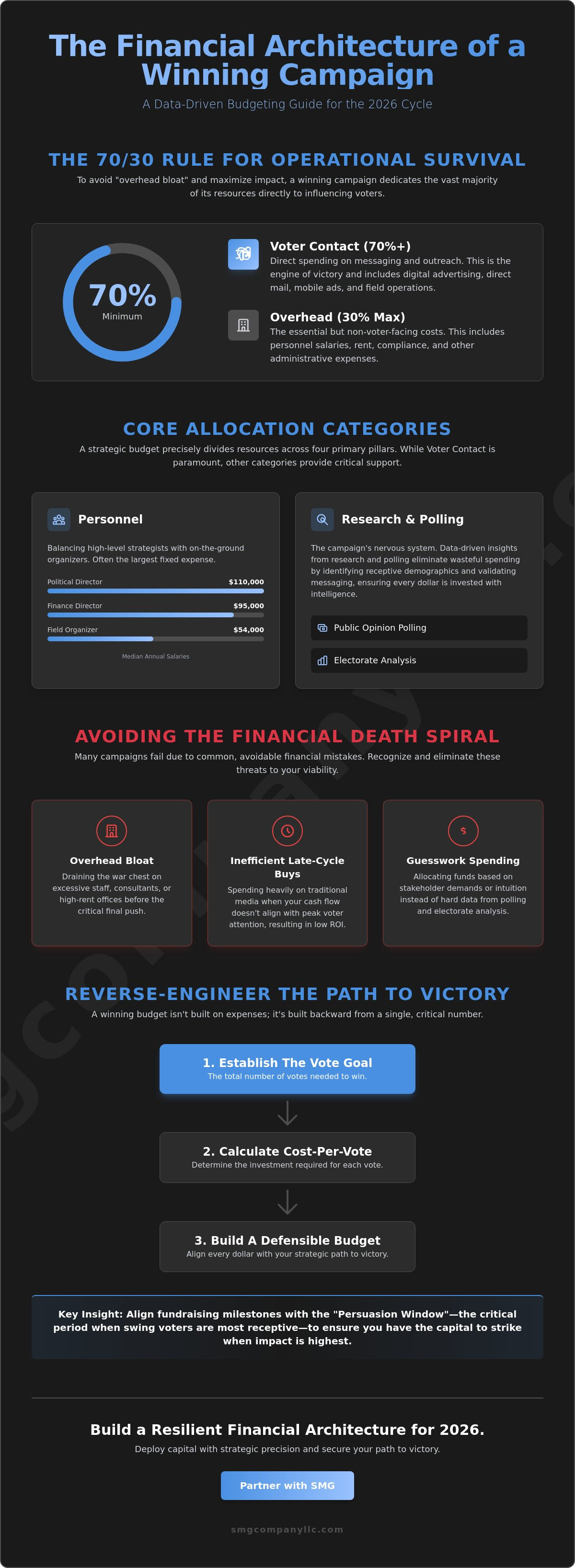
Effective political campaign budgeting is not a passive accounting exercise; it is the tactical deployment of capital designed to shift public sentiment and secure institutional influence. Every dollar spent must be an intentional move toward a specific outcome. This process begins with a rigorous understanding of campaign finance principles, which dictate how resources are raised and legally allocated. To build a truly resilient operation, you must first understand how to write a campaign plan that treats the budget as a living extension of your strategic blueprint. Distinguishing between fixed "hard costs" like office space and "strategic investments" like targeted digital ads allows a campaign to remain agile as the race evolves.
To better understand the foundational elements of campaign finance and fundraising, watch this helpful video:
Reverse-Engineering the Path to Victory
Winning starts with a single number: the vote goal. We reverse-engineer the budget by looking at the total votes needed to win and calculating the cost-per-vote. In high-stakes environments like New Jersey, historical electorate data suggests that cost-per-vote varies significantly by district density and media market. You must identify your "Persuasion Window," which is the critical period when swing voters are most receptive to messaging. Aligning your fundraising milestones with these specific phases ensures you have the liquidity to strike when the impact is highest. If your cash flow doesn't peak when voter attention does, your path to victory narrows rapidly.
The 70/30 Rule for Voter Contact
Adopting a strict 70/30 rule is essential for operational survival. At least 70% of your total spend should go directly toward voter contact. Many campaigns succumb to "overhead bloat," where excessive personnel or unnecessary office amenities drain the war chest before the final push. To avoid this, prioritize high-level public opinion polling services early on. This intelligence validates your spending, ensuring you're investing in the right messages and the right voters rather than guessing with stakeholder funds. A lean, data-driven operation is always more formidable than a large, inefficient one.
Core Allocation Categories: Where the Money Goes
Strategic political campaign budgeting requires a precise division of resources across four primary pillars:
Personnel: Balancing high-level strategists with local organizers.
Research: Using data to eliminate wasteful spending.
Voter Contact: Deploying messaging through digital, mobile, and physical channels.
Operations: Managing the administrative and compliance infrastructure.
While a foundational campaign budget template provides a useful starting point, winners in 2026 will weight these categories based on their unique path to victory. Personnel costs often represent the largest fixed expense. Median salaries for key roles, such as political directors at $110,000 and finance directors at $95,000, must be balanced against the need for local field organizers who maintain a presence in the community. These organizers, with a median salary of $54,000, are essential for ground-level engagement.
Research and polling serve as the campaign's nervous system. By investing in sophisticated electorate analysis, a campaign avoids the trap of blind spending. This data identifies which demographics are most receptive and which require a heavier financial lift. Operations, though less visible, cover the essential governance and compliance costs that keep the campaign legally viable and operationally stable.
Digital and Mobile-First Outreach
In high-density environments like Newark, traditional media often fails to reach mobile-centric voters. Effective budgeting now prioritizes digital advertising for campaigns, specifically allocating funds for geofenced mobile ads and text-based broadcasting. Disruptive assets like the SMG Video Truck provide a physical presence in urban centers that digital-only efforts cannot replicate. These mobile billboards offer a high-impact, high-visibility return on investment that bypasses the noise of traditional broadcast channels. This multi-channel approach ensures your message reaches voters where they live and work.
Research as a Risk Mitigation Tool
Precision polling is a financial safeguard. It allows you to narrow your target audience, ensuring that voter contact funds aren't wasted on citizens who are either unreachable or already committed. Campaigns should allocate specific funds for focus groups to refine their political messaging services before a full-scale media rollout. This iterative testing ensures that the final messaging resonates with the intended demographic. Strategic leaders don't guess; they use data to determine where every dollar will have the greatest impact. If you're ready to build a defensible financial plan, our experts in campaign management can help align your resources with your goals.
Scenario Planning: Realistic, Ideal, and Lean Models
Strategic political campaign budgeting requires more than a single spreadsheet; it demands a series of financial contingencies that account for the volatility of the 2026 cycle. You must prepare for three distinct operational realities to ensure your path to victory remains viable. These models aren't mere suggestions. They're defensive and offensive frameworks that allow for rapid pivots as fundraising totals and internal polling data shift. In complex environments like New Jersey, where media markets are expensive and voter segments are highly fragmented, this level of scenario planning is a non-negotiable requirement for leadership.
The Lean Model: Tactical Precision
The lean model is built for survival and precision. It focuses exclusively on the "Win Number" by stripping away all non-essential expenditures. In this scenario, you eliminate physical headquarters and reduce the consultant roster to only the most critical strategic partners. Every available dollar is funneled into high-yield digital outreach and targeted field work. You rely heavily on earned media to supplement a restricted paid-media budget. This approach ensures that even on a shoestring, the core mission of direct voter contact is never compromised. It's about doing more with less by refusing to spend on anything that doesn't directly move the needle.
The realistic model serves as the operational baseline. It utilizes data-driven allocation based on conservative fundraising projections. This model ensures that essential infrastructure is maintained while allowing for steady voter persuasion throughout the critical "Persuasion Window." It's a balanced approach that avoids the common pitfall of the last-minute panic spend by pacing resources across the entire cycle. It prioritizes stability and consistent engagement over high-risk, high-reward gambles.
The Ideal Model: Strategic Saturation
When fundraising exceeds benchmarks, the ideal model allows for strategic saturation and electorate expansion. This is the path to dominance. You invest in multi-channel saturation across television, digital, and mobile advertising. This model also funds deep-dive research and public opinion polling to anticipate and neutralize opponent attacks before they resonate with voters. With this level of capital, you can deploy disruptive assets like mobile video trucks to high-density areas, ensuring your message is unavoidable and authoritative.
Pivoting between these models is a hallmark of seasoned campaign management. As internal polling shifts, you must be prepared to reallocate capital instantly. If a demographic you previously considered safe becomes competitive, you might shift from an "Ideal" offensive posture to a "Realistic" defensive strategy to protect your base. This level of financial agility is the ultimate safeguard for your campaign capital, ensuring that you're always playing the most effective hand available.
Avoiding the Financial Death Spiral: Common Pitfalls
The psychological pressure of a high-stakes race often triggers reactive decision-making. This is where the financial death spiral begins. One of the most damaging errors in political campaign budgeting is the "last-minute panic spend." As the election nears, campaigns often dump remaining reserves into late-cycle television buys. These are frequently inefficient. Rates are at their highest, and most voters have already formed their opinions. While federal candidates are legally entitled to the lowest unit rate for broadcast advertising in the 60 days before a general election, even a 30% savings won't fix a message that's delivered too late to matter. A strategic architect avoids this by front-loading persuasion efforts when they have the most impact.
Consultant bloat is another silent killer. You must guard against unnecessary retainers that don't directly drive votes. Every individual on your payroll must serve a functional purpose that contributes to your vote goal. Similarly, ignoring your "burn rate" can lead to disaster. Tracking weekly expenditures against actual fundraising reality is the only way to maintain liquidity. If your weekly spend consistently outpaces your intake, you're effectively bankrupting your final two weeks of voter contact. This lack of discipline is what leads to the fear of running out of cash when it's needed most.
The Trap of Unmeasured Media
"Spraying and praying" in large media markets wastes precious capital. You can't afford to guess where your message is landing. Tracking conversion rates on digital voter outreach allows you to see which segments are engaging with your content. If a specific tactic is underperforming mid-cycle, cut it immediately. This level of agility allows you to reallocate funds to channels that show a higher return on investment. With digital platforms expected to account for 50% of all political ad spending in 2026, the ability to analyze and pivot is a core competitive advantage.
Managing Stakeholder Expectations
Maintaining your persona as a strategic architect means having the confidence to say "no." High-cost, low-impact events like expensive galas often drain more resources than they generate in net value. You must educate your donors and stakeholders on why research-backed messaging and public opinion polling are superior investments compared to vanity projects like static billboards. Transparency in fund management isn't just about ethics; it's about instilling confidence that every dollar is being used to build a path to victory. If you need a partner to oversee these complex financial decisions, our campaign management experts provide the seasoned authority your operation requires.
Executing the 2026 Budget with Strategic Precision
Winning in the 2026 cycle requires more than a sound theory; it requires the ruthless execution of your financial plan. A budget only succeeds when it's treated as a blueprint for victory rather than a static document. By integrating public opinion polling, high-impact digital assets, and a disciplined field strategy, you transform your war chest into a precision instrument of influence. This is where SMG’s seasoned authority becomes the ultimate safeguard for your campaign capital. We don't just manage funds; we architect the path to victory by ensuring every dollar is deployed with maximum strategic confidence.
Our deep roots in the New Jersey political landscape provide a distinct advantage in navigating local market costs. We understand the hidden mechanics of influence in this region and how to bypass the inflated rates often found in major media markets. This local intelligence, combined with our history of high-stakes success across more than 40 states, allows us to benchmark your spend against the most effective campaigns in the country. We ensure your political campaign budgeting isn't just defensible, but optimized for the specific challenges of your district.
The SMG Advantage: Data-Driven Stewardship
We utilize disruptive data analysis to optimize your spend at every stage of the cycle. This isn't about following the status quo; it's about challenging it through a lens of deep-rooted expertise. When you partner with us, you gain direct access to specialized assets like the SMG Video Truck. Because we own and operate these tools, you avoid the third-party markups that often drain the budgets of less efficient operations. This vertical integration ensures your capital stays focused on voter contact rather than administrative overhead. Our approach to stewardship involves a constant evaluation of public sentiment, ensuring your message remains resonant as the environment shifts.
Securing Your Financial Foundation
Preparing for 2026 starts with a comprehensive audit of your current management structure and financial outlook. We help you establish a mission-driven plan that prioritizes institutional influence and community leadership. Our team conducts deep-dive reviews to identify potential "overhead bloat" and reallocate those resources toward high-impact voter persuasion. This methodical rhythm ensures you maintain the calm, ongoing momentum necessary to withstand the frantic energy of a competitive race. Success is built on stability and a continuous presence in the lives of the voters you seek to lead.
Don't leave your financial architecture to chance. It's time to align your fundraising goals with your strategic needs through professional oversight. Schedule a strategic consultation with SMG to master the financial requirements of a winning 2026 campaign and secure your path to victory.
Securing Your Strategic Advantage for 2026
Successful 2026 operations will depend on the ability to reverse-engineer costs from a specific vote goal and maintain liquidity through rigorous scenario planning. By prioritizing direct voter contact and utilizing disruptive assets, you ensure your capital serves as a strategic weapon rather than an administrative burden. Effective political campaign budgeting is the difference between a campaign that survives the final push and one that falters when voter attention is highest.
Our team of NJ-rooted strategic operatives brings experience from over 40 states to your operation. We provide exclusive access to proprietary tools like the SMG Video Truck, ensuring your message dominates the local landscape without unnecessary markups. It's time to move beyond guesswork and establish a defensible financial plan that aligns with your path to victory.
Partner with SMG to build your strategic 2026 budget blueprint. Your leadership deserves a financial foundation as formidable as your vision for the community.
Frequently Asked Questions
How much should a local campaign spend on digital vs. traditional media?
Digital platforms are expected to account for 50% of all political ad spending in 2026. For a local campaign, this allocation should prioritize high-density mobile outreach and Connected TV (CTV) over stagnant broadcast formats. Traditional media still provides broad reach in certain markets, but the precision of digital targeting ensures your capital influences the specific swing voters required for victory.
What is the "burn rate" in a political campaign budget?
The "burn rate" is the weekly pace at which your campaign consumes its cash reserves relative to its fundraising intake. Monitoring this metric is vital to prevent running out of capital during the critical final weeks of the race. A disciplined political campaign budgeting process uses the burn rate to adjust tactical spending in real time, ensuring liquidity remains high when voter attention peaks.
When is the best time to start fundraising for a 2026 election?
Fundraising for the 2026 cycle should begin as early as possible to establish a dominant financial position. By the end of 2025, major party committees had already raised a combined $650 million. Early capital allows for significant "off-cycle" investments in research and infrastructure, which provide a measurable advantage over opponents who wait until the election year to build their war chests.
How much of my budget should be reserved for the final "Get Out The Vote" (GOTV) push?
Campaigns should typically reserve 15% to 20% of their total budget for the final Get Out The Vote (GOTV) push. This phase focuses exclusively on mobilizing identified supporters through high-intensity contact methods like text broadcasting and mobile video assets. Protecting these funds ensures that your persuasion efforts actually translate into ballots cast on election day rather than being lost to late-cycle inefficiency.
Is it better to hire a full-time campaign manager or a consulting firm like SMG?
Hiring a consulting firm like SMG offers institutional depth and access to specialized assets that a single manager cannot provide. While a manager handles daily operations, a firm brings seasoned authority and proprietary tools like the SMG Video Truck to the table. This partnership provides a scalable architecture for victory, leveraging a history of success in over 40 states to benchmark your campaign's performance.
How do I account for unexpected crisis communications in my budget?
Accounting for unexpected crisis communications requires a dedicated contingency fund, usually 5% to 10% of your variable spend. This reserve allows you to deploy rapid-response messaging or conduct flash polling without draining resources from your primary voter contact phases. Maintaining this financial flexibility is a hallmark of strategic leadership and ensures you aren't forced into a defensive posture by unforeseen events.
What are the FEC or state-level compliance costs I need to include?
Compliance costs include the administrative overhead required to meet FEC or state-level reporting requirements. You must account for staff time or specialized consultants dedicated to financial transparency and regulatory adherence. In some jurisdictions, such as California, new 2026 regulations also permit the use of campaign funds for security purposes, which should be factored into your operational overhead if applicable to your race.
Can polling actually save my campaign money in the long run?
Public opinion polling saves money by identifying exactly which voters are persuadable and which messages resonate most effectively. It eliminates the waste associated with broad messaging in expensive media markets. By narrowing your target audience through data-driven political campaign budgeting, you ensure that every dollar spent on advertising is working toward your specific path to victory rather than being wasted on non-voters.
Comments