
Lobbyist Retainer Fees in New Jersey: A 2026 Strategic Pricing Guide

The era of paying for mere access is over. In 2026, a strategic partnership in Trenton requires a sophisticated blend of data analysis and institutional influence. Most organizations feel a justified frustration with the historical lack of transparency surrounding lobbyist retainer fees in New Jersey. It's difficult to justify a high-stakes investment when you're unsure if you're paying for actual results or simply a seat at the table.
We'll provide the clarity you need by breaking down standard market rates and the latest 2026 regulatory requirements. You'll learn how the $2,500 ELEC reporting threshold impacts your compliance strategy and why the 5% increase in statewide lobbying spending reflects a shift toward data-driven advocacy. This guide offers a framework to evaluate performance and ensure your government affairs budget drives a measurable return on investment.
Table of Contents
The Landscape of Lobbyist Retainer Fees in New Jersey (2026)
A lobbyist retainer represents a predictable, monthly investment for organizations requiring consistent legislative monitoring and advocacy. The Landscape of Lobbying has evolved from simple introductions to a complex system of strategic intelligence. This ongoing commitment ensures that a professional firm is always active, identifying threats and opportunities before they reach the floor of the State House. In New Jersey, this fee secures the attention of seasoned insiders who navigate the intersection of public policy, community impact, and institutional power.
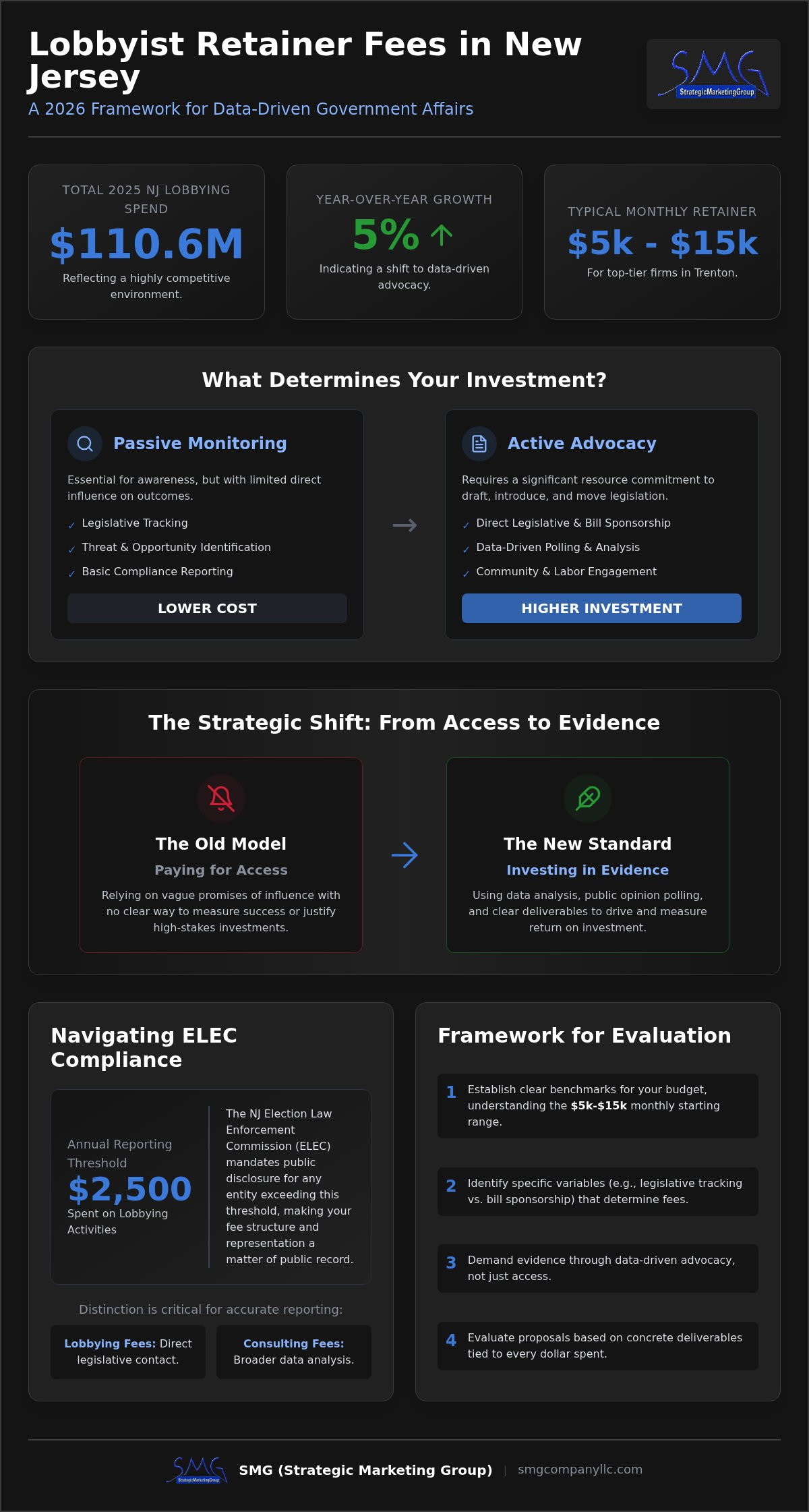
Understanding lobbyist retainer fees new jersey requires looking at the current 2026 political climate. Total lobbying spending in the state reached $110.6 million in 2025, which was a 5% increase over the previous year. This growth highlights a competitive environment where top-tier firms in Trenton and Newark typically command retainers starting at $5,000 to $15,000 per month. These figures reflect the high stakes of New Jersey's legislative cycle and the necessity for specialized counsel that can deliver measurable results.
To gain a perspective on the historical complexity of this field in the Garden State, watch this video:
New Jersey vs. National Average: Why Trenton is Unique
New Jersey is not a typical market. The "Trenton Factor" refers to the state's dense regulatory environment and the rapid pace of its legislative sessions, which often creates a higher cost of entry than in neighboring states. The density of the Garden State's political landscape directly influences lobbyist retainer fees new jersey, as firms must commit significant resources to track the volume of bills moving through the legislature. While national conglomerates offer broad reach, boutique firms rooted in Newark provide deeper connections to local leadership. For 2026, market trends suggest the average NJ retainer floor for professional advocacy now sits at approximately $5,000 per month.
ELEC Reporting: What Your Retainer Discloses
Transparency is strictly enforced by the New Jersey Election Law Enforcement Commission (ELEC). Organizations must navigate L-1-L and L-1-A filing requirements to maintain compliance and public trust. Any entity spending more than $2,500 on lobbying activities in a calendar year must file an annual report. These disclosures are public; your fee structure and choice of representation are visible to competitors and the public alike. Professional firms often distinguish between "lobbying" fees, which involve direct legislative contact, and "strategic consulting" fees, which cover broader organizational management and data analysis. This distinction is critical for accurate reporting and strategic positioning.
Factors That Determine Your Monthly Public Affairs Investment
Determining the appropriate budget for legislative advocacy requires an understanding of the mission's complexity. Fees are not arbitrary figures; they reflect the level of risk, the technicality of the subject matter, and the intensity of the legislative calendar. When evaluating lobbyist retainer fees new jersey, organizations must distinguish between passive monitoring and active bill sponsorship. A firm that simply tracks legislation provides value, but a firm that drafts, introduces, and moves a bill through committee requires a significantly higher resource commitment. This distinction is the primary driver of pricing variance in Trenton.
Reviewing the official NJ lobbying expenditure reports reveals that firms handling complex, multi-layered portfolios often sit at the top of the spending rankings. This is particularly true during high-intensity periods like the state budget season or the "lame duck" session, where the workload can triple overnight. Developing a robust government relations strategy helps define these variables before the first invoice arrives.
The Scope of Service: Beyond the State House
Modern advocacy extends far beyond the hallways of the State House. A comprehensive retainer often includes monitoring Newark City Hall or municipal council meetings where local ordinances can impact statewide operations. Strategic counsel acts as a "war room" partner, providing crisis management when a negative headline or a sudden regulatory shift threatens your objectives. Direct lobbying involves face-to-face meetings with lawmakers, while indirect lobbying might include grassroots mobilization or digital advocacy. Each layer added to the scope increases the monthly investment but also strengthens the overall defensive perimeter of your organization.
Sector-Specific Pricing Nuances
Industry complexity dictates the depth of research and the frequency of engagement required. Highly regulated sectors like healthcare, cannabis, and energy face constant legislative scrutiny, necessitating a more aggressive and permanent presence. Labor and union advocacy require navigating the specific political landscape of New Jersey workforce policy, which involves deep ties to both the community and institutional leadership. Conversely, corporate and tech firms often pay a premium for "education" campaigns, where the lobbyist must translate disruptive business models into language that skeptical lawmakers can understand. Non-profit organizations may find more flexibility, but the requirement for high-level reporting remains just as stringent.
Seniority remains the ultimate pricing variable. Veteran strategists like Lionel Leach bring decades of institutional memory and labor leadership to the table. You aren't just paying for hours; you're paying for the ability to anticipate obstacles that a less experienced agent wouldn't see until it's too late. This level of seasoned authority ensures that your organization doesn't just react to the news, it helps shape the environment in which that news is made.
The ROI of Data-Driven Advocacy: Why Polling Matters
Relationships are the baseline, but they're no longer the finish line. In 2026, influence is measured by the ability to provide political cover to lawmakers through undeniable public sentiment. This shift from "access" to "evidence" is why lobbyist retainer fees new jersey often include a significant investment in strategic intelligence. When a firm can prove that a client's position is the popular one, the dynamic of the conversation in Trenton changes from a request for a favor to a presentation of a mandate.
The legalities of these interactions are clearly defined, and staying within the New Jersey lobbying guidelines is non-negotiable for any reputable firm. However, compliance is merely the floor. The ceiling is reached when data is used to drive the narrative. By testing messages before they reach a committee room, organizations avoid the costly mistake of lead-testing an argument that falls flat with key stakeholders.
Polling as a Legislative Tool
SMG differentiates its approach by integrating public opinion polling services directly into the advocacy process. Benchmark polls are utilized to establish a baseline, revealing how your issue is perceived by the public before the legislative session begins. From there, persuasion polling identifies the specific language and themes that shift voter sentiment. This methodical process reduces the "time to victory" for complex bills. It ensures that the advocacy team isn't guessing which arguments will work but is instead deploying a proven narrative that has already been vetted by the electorate.
Electorate Analysis and Targeted Pressure
Precision is the hallmark of a modern government relations strategy. Through electorate analysis, we identify the specific legislative districts where advocacy will have the greatest impact. If a specific committee chair or a swing-district senator is undecided, we look at the data to understand the pressures they face from their own constituents. We then use digital and mobile advertising to amplify your message within those specific geographies. This ensures that when a lawmaker hears from your team, they've already heard the same message from the people who vote for them. Data-driven insights prevent the waste of retainer dollars on broad campaigns that fail to move the needle where it actually counts.
Avoiding the "Trenton Trap": How to Evaluate Fee Proposals
Selecting a firm based on reputation alone is a strategic risk. The "Trenton Trap" occurs when an organization pays premium rates for perceived prestige while receiving minimal actual advocacy. Evaluating lobbyist retainer fees new jersey requires a granular approach to the engagement letter. You must demand a clear distinction between "access" and "deliverables." Access provides the meeting; deliverables provide the legislative language, the committee testimony, and the strategic path to a governor's signature. Without this clarity, your retainer becomes a sunk cost rather than a strategic asset.
Verification is the second pillar of a sound investment. Utilize the NJ ELEC database to scrutinize a firm's recent track record and active client list. A firm's history of success in specific committee rooms is more valuable than a general list of contacts. You should also assess their modern toolkit. A firm that lacks a digital advertising for campaigns arm is fighting a 21st-century battle with 20th-century tools. Influence in 2026 requires the ability to apply pressure through digital channels and traditional shoe-leather lobbying simultaneously.
The Danger of "Ghost" Retainers
Some firms collect monthly fees while providing only sporadic updates. These "ghost" retainers offer no transparency and little value. To avoid this, establish Key Performance Indicators (KPIs) at the start of the engagement. Your public affairs partner should provide monthly reporting and participate in "all-hands" strategy calls to align their activities with your corporate goals. If a firm cannot provide a detailed report of their meetings, bill tracking, and intelligence gathering, they aren't managing your interests; they're simply managing your budget.
Negotiating Your Agreement
The structure of your agreement should reflect your specific needs. While a monthly retainer is standard for ongoing monitoring and relationship building, project-based fees may be more appropriate for a single legislative push. You must also understand the legal standing of "Success Fees" in New Jersey; the state generally prohibits contingency-based lobbying fees to maintain ethical standards. Finally, ensure your budget accounts for expenses like travel, meals, and event costs. A transparent proposal will outline these costs upfront to prevent surprises on your monthly invoice.
Before signing your next engagement letter, ensure your partner has a physical and influential presence in both Newark and Trenton. If you are ready to move beyond traditional access and toward data-backed victory, contact our team to discuss a more precise approach to your government relations strategy.
SMG: Strategic Government Relations for the Modern Era
SMG operates at the high-stakes intersection of institutional power and ground-level community organizing. Our approach to government relations strategy development is recognized as the gold standard in New Jersey. We don't simply monitor the legislative calendar; we actively shape the environment that dictates it. Led by veteran strategist and prominent labor leader Lionel Leach, our firm brings a history of success across 40 states to every local challenge in the Garden State. We understand the hidden mechanics of influence and how to build a path to victory where others see only obstacles.
We provide a comprehensive strategic intelligence package that justifies every dollar of your investment. When evaluating lobbyist retainer fees new jersey, the true metric of value is the integration of multifaceted tools into a single, cohesive movement. From sophisticated political messaging services to the tactical deployment of the SMG Video Truck, we ensure your position is visible, audible, and undeniable. We turn complex polling data into winning legislative strategies that provide the political cover necessary for lawmakers to take bold action.
A Disruptive Force in NJ Public Affairs
We challenge the status quo by moving beyond traditional access models. Our firm utilizes innovative voter reengagement tools to build grassroots support that mirrors the data found in our polling. Transparency is the cornerstone of our client relationships. We provide measurable success through monthly reporting and clear KPIs that ensure your objectives remain the priority. You're invited to contact SMG to discuss a tailored retainer that fits your 2026 objectives and provides the strategic confidence your organization requires.
From Newark to the National Stage
Our Newark roots provide a profound respect for local engagement, while our experience in over 40 states provides a high-level strategic outlook. Having a full-service partner means polling, strategy, and execution happen under one roof. This efficiency eliminates the friction often found when coordinating multiple consultants. It's time to move toward a more precise approach to your government affairs. We invite you to schedule a strategic consultation to evaluate your public affairs needs and establish a framework for continuous legislative presence.
Building a Path to Legislative Victory in 2026
The landscape of public affairs in the Garden State has shifted toward a model where data and strategic intelligence are the primary drivers of success. Organizations can no longer afford to view lobbyist retainer fees new jersey as a cost for passive representation. Instead, these investments must secure a partner who integrates public opinion polling and targeted electorate analysis to move the needle in Trenton. By demanding transparency in deliverables and avoiding firms that rely on outdated "access-only" models, your organization establishes a foundation for measurable impact and long-term stability.
SMG represents this new standard of advocacy. Led by recognized political leader Lionel Leach, our firm brings a history of success in over 40 states to your most complex local challenges. We integrate data-driven polling into every strategy, ensuring that your legislative goals are backed by the undeniable voice of the community. Don't leave your institutional influence to chance. Secure Strategic Counsel for Your 2026 Legislative Goals and transform your government relations into a powerful engine for progress. Your path to victory begins with a strategy rooted in precision and seasoned authority.
Frequently Asked Questions
What is the average monthly retainer for a lobbyist in New Jersey?
Market rates for professional advocacy in Trenton typically fall between $5,000 and $15,000 per month. This range depends on the complexity of your legislative goals and the firm's seniority. Boutique firms with specialized expertise often sit at the midpoint, while high-volume firms with extensive administrative overhead may command the upper end of the spectrum for comprehensive representation.
Are lobbyist fees in NJ tax-deductible for businesses?
Under federal tax law, expenses incurred for lobbying and influencing legislation are generally not tax-deductible for businesses. This restriction applies to the portion of your dues or retainer fees used for direct legislative advocacy at the state and federal levels. You should consult with a tax professional to determine how these rules apply to specific strategic consulting services that fall outside the legal definition of lobbying.
Does the NJ ELEC require the public disclosure of all retainer fees?
The New Jersey Election Law Enforcement Commission (ELEC) requires any organization spending more than $2,500 annually on lobbying to file public disclosure reports. These filings include a detailed breakdown of lobbyist retainer fees new jersey paid to external firms. This transparency ensures that the financial mechanics of influence are accessible to the public; however, specific strategic consulting work not involving direct advocacy may be categorized differently.
What is the difference between a lobbyist and a government relations consultant?
A lobbyist, officially termed a Governmental Affairs Agent in New Jersey, focuses on direct communication with lawmakers to influence specific bills or regulations. A government relations consultant often provides a broader strategic framework, including public opinion polling and long-term organizational positioning. While the roles overlap, the legal requirement to register with ELEC is triggered by the act of attempting to influence legislation or government processes.
How do I know if my NJ lobbyist is actually working on my bill?
Accountability is maintained through regular activity reports and legislative tracking logs. Your firm should provide a monthly summary of committee hearings attended, meetings held with legislators, and any shifts in bill status. If your partner isn't providing a clear record of their engagement with key power centers in Newark or Trenton, they aren't meeting the professional standard for high-stakes advocacy.
Can non-profits pay for lobbying retainers with grant money?
Federal grant funds are strictly prohibited from being used for lobbying activities under the Uniform Guidance. Some private foundations also include specific clauses that prevent their funds from being used to influence legislation. Non-profits typically use unrestricted funds or specific advocacy grants to cover their lobbyist retainer fees new jersey while ensuring strict accounting separation to maintain their tax-exempt status and grant compliance.
What happens if a lobbyist fails to register with the state of New Jersey?
Failure to register as a Governmental Affairs Agent can result in significant financial penalties and administrative sanctions from ELEC. Both the lobbyist and the represented entity can be held liable for non-compliance. Beyond the legal fines, a failure to register causes irreparable damage to an organization's reputation and can lead to the dismissal of the legislative goals they were attempting to advance.
Why do some NJ firms charge a higher retainer than others?
Pricing variance usually reflects the seniority of the firm’s leadership and the depth of their institutional ties. Firms led by veteran strategists with deep roots in labor or community organizing often charge a premium for their predictive insights. Additionally, highly regulated sectors like healthcare or cannabis require a more intensive workload, necessitating higher retainers to cover the research, monitoring, and constant engagement required for success.
Comments