
2026 Campaign Guide: Social Media & Voter Re-engagement

The digital town square has been replaced by a high-stakes laboratory of precision targeting. You've likely noticed that traditional outreach feels increasingly ineffective as platform algorithms shift and voter fatigue reaches a breaking point. It's a significant challenge to distinguish genuine voter sentiment from the background noise of a saturated digital environment. We understand the frustration of navigating a landscape where misinformation can compromise years of work in a single afternoon.
This guide provides the strategic architecture you need to master the hidden mechanics of digital influence. You'll learn how to transform social media for political campaigns into a surgical tool for electoral victory. By looking at data through a disruptive lens, we'll show you how to move beyond basic engagement and toward actual persuasion. We'll outline a multi-platform roadmap that integrates public opinion polling with sophisticated social targeting. You'll also discover a framework to insulate your campaign from digital crises and maintain steady momentum through the final vote.
Table of Contents
The Evolution of Social Media in Political Campaigns (2026)
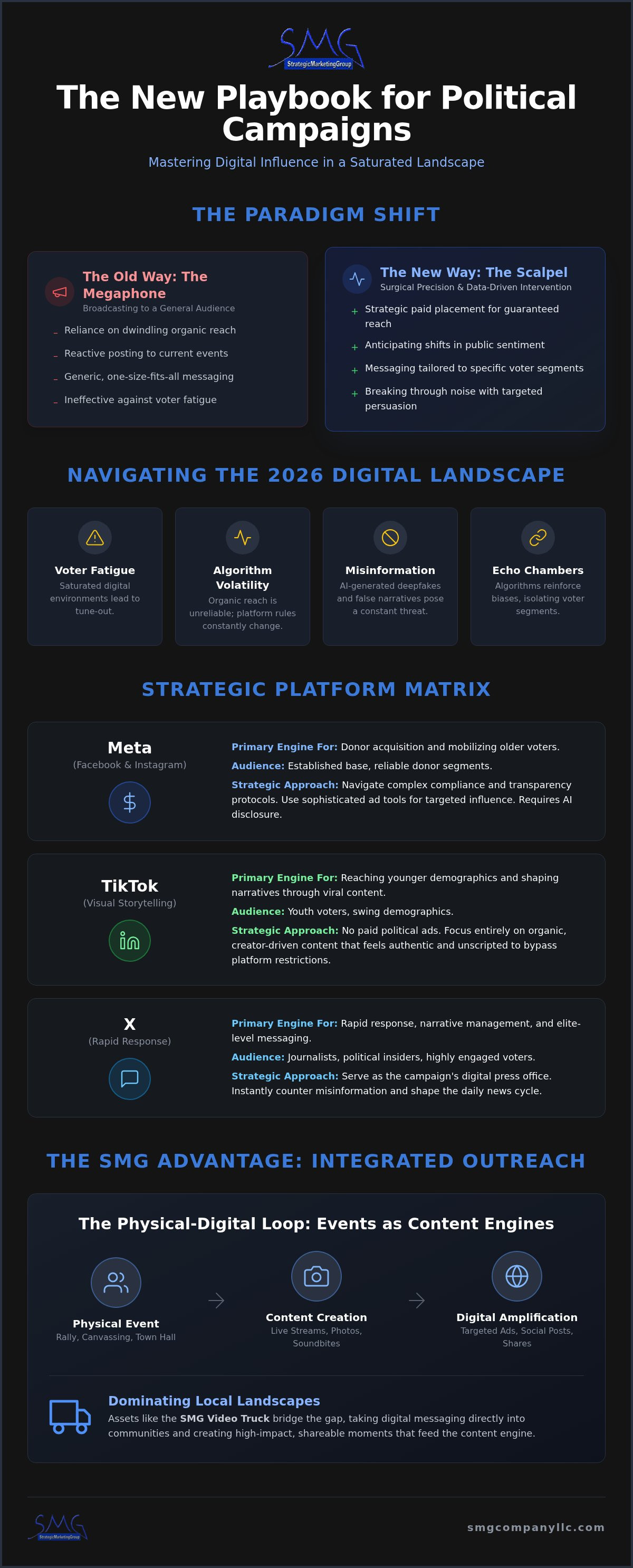
The paradigm of social media for political campaigns has shifted from the megaphone to the scalpel. In the 2026 cycle, campaigns can't rely on broad broadcasting to reach a general audience. Platforms have matured into sophisticated data environments where success is measured by the precision of voter re-engagement. This surgical shift requires a move away from reactive posting toward a disruptive strategy that anticipates shifts in public sentiment. You don't wait for the conversation to happen. You define the boundaries of the debate through data-driven intervention.
Successful social media for political campaigns now demands a deep understanding of the evolution of social media in politics. Organic reach has largely vanished. Strategic paid placement is now the only reliable way to break through the noise. Today, these platforms function as the primary engine for electorate analysis, providing a real-time feedback loop that informs every other aspect of the campaign management process. This analysis allows strategists to identify micro-trends before they surface in traditional polling.
To better understand this concept, watch this helpful video:
From Town Square to Targeted Echo Chambers
Algorithms have fundamentally fragmented the modern electorate, creating distinct digital silos that reinforce existing voter biases. While the town square model once allowed for cross-partisan dialogue, the 2026 reality is one of targeted echo chambers. This environment makes authenticity the most valuable currency in digital media. Voters can sense over-produced, corporate messaging instantly. They respond instead to raw, direct communication that feels personal and unscripted. Success now depends on challenging these echo chambers through strategic disruption rather than simply shouting into them. Our role is to bridge these gaps by delivering messages that resonate within these specific, isolated communities.
The Physical-Digital Loop
The distinction between offline activity and online presence has dissolved. In 2026, every canvassing effort or local rally must be engineered for digital virality. We don't just hold events; we create content engines that feed the digital beast. Real-time streaming has bypassed traditional news cycles, allowing campaigns to speak directly to the community without a media filter. This speed of communication forces a constant state of readiness. The candidate's digital footprint is the new permanent record, an immutable archive of every public statement and social interaction. It's a high-stakes environment where a single moment in a small town can become a national narrative within minutes, requiring a strategy that balances local engagement with global visibility.
Strategic Platform Selection: Navigating the 2026 Digital Landscape
Success in social media for political campaigns depends on a cold assessment of where voters actually reside. The 2026 Platform Matrix helps strategists distinguish between environments for base mobilization and those suited for swing voter persuasion. For example, Meta remains the primary engine for donor acquisition and older voter mobilization. Its sophisticated tools for identity verification and AI disclosure requirements, solidified by mid-2026, make it a necessary but highly regulated space for institutional influence. You can't simply post; you must navigate a complex web of compliance and transparency protocols.
While Facebook serves the established base, platforms like Instagram and TikTok are essential for shaping political campaigns through visual storytelling. However, your strategy must respect platform constraints. Since TikTok maintains a complete ban on paid political advertising as of August 2026, campaigns must rely on organic, creator-driven content to reach younger demographics. On X, the focus remains on rapid response and elite-level messaging, serving as a digital press room for journalists and political insiders. This platform is where the narrative is often set before it filters down to the broader electorate.
Multi-Platform Footprints: Why Ubiquity is a Risk
Attempting to maintain a high-intensity presence on every platform is a strategic error that dilutes resources and confuses the campaign's core message. Content must be tailored to the platform's specific culture. A message that goes viral on TikTok might fail to move the needle in a local municipal race in Newark because the audience and intent are mismatched. We advise allocating resources based on rigorous voter segmentation analysis rather than a desire for digital ubiquity. Efficiency in 2026 is found in depth, not breadth. Focus your budget where your data shows the highest concentration of persuadable voters.
Emerging Platforms and Decentralized Media
The 2026 cycle has seen a significant shift toward private messaging groups like WhatsApp and Signal for grassroots mobilization. These decentralized channels offer a level of trust that public platforms often lack. Leveraging micro-influencers within local community digital groups allows a campaign to maintain brand consistency while adapting to platform-specific vernacular. This approach requires a nuanced understanding of public sentiment and institutional influence. It's about building a path to victory through authentic, peer-to-peer engagement that bypasses traditional media gatekeepers.
Navigating these complex systems requires a partner who understands the hidden mechanics of digital influence. Our strategic campaign architects help you build a path to victory by selecting the right platforms for your specific electoral goals.
Data-Driven Voter Targeting and Electorate Analysis
The modern strategist views social media for political campaigns as a data-rich laboratory rather than a megaphone. We move beyond vanity metrics like likes or shares to focus on voter intent, a metric that tracks the likelihood of a digital interaction converting into a ballot cast. This requires a seamless integration of public opinion polling services with your digital ad spend. By syncing these systems, we ensure that your budget follows the data, not just the trend. It's about ensuring every dollar spent is backed by a verified shift in public sentiment.
Micro-targeting has evolved. In 2026, we utilize first-party voter files to construct custom social audiences with surgical precision. This isn't just about basic demographics; it's about behavioral history and verified residency. For campaigns in Newark and throughout New Jersey, geofencing provides a critical advantage. We can deploy hyper-local messaging that triggers when a voter enters a specific community hub or transit center. This localized approach ensures that your message is relevant to the immediate concerns of the neighborhood, bridging the gap between digital noise and physical reality.
The Marriage of Polling and Digital Media
Social media now serves as a real-time focus group for message testing. We can deploy multiple creative variations and see which resonates with specific segments before scaling the spend. This allows us to adjust digital advertising for campaigns based on daily polling shifts. SMG utilizes multi-layered data sets to identify specific re-engagement opportunities where voter sentiment has softened or shifted. This agility prevents the campaign from wasting resources on static messages that no longer reflect the electorate's mood. We don't guess; we respond to what the data dictates.
Predictive Analytics in Social Outreach
Predictive analytics allow us to identify persuadable voters by analyzing behavioral patterns across the digital landscape. This isn't just about following the loudest voices. According to recent Pew Research on news influencers, a growing segment of the population relies on niche digital figures for political context. We use AI-driven voter modeling to navigate these complex networks ethically and efficiently. This data-driven approach ensures we aren't just preaching to the choir. Instead, we're identifying and engaging the quiet majority of swing voters who actually decide the outcome of the race. Electorate data keeps the campaign focused on the margins where victory is actually built.
Managing the Narrative: Crisis, Compliance, and Misinformation
Control over the campaign narrative is no longer a luxury; it's a requirement for survival. The volatility of social media for political campaigns means a single misinformation attack can derail months of progress in hours. We address this by establishing a Digital War Room. This isn't a passive monitoring station. It's a high-intensity hub designed for rapid-response crisis communications. Our team identifies threats as they emerge, allowing for immediate neutralization before they reach the broader electorate. This proactive stance is the only way to maintain strategic momentum during high-stakes volatility.
Combatting deepfakes and AI-generated attacks is a 2026 necessity. As of June 2026, thirty-one states have enacted laws specifically regulating the use of deepfakes in political messaging. California, for example, requires disclosure for materially deceptive media published within 120 days of an election. We integrate these legal realities into our political messaging services. By combining legal compliance with technical expertise, we ensure your campaign isn't just protected from attacks but is also fully compliant with evolving standards.
Narrative Control in an Unfiltered Environment
We utilize pre-bunking techniques to address common opposition talking points before they gain traction. This involves identifying potential vulnerabilities and framing the conversation on your terms. A Digital Rapid Response team that operates 24/7 is essential for modern narrative control. When hostility arises online, we maintain a steady, professional demeanor that projects leadership. We don't engage in frantic energy. Instead, we provide a sense of stability that reassures voters and keeps the focus on the candidate's core mission. This methodical approach turns potential obstacles into evidence of seasoned authority.
Compliance and Transparency Requirements
Navigating the complex web of FEC and state-level digital ad disclosures is critical. FEC rules (11 CFR 110.11) dictate that "Paid for by" disclaimers must be clear and conspicuous. For digital video, these disclaimers must be visible for at least four seconds. In Washington State, regulations now require commercial advertisers to maintain public records of ad content and targeting demographics. We audit-proof your social media expenditures to prevent regulatory scrutiny from becoming a distraction. Our management of donor data privacy also adheres to strict New Jersey regulations, ensuring the campaign's integrity remains beyond reproach.
Ensure your organization is prepared for the complexities of the 2026 cycle by partnering with a firm that understands the mechanics of institutional influence.
The SMG Advantage: Integrated Digital and Mobile Outreach
A sophisticated strategy for social media for political campaigns is incomplete if it exists only on a screen. True dominance in the 2026 cycle requires a seamless bridge between digital influence and physical presence. We provide the strategic architecture necessary to position your campaign as a disruptive force, moving beyond the limitations of standard agency models. By integrating high-visibility assets like the SMG Video Truck with surgical digital targeting, we ensure your message is inescapable, authoritative, and grounded in the communities you serve.
Mobile-based voter outreach represents the final frontier of modern political campaign management. While social platforms provide the data, direct mobile communication provides the access. We execute text-based communication platforms and voice broadcasting to achieve direct voter re-engagement that bypasses the noise of the public feed. This multi-layered approach ensures that the insights gained from your digital war room are translated into direct, personal interactions with the electorate, driving turnout where it matters most.
The SMG Video Truck: A Digital Asset in the Real World
Physical presence in Newark neighborhoods and high-traffic transit hubs triggers spontaneous social media sharing, turning a mobile billboard into a viral digital asset. The SMG Video Truck serves as a beacon for the campaign, using high-definition displays to drive voters toward digital town halls and real-time streaming events. There's a significant psychological impact when voters see a high-visibility, professional presence in their own community; it builds confidence and reinforces the candidate's commitment to local leadership. This isn't just advertising. It's a statement of institutional influence that command respect across both physical and digital landscapes.
Strategic Partnership for 2026 Victory
A full-service firm offers a level of coordination that siloed digital agencies simply cannot match. When your public opinion polling, digital advertising, and physical outreach are managed under one roof, the result is a cohesive narrative that adapts instantly to new data. Having a seasoned insider navigate your digital strategy means you're prepared for the hidden mechanics of influence that others might overlook. We don't just provide tools; we design a custom digital roadmap tailored to the specific challenges of your race. The next step toward victory is moving from a reactive posture to a strategy of total engagement. We invite you to partner with the architects of modern electoral success to secure your path forward.
Securing Your Path to Electoral Victory
The 2026 landscape requires more than a standard digital presence; it demands a total engagement strategy. We've explored how the shift toward precision targeting and the integration of real-time polling data have redefined the efficacy of social media for political campaigns. Success now rests on your ability to bridge the gap between digital sentiment and physical mobilization while navigating a complex regulatory environment. Static messaging is a liability in an era defined by rapid-response crisis management and AI-driven challenges.
With experience in over 40 states, SMG provides the seasoned strategic counsel necessary to manage high-stakes volatility. Our approach, led by prominent strategists like Lionel Leach, utilizes innovative assets like the SMG Video Truck technology to dominate the conversation across all fronts. We understand the hidden mechanics of influence and know how to build a path to victory where others see obstacles. Partner with SMG's strategic architects to build your path to victory. The road to success is built on data and driven by expertise. We're ready to help you lead the community forward.
Frequently Asked Questions
How do social media algorithms affect political campaigns in 2026?
Algorithms prioritize high-engagement, often divisive content, which fragments the electorate into isolated digital silos. In 2026, organic reach is virtually non-existent for political accounts; this makes strategic paid placement the only reliable method for message delivery. This environment forces campaigns to move away from broad broadcasting toward precision-targeted re-engagement. Success requires a disruptive approach that anticipates these algorithmic shifts rather than reacting to them after the narrative has already been set.
Is social media advertising effective for local Newark elections?
Digital outreach is highly effective for local Newark elections when combined with geofencing and micro-targeting. These tools allow a campaign to deploy hyper-local messaging that triggers when voters enter specific community hubs or transit centers. By focusing on neighborhood-specific concerns, social media for political campaigns can bridge the gap between digital noise and the physical reality of Newark's diverse wards. This localized approach ensures that resources are concentrated on persuadable voters within specific geographic boundaries.
How does SMG integrate polling data into social media strategies?
We treat social platforms as real-time focus groups, using daily polling shifts to adjust digital ad spend and creative direction. By integrating public opinion polling with digital outreach, we identify specific segments where voter sentiment is softening or shifting. This data-driven loop prevents the campaign from wasting budget on static messaging that no longer resonates. We utilize multi-layered data sets to ensure every digital interaction is backed by a verified movement in real-world sentiment.
What are the compliance rules for political ads on TikTok and Meta?
Compliance requirements vary significantly between platforms as of August 2026. TikTok maintains a complete ban on paid political advertising, requiring campaigns to rely on organic creator content. Meta requires a rigorous authorization process, AI-usage disclosures, and a one-week blackout period for new ads before the election. All digital video ads must include a "Paid for by" disclaimer that remains visible for at least four seconds to satisfy FEC rules and state-level transparency standards.
Can social media really help with voter re-engagement in 40+ states?
Digital tools allow for scalable voter re-engagement across diverse geographic landscapes by utilizing first-party voter files. By analyzing behavioral data, we can identify and target persuadable voters in any of the 40 states where we operate. This approach moves beyond broad demographics to focus on specific individuals who've shown a high probability of conversion. It's a methodical system designed to maintain constant momentum and a stable presence throughout the entire campaign lifecycle.
What is the SMG Video Truck and how does it help a digital campaign?
The SMG Video Truck is a high-visibility mobile asset that bridges the gap between physical neighborhoods and the digital landscape. It functions as a mobile billboard that triggers spontaneous social sharing; this effectively turns a physical presence into a viral digital asset. In high-traffic areas, it drives voters toward digital town halls and streaming events while reinforcing the candidate's commitment to local engagement. This technology provides a sense of stability and institutional influence that traditional digital ads cannot replicate.
How do you handle a digital misinformation attack on a candidate?
Misinformation attacks are neutralized through a 24/7 Digital War Room that utilizes pre-bunking techniques to address opposition talking points before they gain traction. We identify emerging threats immediately and deploy rapid-response communications to stabilize the narrative. This proactive stance is essential in 2026, especially given the rise of AI-generated deepfakes. By maintaining a professional, authoritative demeanor, we ensure the campaign remains focused on its core mission rather than being derailed by digital noise.
What is the ideal social media budget for a Congressional campaign?
Budget allocation should reflect the modern voter's media consumption, where digital and social platforms often account for the majority of ad spend. While specific figures vary based on the district's competitiveness, social media for political campaigns typically requires a significant percentage of the overall media budget to remain competitive. We recommend focusing on depth and precision rather than digital ubiquity. Resources should be allocated based on rigorous electorate analysis to ensure the highest possible return on every dollar invested.
Comments