
Running for School Board in New Jersey: 2026 Guide

A credible school-board campaign starts with understanding the district, not drafting a slogan. If you’re considering running for school board in New Jersey, you’ll want clear answers about eligibility, filing steps, election timing, and campaign finance before you commit.
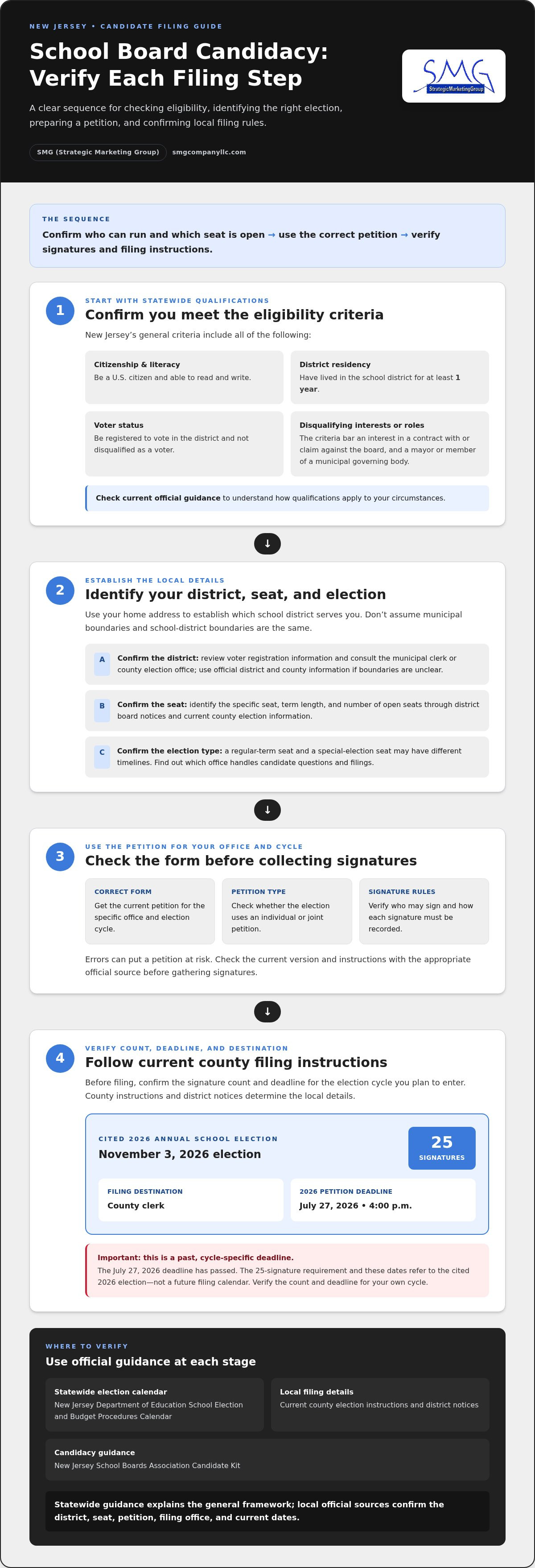
This guide covers statewide requirements and the details that can vary by district, including open seats and local election information. For the November 3, 2026 annual school election, nominating petitions were due to the county clerk by 4:00 p.m. on July 27, 2026, and candidates needed 25 signatures. If you’re planning for a future election, use current official sources to confirm its deadlines and forms rather than relying on an earlier calendar.
You’ll learn what candidates must do to qualify, where to find New Jersey’s official election guidance, and how campaign finance reporting fits into the process. You’ll also find practical ways to build a student-centered campaign around district priorities, informed listening, and constructive community engagement. The goal is a useful starting point that distinguishes statewide rules from local details you’ll need to verify.
Table of Contents
Running for School Board in New Jersey: Start With Your District
A school board governs at the district level, making decisions about policy, budgets, and oversight that shape students’ daily experience. Before planning a campaign, learn how your district is organized and what the board is responsible for. That groundwork helps you focus on issues the board can address instead of promising action outside its authority.
Start by establishing four things: which district serves your residence, which seat may be open, what type of election is involved, and which officials handle election information. School-election arrangements and candidate details can differ by district and cycle. Confirm them locally before setting your campaign timetable.
What does a New Jersey school board do?
The board provides governance, while the superintendent leads day-to-day administration. Board-level work generally includes setting district policy, reviewing and approving the budget, and overseeing the superintendent’s leadership. The superintendent and district staff handle operational decisions, such as implementing policy and coordinating daily services. The board sets direction and provides oversight; it does not manage each school’s routine activity.
For example, if families raise concerns about bus routes, first learn how the district evaluates transportation and how residents can provide feedback. Residents may bring the concern to the board through public comment or another process established by board policy. Board members can ask questions and consider whether policy or budget discussions are warranted, while operational analysis belongs with district administration.
Identify the district, seat, and election cycle
Begin with your home address. Review your voter registration information and consult your municipal clerk or county election office to establish which school district serves that address. If district boundaries or arrangements are unclear, use official district and county information. Don’t assume that a municipality and a school district cover the same area.
Next, identify the specific seat, term length, and election type. A regular-term seat and a seat filled through a special election may follow different timelines. The number of open seats can also change from one district or cycle to another. Check the district’s board notices and current county election information, then confirm which office handles candidate questions and filings.
Election dates are cycle-specific. New Jersey’s 2026 annual school election was scheduled for November 3, with nominating petitions due July 27. Those dates are not a template for a later election. Consult the current New Jersey Department of Education School Election and Budget Procedures Calendar, along with county and district notices, before planning petition collection or campaign activity.
Use statewide guidance to understand the general framework. Verify the district, seat, election type, contacts, and current dates with official local sources. This distinction matters when running for school board in new jersey: statewide rules set important parameters, while local election information determines the details of a candidacy.
Check New Jersey School Board Candidate Eligibility and Filing Rules
Filing is a sequence, not a single form. Before collecting signatures, confirm that you meet the statewide qualifications, identify the correct election and petition, and verify your county’s current filing instructions. Requirements and deadlines can change, so a petition or calendar from an earlier cycle may not apply.
Confirm eligibility and the correct election
New Jersey’s general eligibility criteria include being able to read and write, being a U.S. citizen, and having lived in the school district for at least one year. Candidates must be registered to vote in the district and not disqualified as voters. The criteria also bar candidates with an interest in a contract with or claim against the board, as well as a mayor or member of a municipal governing body. Review current official instructions to understand how these qualifications apply to your circumstances.
Then establish the election type and the seat you intend to seek. Election timing and ballot arrangements can vary by district and cycle, so don’t assume a date or filing method from another town applies to you. The New Jersey School Boards Association Candidate Kit provides candidacy guidance. For local procedures, follow current county election instructions and district notices.
Prepare and submit the nominating petition
Once you’ve confirmed eligibility and election details, locate the petition for the specific office and cycle. Check whether the election uses an individual or joint petition, and get the current version from the appropriate official source. Before gathering signatures, verify who may sign and how each signature must be recorded. Errors can put a petition at risk.
For the November 3, 2026 annual school election, candidates needed 25 signatures, and petitions were due to the county clerk by 4:00 p.m. on July 27, 2026. That deadline has passed, so it is not a future filing date. The 25-signature requirement applies to the cited 2026 election; verify the requirement for the cycle you plan to enter.
Confirm your eligibility using current official guidance.
Identify the election, seat, and correct petition form.
Verify signature qualifications, the required count, and how to collect signatures.
Confirm the filing office, accepted submission method, and deadline with the county election office.
Keep statewide guidance separate from local procedure. State rules establish the framework, while the county’s current instructions determine where and how to file. Once those steps are clear, you can focus campaign planning on informed listening and a message grounded in district priorities. Strategic campaign planning can connect research, outreach, and political messaging.
Build a New Jersey School Board Campaign Around Local Needs
A strong school-board platform reflects what residents are experiencing, not only what a candidate personally cares about. For anyone running for school board in new jersey, respectful listening can help distinguish an individual concern from a broader district priority. It also helps you avoid promising outcomes the board can’t deliver.
Listen before defining campaign priorities
Start with public information and direct conversations. Attend board meetings, review district plans and budget materials, and observe how trustees discuss community input. Then speak with families, educators, and other residents. Ask open questions, listen before offering solutions, and record recurring themes separately from concerns that may be specific to one person or school.
Keep observations distinct from assumptions. A few conversations can reveal important experiences, but they don’t necessarily represent the entire district. Seek perspectives across schools, neighborhoods, and different community groups. Public opinion research and electorate analysis for political campaigns can help identify patterns and sharpen questions. Use them to complement, not replace, conversations with residents.
Turn community concerns into a focused message
Translate what you hear into a small number of clear priorities tied to board responsibilities, such as policy, budget decisions, or oversight. For each priority, explain the issue, why it matters to students and families, and what role a board member could play. Avoid promising an operational fix that belongs to district administration or guaranteeing an outcome outside the board’s control.
Use plain, specific language. If residents raise concerns about student well-being, for example, describe the board-level questions you would examine, such as how district policies and available supports are reviewed. Don’t present one conversation as proof of districtwide consensus. A credible message explains how you arrived at a priority and what you still need to understand.
State the concern: Describe the issue in language residents recognize.
Connect it to the board: Identify the policy, budget, or oversight responsibility involved.
Explain your approach: Name the questions, evidence, or public input you would consider.
Set a realistic expectation: Clarify what a board member can influence without promising a guaranteed result.
Consistency matters across conversations, public remarks, and campaign materials. A concise platform gives voters a clear account of your priorities while leaving room to respond thoughtfully as new information emerges. For more on developing clear campaign language, see strategic political messaging services.
Plan School Board Campaign Communications and Compliance Carefully
Campaign communication works best when each channel has a clear purpose. In-person conversations can surface concerns and build trust. Public events let candidates explain priorities and hear questions in a shared setting. Digital updates can provide timely information and direct residents to campaign materials. Across channels, make your priorities easy to understand and keep the message consistent.
Choose methods that fit local habits, accessibility needs, and the campaign’s capacity to respond. A simple content calendar can coordinate events, online updates, and follow-up. After a public meeting, for example, a campaign might share a concise summary of its position and invite residents to continue the conversation. Keep claims accurate, respectful, and connected to your platform. Don’t imply that a candidate can direct district staff or guarantee a board outcome.
Choose communication methods that fit the community
Use direct outreach to listen, public events to engage multiple residents, and digital communication to distribute clear, consistent updates. Match the mix to the community rather than assuming one channel reaches everyone. Schedule messages around campaign activity, assign responsibility for responses, and review content for accuracy before publication. This keeps communication useful and aligned with the priorities you’ve stated.
Keep records and confirm reporting obligations
Campaign finance compliance is a separate workstream. New Jersey candidates must follow applicable campaign finance reporting requirements and file reports with the New Jersey Election Law Enforcement Commission (ELEC). For the 2026 election, contributions over $200 must be reported. Check current ELEC guidance for thresholds, deadlines, filing instructions, and how the requirements apply to your campaign and committee circumstances.
Keep organized records from the outset. Log contributions and expenditures as they occur, preserve supporting documentation, and use a consistent system to track campaign activity. The 2026 guidance also prohibits candidates and their representatives from soliciting contributions on property owned or leased by the state, a county, a municipality, or a board of education. Review current official rules before planning fundraising activity. This overview is general information, not legal advice or a complete compliance determination.
For a broader framework connecting outreach, messaging, and campaign operations, see this political campaign management guidance. SMG’s campaign management and messaging support brings these elements into a coordinated strategy.
Take the Next Steps Toward Running for School Board in New Jersey
A thoughtful candidacy moves from local understanding to verified requirements and then to campaign readiness. Use this checklist to organize the work, keep official procedures distinct from campaign planning, and identify what still needs attention before you proceed.
Use a practical candidate readiness checklist
Confirm the district and seat. Establish which school district serves your residence, which seat is open, and whether the election is regular or special.
Review eligibility guidance. Use current state instructions to assess candidate qualifications, then resolve any questions before preparing filing documents.
Get the correct petition. Locate the form for your specific election and verify signature requirements, signer qualifications, filing location, and accepted submission method.
Build a current calendar. Record official petition, election, and campaign finance dates from current state and county sources. The 2026 annual school election is scheduled for November 3, and its petition deadline was July 27, 2026. That filing date has passed, is specific to that cycle, and must not be reused for a later election.
Prepare for public engagement. Plan how you’ll listen to residents, communicate your priorities, and keep campaign records organized.
Identify remaining needs. Decide whether you need more district research, a clearer message, or additional organizational support to move forward responsibly.
Readiness means more than submitting a petition. A candidate should be able to explain how their priorities relate to board responsibilities, how they’ll hear from different parts of the community, and how they’ll keep campaign activity and reporting organized. For anyone running for school board in new jersey, this preparation connects the formal candidacy process with the public service the role requires.
Connect campaign strategy to informed community engagement
Research can help a campaign understand public sentiment and identify questions that deserve closer attention. Public opinion polling and electorate analysis can inform that work, but neither replaces direct conversations with families, educators, and other residents. Used responsibly, research gives a candidate another way to assess whether campaign assumptions align with what people are expressing.
Campaign management and political messaging can coordinate priorities, outreach, and communications into a consistent strategy. The aim is not to promise an electoral result. It is to organize the campaign around evidence, community listening, and a clear account of what a school board member can contribute.
SMG’s political campaign expertise includes polling, campaign management, and strategic communications.
Turn Your Candidacy Into Constructive Community Leadership
Running for school board in New Jersey is a decision to take part in shaping the district’s future. Turn that intention into steady, accountable engagement: keep learning from residents, test assumptions against evidence, and communicate priorities with care. A campaign’s credibility comes not only from what it promises, but from how it listens and follows through.
Strategic support can help organize that work. SMG has political experience spanning more than 40 states, with campaign work across local, state, and federal elections. Its capabilities include polling, electorate analysis, campaign management, and strategic communications. These tools can help campaigns understand public sentiment and coordinate their approach without replacing direct community engagement.
Bring a clear purpose, a willingness to listen, and respect for the responsibilities of public service. Your district benefits when candidates lead with care and commitment.
Frequently Asked Questions
Are New Jersey school board elections partisan?
No. New Jersey school board elections are generally nonpartisan, so candidates don’t run under party labels on the ballot. A candidate may still discuss political views or receive a party’s public endorsement, but should distinguish personal campaign activity from official board business. Before using party names or materials in campaign communications, review current election guidance and applicable campaign finance rules. Verify local ballot arrangements and election procedures for the specific district, too.
How many members serve on a New Jersey school board?
There isn’t one fixed number of members for every New Jersey school board. Board size depends on the district’s structure and applicable requirements, so don’t assume a neighboring district has the same roster. Check the district’s official website, board meeting materials, or governing documents for current membership and term structure. That information can clarify how many seats are elected at once and whether a vacancy or full term is involved.
Do New Jersey school board members receive a salary?
No. New Jersey school board members generally serve without a salary for their board service. The role is a public service position, not a paid district job. Board membership is separate from employment by the school district, which involves a different relationship, duties, and terms. To understand the practical commitment, review meeting schedules, committee responsibilities, and district policies rather than treating the position as an income source.
Can a New Jersey school board member be removed before the end of a term?
Yes, removal may be possible under specific legal procedures, but a board member can’t simply be removed because colleagues or voters disagree with a decision. The applicable grounds and process depend on state law and the circumstances. A dispute about policy is different from alleged misconduct or failure to meet legal duties. Anyone considering a removal action should consult current New Jersey statutes and appropriate official guidance rather than relying on general campaign information.
How are school board vacancies filled between elections in New Jersey?
A vacancy is generally filled through an appointment process, with the remaining board members selecting a qualified person to serve until the applicable election or term endpoint. The precise procedure and timing depend on state law, the vacancy date, and the district’s circumstances. For example, a midterm resignation may be handled differently from a vacancy close to an election. Review the current statute and district notices to confirm how a particular seat will be filled.
Can a New Jersey school board candidate endorse a political party?
Yes. A candidate may publicly express support for a political party or receive an endorsement, even though school board races are generally nonpartisan on the ballot. Keep the distinction clear: an endorsement reflects a campaign position, not an official action by the school board. Campaign materials and fundraising must also comply with current election and finance rules. Before publishing an endorsement or using party-related material, review applicable official election guidance.
Are New Jersey school board meetings open to the public?
Generally, yes. New Jersey’s Open Public Meetings Act requires public bodies, including school boards, to conduct most official business in meetings open to the public. The law allows closed sessions for specified confidential matters, such as certain personnel or legal discussions. Boards must follow notice and meeting procedures, but the public’s ability to attend doesn’t mean every topic is discussed in open session. Check the district’s posted agendas and meeting notices for access details.
Comments