
Run for Office in New Jersey: 2026 Candidate Guide

Your first campaign decision shouldn’t be what to post or whom to call. It should be whether you understand the office, the rules, and the community you intend to represent. If you’re searching for a first time candidate guide nj, start with a clear sequence: assess your readiness, verify the requirements, then build a campaign around what residents say matters.
It’s reasonable to feel unsure where to begin. New Jersey filing rules, forms, and deadlines vary by office, and prior political experience isn’t a prerequisite for listening well or serving with purpose. Start by establishing a sound foundation before making public commitments.
This guide explains how to assess a potential run, find official information about eligibility and filing, and turn community concerns into a credible campaign plan. You’ll also learn how to approach compliance, voter research, and early campaign decisions in the right order. Informed preparation, rather than assumptions, can help you move toward candidacy with greater clarity and a stronger connection to the people you hope to represent.
Table of Contents
Considering a First-Time Run for Office in New Jersey? Start with the Decision
A first campaign can feel complex before you’ve even chosen a filing form. Instead of trying to solve every campaign challenge at once, define the office and community, understand why you might run, and assess what responsible preparation would require. This first time candidate guide nj begins with that decision, not a promise of victory.
Political experience can help, but it isn’t the same as readiness. A credible decision rests on preparation, careful listening, and the ability to follow through on commitments. The overview of Elections in New Jersey can provide context as you begin. Verify office-specific requirements with the appropriate official sources.
For perspective on a practical campaign consideration, watch this video on raising money for a political campaign:
Clarify the office, community, and reason for running
Name the office and jurisdiction you’re considering. A local, county, or state role serves a defined constituency and carries distinct responsibilities, so be specific about the place and people involved. Then describe your motivating concern in plain language. For example: “Residents need clearer communication about local decisions.” Treat that statement as a starting point to test through conversations, not as a finished campaign message.
Listen across neighborhoods and perspectives, including to people who may not share your initial view. Ask what residents see as the problem, whom it affects, and what they want decision-makers to address. Note where accounts converge and where they differ. This can help you judge whether your motivation reflects a broader community priority or a narrower personal concern.
Assess readiness without assuming prior political experience
A campaign readiness assessment is an early review of your purpose, capacity, and obligations before you commit to running. It isn’t a prediction of electoral success. Consider whether you can make time for sustained preparation, who you trust to offer candid support, how you communicate under pressure, and how a campaign would affect work and family responsibilities.
Motivation matters, but it doesn’t show by itself that a campaign can be organized responsibly. Make a short list of what you know, what you need to learn, and what support you would need to proceed.
Clarify why this office is the right place to address the concern.
Identify time constraints and trusted people who could provide support.
Record questions about eligibility, filing, and election obligations for the appropriate election office.
Discuss campaign-planning questions with experienced advisers before making commitments.
Use your answers to choose a next step: continue researching, deepen community conversations, or explore a campaign plan. A deliberate assessment makes the decision more grounded and gives any future campaign a stronger foundation.
How to Verify New Jersey Candidate Requirements and Deadlines
Candidate requirements depend on the office and election. A filing date or form that applies to one race may not apply to another, so don’t rely on an old checklist, a social media post, or another campaign’s calendar. A disciplined verification process helps you identify the right authority and plan around current instructions.
For filing and reporting requirements, rely on current guidance from the official election authority responsible for your office and election. The New Jersey Division of Elections is a useful starting point for state-level information. Also verify instructions with the relevant county or municipal office. Knowing which authority handles your filing is central to this first time candidate guide nj.
Find the official source for the office you are considering
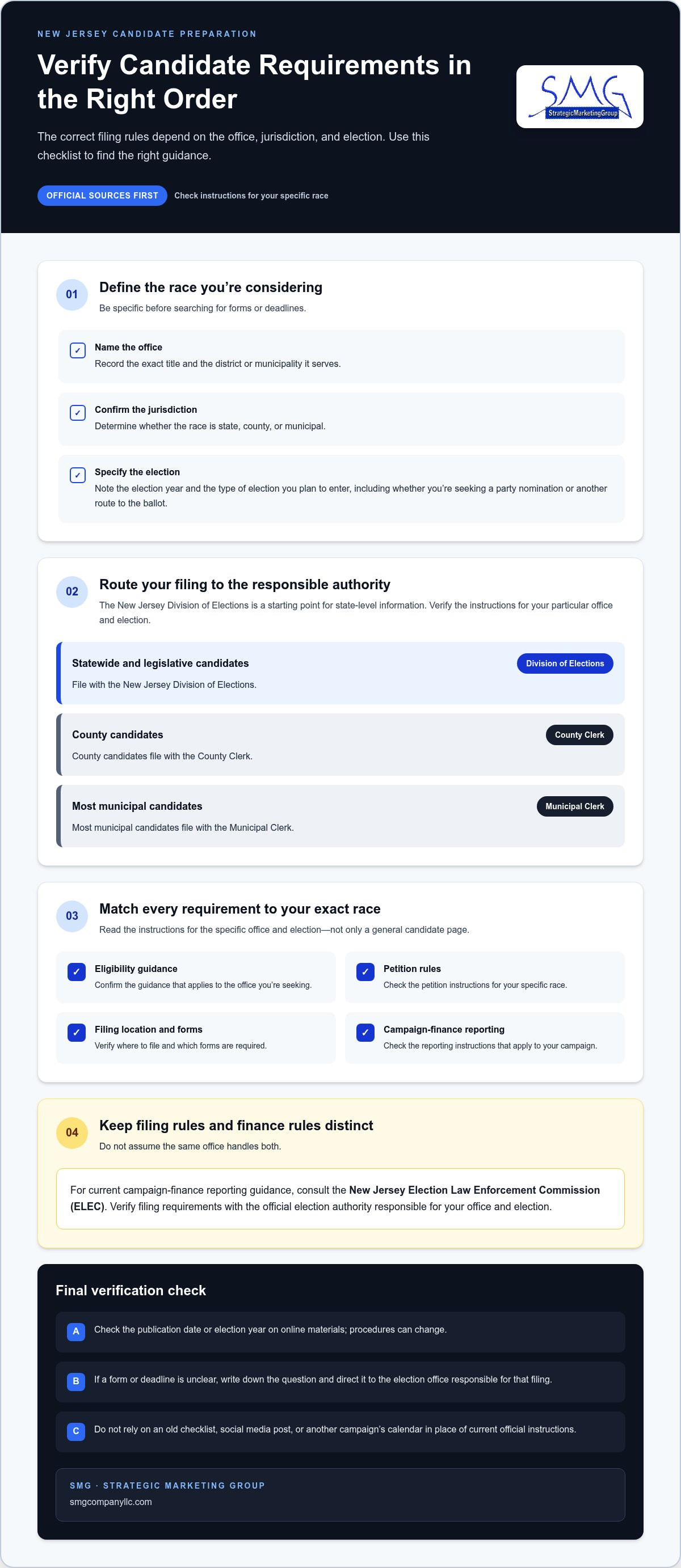
Work through these steps in order. First, name the office and its jurisdiction. Next, identify the election you intend to enter and whether you’re seeking a party nomination or another route to the ballot. Then use the New Jersey Division of Elections as your starting point and follow its direction to the authority responsible for that office. Statewide and legislative candidates file with the Division, county candidates with the County Clerk, and most municipal candidates with the Municipal Clerk, according to the current research provided for this guide.
Identify the office. Record the exact title and the district or municipality it serves.
Confirm the jurisdiction. Determine whether the race is state, county, or municipal.
Specify the election. Note the election year and the type of election you plan to enter.
Locate the responsible authority. Start with the Division of Elections, then verify the relevant County Clerk or Municipal Clerk’s instructions.
Match the requirements. Confirm eligibility guidance, petition rules, filing location, forms, and campaign-finance reporting instructions for your specific race.
Read the instructions for the exact office and election, not just a general candidate page. If a form or deadline is unclear, write down your question and contact the election office responsible for that filing. Check the publication date or election year on online materials because procedures can change. Apply the same care to campaign-finance obligations: consult the New Jersey Election Law Enforcement Commission (ELEC) for current reporting guidance rather than assuming filing rules and finance rules come from the same office.
Build a personal compliance calendar from verified guidance
Once you’ve verified the requirements, turn them into a calendar. Enter each confirmed filing date, form, submission method, and reporting milestone. For each item, note the official source and the date you checked it. Keep copies of submitted documents, confirmations, and written notes from calls with election offices. This creates a working record you can revisit as the campaign develops instead of relying on memory.
SMG provides campaign strategy and management to help organize campaign decisions around verified requirements. Learn more about campaign management and strategy support.
How to Build a New Jersey Campaign Foundation Before Launch
Once you’ve identified a possible race, test the idea against what residents are experiencing. A candidate’s first impression can point toward an important issue, but it’s only a starting hypothesis. Structured listening helps reveal which concerns recur, who is affected, and where experiences differ. That evidence can sharpen your understanding before you decide what a campaign should emphasize.
This first time candidate guide nj puts community listening ahead of campaign messaging because a message based on one conversation or personal experience may not reflect wider priorities. Informal conversations provide context and uncover questions, but they don’t establish how common a view is across the electorate. Organized research can provide a more systematic view, but it is useful only when designed to answer the right questions.
Listen to residents before deciding what the campaign will emphasize
Start with small-group conversations across different neighborhoods and perspectives. Ask open questions, listen without steering the discussion, and take consistent notes. Track recurring concerns, distinct experiences, and unresolved questions. Treat these discussions as qualitative insight, not representative polling: they can help you understand how people describe an issue, but they can’t establish how widely that view is held.
As patterns emerge, an electorate analysis guide can help you think about how voter information supports campaign planning. If early impressions leave important questions unanswered, professional public opinion polling can provide structured evidence to inform decisions. Polling can test relevant questions systematically, but it shouldn’t be presented as a guarantee of voter behavior or election results.
Turn community insight into a focused campaign message
Before elevating an issue into a central theme, ask three questions: Is there a clearly described community need? Does the office have responsibility or influence over it? Can you explain a credible direction for addressing it without promising an outcome beyond the office’s authority? This keeps the message grounded in what residents have shared and in the actual scope of the role.
For instance, if residents raise concerns about communication around local decisions, distinguish the concern itself from assumptions about what every voter believes. Then examine whether the office can improve relevant processes or public communication. Avoid turning a handful of comments into a claim about the entire electorate. A disciplined message reflects both the evidence you have and what remains uncertain.
Keep a brief record of the issue, the people and perspectives you’ve heard, the questions still open, and the office’s connection to the concern. Candidates seeking a more systematic understanding of voter priorities can learn about SMG’s public opinion polling services. Research should inform judgment, not replace direct engagement or responsible campaign decisions.
Community priorities also sit alongside the practical obligations of running. For current campaign-finance guidance, consult the New Jersey Election Law Enforcement Commission (ELEC). A sound foundation brings resident insight, the office’s responsibilities, and informed campaign planning together before public messaging takes shape.
What a First-Time New Jersey Candidate Should Prioritize in the Early Campaign
Early campaign work is strongest when it has a clear order. Before adding activities, decide what the campaign needs to learn or accomplish first, who owns each responsibility, and how you’ll know whether priorities need to change. This first time candidate guide nj focuses on that early structure, not detailed budgets, field operations, or a complete campaign plan.
Use your verified campaign timeline to set a small number of measurable objectives. For example, an early objective might be to complete a defined round of community conversations by a specific point in your planning schedule. Keep the target realistic, connect it to a campaign decision, and revisit it as new information emerges.
Set initial priorities and assign clear responsibilities
Even a small campaign benefits from clear ownership. One person may hold several roles, but responsibilities should be explicit so essential tasks don’t disappear between conversations. Start with a simple sequence: establish priorities, assign owners, set review points, and adjust the plan as the campaign learns more.
Set objectives. Choose a few concrete early goals that align with the verified election timeline.
Assign responsibilities. Identify who coordinates scheduling, communications, compliance tracking, and community outreach.
Establish review points. Set a regular time to assess progress, unresolved questions, and whether priorities remain appropriate.
Trusted support should include people who can raise concerns candidly, not only reinforce the candidate’s assumptions. Keep compliance tracking organized and use the official guidance you verified rather than relying on informal recollection. These planning practices don’t replace detailed finance, field, or legal guidance.
Communicate consistently while building community trust
Public communication should reflect what residents have actually raised and what the office can responsibly address. Use clear, factual language. Check that speeches, digital content, and conversations convey the same central priorities, and correct mistakes rather than allowing confusion to spread.
Outreach should be respectful and accessible. Make room for different perspectives, explain how people can share their concerns, and avoid implying that one channel reaches every resident. Digital advertising can extend a campaign’s message to an intended audience, but it doesn’t replace direct engagement or guarantee attention, persuasion, or votes. A steady mix of listening and clear communication helps demonstrate that residents’ input is taken seriously.
Review campaign decisions against community feedback and the responsibilities of the office. If new information changes your understanding, update the message and explain why. SMG’s campaign management services can help connect campaign priorities with execution.
For support organizing early campaign priorities and responsibilities, explore SMG’s campaign management support.
How SMG Can Support a First-Time Candidate in New Jersey
Once you’ve clarified the office, checked the official requirements, and begun listening to residents, the next challenge is coordinating decisions. Strategic support can connect campaign goals with research, communications, and execution. This first time candidate guide nj focuses on preparation rather than promises: experienced guidance can help organize a campaign, but it can’t guarantee an election outcome.
SMG works with campaigns at local, state, and federal levels, with experience across more than 40 states. Its support can be relevant at different stages, whether you’re assessing a race or preparing to move forward. Campaign advisers can help shape strategy, while official election offices remain the source for current filing forms, deadlines, and procedures.
Match campaign support to the candidate’s immediate needs
Start by identifying the decision you need to make. Research and planning are most useful when tied to a defined question, rather than treated as activity for its own sake. SMG’s campaign management, public opinion polling, electorate analysis, and digital advertising can support different parts of that work.
Public opinion polling can assess public sentiment and test how messages perform against a defined campaign question. The results inform decisions; they don’t guarantee how voters will respond.
Campaign management can help organize budgeting, staffing, field operations, and day-to-day strategy around the campaign’s objectives and timeline.
Electorate analysis can help organize a more informed view of the voting community, giving campaign decisions a stronger research foundation.
Digital advertising can extend campaign communications to intended audiences as one part of a broader strategy, not a substitute for direct community engagement.
The right starting point depends on what remains unresolved. If you’re uncertain about community priorities, research may be the immediate need. If responsibilities and workstreams are unclear, campaign management can help bring structure. Keep official compliance questions on a separate track and verify them with the appropriate state, county, or municipal election authority.
Move from first questions to a strategic conversation
A useful first discussion begins with a concise picture of the race. Be prepared to describe the office and jurisdiction, the election context, your initial objectives, and the questions you’ve identified through conversations with residents. You don’t need a complete campaign plan to begin organizing those questions. A clear starting point makes it easier to determine which decisions require research, strategy, or operational attention.
SMG’s experience across more than 40 states provides perspective on campaign work in varied political environments, while each campaign’s decisions still need to reflect its own electorate and circumstances. Strategic support brings structure to the work, but it does not promise votes or victory.
If you’re ready to discuss your campaign objectives and next steps, start a campaign strategy conversation with SMG.
Make Your Next Step Deliberate
Considering a run doesn’t require you to have every answer today. It does require a willingness to keep asking better questions, test your assumptions against what residents share, and make decisions with care. Treat candidacy as a sequence of informed choices, not a single leap. Set a practical next milestone: decide what you need to learn before you’re ready to commit, and when you’ll revisit that decision.
This first time candidate guide nj is a starting point, not a substitute for the judgment your community and circumstances require. A thoughtful campaign takes shape through disciplined preparation and a clear sense of responsibility to the people it seeks to represent. Move forward at a pace that gives those responsibilities the attention they deserve.
If you’re ready to examine your objectives and organize the work ahead, discuss your campaign strategy with SMG. A focused conversation can help you turn your next questions into a practical plan.
Frequently Asked Questions
How do I start a campaign for office in New Jersey?
Start by defining the office and writing down what you still need to learn before deciding to run. The practical next step in this first time candidate guide nj is to separate three workstreams: official requirements, conversations with residents, and your own capacity to take on the role. Keep a decision log with open questions, answers, sources, and dates checked. That record helps distinguish verified facts from assumptions as planning progresses.
Can I run for office in New Jersey without prior political experience?
Prior campaign experience isn’t the same as eligibility, and it doesn’t by itself determine whether you can organize responsibly. The rules for the specific office determine eligibility, so verify them with official election sources. To prepare for the work, consider attending public meetings, learning how the office makes decisions, and asking trusted people to challenge your assumptions. These steps can build practical familiarity, but they don’t replace formal requirements.
How do I find candidate filing deadlines in New Jersey?
Match the exact office and election to current instructions from the New Jersey Division of Elections or the relevant county or municipal election office. Check that any calendar or form applies to your race and election year, then note when and where the filing must be submitted. Keep a copy of the source alongside your calendar entry. If instructions conflict or seem incomplete, ask the responsible office for clarification.
Do first-time candidates in New Jersey need a campaign treasurer?
There isn’t a safe blanket answer for every candidacy. Applicable campaign-finance rules and circumstances determine what steps are required. Before accepting contributions or spending campaign funds, review current guidance from the New Jersey Election Law Enforcement Commission (ELEC). Ask specifically whether your campaign must designate a treasurer, what records to maintain, and which reporting obligations apply. Keep the guidance and any response with your campaign records so the team can follow the same procedures.
How can a first-time candidate learn what New Jersey voters care about?
Use conversations to learn how residents describe local problems, then separate those impressions from claims about what voters statewide or district-wide think. For example, ask residents what decision by the office would make a practical difference in their neighborhood, and record answers consistently. If you need to understand how widely views are shared or compare messages, professionally designed public opinion research can add systematic evidence. Interpret findings within the limits of the research method.
Is campaign consulting the same as legal advice for New Jersey candidates?
No. Campaign consulting can inform strategy, research, communications, and campaign operations; it doesn’t replace official procedural guidance or legal advice. SMG provides political and public affairs consulting, including campaign management, public opinion polling, and electorate analysis. Use the appropriate election authority for current filing and reporting instructions, and seek legal advice for questions requiring legal interpretation. Keeping those roles distinct helps a campaign use strategic support without mistaking it for legal representation.
What should I do before announcing a run for office in New Jersey?
Before announcing, prepare a short statement of why you’re considering the office, what community concern motivates you, and what you still need to verify. Test whether the issue fits the office’s responsibilities, and avoid presenting an idea as a firm promise before understanding the office’s authority. Consider how an announcement may affect your personal responsibilities and the people you rely on for support. A deliberate pause can strengthen the decision, whether you proceed or wait.
Comments