
Political Messaging Strategy for Campaigns: The 2026 Architect’s Guide

In an era where $10.8 billion in projected ad spending will saturate every screen, the loudest voice no longer wins; the most architected one does. You've likely felt the frustration of fragmented attention spans and polling data that shifts faster than a news cycle. This high-stakes environment demands a sophisticated political messaging strategy for campaigns that pierces the thick veil of voter apathy. Traditional methods are failing to connect, leaving many teams with expensive media buys that simply don't convert.
This guide provides the master blueprint for data-driven frameworks that survive aggressive opposition attacks and secure a clear ROI on every dollar spent. You'll learn the disruptive tactics used by seasoned insiders to build a cohesive narrative that resonates across a fragmented electorate. We'll examine the specific strategies required to navigate new AI disclosure mandates and the rapid shift toward Connected TV, ensuring your path to victory in 2026 is built on strategic precision rather than guesswork. From managing public opinion polling to refined speech writing, it's time to move beyond the status quo.
Key Takeaways
Understand why 2026 requires a disruptive political messaging strategy for campaigns to overcome historic levels of voter apathy and media saturation.
Learn to utilize public opinion polling as a strategic compass to align candidate values with the shifting priorities of key voter segments.
Analyze the regional mechanics of influence by examining Newark’s unique voter sentiment and the strategic role of local community engagement.
Master the deployment of high-visibility tactics, such as mobile video trucks and precision geofencing, to capture attention in a fragmented digital landscape.
Discover the data-driven frameworks used by strategic architects to build a resilient narrative that survives opposition attacks and delivers a clear ROI on messaging spend.
Table of Contents
What is a Political Messaging Strategy for Campaigns?
A political messaging strategy for campaigns is the strategic alignment of a candidate’s core values with the visceral priorities of the electorate. It's not a collection of slogans or reactive talking points. Instead, it's a deliberate architecture designed to establish credibility and project authority. In any high-stakes political campaign, the message serves as the intellectual foundation for every voter interaction. It is a competitive framework that operates in a zero-sum environment; if you aren't defining the narrative, your opponent is.
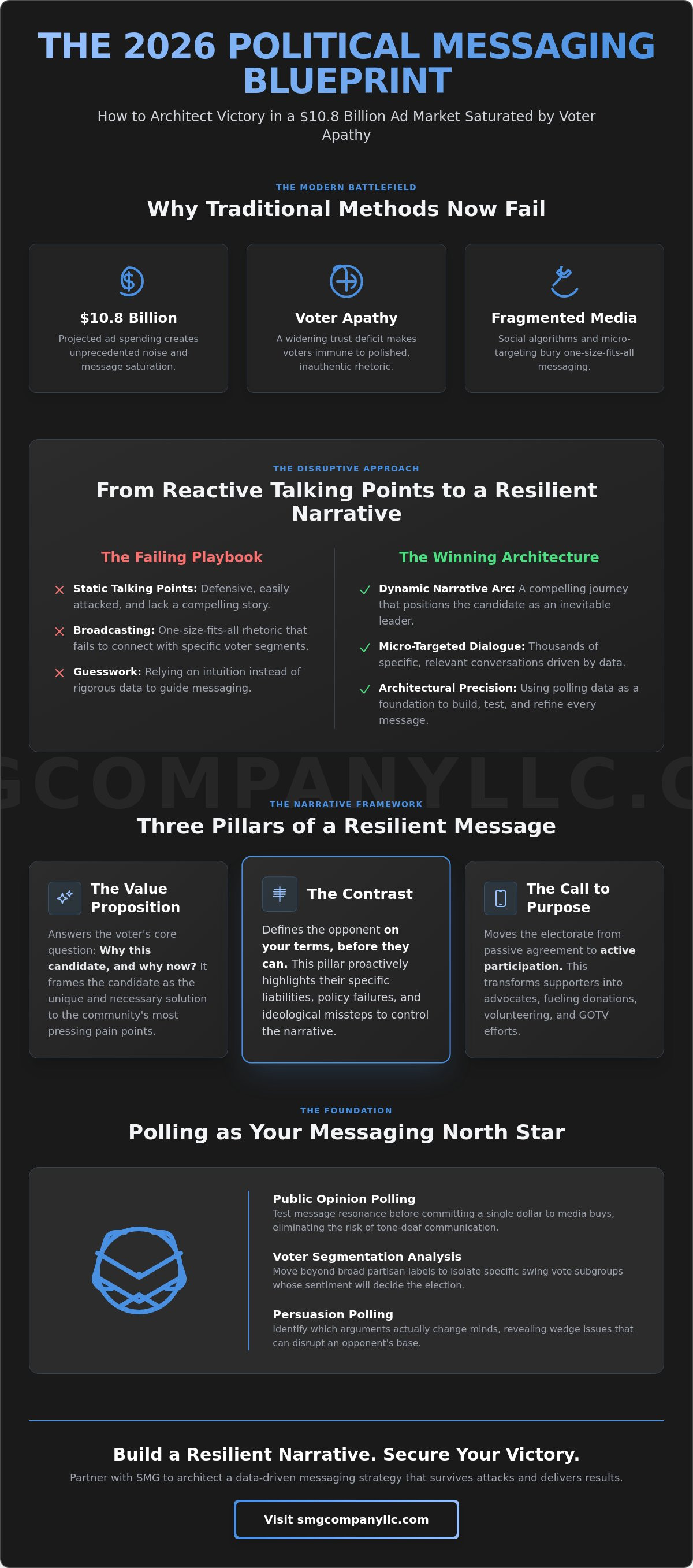
The 2026 election cycle demands a disruptive approach. With total political ad spending projected to reach between $10 billion and $10.8 billion according to April 2026 reports, the volume of noise is unprecedented. Breaking through this saturation requires more than just a large budget. It requires a message that challenges the status quo and forces a conversation on your terms. We distinguish between static talking points and a comprehensive narrative arc. While talking points are defensive, a narrative arc is dynamic. It moves the candidate from an initial introduction to a position of inevitable leadership, turning isolated facts into a compelling journey for the voter.
Effective messaging also performs a dual role in the mechanics of victory. It must persuade the undecided while acting as the primary fuel for base mobilization. A sophisticated political messaging strategy for campaigns ensures that the final push for Get Out The Vote (GOTV) feels like the natural conclusion of the story you've been telling since the launch. It bridges the gap between high-level policy and the everyday concerns of the community.
The Core Elements of a Winning Message
Three distinct pillars support every successful narrative:
The Value Proposition: This answers the voter's most basic question: Why this candidate, and why right now? It positions the candidate as the unique solution to the community's current pain.
The Contrast: You must define the opponent on your terms. This highlights their specific liabilities and ideological missteps before they can frame their own story.
The Call to Purpose: This moves the electorate from passive agreement to active participation. It transforms supporters into advocates who are ready to volunteer and donate.
Why Traditional Political Rhetoric Fails in 2026
The trust deficit in modern governance has never been wider. Voters have grown immune to polished, focus-grouped scripts that feel disconnected from reality. The shift from broad broadcast messaging to micro-targeted dialogue means candidates can't rely on one-size-fits-all rhetoric. You're no longer speaking to a monolithic audience; you're engaging in thousands of simultaneous, specific conversations. Social media algorithms now dictate narrative survival. If a message isn't built to thrive in these digital environments, the platform's architecture will bury it. Success requires an expert understanding of how data and sentiment intersect to create movement.
The Data-Driven Architecture: Polling as Your Messaging North Star
Winning an election is a matter of architectural precision. While many campaigns treat polling as a simple scoreboard, we view it as the structural foundation for your narrative. A successful political messaging strategy for campaigns doesn't guess what voters want; it extracts those priorities through rigorous Public Opinion Polling. This data allows us to test message resonance before a single dollar is committed to media buys. By identifying the specific language that triggers a positive response, we eliminate the risk of tone-deaf communication and ensure every broadcast has a purpose.
We utilize Voter Segmentation Analysis to isolate the swing vote, moving beyond broad partisan labels. This process identifies the specific subgroups whose shift in sentiment will decide the outcome. In high-stakes contests, we employ Persuasion Polling to determine which arguments actually change minds rather than just reinforcing existing biases. This data often reveals wedge issues that can disrupt an opponent's base, forcing them to defend territory they previously took for granted. Implementing Proven Campaign Messaging Strategies requires this level of granular insight to ensure your narrative remains offensive rather than reactive. Every data point we collect serves to refine the candidate's voice and harden the campaign's defenses against opposition attacks.
Step 1: Benchmark Polling and Electorate Analysis
Every campaign starts with a benchmark poll to establish your day zero baseline. We analyze the electorate mood to determine if voters are anxious, hopeful, or seeking total disruption. This phase maps current sentiment against SMG’s historical data from over 40 states. Understanding these patterns allows us to predict how specific demographics will react to your platform. If you're ready to define your baseline with precision, our team provides the Public Opinion Polling expertise needed to start with total clarity.
Step 2: Message Testing and Refinement
Refinement involves a mix of quantitative surveys and qualitative focus groups. Quantitative data provides the what, while focus groups explain the why. We subject every narrative to a Stress Test to see if it survives a $1M opposition attack cycle. If the message buckles under hypothetical pressure, it's discarded. The final output is a single, data-backed sentence that defines the candidate’s core mission. This clarity ensures every subsequent speech or advertisement remains disciplined and effective, preventing the message drift that often plagues less structured campaigns.
Navigating the New Jersey Landscape: A Strategic Case Study
New Jersey’s political environment is notoriously complex. It's a collection of power centers where labor leadership and local party structures dictate the pace of engagement. A localized political messaging strategy for campaigns in this region can't rely on generic national talking points. Instead, it must address the specific institutional mechanics of the Garden State. Property taxes remain the primary concern for suburban voters, while transit reliability and infrastructure dominate the conversation in the northern commuter corridors. Success requires a narrative that acknowledges these pressures while projecting a clear path toward governance.
Labor leadership plays a pivotal role in New Jersey campaigns, acting as a bridge between policy and the workforce. Effective messaging involves more than just seeking an endorsement; it requires aligning a candidate's platform with the long-term goals of organized labor. This institutional influence is a cornerstone of the region's political architecture. When we develop a political messaging strategy for campaigns, we integrate these community engagement dynamics to ensure the narrative resonates within the halls of union locals and civic organizations alike. It's about showing a profound respect for the leadership already active on the ground.
Messaging for Newark and Urban Leadership
Newark serves as a critical case study in urban leadership. Building trust here requires more than just a presence; it demands authentic representation. Diverse urban demographics are highly sensitive to candidates who lack deep roots or local understanding. Our firm’s history in Newark provides a distinct advantage. We focus on narratives that emphasize community investment and local empowerment, ensuring the candidate’s message feels earned rather than manufactured. It's the intersection of civic duty and strategic positioning that defines victory in these high-stakes urban contests.
Leveraging State-Level Government Relations
Legislative advocacy is the silent engine behind a successful campaign narrative. By monitoring ongoing developments in Trenton, we help candidates translate complex legislative wins into accessible campaign-trail stories. This ensures message consistency between the state house and the ballot box. A candidate who can articulate how a specific bill improves the daily lives of residents gains an immediate edge. We provide the government relations strategy necessary to turn policy expertise into a formidable political weapon, ensuring your narrative survives the scrutiny of the press and the public.
Disruptive Execution: Multi-Channel Delivery in the Digital Age
Strategic architecture is useless without disruptive execution. A modern political messaging strategy for campaigns must be as mobile as the voters it seeks to influence. We employ a multi-touchpoint philosophy that ensures your narrative is present across every channel. This isn't about mere repetition; it's about strategic saturation. We utilize Voice and Text Broadcasting to establish a direct-to-voter persuasion tool that bypasses the filters of traditional media. By reaching voters where they already spend their time, we create a sense of continuous presence that builds trust over time. This method allows us to pivot quickly, responding to opposition attacks within minutes rather than days.
Mobile-First Voter Reengagement
Mobile advertising is the front line of electorate analysis in 2026. We don't just use SMS for fundraising; we use it for narrative reinforcement. Every text sent is an opportunity to harden the campaign's core message. We utilize precision geofencing to deliver targeted mobile ads to voters at specific community events or geographic landmarks. We analyze real-time digital engagement data to inform our physical deployment, ensuring that your message is physically present in the exact neighborhoods showing the highest digital activity. If you're ready to dominate the digital landscape, our Digital & Mobile Advertising solutions provide the precision you need to win.
The SMG Video Truck: Dominating the Physical Space
The SMG Video Truck serves as a mobile billboard that voters cannot skip, mute, or scroll past. It breaks through the digital noise with high-impact outdoor media that commands attention in the physical world. We target strategic locations such as transit hubs, rallies, and early voting sites where voter concentration is highest. This physical presence is then integrated with social media strategies to create viral moments that extend the reach of your message far beyond the street corner. When voters see a high-definition video of your mission moving through their community, the narrative becomes visceral and unavoidable. This hybrid approach ensures that your political messaging strategy for campaigns remains inescapable throughout the entire election cycle.
Partnering with SMG: Strategic Architects of Your Victory
Partnering with SMG provides access to a firm that understands the complexities of the 2026 electoral cycle. We've built paths to victory in over 40 states, refining a political messaging strategy for campaigns that is both intellectually formidable and socially rooted. Our team doesn't just offer advice; we provide a full-service infrastructure where Public Opinion Polling, Campaign Management, and Government Relations Strategy work in total alignment. This unified approach eliminates the narrative drift that occurs when multiple agencies handle different aspects of a race. By housing every tactical tool under one roof, we ensure your message remains consistent and powerful from launch to election day.
Our commitment to civic duty and community leadership is reflected in our methodical approach to every contest. We don't rely on breathless hype or generic templates. Instead, we opt for a steady, professional demeanor that suggests deep-rooted expertise. Whether we're utilizing Voice and Text Broadcasting for direct voter engagement or deploying the SMG Video Truck for high-impact physical visibility, every action is a calculated step toward a specific strategic outcome. This level of precision is why seasoned candidates trust us to handle their most complex challenges.
From Local Mayors to Members of Congress
The SMG messaging framework is designed for scalability. Whether you're running for a local mayoral seat or a position in Congress, the fundamental need for a data-driven narrative remains constant. High-stakes political environments don't allow for trial and error. They require the steady hand of a seasoned insider who knows how to navigate complex systems of influence. The "SMG Difference" lies in our ability to be a disruptive force while maintaining a profound respect for the gravity of public office. We bridge the gap between sophisticated data analysis and the authentic pulse of the community, creating a persona for our candidates that is both authoritative and accessible.
Secure Your Strategic Foundation for 2026
Early engagement is the most reliable predictor of success in any political messaging strategy for campaigns. Waiting until the election cycle is in full swing means you're already behind the curve. Initiating a benchmark poll and electorate analysis with SMG allows you to define the battlefield before your opponent even steps onto it. This early data informs everything from your initial speech writing to your long-term digital and mobile advertising spend. We provide the strategic foundation necessary to turn a candidate's vision into an inevitable victory. Build your path to victory by partnering with architects who understand the mechanics of power and the importance of local engagement.
Securing Your Strategic Advantage for 2026
The 2026 election cycle will reward those who move beyond traditional rhetoric to embrace a data-driven political messaging strategy for campaigns. Success in this high-stakes environment requires an architectural approach that balances sophisticated electorate analysis with high-impact execution. We've examined how polling serves as a strategic north star and how disruptive tools like the SMG Video Truck break through the noise of a saturated media market. These aren't just tactics; they're the building blocks of a narrative designed to survive, resonate, and win.
Securing a victory requires a partner who understands the hidden mechanics of influence and the profound importance of local engagement. SMG brings a history of success across over 40 states, led by a team of prominent political operatives and labor leaders who know how to navigate complex governance systems. As pioneers of mobile-first voter reengagement, we provide the stability and momentum needed to sustain a formidable narrative. Partner with the strategic architects at SMG to build your winning campaign strategy. It's time to build a path to victory that reflects the gravity of your leadership and the needs of your community.
Frequently Asked Questions
How do you develop a political message that resonates with swing voters?
Developing resonance requires isolating the specific policy outcomes that overlap with a swing voter's practical priorities. We use voter segmentation to move beyond partisan labels and identify the specific concerns, such as economic stability or infrastructure, that drive these individuals. A successful political messaging strategy for campaigns treats swing voters as pragmatic actors who prioritize tangible results over ideological purity.
What is the difference between political messaging and a campaign slogan?
A slogan is a condensed brand statement, while messaging is the comprehensive strategic framework that supports it. Messaging encompasses the narrative arc, the contrast with opponents, and the data-backed proof points that validate a candidate’s platform. While a slogan is designed to capture immediate attention, the messaging architecture is what sustains a campaign through the intense scrutiny of an election cycle.
How often should a campaign update its messaging strategy based on polling?
Messaging should remain fundamentally stable, with tactical adjustments made only when tracking polls indicate a verified shift in electorate mood. Constant pivots suggest a lack of conviction and can quickly alienate a candidate's base. We recommend using polling data to refine delivery and emphasis rather than abandoning the core narrative arc established at the campaign's inception.
Can digital advertising alone win a local election in New Jersey?
Digital advertising is a formidable tool, but it rarely delivers victory in New Jersey without being paired with ground-level engagement and a physical presence. The state’s political landscape is heavily influenced by labor leadership and local civic organizations that value direct contact. A winning strategy must integrate digital precision with high-visibility physical assets to overcome the intense media saturation of the NJ/NY metro market.
What role does electorate analysis play in speech writing for politicians?
Electorate analysis dictates the specific lexicon and emotional register used in every public address. By understanding the demographic nuances of a region, we tailor speech writing to reflect the local vernacular and specific community anxieties. This ensures that a candidate’s political messaging strategy for campaigns feels authentic and earned rather than like a generic script from a national consultant.
How does SMG handle political crisis communications and narrative repair?
We handle narrative repair by immediately deploying data-backed counter-messaging through our established direct-to-voter channels. Crisis communications requires a rapid return to the candidate’s core mission to prevent an opponent from defining the situation. By utilizing Voice and Text Broadcasting, we ensure the campaign’s perspective reaches the electorate before a negative story can solidify into a permanent narrative.
Why is mobile-first advertising critical for voter reengagement in 2026?
Mobile-first advertising is essential because the smartphone is the only device providing a continuous, direct link to the voter throughout their day. With political ad spending projected to reach record highs in 2026, mobile platforms offer the most effective way to bypass traditional media saturation. It allows for precision geofencing and rapid reengagement that broadcast television or radio simply cannot match.
What makes the SMG Video Truck more effective than traditional billboards?
The SMG Video Truck offers mobility and dynamic content that static billboards cannot replicate. It allows a campaign to physically occupy high-density zones like transit hubs, rallies, or early voting sites exactly when voter attention is most critical. This disruptive physical presence creates a visceral experience in the real world, forcing engagement in a way that passive outdoor advertising often fails to do.
Comments