
Political Messaging Services: A Strategic Guide to Voter Persuasion in 2026

Updated: Jun 18
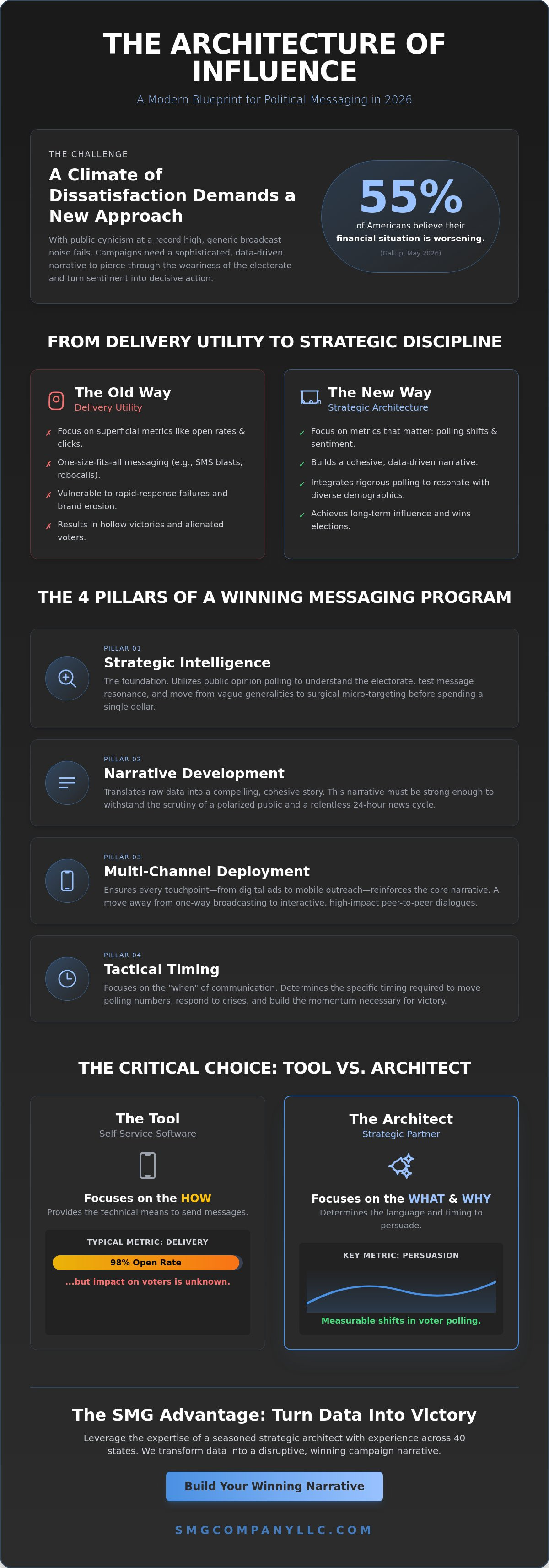
A May 2026 Gallup poll reveals that 55% of Americans believe their financial situation is worsening, marking a record high in public dissatisfaction. This climate requires more than just broadcast noise; it demands a sophisticated approach to political messaging services that can pierce through the cynicism of a weary electorate. You likely recognize that traditional channels are yielding lower engagement while the regulatory environment, particularly regarding automated mobile outreach and AI disclosures, has become a minefield for the unprepared.
The era of treating communication as a mere delivery utility is over. You will discover how to move beyond simple outreach and build a data-driven narrative that wins elections and shifts public opinion. This guide examines the strategic architecture of persuasive communication, from navigating complex compliance requirements to leveraging high-impact delivery channels that resonate with diverse demographics and turn public sentiment into decisive action. We provide the roadmap for building a cohesive narrative that survives the 24-hour news cycle and delivers measurable shifts in voter polling.
Key Takeaways
Shift your focus from simple message delivery to a multi-channel strategic discipline that prioritizes narrative development and long-term influence.
Utilize sophisticated political messaging services to build a communication architecture that integrates rigorous polling to ensure your message resonates with diverse demographics.
Analyze the critical differences between self-service software and a strategic partner to ensure your campaign narrative survives the pressures of a modern news cycle.
Redefine campaign success by tracking measurable sentiment shifts and voter polling results rather than relying on superficial digital metrics like clicks or open rates.
Leverage the expertise of a seasoned strategic architect with experience across 40 states to transform data into a disruptive, winning campaign narrative.
Table of Contents
Beyond the Inbox: Redefining Political Messaging Services in 2026
The Architecture of Influence: Core Components of a Messaging Program
Strategic Firm vs. SMS Platform: Choosing the Right Messaging Partner
Evaluating Messaging ROI: Metrics That Matter Beyond Open Rates
The SMG Advantage: Data-Driven Narratives for High-Stakes Victory
Beyond the Inbox: Redefining Political Messaging Services in 2026
Modern political messaging services are often misunderstood as mere digital pipelines for distributing text messages or robocalls. In reality, these services represent a sophisticated, multi-channel discipline that sits at the intersection of data science and political communication. Success in the 2026 cycle requires a move away from the utility mindset. Instead, campaigns must view messaging as a comprehensive strategic architecture designed to shape public sentiment long before a single notification appears on a voter's device.
Relying solely on high delivery metrics is a tactical error that seasoned insiders avoid. While an SMS campaign might boast a 98% open rate, that number is a hollow victory if the content fails to resonate or, worse, alienates the recipient. Effective communication focuses on the psychological triggers of the electorate. It ensures that every touchpoint reinforces a cohesive narrative that can withstand the scrutiny of a polarized public and a relentless news cycle.
To better understand the evolving regulatory environment and the impact of technology on campaign narratives, watch this discussion on AI and messaging:
The Evolution of Electorate Communication
Voter attention spans have contracted significantly. The modern electorate prioritizes short-form, high-impact content over traditional broadcast lectures. This shift from one-way broadcasting to interactive, peer-to-peer dialogues has changed the fundamental rules of engagement. In a 2026 environment where a record 55% of Americans report their financial situation is worsening, a one-size-fits-all message isn't just ineffective; it's a liability. Campaigns must now use granular data to segment audiences and deliver personalized narratives that address specific local concerns and immediate economic anxieties.
Delivery vs. Strategy: Why the Difference Matters
The distinction between delivery and strategy is the difference between a tool and a blueprint. Delivery services focus on the how, providing the technical means to send thousands of messages. Strategic services focus on the what, determining the specific language and timing required to move polling numbers. Deploying delivery tools without a comprehensive political messaging strategy for campaigns leaves a candidate vulnerable to rapid-response failures and brand erosion. Strategic firms act as architects. They protect the campaign’s integrity through crisis communications and ensure that every broadcast, whether digital or mobile, serves the broader mission of voter persuasion.
The Architecture of Influence: Core Components of a Messaging Program
High-stakes campaigns don't happen by accident. They are the result of a meticulously built architecture designed to sway public sentiment through a structured stack of political messaging services. This stack consists of four critical pillars: strategic intelligence, narrative development, multi-channel deployment, and tactical timing. Without this underlying framework, a campaign’s outreach is merely a series of disconnected outbursts that fail to build the momentum necessary for victory.
Intelligence is the foundation of this structure. You cannot persuade an electorate you don't understand. This is where public opinion polling services become essential. They provide the raw data required to test message resonance before a single dollar is spent on broad distribution. By identifying specific voter anxieties, campaigns move from vague generalities to surgical micro-targeting. Understanding the core components of a messaging program ensures that your outreach is rooted in psychological reality rather than hopeful assumptions.
Effective persuasion requires a seamless integration of digital media, mobile advertising, and traditional speech writing. While digital tools provide the reach, the written word provides the depth. This holistic approach prevents the fragmentation that often plagues modern campaigns. It ensures a candidate’s voice remains consistent whether it’s heard on a stage or read on a smartphone screen. Building a strategic path to victory requires a partner who understands these hidden mechanics of influence.
Data-Driven Narrative Development
Narrative development uses focus groups and sophisticated surveys to pinpoint "wedge" issues that drive voter movement. A candidate’s core story must be built to withstand the inevitable friction of opposition research. By developing messaging that speaks to diverse local demographics, we ensure the narrative remains authentic while addressing the specific economic or social concerns of different community segments. It's about crafting a story that survives the scrutiny of a 24-hour news cycle.
Multi-Channel Deployment Strategies
Consistency is the hallmark of a professional operation. There must be a visible synergy between P2P texting, social media engagement, and high-impact physical assets like the SMG Video Truck. Timing is equally critical. Strategic architects plan a messaging crescendo that builds momentum throughout the cycle. This ensures the campaign peaks in the final weeks, precisely when undecided voters are most attentive and ready to be moved toward a final decision.
Strategic Firm vs. SMS Platform: Choosing the Right Messaging Partner
Choosing between a self-service platform and a strategic consulting firm is the most consequential decision a campaign manager makes. Many campaigns default to low-cost SMS tools, viewing outreach as a simple volume game. However, sophisticated political messaging services require more than a "send" button. A strategic architect doesn't just manage delivery; they manage the candidate’s reputation and the narrative arc of the entire election. While the initial cost of a full-service firm may seem higher, the cost of a failed narrative is far greater.
Hiring an insider firm provides a level of oversight that software cannot replicate. It ensures that every communication is part of a larger, cohesive strategy designed to shift polling data. By prioritizing data-driven narratives over gut feeling, campaigns move beyond broad outreach to surgical persuasion. This distinction is vital when the goal is a measurable shift in voter sentiment rather than just a high volume of digital impressions. You aren't just buying a utility; you're investing in a path to victory.
The Limitations of Self-Service Tools
Self-service platforms often present a significant hidden risk. Without professional oversight, campaigns frequently trigger carrier blocks by sending messages that appear as spam. These tools also lack situational awareness. This is a critical failure in complex environments like New Jersey or high-stakes national races. Campaign staff are left to manage the massive burden of data management and regulatory compliance alone, diverting focus from essential leadership duties. Software can't tell you if your message will backfire in a specific zip code.
The Value of the Strategic Insider
A strategic partner offers access to proprietary electorate analysis that reveals how voters actually behave. This level of insight allows for strategic counsel that adapts in real time to polling shifts. Beyond digital channels, an insider firm can execute disruptive physical tactics, such as the SMG Video Truck, to dominate the local environment. This combination of data and mobility creates a level of influence that software alone cannot build. It ensures your campaign is proactive rather than reactive.
Evaluating Messaging ROI: Metrics That Matter Beyond Open Rates
ROI in the political sphere is distinct from commercial marketing. While a retailer measures success in sales, a campaign measures success in the accumulation of power and public trust. High-quality political messaging services move past vanity metrics like open rates or click-throughs. The only return on investment that matters is a measurable shift in voter sentiment and, ultimately, the final tally on election night. We prioritize outcomes that reflect genuine influence rather than digital noise.
We track these shifts through rigorous benchmark and tracking polls. These tools offer a real-time scoreboard for narrative resonance, allowing for quick pivots when a message fails to land. Effectiveness is also gauged through digital advertising for campaigns, where we analyze how specific segments react to curated content. In the high-stakes environment of 2026, conversion isn't a digital sign-up; it's the physical act of a voter casting a ballot during Get Out The Vote (GOTV) efforts.
Quantitative vs. Qualitative Success
Precision often outweighs volume. A low-volume, high-precision message targeted at a specific swing demographic frequently outperforms a generic mass blast. We use sophisticated reengagement analysis to see if crossover support is growing or if the base is sufficiently energized. Message testing is a critical safeguard here. It prevents expensive narrative errors by vetting themes before they reach the broader electorate. This ensures that every dollar spent on political messaging services contributes directly to a winning narrative arc.
Compliance and Deliverability as ROI Protectors
Compliance isn't just a legal hurdle; it's an ROI protector. Non-compliance leads to heavy fines and carrier blacklisting, which can silence a campaign during critical windows. Professional firms maintain white-listed status by adhering to the evolving FCC and state-specific regulations, such as the Texas text message rules that went into effect in September 2025. Reliable deliverability ensures that your strategic investment actually reaches the intended recipient rather than disappearing into a carrier's spam filter. When messages fail to deliver, the campaign loses both its financial investment and its opportunity to influence the voter.
To ensure your narrative reaches the right audience with precision, partner with a strategic architect today.
The SMG Advantage: Data-Driven Narratives for High-Stakes Victory
Winning an election in 2026 requires a partner who understands that communication is an exercise in strategic architecture. SMG doesn't function as a mere software vendor; it acts as a disruptive force and a seasoned insider in the field of political influence. While generic platforms offer broad, national reach, they often lack the localized nuance required to move the needle in high-stakes regions like New Jersey. With a track record spanning over 40 states and deep roots in the Tri-State area, SMG provides the sophisticated political messaging services necessary to navigate complex institutional systems and shifting public sentiment.
Our approach prioritizes victory over raw volume. We integrate unique physical assets, such as the SMG Video Truck, with rigorous public opinion polling to create a multi-dimensional presence that competitors cannot replicate. This combination allows a campaign to dominate the local environment while maintaining a data-backed narrative. We don't just send messages; we build the path to victory by looking at social trends through a lens that challenges the status quo and identifies the hidden mechanics of voter persuasion.
A Legacy of Strategic Success
The firm’s leadership, including Lionel Leach and a team of veteran political operatives, brings decades of experience to the table. This expertise has been applied at every level of government, from local mayoral races to high-profile congressional campaigns. SMG’s history is defined by a mission-driven focus on civic duty and community leadership. We utilize a sophisticated lexicon of strategy and governance to interpret data, ensuring that every narrative we develop is intellectually formidable and socially rooted. This seasoned authority allows us to anticipate obstacles and pivot strategies with a precision that less experienced firms lack.
Full-Service Execution
SMG manages the entire lifecycle of campaign communication within a seamless ecosystem. Our capabilities extend from initial speech writing and message development to the technical execution of digital and mobile advertising. By maintaining control over every touchpoint, we ensure that the core narrative remains consistent and impactful throughout the cycle. This full-service model removes the burden of coordination from campaign staff, allowing leadership to focus on the broader goals of governance and engagement. We provide the stability and continuous presence required to win in a fast-moving environment.
To secure your campaign’s future, Partner with SMG for your 2026 political messaging needs.
Architecting Your Path to Victory in 2026
The upcoming electoral cycle demands a shift from simple message delivery to complex narrative architecture. Successful campaigns recognize that high delivery rates mean little without a data-backed story that resonates with a frustrated electorate. By integrating public opinion polling with disruptive assets like the proprietary SMG Video Truck, leadership can move beyond the limitations of self-service software. Expertly managed political messaging services provide the strategic foundation necessary to shift sentiment and secure measurable polling gains.
Led by prominent New Jersey political strategists and backed by experience in over 40 states, SMG understands the hidden mechanics of influence. We don't just broadcast; we build the path to victory by ensuring your voice remains consistent across every touchpoint. It's time to move beyond the noise and focus on the metrics that actually matter for your campaign’s bottom line. Secure Your Strategic Messaging Consultation with SMG and take the first step toward a decisive victory. Your vision for leadership deserves a narrative that survives the 24-hour news cycle and delivers results.
Frequently Asked Questions
What are the main types of political messaging services?
Political messaging services encompass a suite of strategic tools including public opinion polling, campaign management, speech writing, and mobile advertising. These services work in tandem to build a cohesive narrative across digital and traditional channels. By utilizing voice and text broadcasting alongside physical assets like the SMG Video Truck, campaigns ensure their message reaches voters where they live and work.
How is political text messaging regulated in 2026?
Regulation in 2026 focuses on voter consent and transparency, particularly regarding AI-generated content and automated outreach. Under the Telephone Consumer Protection Act (TCPA), automated texts to mobile phones require prior consent, while several states now mandate disclosures for AI-manipulated ads. For example, Texas implemented strict rules in September 2025 that treat marketing texts as telephone solicitations, requiring clear, documented consent from every recipient.
What is the difference between broadcast SMS and peer-to-peer (P2P) texting?
The primary difference lies in the method of delivery and the resulting regulatory requirements. Broadcast SMS uses automated systems to reach large audiences simultaneously, which necessitates prior recipient consent for mobile devices under FCC guidelines. Peer-to-peer (P2P) texting involves individuals manually sending messages to voters. This manual interaction allows for direct engagement without the same automated consent hurdles, making it a staple for personalized voter outreach.
How do messaging services integrate with public opinion polling?
Integration occurs when polling data informs the development of the narrative before any outreach begins. Public opinion polling identifies specific voter anxieties and tests message resonance, ensuring the content of the messaging program is data-driven. This prevents the campaign from wasting resources on narratives that fail to move the needle or address the 55% of Americans who currently feel their financial situation is worsening.
Can political messaging services help with crisis communications?
Yes, comprehensive political messaging services are essential for effective crisis management and rapid response. These services allow a campaign to pivot its narrative quickly based on real-time sentiment shifts detected through tracking polls. By maintaining control over the 24-hour news cycle, a strategic firm protects the candidate’s brand from opposition research and ensures that the campaign remains proactive rather than reactive during high-stakes events.
How do you measure the success of a political messaging campaign?
Success is measured by tangible shifts in voter polling and final election results rather than superficial digital metrics. While open rates for SMS often exceed 90%, the true ROI is found in measurable changes in public sentiment and successful Get Out The Vote (GOTV) conversion. We use benchmark and tracking polls to provide a constant scoreboard, evaluating whether the messaging is effectively persuading undecided voters and moving them toward a final decision.
What role does digital media play in a messaging strategy?
Digital media provides the infrastructure for multi-channel synergy, connecting mobile advertising with social engagement and streaming platforms. It allows for advanced micro-targeting that traditional broadcast media cannot match, ensuring the campaign narrative remains consistent across all touchpoints. This ensures that every digital interaction reinforces the central message, building the momentum necessary to survive a relentless news cycle and influence diverse demographics.
Why should a campaign choose a strategic firm over a self-service platform?
A strategic firm provides expert oversight and situational awareness that self-service software cannot replicate. Beyond simple delivery, a firm manages complex compliance requirements and offers proprietary electorate analysis to guide the campaign's direction. This partnership allows leaders to focus on their civic duties while seasoned architects handle the hidden mechanics of influence and deploy disruptive tactics, such as mobile video trucks, to secure victory.
Comments