
NJ Real Estate Development: Public Opinion Research Guide

A development can make sense on paper and still leave nearby residents with serious questions. The challenge is finding out which concerns are widely shared, which reflect individual experiences, and what the project team can usefully address. A disciplined approach to public opinion research for real estate development nj can help developers distinguish credible community signals from informal or unrepresentative feedback.
It’s understandable to want a clear measure of support before important project decisions are finalized. But useful research does more than count favorable and unfavorable responses. It reveals local priorities and connects community sentiment to practical choices, without promising approval or treating one result as the whole story.
This guide explains how to select a research method suited to your project and decision, including when surveys or focus groups may help. It also covers how to assess findings responsibly and apply them in planning and community engagement. With sound evidence, developers can approach complex stakeholder environments with greater clarity and make more informed decisions before the next key milestone.
Table of Contents
Why public opinion research matters for real estate development in NJ
In New Jersey, a development proposal enters a community with its own history, priorities, and expectations. Public opinion research provides structured evidence about residents’ views, concerns, and priorities. Rather than treating a few public comments as representative of everyone nearby, developers can use well-designed surveys and focus groups to understand what people notice, value, question, or misunderstand.
That distinction matters when development decisions bring competing needs into close contact. A project may raise questions about housing, redevelopment, traffic, infrastructure, or how a site fits its surroundings. The relevant trade-offs differ by location. Research can help identify which issues deserve closer attention before decisions are finalized, instead of relying on statewide assumptions or the loudest voices at a public meeting.
How can public opinion research for real estate development nj help developers?
Research can test whether residents understand a project’s proposed features and identify which ones shape their response. A survey can help measure how common certain priorities or concerns are among a defined audience. A focus group can explore why people react as they do, clarify confusion, and uncover issues the project team may not have anticipated.
Research can also reveal differences among nearby communities and stakeholder groups. One area may focus on access or traffic; another may place more weight on housing options or neighborhood character. Comparing these perspectives helps distinguish recurring themes from isolated comments. Informal listening and public meetings can be useful, but neither alone establishes how widespread a view is. Public opinion research adds evidence; it doesn’t replace ongoing engagement.
Why does local development context change the research question?
A useful study starts with the specific project and its surroundings. The right questions may depend on local housing needs, redevelopment plans, available land, and infrastructure capacity. Where relevant, the research can examine concerns about flood exposure or water infrastructure. Include these topics because the project context warrants them, not simply because they appear on a generic checklist.
Statewide sentiment can provide background, but it can’t stand in for the views of people who live near a particular site. Research is not a campaign for a project or a vote on whether it proceeds. Public discussion of opposition by residents to proposed real estate captures one form of resistance, but local responses may also include practical questions, conditional support, or competing priorities. Findings should inform planning alongside feasibility work, technical analysis, and applicable requirements. They are decision support, not a promise of approval or an automatic design directive. That is the purpose of public opinion research for real estate development nj: to make the community context clearer before key choices are finalized.
How to design public opinion research for a New Jersey development
Begin with the decision, not the questionnaire. Are you assessing which project features need clearer explanation, identifying concerns to investigate, or comparing priorities among affected groups? A focused question keeps the research relevant to the next project milestone. Without one, even a large volume of responses may be difficult to apply.
For public opinion research for real estate development nj, the study area should reflect the site and the people likely to experience its effects. That could include nearby residents, local businesses, or other stakeholder groups, depending on the proposal. A fixed radius may miss relevant perspectives, so document why the audience and geographic boundaries make sense.
When should a developer use surveys or focus groups?
Surveys help measure how common defined views or priorities are among the people reached through the study’s recruitment approach. Focus groups serve a different purpose: they let researchers explore how participants interpret a proposal, why certain features matter, and what questions or concerns shape their reactions. Use both when the decision requires a broad view and a deeper explanation. Neither method substitutes for the other.
For example, if a project team needs to understand whether access, housing, or infrastructure is a more prominent concern, a survey can compare responses to those topics. Follow-up focus groups can probe what participants mean and what information might address points of confusion.
How should the research scope reflect a New Jersey project?
Build the research plan around local conditions, rather than using a generic development questionnaire. Depending on the site, relevant topics might include housing needs, redevelopment, access, infrastructure, or environmental concerns. The NJHOMES Program offers state-level context on municipal affordable housing support and community engagement, but it doesn’t replace research into a specific project’s audience and setting.
Before collecting responses, define how participants will be recruited, how questions will be worded, when fieldwork will take place, and how findings will be analyzed. Neutral wording matters. A question that highlights only potential benefits can steer responses; a clear description of the proposal and relevant trade-offs supports a more useful assessment. State the study’s limitations, too, including which audiences it may not reflect.
These choices make findings easier to interpret and harder to overstate. SMG’s public opinion polling includes surveys, focus groups, and data analysis. Developers assessing a research approach can learn about public opinion polling as a way to examine community sentiment and inform project decisions.
How to assess research quality before relying on findings
A polished report isn’t proof of sound research. Before relying on findings, assess whether the study was designed to answer a real project decision, reached the people whose views matter, and explains how its conclusions were drawn. For public opinion research for real estate development nj, these checks help developers distinguish credible evidence from a collection of responses that may not represent the intended community.
What makes a project survey credible and useful?
Start with the target population. Ask who the study is intended to represent and why that audience fits the project. Then review how respondents were recruited. An open online questionnaire, for example, may attract people with strong views while missing residents who don’t encounter it. That doesn’t automatically make the responses useless, but the recruitment method and its limits should be clear.
Request the questionnaire, field dates, response details, and explanation of the analysis. Check the wording for leading assumptions or loaded descriptions. “Would you support this housing proposal?” may prompt a different reaction from a neutral question that first describes the proposal and asks about specific features. Questions should be understandable without assuming residents already know project details.
A useful report separates what respondents said from what the researcher concludes or recommends. It should identify limitations, including which perspectives may be underrepresented and how that affects interpretation. A large response count alone doesn’t establish that findings reflect the target population.
What should developers ask a potential research partner?
Ask the partner to connect each proposed method to the decision at hand. If the team needs to compare how common certain concerns are, ask how the survey will measure them. If it needs to understand why residents interpret a feature in a particular way, ask whether qualitative discussion is appropriate. The rationale should be specific, not a default method presented as suitable for every project.
Use these questions to evaluate the plan:
Audience: Who will be included, and how will recruitment reach people with different perspectives?
Question design: How will the team keep wording clear and neutral?
Interpretation: How will it distinguish recurring patterns from views concentrated in a subgroup?
Experience: What relevant work can the partner document, and can any claimed real-estate credentials be verified?
A capable partner should be candid about what the study can and can’t establish. Findings can inform planning and engagement, but they don’t guarantee approval, prove consensus, or replace technical analysis and applicable requirements. Treat them as evidence with defined boundaries, then weigh them alongside the other considerations shaping the project.
How to turn New Jersey community research into better project decisions
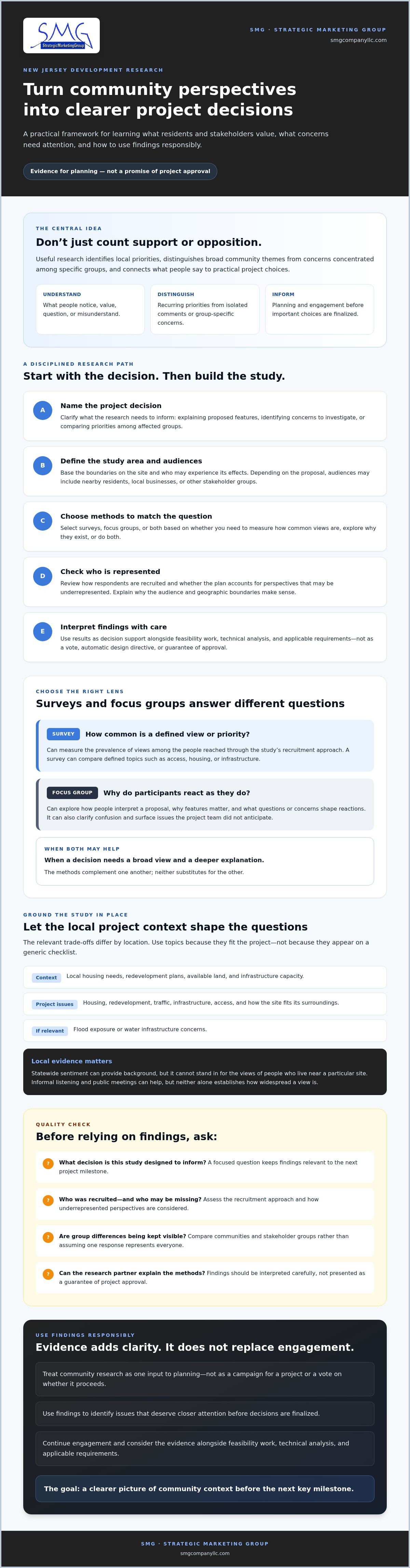
Research creates value when it improves the questions a project team asks. It shouldn’t be treated as a list of instructions to follow automatically. A recurring concern about traffic, for example, may point to a need for further access or infrastructure review, not a predetermined design change. The team should assess each finding alongside feasibility, technical analysis, and project objectives.
Start by distinguishing broadly shared priorities from concerns concentrated among particular respondents. Both can matter, but they have different implications. A concern raised across the study audience may warrant project-wide consideration; an issue specific to a location or stakeholder group may call for targeted follow-up. Keep the research audience and limitations visible as findings move into planning discussions.
Which project decisions can research inform?
Use findings to identify where additional review or clearer communication may be needed. If residents prioritize access, the project team can examine whether the proposal explains circulation and connections clearly. Questions about housing, infrastructure, or environmental effects can be referred to relevant experts for assessment. Research identifies what deserves attention; it doesn’t independently determine technical answers.
Research can also test whether people understand the project’s intended benefits and trade-offs. If responses suggest a key feature is misunderstood, revise the explanation and consider whether more information is needed before the next decision. Document the connection between evidence and action: what was heard, what the team reviewed, and what remains unresolved. This creates a practical record without implying that every finding must lead to a design change.
How should research connect with ongoing community engagement?
Share results in plain language and describe whose views were included. Avoid presenting a study as proof that an entire municipality agrees. Explain which concerns can be addressed through project information or review, which require further analysis, and why some questions may remain open. Clear distinctions build credibility, especially when residents’ views differ.
Use unresolved issues to guide the next stage of engagement. If the research surfaces questions about infrastructure capacity or environmental effects, identify what information is needed and who can assess it. If people interpret a project feature differently than intended, clarify the explanation and invite focused feedback. The aim is not to eliminate disagreement, but to ensure decisions reflect a careful understanding of the evidence and its limits.
For developers seeking structured insight into public sentiment, explore SMG’s public opinion polling, which includes surveys, focus groups, and data analysis. Used responsibly, public opinion research for real estate development nj can help teams prioritize follow-up, clarify communication, and make better-informed planning decisions without mistaking feedback for consensus.
Choosing a public opinion research partner for real estate development in NJ
The right partner should begin with the decision your team needs to make, then explain how the research will produce useful evidence. A proposal for public opinion research for real estate development nj should connect its methods to the project’s specific questions, not offer a standard package without explaining its relevance.
What should a development research proposal include?
Look for a clear objective, a defined audience, and a rationale for the proposed method. The proposal should outline the questionnaire or focus group discussion guide, explain how participants will be recruited, and describe the analysis plan. If both surveys and focus groups are proposed, ask what each method will contribute and how their findings will be considered together.
Deliverables should distinguish between what respondents said, how the findings are interpreted, and what next steps the research may suggest. Ask how the provider will communicate uncertainty, recruitment limitations, and perspectives the study may not capture. A credible proposal won’t present findings as a guarantee of approval or proof that every community member agrees.
Objective: What decision or information need will the research address?
Audience and methods: Who will be included, and why are the chosen methods appropriate?
Reporting: How will evidence, interpretation, recommendations, and limitations be made clear?
Local readiness: What New Jersey sampling and fieldwork capabilities are available for this project?
How can SMG support a public opinion research engagement?
SMG’s public opinion polling services include surveys, focus groups, and data analysis. These methods serve different research needs: surveys can help measure patterns among respondents, while focus groups can explore how people understand an issue and explain their views. A project may benefit from one method or a combination, depending on the decision and research design.
SMG’s public affairs perspective and experience in more than 40 states may be relevant in complex stakeholder environments. That background doesn’t establish specific real-estate development engagements or New Jersey fieldwork capacity. Developers should ask SMG to confirm whether its available sampling, fieldwork, and project capabilities fit the proposed study, and verify any real-estate credentials relevant to their needs.
A scoped discussion can clarify the project question, the research approach, and what the findings can reasonably establish. Select a partner based on the fit between its verified capabilities and your brief, not on claims that remain unconfirmed.
Make the Next Project Decision With Clearer Insight
Strong community research begins with a defined project decision, reaches the audiences affected, and uses a method suited to the question. For public opinion research for real estate development nj, the value lies not in securing a simple measure of support, but in understanding which priorities are shared, where concerns differ, and what deserves further review.
Use findings as one input to planning. Interpret them within the study’s limits, distinguish evidence from recommendations, and carry unanswered questions into continued community engagement. That discipline helps teams respond thoughtfully without treating research as a guarantee of approval or a substitute for technical analysis.
SMG offers surveys, focus groups, and data analysis, with experience in more than 40 states. Developers considering a research engagement can discuss a public opinion research engagement with SMG and confirm how its capabilities fit their project’s needs.
With a clear question and credible evidence, your team can make better-informed decisions and approach community conversations with greater confidence.
Frequently Asked Questions
What is public opinion research for real estate development?
Public opinion research is a structured way to gather evidence about how a defined audience views a proposed development and its features. It can examine residents’ priorities, questions, concerns, and understanding of the proposal. Methods may include surveys, focus groups, or both. The findings help a project team understand community perspectives, but they don’t represent a formal vote or determine whether a project proceeds.
How can a New Jersey developer use public opinion research?
A New Jersey developer can use research to identify which project features deserve closer review, where explanations may be unclear, and which concerns warrant follow-up. For example, responses may raise questions about housing, access, infrastructure, or environmental conditions. The team can refer those issues to relevant experts and use the results to guide communication and engagement. Findings should inform planning alongside feasibility work and technical analysis.
Should a real estate developer use a survey or focus groups?
Choose a survey to measure how common defined views or priorities are among the respondents reached through the study. Use focus groups to explore how participants interpret the proposal and why particular issues matter to them. If the project needs both measurable patterns and detailed context, the methods may be combined. The right choice depends on the decision the research needs to inform, not on a one-size-fits-all rule.
How do you know whether a public opinion survey is reliable?
Review the survey’s target population, recruitment approach, questionnaire, field dates, analysis, and stated limitations. Check whether the questions are clear and neutral, and ask which perspectives may be underrepresented. A large number of responses alone doesn’t prove the findings represent the intended audience. A transparent report should distinguish respondent results from interpretation and explain what conclusions the study can reasonably support.
When should public opinion research begin for a development project?
Begin when the team can describe the proposal clearly and before key decisions are finalized. At that stage, research can help identify priorities, test whether project information is understood, and flag questions for further review. Starting too early, before the project has enough definition to explain, may produce feedback on an unclear concept. Waiting until decisions are fixed can limit the practical use of community findings.
Can public opinion research guarantee support for a New Jersey development?
No. Research can clarify community views and help developers respond to concerns, but it can’t guarantee support, approval, or consensus. Results reflect the people reached, the questions asked, and the study’s methods and limitations. Treat the findings as one input to planning and engagement. They should be considered alongside technical analysis, feasibility, and applicable requirements, with unresolved concerns acknowledged rather than presented as settled.
What should I ask a public opinion research firm before hiring?
Ask how the proposed method answers your project decision, who the study will include, how participants will be recruited, and how the team will address differing perspectives. Request details on the questionnaire or discussion guide, analysis plan, deliverables, and limitations. Verify relevant experience, including any claimed real-estate work, and confirm New Jersey sampling and fieldwork capabilities rather than assuming them. SMG offers surveys, focus groups, and data analysis.
Comments