
New Jersey Campaign Operations Checklist: Election Law Compliance in 2026

A campaign can miss a compliance obligation long before a filing deadline arrives. The campaign operations checklist new jersey teams need is more than a calendar. It’s a working record that assigns each task an owner, sets a review path, and keeps supporting documents organized. When fundraising, advertising, staff activity, and reporting run on separate tracks, gaps can surface when there’s little time to address them.
That coordination challenge is familiar to campaigns managing several workstreams at once. A repeatable process clarifies who handles filings, who maintains records, and when communications need review. It also helps campaign leaders route formal compliance questions to qualified legal or compliance professionals.
This checklist outlines practical workflows for assigning responsibilities, tracking verified dates, documenting fundraising and spending, reviewing campaign communications, and maintaining records throughout the election cycle. It’s designed to help New Jersey campaigns build an orderly operating foundation, with campaign management and strategic communications aligned around accurate information and timely review.
Table of Contents
Why a New Jersey campaign operations checklist must include compliance
New Jersey election-law checks to complete before campaign activity
A campaign operations checklist for money, communications, and records
How to run compliance reviews throughout a New Jersey campaign
Put the New Jersey campaign checklist into operation with experienced management
Why a New Jersey campaign operations checklist must include compliance
A campaign operations checklist is an owned working record of tasks, assigned people, supporting evidence, and review dates. It connects the strategic plan to the administrative work that keeps a campaign organized. A strong campaign operations checklist new jersey teams can rely on does more than list upcoming filings. It identifies who verifies requirements, where decisions are documented, and how unresolved questions reach the right reviewer.
Build compliance into that system from the start. Applicable rules can depend on the office sought, the campaign’s committee structure and status, its activity, and the jurisdictions involved. A local race, a statewide campaign, and a federal campaign shouldn’t be presumed to follow identical requirements. Record who determines which state and federal rules apply, and keep that determination with the campaign’s operating records.
This video offers additional New Jersey political context as you consider how campaign activity is coordinated:
Which New Jersey campaigns need a tailored compliance workflow?
Every campaign needs a workflow suited to its circumstances, but not necessarily the same workflow. A county or municipal race may involve different authorities and obligations than a state or federal contest. Committee status and activity matter too: fundraising, spending, and political communications can raise questions that depend on the campaign’s specific facts. Assign a named person to document the requirements that apply, the source consulted, and who reviewed the determination.
For a general overview of the New Jersey Election Law Enforcement Commission (ELEC), use the reference as orientation, then verify current requirements through ELEC and the relevant election authorities. Direct campaign-specific questions, including how state and federal rules interact, to qualified counsel or compliance professionals.
How to use this checklist without treating it as legal advice
Treat each checklist item as an operational prompt, not a definitive interpretation of election law. For every requirement the campaign determines applies, record its authoritative source, the assigned owner, the reviewer, and the evidence that supports completion. If a rule is unclear or campaign activity changes, flag the question for qualified review rather than relying on an old assumption.
This discipline makes compliance visible in daily operations. Compliance is a continuous workflow, not a one-time launch task. As campaigns add staff, vendors, fundraising activity, or advertising, their records and review process should keep pace. Strong campaign management coordinates those workstreams without replacing legal judgment. For a broader look at organizing people, schedules, and campaign priorities, see New Jersey campaign management guidance.
New Jersey election-law checks to complete before campaign activity
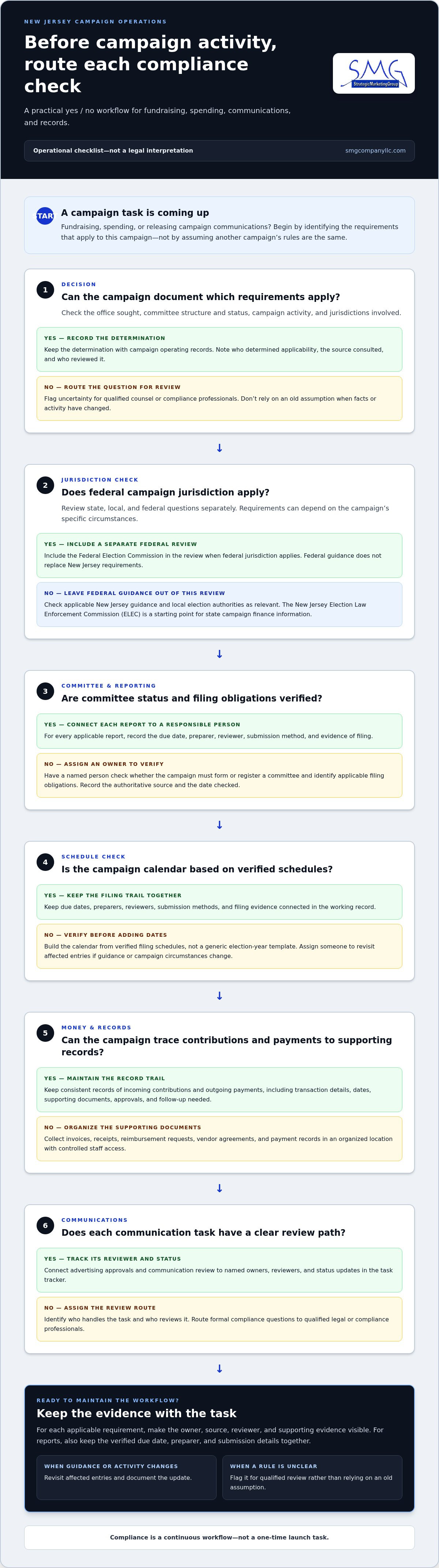
Before fundraising, spending, or releasing campaign communications, establish how the team will identify applicable rules and locate current guidance. The New Jersey Election Law Enforcement Commission official website is a starting point for state campaign finance information. Local election authorities may also be relevant, and federal campaigns require a separate jurisdictional review. A campaign operations checklist new jersey teams maintain should record the source, verification date, responsible owner, and reviewer for each applicable requirement.
Separate the review into state, local, and federal questions. Don’t assume a rule for one office or committee applies to another. Campaign activity, committee status, and the office sought can affect which obligations require attention. Qualified counsel or compliance professionals should resolve questions of legal interpretation and determine applicability. Campaign staff can then turn those determinations into assigned tasks and documented procedures.
Set up committee, reporting, and finance checks
Assign a named owner to verify whether the campaign must form or register a committee and identify its applicable filing obligations. Have the owner document the authoritative source and the date it was checked, then coordinate with the people preparing and reviewing required reports. Include the Federal Election Commission in the review only when federal campaign jurisdiction applies. Federal guidance is not a substitute for New Jersey requirements.
Build a calendar from verified schedules rather than relying on a generic election-year template. For every applicable report, record the due date, preparer, reviewer, submission method, and evidence of filing. If guidance changes or the campaign’s circumstances shift, assign someone to revisit affected entries and document the update. This creates a traceable process instead of leaving deadline knowledge with one staff member.
Review contributions, expenditures, and required disclosures
Use consistent records for incoming contributions and outgoing payments. Capture transaction details, dates, supporting documents, approvals, and any follow-up needed. Preserve invoices, receipts, reimbursement requests, vendor agreements, and payment records in an organized location with controlled staff access. A clear record trail helps the campaign assemble accurate information for review and reporting.
Route contribution eligibility and limit questions to qualified compliance review before funds are accepted or transferred. Record the decision and its supporting guidance rather than relying on informal recollection. Apply the same discipline to campaign communications: before release, review each format, such as a digital advertisement, printed piece, or broadcast message, for applicable disclaimer and disclosure requirements. Requirements may vary by format and context, so don’t reuse an old approval without checking whether it still applies.
Experienced campaign management can help coordinate budgets, staffing, communications, and operational handoffs around these verified processes. SMG campaign management helps organize campaign workstreams while formal compliance determinations remain with qualified professionals.
A campaign operations checklist for money, communications, and records
A useful checklist turns campaign activity into assigned, reviewable work. For each task, identify who completes it, who reviews it, what evidence demonstrates completion, when it is due, and its current status. A campaign operations checklist new jersey teams can adapt should cover financial activity and public communications, while leaving legal interpretations and formal compliance decisions to qualified reviewers.
A complete compliance record captures the action, the owner, the date, and the supporting evidence. Use a shared tracker with controlled access, and establish a consistent process for saving documents so the campaign can retrieve them during review or reporting preparation.
Track campaign funds and supporting documentation
Standardize how the team logs receipts, expenses, invoices, reimbursements, and approvals. The treasurer or designated finance lead should coordinate these records with qualified reviewers and reconcile internal entries against applicable reports before submission. Keep supporting files organized, limit access to staff who need them, and define how records are backed up. These steps protect sensitive information while keeping documentation available for review.
Clear advertising and public communications before release
Use a documented approval path for mail, digital ads, social posts, texts, and broadcast materials. Save the version reviewed, the reviewer’s decision, and the final version released. Verify current disclaimer and disclosure requirements for the communication’s medium and campaign context. Don’t assume an approval for one format applies to another. For channel planning, connect compliance review with the broader campaign digital advertising strategy.
How to run compliance reviews throughout a New Jersey campaign
Compliance review should follow campaign activity and verified filing schedules, not an assumed weekly or monthly formula. A period with new fundraising, vendor payments, or public communications may call for closer review than a quieter stretch. Keep the process consistent: each review should produce a named owner, a record of what was checked, and a path for unresolved questions.
Use this five-step routine to keep reviews focused and repeatable:
Verify the rules. Check current authoritative guidance for each applicable requirement, and note when the source was reviewed.
Assign owners. Name the person responsible for each task and identify a backup who can step in if needed.
Review activity. Compare fundraising, spending, staffing, field operations, and communications against the campaign’s current procedures.
Reconcile records. Compare source documents and internal finance records with information being prepared for applicable reports.
Document decisions. Save the reviewer, date, evidence, open questions, and any corrections or follow-up actions.
Build a deadline calendar and approval trail
For each verified filing date, add the source link to the campaign’s internal calendar, along with the preparer, reviewer, backup owner, reminders, and evidence of completion. Review calendar entries when guidance or campaign activity changes. If staff capacity is limited, backups help prevent tasks from stalling while preserving a clear handoff. Document corrections and the decisions behind them, but route questions about legal remedies to qualified compliance professionals.
Set review points around verified filing schedules and operational changes, such as a new fundraising push or a planned communications release. Escalate uncertain contribution questions, missing or late records, new communication formats, and changes in committee or campaign activity. The designated owner should preserve relevant records and, when appropriate, pause the affected workflow until qualified reviewers provide direction.
Plan a final pre-election review with qualified compliance professionals to surface unresolved items while there is still time to identify next steps. After the election, conduct a closeout review of remaining records, reporting tasks, approvals, and outstanding questions. The checklist should show what was completed and what remains assigned, rather than treating election day as the end of operational responsibility.
Connect compliance reviews to campaign strategy
Finance, field, communications, and management leads should share a view of upcoming activity so review work can be planned before commitments are made or materials go live. Public opinion research can inform campaign strategy and message planning. Public opinion polling services offer a related resource for understanding voter priorities. Keep legal sign-off distinct from strategic, creative, and operational approvals, because each addresses a different question.
A well-run campaign operations checklist new jersey process makes ownership visible without confusing management with legal counsel. SMG’s campaign management can help coordinate campaign workstreams and review rhythms. Explore campaign management support to align operations with campaign priorities.
Put the New Jersey campaign checklist into operation with experienced management
A checklist creates value when the campaign uses it to direct work, not simply archive tasks. Treat it as a living plan that connects verified requirements to owners, dates, records, review steps, and escalation paths. As campaign activity changes, update the plan to reflect new spending, staffing needs, field operations, and communications, then make sure responsibilities are clear.
For a campaign operations checklist new jersey leaders can put into practice, begin with a clear division of responsibility. Campaign managers coordinate campaign workstreams; finance leads organize financial records and reporting preparation; communications staff manage message and creative workflows. Qualified legal or compliance advisers determine how legal requirements apply. Clear roles help the team work with discipline without confusing operational coordination with legal representation.
What an operational partner can coordinate
Experienced campaign management can bring budgets, staffing, field operations, and daily strategy into a coordinated plan. That means ensuring leaders understand upcoming priorities, teams know their roles, and operational decisions support the campaign’s broader objectives. Public opinion polling and electorate analysis can inform strategic choices about voter concerns and message direction. They don’t replace compliance review or determine whether a contribution, report, or communication meets legal requirements.
Keep approval paths distinct. A campaign manager may coordinate a communications timeline, while a qualified adviser reviews applicable legal questions. Creative approval addresses the message and presentation; operational approval confirms that people and resources are ready. Documenting these separate decisions helps prevent a strategic green light from being mistaken for legal sign-off.
Turn the checklist into a campaign-ready plan
Start by assigning an owner and reviewer to each applicable task. Build the first review calendar from requirements and dates verified against current authoritative sources, then add reminders, backup owners, and space to record completion evidence. Establish how staff will escalate a missing record, a change in campaign activity, or a question that cannot be resolved through the documented process. Keep the plan accessible to the people responsible for using it, and update it when roles or priorities shift.
SMG’s campaign management and strategic communications experience can support coordination across campaign priorities and daily workstreams. Its public opinion polling and electorate analysis can also contribute a data-informed perspective to planning, while formal legal interpretations remain with the campaign’s qualified advisers. That boundary is essential: strong operations help ensure questions reach the right reviewer, but don’t substitute for counsel or guarantee compliance.
New Jersey campaign leaders can discuss campaign management with SMG to align operational needs with campaign strategy. Bring campaign leadership, operations staff, and qualified advisers together around one working plan with documented responsibilities.
Build the operating rhythm your campaign needs
Make compliance ownership part of how the campaign leads, plans, and adapts. Use your campaign operations checklist new jersey as a working management tool: revisit it when priorities shift, clarify handoffs, and connect strategic decisions to documented responsibilities. Qualified legal or compliance advisers remain responsible for legal interpretations. Campaign leadership can focus on ensuring the right people, records, and review steps are in place to act on that guidance.
SMG reports campaign experience across more than 40 states, supporting candidates at local, state, and federal levels. Its campaign management brings budgeting, staffing, field operations, and day-to-day strategy into a coordinated operating plan. That coordination can help campaign leaders align activity while preserving a clear distinction between management support and legal advice.
Ready to align your team around its next campaign priorities?Discuss campaign management with SMG and identify the operational structure that fits your campaign. A clear plan gives your team a foundation for focused, responsible work.
Frequently Asked Questions
What should a New Jersey campaign operations checklist include?
A New Jersey campaign operations checklist should cover the people, records, and review steps needed to manage campaign work responsibly. Include owners for finance, communications, staffing, and field activity, plus a way to flag unresolved questions. The campaign operations checklist new jersey teams use should also identify where current guidance is stored and who can update procedures when the campaign changes direction or adds activity.
Which agency oversees campaign finance reporting in New Jersey?
The New Jersey Election Law Enforcement Commission (ELEC) oversees campaign finance reporting within its jurisdiction. The precise filing obligations depend on the committee and campaign activity, so identify the applicable reporting framework rather than assuming every campaign files the same reports. For local contests, also verify whether an election authority has relevant administrative information. Keep the source consulted and verification date with the campaign’s reporting records.
Do New Jersey campaigns have to follow federal campaign finance rules?
Federal campaign finance requirements apply to campaigns for federal office, while state and local campaigns generally need to assess applicable New Jersey and local requirements. Don’t assume a federal filing system or rule automatically governs a state race. If a campaign has activity that could involve more than one jurisdiction, ask qualified counsel or compliance professionals to determine which requirements apply and document that determination before relying on it.
How can a campaign avoid missing an election reporting deadline?
Build deadline controls around dates verified with the authority responsible for the campaign’s reporting. Assign a preparer and reviewer, then set reminders that allow time to gather records, resolve discrepancies, and complete review before submission. If the person responsible becomes unavailable, a designated backup should know where the calendar and source documents are kept. After filing, retain confirmation or other submission evidence with the relevant report.
Do political campaign advertisements in New Jersey need disclaimers?
Some political communications may have disclaimer or disclosure requirements, but the answer can depend on the communication’s format, content, sponsor, and campaign context. Before releasing an ad, identify the channel and the entity responsible for it, then have applicable requirements reviewed by a qualified compliance professional. Don’t assume wording approved for one digital ad or printed piece can be copied unchanged into a text, broadcast, or social post.
How long should a New Jersey campaign keep its financial records?
Use the retention period that applies to the committee and records in question, as a single timeline may not fit every campaign. Check current ELEC instructions and have qualified compliance advisers assess any additional state, local, or federal requirements. Put the resulting schedule in writing, assign someone to maintain the files, and avoid destroying records connected to an unresolved reporting question or review until advisers confirm the appropriate next step.
Can a campaign manager be responsible for election-law compliance?
A campaign manager can coordinate compliance operations by assigning tasks, tracking verified dates, and routing questions to qualified advisers. That management role doesn’t make the manager legal counsel or settle the campaign’s legal obligations. Define responsibilities in writing, including who handles finance records, who reviews communications, and who makes formal compliance determinations. This separation helps the campaign act on expert guidance without confusing operational oversight with legal interpretation.
Comments