
Navigating Government Bureaucracy: 2026 Guide

What if the fastest way to move a government issue forward is to stop treating every agency, hearing, or deadline as a separate obstacle? Navigating government bureaucracy starts with seeing how those pieces connect. Authority may be divided across local, state, and federal levels, and procedural timelines and opportunities for public input aren’t always obvious.
A disciplined approach replaces guesswork with a practical map. Identify who has decision-making authority, understand the process and its key milestones, and prepare credible evidence with messaging grounded in community priorities. Effective engagement takes more than a single introduction or comment. Policy developments can change the path, so organizations need to monitor progress and adapt as decisions move forward.
This guide explains how to trace an issue to the right office, track relevant steps, and coordinate outreach over time. It also covers how public opinion research and ongoing legislative monitoring can inform a measured strategy. The goal is to make each action purposeful, timely, and connected to the people affected, without assuming access or a guaranteed outcome.
Table of Contents
Navigating Government Bureaucracy Starts with Knowing What Is at Stake
Government bureaucracy is the network of institutions, rules, roles, and processes through which public decisions are put into practice. The term can sound impersonal, but these systems are carried out by public servants with defined responsibilities. A neutral overview of the concept appears in Bureaucracy. For an organization, navigating government bureaucracy means finding the offices responsible, understanding how a decision moves, and identifying what information is relevant at each stage.
It’s understandable to feel frustrated when ownership is unclear, timelines shift, or an inquiry receives no immediate answer. A process that appears stalled may still be moving through review, coordination, or another established step. Before escalating, identify what is known about the decision, who owns the next step, and what information could help clarify the issue and its effects on the community.
For a foundational overview of how bureaucratic systems work, watch this video:
What does navigating government bureaucracy actually involve?
Start by naming the decision or action you’re seeking. Then identify the office responsible, the current process stage, what information may help inform the issue, and when or how input is considered. Administrative processes vary by issue, jurisdiction, and decision-making body, so an approach that works in one setting may not fit another.
Government bureaucracy is the structure of offices, rules, responsibilities, and procedures used to carry out public decisions. That structure establishes how work is handled; it doesn’t promise access, influence, or a particular result. Lawful advocacy means presenting relevant information and community perspectives through appropriate channels while recognizing that officials retain decision-making authority.
Why organizations can feel stuck before a decision is made
Responsibility may be shared across offices, or one body may review an issue while another implements the eventual action. Timelines can also change as the process develops. Without a clear picture of ownership and sequence, an organization may mistake a routine review or referral for a final decision, or repeatedly contact an office that cannot resolve the matter.
Persistence matters, but repetition alone isn’t a strategy. Before each follow-up, decide what it should accomplish: Are you seeking process information, submitting relevant evidence, or responding to a development? A concise, prepared approach keeps engagement constructive and tied to the people affected, even when the outcome remains uncertain.
How Government Decisions Move Across Federal, State, and Local Levels
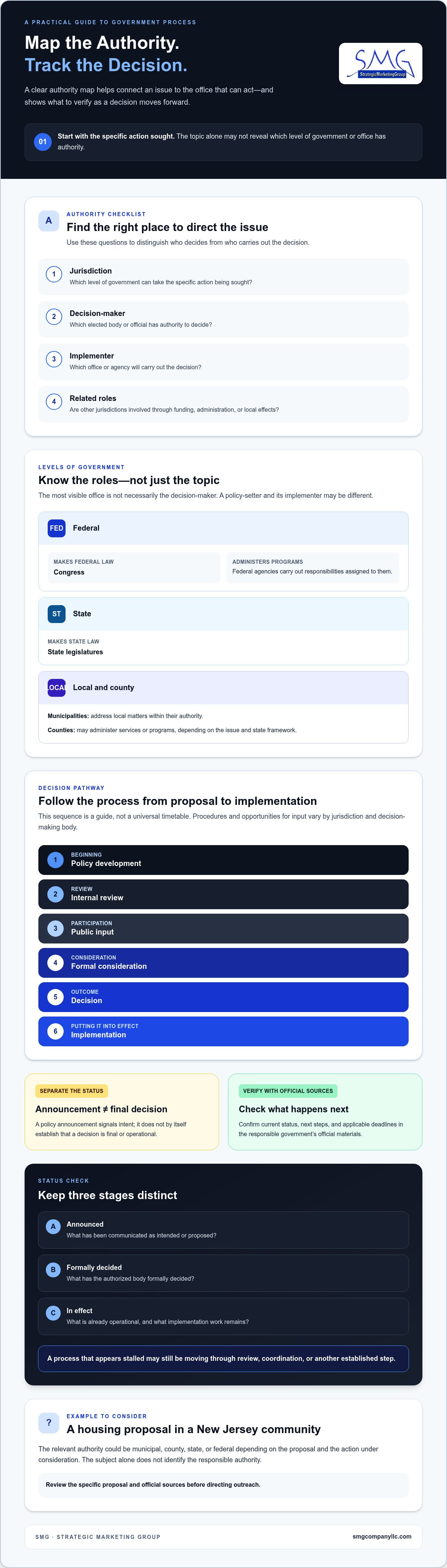
Before outreach begins, map the issue to the jurisdiction with authority to act. A policy can involve more than one level of government, but each office has a distinct role. Congress makes federal law, federal agencies administer programs and carry out responsibilities assigned to them, state legislatures make state law, and municipalities address local matters within their authority. Counties may also administer services or programs, depending on the issue and state framework.
The most visible office isn’t necessarily the decision-maker. An agency may implement a policy established elsewhere, while another body handles a related funding, permitting, or local planning question. Effective navigating government bureaucracy starts by defining the specific action sought, identifying the body authorized to take it, and locating the office responsible for implementation.
Which level of government handles the issue?
Consider a hypothetical organization concerned about a housing proposal in a New Jersey community. The question might involve local land use, a state policy, or a federal program, depending on the proposal and action under consideration. The municipality, county, state, or federal government could have a role, but the subject alone doesn’t identify the responsible authority. Review the specific proposal and official sources before directing outreach.
Build a simple authority map before making contact:
Jurisdiction: Which level of government can take the action?
Decision-maker: Which elected body or official has authority to decide?
Implementer: Which office or agency will carry out the decision?
Related roles: Are other jurisdictions involved through funding, administration, or local effects?
How to follow a decision from proposal to implementation
A decision may move through policy development, internal review, public input, formal consideration, a decision, and implementation. This sequence is a guide, not a universal timetable. Processes and opportunities to participate vary by jurisdiction and decision-making body, so use the responsible government’s official materials to verify current status, next steps, and applicable deadlines.
A policy announcement signals intent; it doesn’t by itself establish that a decision is final or operational. A proposal may still be under review, and implementation may require further direction or administrative work. Separate what has been announced from what has been formally decided and what is already in effect. The GOV.UK innovator's guide to navigating bureaucracy offers a useful perspective on approaching institutional processes, while U.S. procedures should be verified through the relevant U.S. government source.
For organizations tracking decisions across jurisdictions, government relations strategy can help coordinate monitoring and engagement as policy develops.
Why Insider Access Alone Does Not Solve Government Bureaucracy
Relationships can help an organization understand context, identify relevant questions, and communicate with the right people. They can’t replace a clear request, reliable evidence, or the established process. Navigating government bureaucracy depends less on who knows whom than on whether engagement is relevant, well-timed, and supported by information decision-makers can assess.
Informal outreach may open a conversation, but structured engagement gives it direction:
Purpose: State the decision or action you’re seeking, rather than making a general appeal.
Evidence: Provide issue-specific facts and explain how the proposal affects your organization or community.
Timing: Align outreach with verified process stages and participation opportunities.
Follow-through: Record responses, monitor developments, and update your approach when circumstances change.
Relationships versus a credible, well-timed case
A respectful relationship supports communication; a credible case gives that communication substance. Prepare a concise explanation of the issue, the action requested, the evidence behind your position, and its community implications. Consistent, professional contact can keep dialogue constructive, but it doesn’t guarantee access, special consideration, or a preferred decision. Advocacy should inform the process, not imply that established procedures can be bypassed.
Keep participation transparent and appropriate to the process. Sharing relevant evidence or submitting public input where invited is different from suggesting that a personal connection can secure an outcome. No responsible engagement strategy can promise influence or a particular result.
How to interpret delays and changing timelines
A delayed response doesn’t, by itself, reveal why a decision is taking longer. The issue may be moving through review, competing with other priorities, or awaiting information. Separate confirmed milestones from estimates and outside commentary. Track each update with its source and date, and note unanswered questions or assumptions that may need revision.
Deadlines and public-comment opportunities vary by process. Verify them through the responsible official source, and distinguish a posted deadline from an informal estimate. If timing changes, adjust the engagement plan around confirmed information rather than speculation. A clear record helps teams follow developments without treating every pause as a final decision or every delay as evidence of motive.
A Practical Framework for Navigating a Government Process
A repeatable process keeps engagement focused as an issue develops. Separate the outcome your organization wants from the specific government action that could advance it. For example, “improve access” describes a goal; a defined policy change or administrative action is a request that can be assessed, discussed, and tracked.
Use these five steps to organize your work:
Define the outcome. State the change you seek and the specific decision or action that could support it.
Map authority. Identify the responsible decision-making body, implementing office, affected stakeholders, current stage, and next known milestone.
Gather evidence. Assemble accurate, relevant information and explain its organizational and community impact.
Engage appropriately. Match your communication to the process, audience, and available opportunities for participation.
Track progress. Record developments and reassess as authority, timing, or stakeholder perspectives change.
Build an issue map before contacting public officials
Create a working record of what’s known and what still needs confirmation. Mark assumptions clearly, and verify process details against official sources. A simple responsibility matrix can clarify who owns each task internally, who approves messaging, and which external audiences need relevant updates. This prevents duplicated outreach and keeps the organization aligned as the issue moves forward.
Prepare communication that supports informed consideration
Keep each communication concise: identify the issue, state the requested action, summarize the supporting evidence, and explain why it matters to the public or affected communities. Align the core facts and language used in meetings, written materials, polling, and public communications. Public opinion polling services can help organizations understand public sentiment and inform community-aware messaging. For a broader approach to sustained engagement, see government relations strategy development.
Track engagement and adapt as the process changes
Maintain a dated log of official updates, outreach, responses, unresolved questions, and changes to prior assumptions. Revisit the strategy when the responsible authority, timeline, stakeholder positions, or public sentiment shifts. Electorate analysis can help assess stakeholder and voter perspectives as part of that review. These habits make navigating government bureaucracy a managed effort rather than a sequence of disconnected interactions.
For support aligning policy monitoring, evidence, and engagement, explore SMG’s government relations strategy.
How Strategic Government Relations Helps Organizations Navigate Complexity
Internal coordination may be sufficient when an issue has a clear owner, a defined decision path, and manageable monitoring needs. Ongoing public affairs counsel can add capacity when policy developments span jurisdictions, require sustained attention, or create coordination demands across leadership, communications, and subject-matter teams. In either case, the objective is disciplined participation, not a promise of access or a particular result.
What ongoing government relations support can contribute
Legislative monitoring helps an organization follow policy developments and identify when a change may need closer analysis. Strategic counsel can connect those developments to organizational priorities, assess implications, and coordinate next steps over time. The engagement plan should reflect the issue, decision stage, stakeholders, and jurisdictions involved. SMG provides legislative monitoring and government relations strategy, with experience in more than 40 states.
This work is continuous rather than a one-time introduction. As proposals evolve, teams can revisit their objectives, evidence, and communications so the organization responds to meaningful developments instead of reacting to every signal in the same way. Clear internal roles also help leadership, policy experts, and communications teams work from a consistent understanding of the issue.
Connect policy strategy with public priorities
Policy analysis explains what a proposal may do and which decision points matter. Public opinion research adds a different perspective by testing assumptions about community concerns and whether messages are clear. Polling is one tool, not a substitute for understanding the policy, the process, or the people affected. Interpret findings carefully and present them accurately, without suggesting that research guarantees a government response.
Strategic communications can translate an organization’s position into language that is understandable and relevant to its audiences. Pairing clear messaging with evidence and attention to public sentiment helps teams explain why an issue matters while staying responsive to community priorities.
Choose a clear next step for your organization
Begin by writing down the policy issue, the decision stage, the outcome you’re seeking, and the most important information gaps. Then determine what your team can track internally and where additional capacity would help. This gives sustained engagement a clear focus and keeps navigating government bureaucracy connected to the organization’s mission and the people affected.
SMG brings together government relations, legislative monitoring, public opinion polling, and strategic communications for organizations working through complex policy environments. If your team is assessing a government relations challenge, discuss the issue, its current stage, and the next decision your organization needs to prepare for with SMG. Informed, sustained participation is a disciplined next step, whatever the eventual outcome.
Turn a Complex Policy Issue into a Clear Plan
Navigating government bureaucracy becomes more manageable when your organization knows who can act, understands the decision process, and prepares evidence-based engagement. Relationships can support communication, but they work best alongside clear objectives, relevant information, and consistent follow-through.
Start with the next decision your organization needs to understand. Confirm the responsible authority, identify information gaps, and track verified developments. Keep your message grounded in policy details and the experiences of people affected. That disciplined approach helps teams adapt as timelines and priorities evolve, without assuming any particular outcome.
SMG provides government relations and legislative monitoring support to corporate, labor, and nonprofit clients, drawing on experience across more than 40 states. Public opinion research and strategic communications can help organizations understand public sentiment and express their priorities clearly. Discuss your government relations priorities with SMG.
Complex processes can be approached with clarity and purpose. Build your plan, stay attentive, and keep your engagement connected to the communities your organization serves.
Frequently Asked Questions
Is navigating government bureaucracy the same as lobbying?
No. Navigating government bureaucracy is the broader work of understanding institutions, responsibilities, procedures, and decision stages. Lobbying is one form of advocacy that may be used in some contexts. Organizations can also monitor policy, provide relevant evidence, participate in public processes, and communicate with stakeholders. The terminology and rules surrounding advocacy vary by jurisdiction and situation, so verify the terms that apply to your specific process rather than relying on a general description.
How do I find out which government agency handles an issue?
First define the decision or service involved, then determine whether authority sits at the federal, New Jersey state, county, or municipal level. Consult official agency and legislative sources for stated responsibilities and current contact information. Roles may overlap: one body can set policy while another administers or implements it. Verify the specific issue and action you’re seeking before outreach, rather than assuming that the most visible office has final authority.
Can a business influence a government decision?
A business can present relevant evidence, explain how a decision may affect its operations or the community, and participate through appropriate public channels. These steps can inform consideration, but they don’t guarantee influence or a particular outcome. Before outreach, identify the decision-maker, process timing, affected stakeholders, and supporting information. Advocacy is distinct from legal or ethics advice, so questions about legal obligations or conduct should be addressed through appropriate professional guidance.
How long does it take for government to make a decision?
There’s no universal timeline. Timing depends on the issue, jurisdiction, decision stage, and applicable process. Identify official milestones and verify any deadlines or public-comment periods through the responsible body’s sources. Track updates as they occur, since schedules can change. Also distinguish an announcement from a final decision and from implementation: a public statement may come before the action is formally settled or operational.
What should an organization prepare before contacting a public official?
Prepare a concise issue summary, a specific request, credible supporting evidence, and a clear explanation of relevant organizational or community impacts. Note the current process stage so the communication fits the decision at hand. Coordinate key messages internally and assign someone to document responses and follow up. This preparation makes outreach more focused and useful; it doesn’t mean officials will agree with the request or reach a particular decision.
Does hiring a government relations firm guarantee a policy outcome?
No. A government relations firm can’t responsibly guarantee a government decision. Strategic counsel can help an organization monitor developments, assess stakeholders, prepare evidence, and coordinate engagement over time. The relevant public body retains authority, and decisions may depend on factors beyond any organization’s control. The value lies in stronger preparation and sustained strategic support, not certainty about the outcome.
How can organizations track policy changes that affect them?
Set a regular review of official legislative and agency updates, record relevant milestones, and assign an internal owner to assess what each development means for organizational priorities. Focus monitoring on issues that could affect your work instead of forwarding an unfiltered stream of notices. For complex or multi-jurisdiction matters, legislative monitoring and strategic counsel can help teams interpret developments and coordinate a measured response.
Comments