
Mobile Digital Billboard Advertising: How to Plan a Campaign That Reaches People on the Move

Can a mobile digital billboard reach the right people more effectively than a stationary or online ad? Movement alone does not make an ad more effective. Its value depends on whether the route, timing, and message match the people a campaign needs to reach.
Planning the deployment can feel uncertain. A busy road may not be the right road, a passing audience has only moments to absorb a message, and campaign impact takes more than assumptions. A mobile billboard can add targeted, visible presence to a broader campaign, but its route and creative should follow a clear audience strategy.
This guide explains how mobile digital billboards work, when they fit a campaign objective, and how to plan routes, schedules, and concise creative for a priority audience. It also covers how to assess delivery and set realistic measurement criteria before launch, so you can decide whether this format belongs in your campaign mix.
Table of Contents
What Is a Mobile Digital Billboard, and When Does It Fit a Campaign?
How Mobile Digital Billboards Work: Route, Display, and Message
Mobile Digital Billboard vs. Other Campaign Advertising: How to Compare
How to Plan a Mobile Digital Billboard Campaign in New Jersey
How SMG’s Video Truck Can Fit a Mobile Digital Billboard Strategy
What Is a Mobile Digital Billboard, and When Does It Fit a Campaign?
A mobile digital billboard is a vehicle-mounted digital display that carries a campaign message through selected public places. Unlike a stationary digital billboard, which stays at one location, it can travel between areas according to the campaign’s audience and objectives. The format combines a digital message with a planned physical route.
It differs from a vehicle wrap, which shows a fixed design on the vehicle’s body, and an online display ad, which appears on a user’s screen. It also differs from a static outdoor sign because the display can travel rather than remain in one place. For a broader overview of the format and its place in transit media, see this explanation of the mobile billboard.
This video offers a look at one example of billboard truck construction:
How a mobile digital billboard delivers a message
The display brings a concise visual message into public settings as the vehicle follows a planned route. Start by defining who the campaign needs to reach and what the message should accomplish. Then consider where and when that audience is likely to be present. A route is not automatically effective because it covers more distance; it needs to serve the campaign’s purpose.
Because viewing time may be brief, creative should focus on one clear idea rather than copy that requires sustained attention. Route, timing, message, and audience strategy need to work together. Confirm vehicle and display capabilities before finalizing the creative or deployment plan.
Which campaign goals can this format support?
Mobile displays may support public awareness, event promotion, issue education, or reinforcement of a campaign message in selected geographic areas. They can bring a message into public view where the campaign has a reason to focus attention, such as near an event or within a defined community context.
Consider the format one part of a broader media plan, not a substitute for every other channel. A moving display can contribute visibility, but visibility alone does not establish persuasion, turnout, or electoral impact. Set objectives that fit what the format can deliver, then assess execution and results against those objectives.
How Mobile Digital Billboards Work: Route, Display, and Message
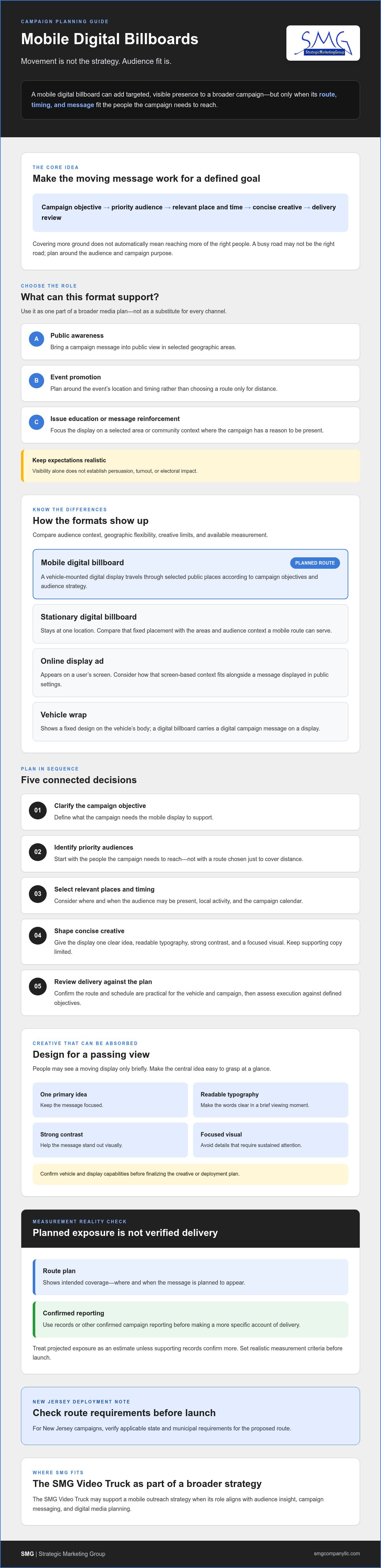
A well-planned campaign follows a practical sequence: define the objective, identify the audience, select relevant places and timing, develop concise creative, and review delivery against the plan. Each decision affects the next. A campaign seeking general awareness across a community may need a different deployment from one promoting a specific event or reinforcing an issue message in selected areas.
Route and schedule determine where and when a mobile message appears. Treat route planning as a strategic decision, not a mileage target. A longer drive does not necessarily serve more priority audience members. The Out of Home Advertising Association of America (OAAA) provides broader context on out-of-home advertising as a channel. Campaign planners still need to match each deployment to their audience and objectives.
How route and timing shape exposure
Begin with the people the campaign needs to reach. Identify relevant settings, consider when those audiences may be present, and compare possible routes with local activity and the campaign calendar. For example, if a message supports a scheduled public event, plan around the event’s location and timing rather than choosing a route solely for distance.
Distinguish planned exposure from verified delivery. A route plan shows intended coverage, not proof of who saw the message. Treat projected exposure as an estimate unless records or other confirmed campaign reporting support a more specific account. Before launch, confirm that the route and schedule are practical for the vehicle and campaign.
What makes mobile billboard creative clear?
People may see a moving display only briefly. Give the creative one primary idea, readable typography, strong contrast, and a focused visual. Limit supporting copy, and make any call to action immediately understandable. A message crowded with details can be difficult to absorb in passing.
Review the final creative against its objective: can it communicate the intended point at a glance, and is it accurate for the campaign dates and audience? For political advertising, verify current disclosure requirements with the appropriate election authorities before deployment. Treat creative approval and route review as connected checkpoints.
For campaigns that need coordinated audience insight and message planning, consider how digital and mobile advertising strategy can fit the broader campaign plan.
Mobile Digital Billboard vs. Other Campaign Advertising: How to Compare
Campaign formats solve different problems. Compare them by audience context, how long the message should remain available, and what evidence you can use to assess delivery. A mobile digital billboard takes a message through selected places. A static placement holds its position, while online advertising appears within digital environments. None is automatically the right choice for every objective.
Mobile billboards compared with static outdoor advertising
A fixed placement may suit a campaign seeking a continuing presence in one location or its surrounding area. Mobility may suit a plan that calls for messages in several selected places or at a particular time. Base the decision on the audience and campaign calendar, not the assumption that movement guarantees broader reach. Confirm the deployment plan and review available documentation before treating potential exposure as verified reach.
Mobile billboards compared with online advertising
Online advertising delivers messages in digital settings, while a mobile display offers a physical presence along a route. Campaign teams can coordinate the channels by aligning geographic priorities, timing, and the central message. For example, online creative can reinforce a message introduced in public, or a mobile deployment can support a defined campaign period. The channels can complement one another without assuming they reach the same people or produce the same response.
For a broader view of planning digital channels within a campaign, see this guide to digital advertising for campaigns. Choose the mix based on the objective, audience evidence, execution requirements, and the measures each channel can credibly provide.
How to Plan a Mobile Digital Billboard Campaign in New Jersey
A New Jersey campaign should start with its audience and objective, not a route map. A mobile digital billboard can support geographically focused outreach, but an effective deployment depends on local context, practical access, clear creative, and agreed standards for reviewing delivery. Newark can serve as an illustrative urban setting, but no route should be assumed to fit without campaign-specific research and verification.
Set campaign objectives and select New Jersey locations
Use this sequence to develop a plan:
Define the goal. Decide whether the campaign aims to raise awareness, promote an event, explain an issue, or reinforce an existing message.
Identify the audience. Specify the communities or groups the campaign needs to reach. Electorate analysis can connect audience understanding to geographic and message decisions.
Choose relevant locations and timing. Use campaign input and local knowledge to assess communities, events, and places that may align with the objective. Consider how the campaign calendar and local activity affect the proposed schedule.
Check route feasibility. Verify access, vehicle logistics, and applicable state and municipal requirements for the specific plan. Conditions may vary by location, so do not assume that a route suitable for one New Jersey municipality will work in another.
These steps apply whether a campaign is considering Newark or another New Jersey community. The examples are planning contexts, not claims about specific routes or guaranteed audience reach.
Coordinate creative, campaign rules, and measurement
Before deployment, campaign decision-makers should approve the message, artwork, timing, and review process. Confirm that the creative is accurate for the campaign period and check any required political advertising disclosures with the appropriate election authorities. Verify operational details, including vehicle and display capabilities, scheduling, and route arrangements, rather than assuming specifications or availability.
Set measurement expectations in advance. Agree on what documentation will be provided, how planned activity will be compared with actual execution, and who will review the results. Route records or other execution evidence can help confirm whether the plan was carried out. They do not, by themselves, prove persuasion, turnout, or electoral impact. Keep those outcome claims separate from delivery reporting.
For support aligning campaign objectives, audience insight, and mobile outreach, discuss campaign planning with SMG.
How SMG’s Video Truck Can Fit a Mobile Digital Billboard Strategy
The SMG Video Truck is SMG’s named offering for mobile outreach. Assess its potential role within the campaign strategy, rather than treating it as a standalone display. Start with the campaign objective and audience insight, then determine whether mobile visibility supports the message and how it could work alongside digital and other campaign communications.
Coordination matters. A message on a mobile digital billboard should reinforce the campaign’s central themes, use language suited to brief viewing, and align with other outreach rather than introduce a disconnected idea. SMG’s work in campaign management, polling, digital and mobile advertising, and messaging can inform how an organization considers those elements together. Confirm specific vehicle, screen, scheduling, and service details before planning a deployment.
Questions to ask before selecting a mobile billboard partner
Set clear expectations before committing to a plan. Ask how the provider approaches route selection and scheduling, what information informs those decisions, how creative is reviewed, and what reporting or execution documentation will be available. Clarify responsibilities for approvals and communication during the campaign.
Confirm practical details for the intended deployment area, including vehicle and display capabilities, route feasibility, and applicable local requirements. For political campaigns, check current disclosure requirements with the appropriate election authorities. If a provider cites audience size, exposure, or outcomes, ask what evidence supports the figures and how they were calculated. Distinguish estimates from documented delivery, and delivery from persuasion or electoral impact.
Integrating mobile display with campaign messaging
Use the truck’s creative as part of a consistent communications plan. The message should reflect the campaign’s priorities and remain coherent with its digital advertising and other outreach. Teams developing the message can review SMG’s guide to political messaging services for further perspective on aligning language with campaign objectives.
Before moving forward, document the goal, audience, proposed schedule, creative approval process, operational requirements, and measures for reviewing execution. These decisions help determine whether the format belongs in the campaign mix without assuming a particular result.
To assess whether this approach fits your organization’s objectives, explore SMG’s campaign and mobile advertising capabilities.
Build Your Campaign Around a Clear Plan
A mobile digital billboard earns its place in a campaign when its route, timing, and message serve a defined audience objective. Compare it with static and online options, then set realistic measures for verifying delivery. In New Jersey, confirm route feasibility, local requirements, operational details, and applicable political advertising disclosures before launch.
SMG offers digital and mobile advertising as part of its public affairs capabilities, including the SMG Video Truck as a mobile outreach offering. The firm reports experience in more than 40 states. These capabilities can be considered alongside campaign management, audience insight, and message planning, with execution details confirmed for each campaign.
Ready to assess how mobile outreach could fit your objectives? Explore SMG’s campaign and mobile advertising capabilities and take the next step toward a focused, well-coordinated campaign plan.
Frequently Asked Questions
What is a mobile digital billboard?
A mobile digital billboard is a digital display mounted on a vehicle to present messages in selected locations. Unlike a stationary billboard, its route and schedule can change where and when a message appears. Plan those choices around a defined audience and campaign objective rather than assuming movement guarantees reach. Before committing, confirm the provider’s operational details, including display capabilities and what deployment documentation will be available.
How does a mobile digital billboard campaign work?
A campaign starts by defining its objective and priority audience. Planners then identify relevant locations and timing, develop concise creative, and confirm route and operational requirements with the provider. During the agreed deployment, the vehicle displays the approved message. Before launch, ask what reporting is available and how exposure will be described. Route activity can document execution, but it does not by itself prove that people noticed, believed, or acted on the message.
Is a mobile digital billboard effective for political campaigns?
A mobile digital billboard can support political campaign visibility, event promotion, or issue communication when its route, timing, and message fit the objective. Its value depends on planning and on how the campaign defines success. Do not treat the format as a guaranteed way to persuade voters or increase turnout. Consider how it may complement polling, digital advertising, field activity, and other outreach, then assess documented delivery separately from changes in opinion or behavior.
How do you choose a route for a mobile digital billboard?
Start with the campaign objective, priority audience, and schedule. Identify places where that audience may be present, then check whether the route is practical and relevant to local activity. In New Jersey, verify requirements and conditions for the specific municipality rather than assuming they are uniform statewide. Confirm the final route and schedule with the provider and appropriate local sources. A proposed route indicates intended coverage, not guaranteed exposure or audience reach.
What should a mobile digital billboard display say?
Use one primary message that people can understand quickly. Keep the copy concise, choose legible text, and use clear contrast and visual hierarchy so the main point stands out. Add a call to action only if it is practical for the audience and setting. Before approving the final artwork, check that the message is accurate for the campaign and timing. For political content, verify applicable disclosure requirements with the appropriate election authorities.
How can a campaign measure a mobile digital billboard?
Agree on measurement expectations before deployment. Ask the provider what can be documented, such as route and schedule records or other available reporting, and clarify how the information will be shared. Separate verified delivery from estimated exposure and downstream outcomes. Vehicle activity alone cannot establish awareness, persuasion, or behavior change. If the campaign needs to assess shifts in public opinion, use appropriate research methods rather than drawing conclusions from route records alone.
What is the difference between a mobile digital billboard and a video truck?
The terms can overlap in everyday conversation, but a name alone does not confirm a vehicle’s specifications or capabilities. A mobile digital billboard describes advertising delivered through a moving digital display. A video truck may refer to a provider-specific offering, so assess it using confirmed details. Ask about display format, creative requirements, route planning, scheduling, and reporting before comparing options. For the SMG Video Truck, verify current operational details directly before building them into a campaign plan.
Comments