
Mobile Advertising for Voters: Strategic Trends and Electorate Reengagement in 2026

Updated: Jun 18
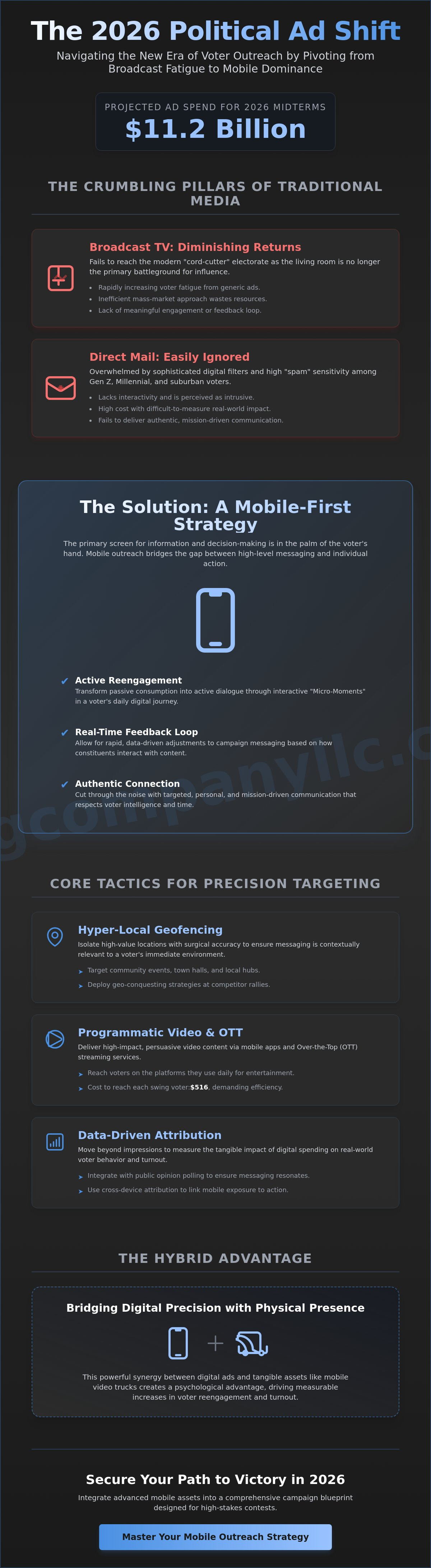
With political ad spending projected to reach a staggering $11.2 billion for the 2026 midterm cycle, the primary challenge isn't a lack of resources but the rapid decay of traditional influence. You've likely noticed that the once-reliable pillars of broadcast TV and direct mail are crumbling under the weight of voter fatigue and sophisticated digital filters. It's clear that reaching a modern electorate requires more than just a larger budget; it demands a strategic pivot toward mobile advertising for voters that respects the boundaries of the digital screen while capitalizing on physical presence.
We understand that the current regulatory environment, from Meta's final-week ad blocks to the FCC's February 2026 requirements for robotexts, creates a complex path for any campaign. This article provides a clear framework for mastering the evolving landscape of mobile outreach with data-driven strategies that bridge the gap between digital precision and physical impact. We'll examine the synergy between mobile-first targeting and physical assets to ensure your messaging drives measurable increases in voter reengagement and turnout.
Key Takeaways
Identify why traditional broadcast and mail channels fail to reach the 2026 "cord-cutter" electorate and how to pivot accordingly.
Implement hyper-local geofencing and programmatic video to achieve precision in mobile advertising for voters across community events and digital apps.
Discover the psychological advantage of a hybrid strategy that bridges digital messaging with a tangible, physical presence in the community.
Navigate the complex 2026 regulatory landscape with a framework for data integrity and state-specific disclosure requirements.
Integrate advanced mobile assets into a comprehensive campaign management blueprint designed to secure victory in high-stakes contests.
Table of Contents
The Evolution of Mobile Advertising for Voters in 2026
The 2026 election cycle marks a definitive break from the era of mass-market broadcasting. Traditional media channels, specifically linear TV and direct mail, no longer command the undivided attention of the electorate. As voters increasingly transition to "cord-cutter" lifestyles, the physical living room is no longer the primary battleground for political influence. Voters have changed. This shift toward mobile advertising for voters reflects a broader trend where the primary screen for information gathering and decision-making is held in the palm of the hand.
Mobile devices serve as a real-time feedback loop for campaign messaging, allowing for rapid adjustments based on how constituents interact with content. With campaigns projected to spend an average of $516 in video advertising to reach each persuadable swing voter in 2026, the margin for error is nonexistent. Efficiency is the only path to victory. Strategic mobile advertising for voters is the mechanism that bridges the gap between high-level messaging and individual action.
To better understand the role of mobile technology in modern elections, watch this report on how smartphones assist the electorate:
From Passive Consumption to Active Reengagement
The transition from passive consumption to active reengagement represents a fundamental shift in campaign strategy. Voters no longer simply receive messages; they interact with them through "Micro-Moments" throughout their daily digital journeys. Effective reengagement requires that these mobile touchpoints are not isolated events. Instead, they must be deeply integrated with public opinion polling services to ensure the messaging resonates with current sentiment. This data-driven approach transforms a standard ad into a strategic tool for dialogue, moving away from one-way broadcasting toward a more dynamic, two-way mobile interaction.
The 2026 Electorate: Mobile Habits and Expectations
The 2026 electorate is defined by high expectations for transparency and authenticity. Gen Z and Millennial voters, along with shifting suburban demographics, have developed high "spam" filters for traditional political rhetoric. To break through the noise, campaigns must utilize sophisticated targeted advertising techniques that feel personal rather than intrusive. A disruptive strategy is required to capture attention in an environment saturated with content. This means moving beyond generic appeals toward high-stakes, mission-driven communication that respects the voter's intelligence and time. Authenticity isn't a buzzword; it's a requirement for survival in a mobile-first world.
Core Tactics: Precision Targeting in the Mobile Space
Precision defines the modern path to victory. In 2026, the effectiveness of mobile advertising for voters rests on a campaign's ability to isolate high-value locations with surgical accuracy. We no longer rely on the broad, wasteful methods of previous cycles. Instead, we utilize hyper-local geofencing to engage voters exactly where they are; at community events, town halls, or local hubs. This tactical approach ensures that messaging is not just seen, but is contextually relevant to the voter’s immediate environment.
Programmatic video advertising complements this by delivering high-impact content via mobile apps and Over-the-Top (OTT) services. These tools allow for a sophisticated level of Mobile Technology and Public Outreach that was once reserved only for national budgets. By linking these mobile exposures to real-world behavior through cross-device attribution, campaigns can finally measure the tangible impact of their digital spend on actual voter turnout. It's about moving beyond impressions to focus on confirmed engagement.
Geofencing and Geo-Conquesting for Campaigns
The mechanics of geofencing involve setting virtual perimeters around strategic physical locations. When a voter enters this zone with a mobile device, they become eligible to receive targeted campaign content. For instance, a campaign might geofence a community center in Newark during a local forum to capture the attention of engaged citizens. Geo-conquesting takes this further by placing perimeters around a competitor’s rally, allowing you to provide a counter-narrative in real time. For these tactics to succeed, creative assets must be punchy, direct, and designed for immediate mobile consumption. Successful campaign management requires this level of disruptive, location-based intelligence.
Strategic SMS: Beyond the "Spam" Filter
Text-based communication remains one of the most direct ways to reach a voter, but it's fraught with regulatory hurdles. Navigating 10DLC regulations and carrier requirements in 2026 is mandatory to ensure deliverability. We focus on peer-to-peer (P2P) messaging that avoids the "spam" feel of automated broadcasts. These messages should feel personal and authoritative, serving as a trusted source of information for Get Out The Vote (GOTV) efforts. When integrated with broader mobile advertising for voters, SMS becomes a powerful finishing tool that drives the final push toward the ballot box. It's a high-stakes game where compliance and tone are just as important as the message itself.
Digital Precision vs. Physical Presence: The Hybrid Advantage
Modern campaigns often retreat into purely digital silos. This is a strategic error. While digital precision allows for efficient spending, a lack of physical presence can leave a candidate feeling detached from the community they seek to lead. There is a profound psychological weight to seeing a message in the physical world. It transforms an abstract digital advertisement into a grounded reality that suggests stability and commitment. By synergizing the SMG Video Truck with digital geofencing, we create a high-frequency environment that traditional digital-only strategies cannot match. This hybrid approach ensures that mobile advertising for voters is supported by a tangible, undeniable presence in the neighborhood.
The data suggests that physical visibility drives digital action. When a campaign establishes a physical footprint, branded search queries for the candidate often see a measurable spike within the targeted area. This isn't a coincidence. It's the result of a coordinated effort to dominate both the physical and digital horizons. We don't just want to be on the voter's phone; we want to be part of their physical environment. This dual-layered strategy forces the electorate to take notice in a way that easily ignored banner ads never could.
The SMG Video Truck: A Mobile Megaphone
The SMG Video Truck functions as a high-stakes tactical asset. Equipped with high-resolution LED displays and high-fidelity audio, these units are designed to command attention in high-traffic corridors across New Jersey and beyond. During the critical final 72 hours of a campaign, rapid-response messaging becomes the priority. The ability to deploy a physical asset to a specific neighborhood within hours allows for a level of agility that broadcast media cannot provide. It is a tool for community leadership that communicates power and presence simultaneously.
Retargeting the Physical Audience
The true advantage of this model lies in the data integration. We don't view the video truck as a standalone hardware solution. Instead, it serves as a beacon for mobile advertising for voters. By capturing anonymous device IDs from individuals in the vicinity of the physical asset, we can execute follow-up digital ads that reinforce the message seen on the street. This creates a seamless narrative arc. A voter sees the truck at a local intersection and later receives a programmatic video ad on their smartphone. This repetition bridges the gap between the "outdoor" experience and the "in-pocket" digital journey, ensuring the message remains top-of-mind until the ballot is cast.
Execution and Compliance: Navigating the 2026 Landscape
Success in 2026 requires more than just high-impact creative; it demands a rigorous adherence to a fragmented regulatory environment. Managing mobile advertising for voters involves navigating a patchwork of platform-specific restrictions and state-level mandates. For example, Meta reaffirmed in February 2026 that it will block new political ads in the final seven days before Election Day. Campaigns must have their assets live and gaining impressions before this window closes to maintain momentum. Compliance isn't a secondary concern. It's a strategic prerequisite for institutional influence.
Managing voter data with integrity is equally critical. With the FCC requiring prior permission for political robotexts to mobile phones as of February 27, 2026, the era of unsolicited digital "spam" is over. We prioritize privacy standards and secure electorate analysis to ensure every touchpoint is both legal and respectful. Budgeting for these efforts requires a balanced allocation. While Connected TV (CTV) is projected to see up to $2.9 billion in spending this cycle, physical mobile assets like video trucks provide the necessary "grounded" presence that digital-only spends lack. Measuring success moves beyond superficial "clicks" to track genuine sentiment shifts and projected turnout metrics.
Political Disclosure and Transparency
Transparency is the baseline for modern campaign credibility. Mandatory "Paid for by" disclosures are required for all digital and mobile video ads, yet platform rules vary significantly. Google and YouTube now require full identity and location verification, archiving all political content in a public Transparency Center. Additionally, as of March 2026, both Google and Meta mandate disclosures for any AI-generated or altered content. Several states, including California and Texas, have enacted similar laws. We ensure every asset meets these evolving standards, protecting the campaign from late-cycle legal challenges or platform bans.
Analyzing Mobile Campaign Performance
We analyze performance through the lens of voter reengagement rather than just reach. Key Performance Indicators focus on interaction depth and the correlation between ad exposure and ballot activity. By utilizing A/B testing in mobile creative, we refine the "win" message in real time to maximize impact. This granular mobile data doesn't exist in a vacuum. It directly informs the next round of public opinion polling, creating a cycle of continuous improvement. If you're ready to secure your presence in the 2026 cycle, contact our team to discuss a compliant, mobile-first strategy.
The SMG Approach: Building a Path to Victory
Victory in high-stakes political contests isn't achieved through isolated tactics; it's the result of a coordinated strategic architecture. SMG (Strategic Marketing Group) stands as the preferred partner for complex campaigns because we don't view digital tools as peripheral add-ons. Integrating mobile advertising for voters into a comprehensive campaign management blueprint is our standard. We move beyond basic impressions to focus on the hidden mechanics of influence, ensuring every digital touchpoint serves a broader mission of community leadership and electoral success.
Our firm brings a seasoned "insider" advantage to every engagement, backed by decades of experience across more than 40 states. This history allows us to anticipate shifts in voter sentiment before they manifest in standard data sets. We understand that a campaign is a living system. By treating mobile assets as dynamic extensions of your ground game, we bridge the gap between abstract data points and the physical reality of the ballot box. We don't just manage ads; we build the path to victory where others see only obstacles.
Strategic Architecture for Modern Campaigns
We view mobile technology as a sophisticated tool for navigating complex political systems. Our approach leverages a unique synergy between government relations strategy and digital advocacy. This disruptive lens allows us to identify emerging social trends that generic agencies often miss. By aligning your mobile presence with deep-rooted electorate analysis, we ensure your message remains authoritative and resilient. We focus on the broader impact of every action, creating a stable presence that commands respect from both constituents and institutional stakeholders.
Next Steps for Your Campaign
Preparation for the 2026 cycle begins with an honest assessment of your current operational readiness. We provide a comprehensive audit of your mobile assets to identify gaps in reach and compliance. From there, we develop a custom mobile-first voter outreach plan tailored to the specific nuances of your district. This isn't a one-size-fits-all solution; it's a precision-engineered strategy designed for high-stakes environments. If you're ready to move beyond traditional limitations, Contact SMG for a strategic consultation on your mobile voter outreach. Together, we'll ensure your campaign is positioned for a decisive outcome.
Securing Your Strategic Advantage in the 2026 Cycle
The 2026 political landscape demands a departure from outdated broadcasting models. Success requires a mastery of mobile advertising for voters that balances digital precision with a grounded, physical presence in the community. By integrating hyper-local geofencing with the innovative SMG Video Truck technology, your campaign can establish an undeniable presence that persists long after a voter puts their phone away. Navigating the complexities of 10DLC regulations and platform-specific ad blocks isn't just a hurdle; it's the foundation of a viable path to victory.
Led by seasoned political strategists like Lionel Leach, SMG brings an insider perspective honed through high-stakes contests in over 40 states. We don't just provide services. We architect the influence necessary to win in a fragmented media environment. It's time to move beyond the limitations of generic outreach and embrace a framework built for the modern electorate. Partner with SMG to deploy a data-driven mobile advertising strategy for your next campaign. Your path to community leadership and electoral success starts with a strategy that respects the gravity of the mission.
Frequently Asked Questions
Is mobile advertising for voters more effective than direct mail?
Mobile outreach offers a level of frequency and real-time engagement that static mailers cannot match. While direct mail often ends up discarded, mobile ads reach voters on the devices they check dozens of times per day. This approach allows for immediate data tracking and the ability to pivot messaging based on live interaction. It's a more agile and measurable alternative for the 2026 cycle.
Can I use geofencing to target specific neighborhoods or voting precincts?
Precision is the primary benefit of geofencing technology. Campaigns can draw virtual perimeters around specific precincts, community centers, or even individual street blocks to ensure messaging is contextually relevant. This surgical targeting minimizes wasted spend by focusing exclusively on the geographic areas most critical to your path to victory. It's an essential tool for local legislative or municipal contests.
How much does it cost to run a mobile advertising campaign for a local election?
Total investment depends on the geographic scope, the duration of the flight, and the specific mix of programmatic video and SMS. While some high-level platforms require significant minimum spends, local campaigns should evaluate their goals against current market rates for impressions and data. It's best to consult with a strategic partner to build a budget that aligns with your specific turnout objectives.
What are the legal requirements for political ads on mobile devices?
All mobile political content must include clear "Paid for by" disclosures to meet federal and state transparency mandates. Additionally, platforms like Google and Meta require identity verification and have strict rules regarding the disclosure of AI-generated content as of March 2026. Navigating these requirements is mandatory to avoid ad blocks or campaign suspensions during the critical final weeks of the election.
What happens if a voter opts out of SMS communications?
Campaigns must immediately cease all text-based outreach to any individual who requests to opt out. Under the FCC regulations effective February 27, 2026, respecting these requests is a legal requirement. Failure to manage your opt-out lists with integrity can lead to carrier-level blocking and significant regulatory penalties. It's vital to use a platform that automates this compliance to protect your campaign's reputation.
How does the SMG Video Truck integrate with digital advertising?
The video truck serves as a physical beacon that triggers digital reengagement. As the truck moves through high-traffic areas, it establishes a grounded presence that reinforces the mobile advertising for voters appearing on their smartphones. By capturing anonymous device data in the vicinity of the truck, we can serve follow-up digital ads to those same individuals. This creates a high-frequency narrative arc that spans both the physical and digital worlds.
Can mobile advertising help with voter reengagement for disenfranchised groups?
Mobile outreach is a powerful tool for reaching populations that have moved away from traditional news sources. By delivering authentic, mission-driven content directly to the primary screen used by these voters, campaigns can bypass the noise of broadcast media. This direct line of communication is often the most effective way to address specific community concerns and drive turnout in areas where traditional outreach has failed.
What is the best way to measure the ROI of mobile political ads?
True ROI is measured by correlating digital engagement with precinct-level turnout and shifts in public sentiment. While "clicks" provide a baseline, we focus on how mobile interactions translate into actual movement at the ballot box. By integrating mobile data with periodic polling, campaigns can see a clear picture of how their digital spend is influencing the electorate's decision-making process in real time.
Comments