
How to Write a Campaign Plan: A Strategic Blueprint for 2026 Success
- lionelleach
- May 17
- 12 min read

Updated: Jun 18
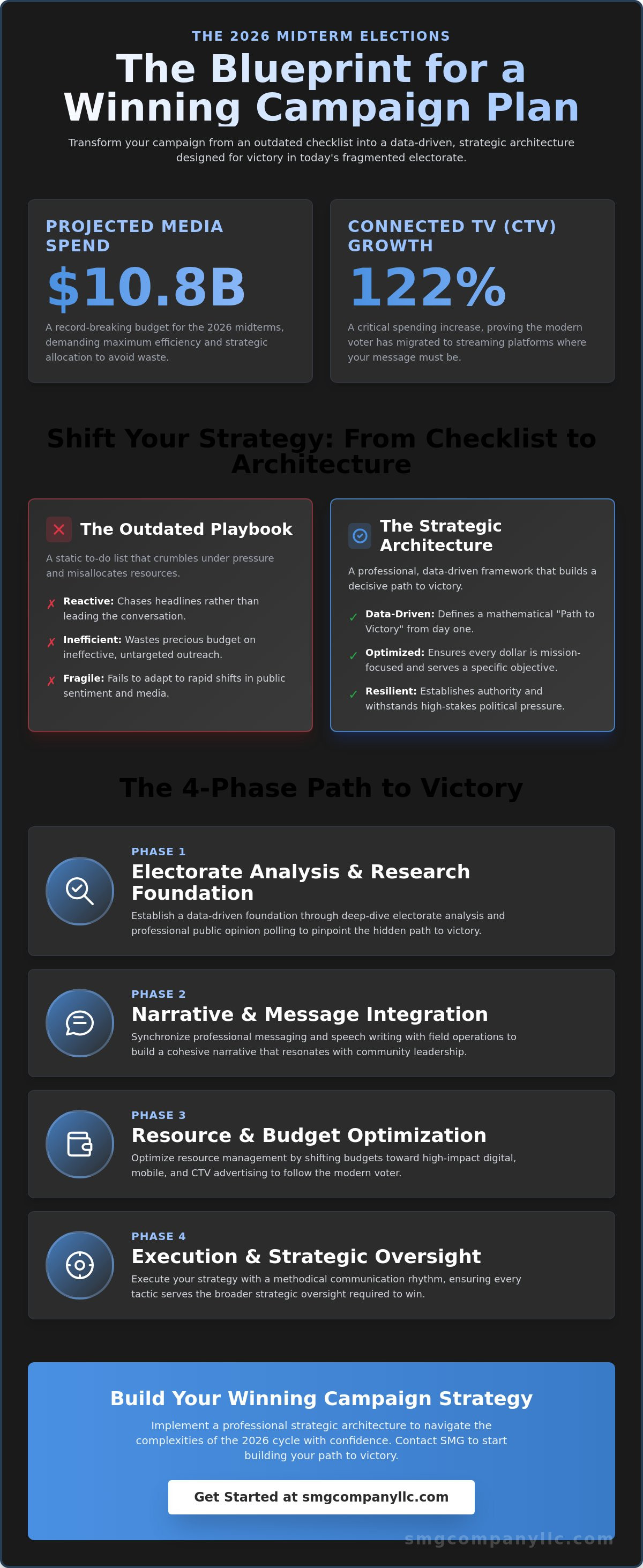
With political media spending projected to reach a record $10.8 billion for the 2026 midterms, can your organization afford to rely on an outdated playbook? You're likely facing the daunting reality of a fragmented electorate and the legitimate fear of exhausting your budget on outreach that fails to move the needle. Mastering how to write a campaign plan is no longer a matter of simple logistics; it's about constructing a strategic architecture that transforms raw data into a decisive path to victory. We understand the pressure of competing against established incumbents who possess deep pockets and institutional advantages.
This article provides the professional blueprint you need to navigate the complexities of the 2026 cycle with confidence. You'll learn to master the architecture of a winning campaign through disciplined electorate analysis and strategic budget allocation. We'll examine the critical shift toward Connected TV, which is expected to see a 122% spending increase, and explain how to maintain messaging integrity under new AI disclosure regulations. From your first public opinion poll to the final GOTV push, this guide offers a clear roadmap to ensure your vision translates into measurable success at the ballot box.
Key Takeaways
Identify the critical distinction between an administrative checklist and a strategic architecture when learning how to write a campaign plan that wins.
Establish a data-driven foundation through deep-dive electorate analysis and public opinion polling to pinpoint the hidden path to victory.
Synchronize professional messaging and speech writing with field operations to build a cohesive narrative that resonates with community leadership.
Optimize resource management by shifting budgets toward digital and mobile advertising to follow the modern voter’s migration to streaming and connected platforms.
Execute your strategy with a methodical communication rhythm, ensuring every tactic serves the broader strategic oversight required for the 2026 cycle.
Table of Contents
Beyond the Template: Why Most Campaign Plans Fail Early
Most candidates treat their initial strategy as a simple to-do list. They fill out a template and assume the work is finished. However, a professional campaign plan is a sophisticated strategic architecture, not an administrative checklist. In the volatile 2026 environment, where media fragmentation and regulatory shifts are constant, static plans often crumble before the first primary. Understanding how to write a campaign plan requires a commitment to structural integrity that can withstand high-stakes pressure and rapid shifts in public sentiment.
We look at data through a disruptive lens. This approach challenges the political status quo by identifying the hidden mechanics of influence. Before writing a single tactic, a campaign must define its "Path to Victory." This is the cold, mathematical reality of where your votes will come from and how much they will cost to secure. Without this foundation, you aren't running a campaign; you're simply participating in an expensive exercise in hope.
Review this step-by-step guide to visualize the transition from planning to execution:
The Cost of Poor Planning in High-Stakes Contests
Misallocated resources are the primary cause of failure in local and state races. When a campaign lacks a data-driven foundation, it falls into the trap of reactive decision-making. This erosion of strategy forces candidates to chase headlines rather than lead conversations. Reactive movements waste precious budget on ineffective outreach, which is particularly dangerous when total political media spending is projected to exceed $10.4 billion in 2026. A mission-driven, formal strategic register ensures that every dollar spent serves a specific, documented objective rather than an emotional response to an opponent's move.
Defining Your Campaign's Core Mission
Authority is established through a declarative mission statement. This is not a collection of platitudes; it's a professional statement of intent that aligns civic duty with community leadership goals. A campaign must project a steady, professional demeanor to be taken seriously by the electorate and institutional influencers. By grounding the mission in a profound respect for governance, you create a persona that is both intellectually formidable and socially rooted. This clarity of purpose allows the campaign to navigate complex systems with precision, ensuring that the candidate is viewed as a seasoned leader ready for the gravity of public office.
Phase 1: Electorate Analysis and the Research Foundation
Victory begins with a cold assessment of the landscape. While many candidates start with a list of tasks, those who understand how to write a campaign plan start with raw intelligence. The foundation of any successful run is a deep-dive electorate analysis that uncovers the "hidden" swing vote. These aren't just undecided voters; they're specific segments of the population whose behavior is influenced by shifting social trends and local institutional power. In diverse urban centers like Newark, the research foundation must account for multi-generational households and the specific, trusted communication channels they utilize. Standard digital metrics often fail to capture the influence of local community leaders, making a disruptive lens essential for accurate forecasting.
Establishing a baseline is the first move in a high-stakes contest. It is impossible to measure progress without a clear understanding of where you stand on day one. Utilizing professional public opinion polling services allows a campaign to capture initial sentiment before a single dollar is spent on outreach. This data doesn't just show who supports you; it reveals the legislative and social trends that will define the 2026 cycle. A campaign that fails to establish this baseline is essentially navigating without a map; securing professional public opinion polling services is the first step toward strategic dominance.
The 5 Steps of Data-Driven Voter Research
A methodical approach to research prevents the waste of precious resources. Follow these steps to build your foundation:
Step 1: Establish a benchmark political poll to gauge initial sentiment and name recognition.
Step 2: Segment the electorate by behavior and values rather than relying on broad demographics.
Step 3: Test message effectiveness through digital tracking to see which narratives actually trigger engagement.
Step 4: Analyze historical voter reengagement patterns, accounting for the 2026 Meta ad blackout period that will restrict late-stage digital persuasion.
Step 5: Synthesize these findings into a functional "Path to Victory" document that dictates every future tactic.
Navigating the Hidden Mechanics of Influence
Electorate analysis is the study of social dynamics and institutional power. Beyond the individual voter, you must understand the institutional influence that shapes public trust. Gatekeepers in state and local government structures don't just hold authority; they define the boundaries of the political conversation. Identifying these gatekeepers allows a campaign to build a path to victory where others see obstacles. By mapping these hidden mechanics, you can align your mission with the existing pulse of the community, ensuring your campaign is both intellectually formidable and socially rooted.
Crafting the Narrative: Integrating Message with Field Strategy
A campaign narrative acts as the connective tissue between high-level strategy and local engagement. It's not enough to possess a message; that message must be synchronized with every field interaction to maintain narrative control. When determining how to write a campaign plan, you must ensure your speech writing and messaging efforts aren't isolated from the ground game. A sophisticated vocabulary that resonates with community leadership establishes authority, while a grounded approach ensures the candidate remains socially rooted in the pulse of the community.
We utilize the SMG Video Truck to provide a disruptive advantage in high-traffic areas. This mobile media asset reinforces the ground game by bringing high-impact visuals directly to the electorate, creating a sense of momentum that traditional static ads cannot replicate. It's a functional approach where statements of capability are followed by the broader impact of those actions, ensuring a constant presence that challenges the status quo. This synergy between physical presence and professional messaging is what distinguishes a seasoned campaign from an amateur effort.
Strategic Messaging and Narrative Control
Control the conversation by moving from breathless hype to authoritative, declarative messaging. This shift establishes credibility and clarity, which are essential for serious governance. Your plan should include a Strategic Communications calendar that maps out 2026 milestones, allowing for a methodical and purposeful communication rhythm. Crisis communications must be pre-planned, providing a professional-grade messaging strategy that handles multifaceted challenges with precision. This proactive stance ensures that the campaign dictates the terms of engagement rather than reacting to external pressures or opponent maneuvers.
Building a Modern Ground Game
Modern field operations require more than just door knocking. Implementing voter reengagement strategies via Voice and Text Broadcasting allows for rapid, scalable outreach that supports the broader mission. These tools ensure that your message reaches voters through their most personal devices, providing a stable and continuous presence in a fast-moving environment. Digital & Mobile Advertising further supports field teams by geofencing key events and community hubs, ensuring that the ground game is reinforced by a data-driven digital layer. This multi-channel approach guarantees that your campaign remains deeply connected to the pulse of the community while maintaining a high-level strategic outlook.
Resource Management: Budgeting for Digital and Ground Game
Strategic resource allocation is the hallmark of a seasoned campaign. In the current environment, budgeting must move past traditional percentages and toward a model of data-driven precision. When determining how to write a campaign plan, your financial blueprint must account for the massive migration of voters to streaming and mobile platforms. Total political media spending is projected to reach $10.8 billion in 2026, meaning your capital must be deployed with surgical efficiency to avoid being drowned out by high-volume competitors. Every dollar should be tied to a specific metric from your initial electorate analysis, ensuring that your financial strategy serves your path to victory.
Specialized assets like the SMG Video Truck justify their cost by providing a disruptive physical presence that traditional media cannot match. While broadcast TV spending is expected to drop by 13% from 2024 levels, the demand for high-impact, local visibility remains high. A mobile video asset allows a campaign to dominate the visual landscape in specific congressional or state legislative districts without the waste of broad-market buys. This functional approach to budgeting prioritizes efficiency, allowing for a steady and reliable momentum that lasts from the filing deadline through Election Day.
The 2026 Digital Media Spend Allocation
Digital advertising in 2026 requires a journalistic and narrative style to bypass voter fatigue and establish deep-rooted credibility. With Connected TV (CTV) spending projected to hit $2.7 billion, campaigns must budget for high-quality video production that meets the sophisticated standards of streaming audiences. Compliance is another critical budget line; you must allocate funds for identity verification processes on Google and the management of "Paid for by" disclosures across all platforms. Budgeting for mobile-based voter outreach is a strategic necessity for any candidate seeking to maintain a constant presence in the 2026 political cycle.
Staffing and Management Fees
Structuring management fees for high-stakes political contests requires a focus on strategic counsel rather than just administrative labor. A campaign plan should utilize monthly retainer structures to manage the lifecycle of the contest, providing stability for the candidate and the consulting team. Full-service partners often reduce long-term campaign overhead by consolidating multifaceted challenges, such as integrating Digital & Mobile Advertising with Voice and Text Broadcasting, under a single strategic architect. This consolidation ensures that the emotional register of the campaign remains formal and mission-driven across every channel. For those ready to build a data-driven financial blueprint, our campaign management experts provide the seasoned authority needed to navigate these complex systems.
From Blueprint to Victory: Execution and Strategic Oversight
Execution is the test. It requires precision. Strategy dictates action. When finalizing how to write a campaign plan, you must account for the shift from theoretical modeling to active tactical deployment. This phase requires a methodical and purposeful communication rhythm that avoids the frantic energy of amateur operations. Instead, a successful campaign maintains a steady, reliable momentum that suggests stability and continuous presence. This stability is particularly vital as you navigate the final seven days of the 2026 cycle, during which Meta will block all new political and issue advertisements. You can't rely on last-minute digital pivots; you must rely on the architecture you've already built.
Ongoing legislative monitoring ensures your strategy remains relevant as the governance landscape shifts. A campaign isn't a static document. It's a living system. Understanding how to write a campaign plan as a dynamic architecture allows for the strategic flexibility needed to counter an incumbent's late-stage maneuvers. By analyzing real-time shifts in voter trust and institutional influence through mid-campaign persuasion polling, you can refine your messaging to ensure it continues to resonate with community leadership. This data-driven oversight allows you to close the loop, successfully transitioning a campaign victory into a long-term governing strategy that respects the gravity of public office.
The Rhythms of a Winning Campaign
A professional-grade operation moves from broad assertions of identity to specific evidence of activity. This progression builds credibility with the electorate and suggests a firm capable of handling multifaceted challenges. Maintaining a calm, ongoing momentum is essential to avoid late-stage panic, which often leads to the waste of budget on ineffective outreach. This is where a full-service partner becomes indispensable. By integrating Campaign Management with Government Relations Strategy, you ensure that every tactical move, from a voice broadcast to a mobile video truck deployment, is synchronized with the broader strategic outlook. It's a functional approach that prioritizes efficiency and establishes a history of high-stakes success.
Finalizing Your Path to Victory
The final test of any plan is the Strategic Architect test: does the blueprint lead to a predictable and repeatable win? A truly effective plan doesn't just secure a seat; it establishes a legacy of community leadership and civic duty. It positions the candidate as a seasoned insider who understands the hidden mechanics of influence and knows how to navigate obstacles that others find insurmountable. Establishing this foundation requires a profound respect for local engagement and a commitment to data-driven precision. For those seeking a professional New Jersey blueprint, engaging with seasoned experts ensures your path to victory is built on a foundation of deep-rooted expertise and strategic confidence.
Securing Your Strategic Advantage in 2026
The 2026 cycle won't reward those who rely on outdated templates or reactive tactics. Success requires a transition from simple administrative checklists to a robust strategic architecture that anticipates regulatory shifts and media fragmentation. By grounding your efforts in rigorous electorate analysis and professional polling, you've established a baseline that dictates every future move. We've examined how integrating sophisticated messaging with high-impact assets like the SMG Video Truck creates a presence that challengers can't ignore. Mastering how to write a campaign plan is the fundamental step toward transforming your vision into a governing reality.
Led by nationally recognized political operatives with experience in over 40 states, our firm provides the deep-rooted expertise required for high-stakes victory. We leverage innovative mobile video and digital assets to ensure your message penetrates the noise of a record-breaking media landscape. Partner with the strategic architects at SMG to build your winning blueprint today. Your commitment to community leadership deserves a path to victory built on precision and seasoned authority. We look forward to helping you navigate the complexities of the upcoming election cycle with confidence.
Frequently Asked Questions
How long does it take to write a comprehensive political campaign plan?
Developing a professional architecture typically requires four to eight weeks of intensive research and strategic modeling. This timeline accounts for the initial electorate analysis, public opinion polling, and the synchronization of messaging with field operations. Starting early is essential to ensure every tactic is data-driven rather than reactive.
Can a campaign plan be changed once the election cycle has started?
A strategic blueprint must be dynamic and responsive to shifting public sentiment and mid-campaign persuasion polling. While the core mission remains stable, tactical adjustments are necessary to counter opponent maneuvers or regulatory changes. Professional oversight ensures these adaptations maintain the campaign's structural integrity without succumbing to late-stage panic.
What is the most important part of a campaign plan for a local race?
The "Path to Victory" document is the most critical element of a local campaign plan. It identifies the specific voter segments and community hubs required to achieve a winning margin. In local contests, understanding the hidden mechanics of institutional influence and local gatekeepers often outweighs broad-market advertising.
How much should I budget for digital vs. traditional outreach in 2026?
Budget allocation should follow the migration of the electorate toward mobile and streaming platforms. For the 2026 cycle, many campaigns are directing a significant portion of their media spend toward digital and Connected TV assets to mirror voter behavior. Traditional channels still hold value for specific demographics, but mobile-first outreach is now a strategic requirement for maintaining a constant presence.
Is a campaign plan different for a non-profit advocacy group?
Advocacy plans focus on long-term institutional influence and policy shifts rather than a single election day deadline. While the fundamentals of how to write a campaign plan remain similar, the metrics of success involve legislative milestones and sustained public sentiment shifts. These organizations prioritize government relations strategy to navigate complex regulatory systems over time.
What happens if my opponent's polling data contradicts my own?
Contradictory data requires a disruptive lens to identify potential biases in methodology or sample selection. You should rely on your internal benchmark and track polls, as these are tailored to your specific strategic objectives. Professional public opinion polling provides the seasoned authority needed to filter out noise and focus on actionable voter behavior.
How do I ensure my campaign plan complies with local New Jersey regulations?
Compliance requires a methodical review of the New Jersey Election Law Enforcement Commission (ELEC) guidelines. Campaigns must ensure all digital, voice, and text broadcasts include the necessary "Paid for by" disclosures. It's advisable to consult with a professional campaign management partner who understands the specific reporting cycles and transparency rules for the region.
Can I write a campaign plan without professional polling data?
Attempting to build a blueprint without raw intelligence is a high-stakes gamble that often leads to misallocated resources. Without a benchmark poll, you lack a factual baseline to measure message effectiveness or voter reengagement patterns. Professional polling is the foundation that transforms a simple checklist into a winning strategic architecture when learning how to write a campaign plan that actually succeeds.
Comments