
How to Run for Mayor in New Jersey: 2026 Strategic Guide
- lionelleach
- 7 days ago
- 12 min read

In the Garden State, the path to the mayor’s office is often paved with bureaucratic traps designed to disqualify the unprepared before the first vote is even cast. You likely recognize that winning requires more than just a vision for your municipality; it demands a mastery of the institutional mechanics that govern our local elections. Understanding how to run for mayor in New Jersey means navigating a landscape where a single technical error on a petition or a misunderstanding of "home rule" powers can end a candidacy prematurely.
This strategic guide provides the blueprint you need to master the legal hurdles and logistical demands of the 2026 election cycle. You'll gain a clear roadmap to ballot access that accounts for the new signature requirements under law A-5117 and the latest ELEC contribution limits. We'll preview the essential steps for building a professional campaign network, from managing partisan filing deadlines in March to executing a data-driven strategy that turns public sentiment into a decisive victory.
Table of Contents
Understanding NJ Municipal Structures and Candidate Eligibility
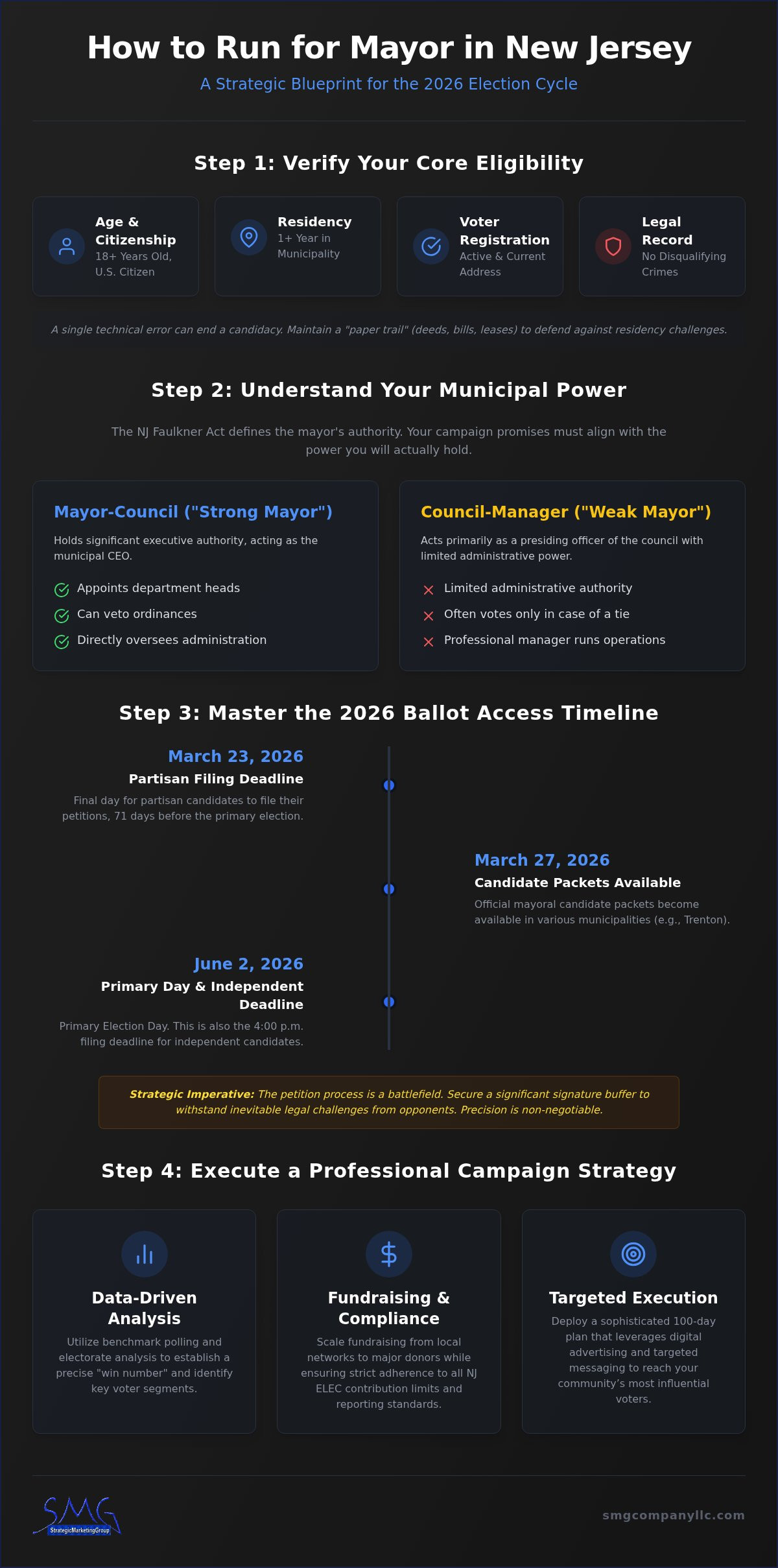
Before you launch a campaign, you must verify your fundamental eligibility. New Jersey law requires all mayoral candidates to be at least 18 years of age and citizens of the United States. Crucially, you must have been a resident of your specific municipality for at least one full year prior to the election date. Your voter registration must also be active and reflect your current address within that district. Failing to meet these baseline requirements provides opponents with an immediate opportunity for a legal challenge that could end your run before it starts.
Legal eligibility also extends to your personal record. Candidates can be disqualified under the "Crimes Involving Moral Turpitude" clause. This provision is often interpreted broadly in New Jersey politics; it can include various offenses that suggest a lack of honesty or integrity. If you are serious about learning how to run for mayor in New Jersey, a thorough self-audit of your legal and financial history is a non-negotiable first step. Transparency at this stage prevents devastating opposition research from surfacing in the final weeks of the race.
To better understand how these requirements play out in a high-stakes environment, watch this report on mayoral candidates in one of the state's largest cities:
Faulkner Act vs. Traditional Forms of Government
New Jersey's local governance is famously complex. The New Jersey Municipal Structures framework includes five types of government and twelve distinct forms. The Faulkner Act, or the Optional Municipal Charter Law, allows towns to choose between several models, most notably the Mayor-Council and Council-Manager forms. In a Mayor-Council "Strong Mayor" system, you hold significant executive authority, including the power to appoint department heads and veto ordinances. Conversely, in a Council-Manager "Weak Mayor" system, the mayor is often a presiding officer of the council with limited administrative power. Understanding this distinction is vital for your messaging. You don't want to promise executive actions you won't actually have the power to take once you're in the office.
Residency and Domicile Requirements
The 12-month residency requirement is a frequent target for litigation. Opponents will scrutinize your utility bills, tax records, and driver’s license to prove you haven't lived in the town long enough. To insulate your candidacy, maintain a "paper trail" of residency. This includes property deeds, lease agreements, and records of community involvement. If your domicile is questioned, having a robust file of documentation can prevent a costly and distracting court battle. Knowing how to run for mayor in New Jersey requires a defensive strategy that protects your spot on the ballot from the very beginning.
Navigating the Petition Process and Ballot Access
Securing a place on the ballot is the first true test of a campaign's operational capacity. If you're learning how to run for mayor in New Jersey, you must recognize that the petition process isn't just an administrative task; it's a strategic battlefield where technicalities can end a movement before the first vote is cast. Precision in this phase is the difference between a viable candidacy and a dismissed application.
For the 2026 cycle, the calendar dictates your pace of play. Partisan candidates must navigate a tighter window than those running as independents. Reviewing the official NJ Candidate Petition Process early ensures your team isn't scrambling as deadlines approach. Key dates for the 2026 cycle include:
March 23, 2026: Petition filing deadline for partisan candidates (71 days before the primary).
March 27, 2026: Mayoral candidate packets become available in municipalities like Trenton.
June 2, 2026: Primary Election Day and the 4:00 p.m. filing deadline for independent candidates.
Partisan Primaries vs. Non-Partisan Municipal Races
New Jersey features a unique "Line" system in partisan primaries. Running on the county-endorsed line provides a significant statistical advantage, often dictating the winner of the June 2 Primary. Non-partisan races, often held in May, remove party labels but increase the pressure on individual brand building. Whether you're navigating a Newark May election or a November partisan contest, your ballot slogan must be both legally compliant and punchy. It’s your first opportunity to define your platform in six words or less. Professional campaign management ensures your slogan resonates while meeting strict statutory guidelines.
Securing and Defending Your Signatures
Under the new law (A-5117/S-3994) effective February 2025, signature requirements are based on census population. For cities over 100,000 residents, you need 100 signatures. For smaller towns under 2,500, the requirement is only five. However, the statutory minimum is a floor, not a ceiling. Opponents routinely use "signature stripping" to disqualify candidates, challenging signers based on non-registration, incorrect ward placement, or illegible handwriting. We recommend a 50% cushion. If you need 100 signatures, don't stop until you have at least 150. This surplus acts as a strategic shield during the inevitable challenge period. Understanding these technical nuances is the core of how to run for mayor in New Jersey successfully.
Strategic Foundation: Polling and Electorate Analysis
Securing a spot on the ballot is a logistical victory; winning the mayor’s office is a strategic one. Many candidates fail because they're relying on anecdotal evidence or "gut feelings" rather than hard data. If you want to master how to run for mayor in New Jersey, your first investment should be a benchmark political poll. This initial survey establishes your baseline name recognition, identifies the community's most pressing concerns, and tests your potential vulnerabilities before your opponents do.
Success in the Garden State depends on identifying your "Win Number." This is the precise number of votes required to secure a majority or plurality in your specific municipality. By analyzing historical turnout from the 2022 and 2024 cycles, we can project the likely 2026 turnout. Knowing whether you need 3,000 votes in a small borough or 30,000 in a major city dictates every resource allocation decision you make, from mailers to canvassing routes. In competitive non-partisan races, like the 2025 Jersey City contest where the winner secured 29% in a crowded field, understanding these thresholds is the difference between making a runoff and being eliminated.
The Power of Electorate Analysis
Voter behavior in New Jersey is rarely uniform across a municipality. Modern electorate analysis allows you to segment the population by ward, neighborhood, or demographic profile. Newark’s diverse wards require vastly different messaging than the suburban enclaves of Morris or Bergen Counties. Data shows that the economy was the top issue for 52% of New Jersey voters in the 2025 gubernatorial election. Effective analysis identifies which specific households are most likely to prioritize economic issues over local development or public safety, ensuring your message reaches the right door at the right time.
Message Testing and Public Opinion
Your "Why I am Running" narrative must be tested against current public sentiment. High-level political messaging services allow you to refine your platform based on what actually moves the needle with undecided voters. As you build your platform, you must also maintain strict ELEC Compliance for NJ Candidates regarding how you fund these strategic efforts. Tracking sentiment throughout the 2026 cycle ensures your campaign remains agile. If a local issue suddenly shifts public opinion, your polling data will tell you how to pivot your messaging without appearing reactionary or inconsistent. It's the only way to maintain a stable lead in a fast-moving political environment.
Campaign Infrastructure, Fundraising, and ELEC Compliance
Establishing a robust campaign infrastructure is the primary requirement for moving from a candidate of intent to a candidate of consequence. While your platform provides the vision, your campaign's organizational framework ensures that vision reaches the electorate effectively and legally. Mastering how to run for mayor in New Jersey requires a rigorous commitment to administrative precision, particularly regarding financial disclosures and field operations. A single reporting oversight can result in substantial fines and a narrative of mismanagement that opponents will quickly weaponize.
Your finance committee must evolve quickly beyond a "friends and family" network. To compete in the 2026 cycle, you need a strategy that targets major donors and institutional influences. This requires a methodical approach to fundraising that respects the gravity of New Jersey’s revised campaign finance laws. Building this committee early allows you to secure the capital necessary for the high-intensity final weeks of the race, where visibility and rapid-response messaging are most expensive.
ELEC Compliance and Financial Transparency
Compliance begins with the New Jersey Election Law Enforcement Commission (ELEC). Under the Elections Transparency Act, the regulatory landscape has shifted. For the 2026 mayoral cycle, the individual contribution limit is $5,500 per election to a candidate committee. Furthermore, you're required to report all contributions exceeding $200. Appointing a qualified treasurer and opening a dedicated campaign account are non-negotiable first steps. You must also navigate the updated reporting timelines; while certain expenditures now follow a 72-hour notice rule, all contributions received in the final week before the election must be reported within 24 hours. Ensuring every piece of literature includes the mandatory "Paid for by" disclaimer is a basic but vital component of maintaining legal standing.
Building a Modern Ground Game
A sophisticated ground game in New Jersey’s high-density municipal areas integrates traditional door-knocking with digital precision. Canvassing remains the most effective tool for voter reengagement, but it must be data-driven to avoid wasting resources on low-propensity households. We recommend pairing your physical field efforts with targeted digital advertising for campaigns. This dual-track approach ensures your narrative follows the voter from their doorstep to their mobile device, reinforcing personal connections through geofencing and mobile ad placements. Integrating these tactics allows you to reach voters who feel disconnected from local government, converting passive sentiment into active support on election day.
Professional infrastructure is the difference between a campaign that struggles and one that succeeds. Partner with SMG for comprehensive campaign management to ensure your 2026 mayoral bid is built on a foundation of strategic confidence and regulatory precision.
Strategic Execution: Winning the 2026 Mayoral Race
Victory in the Garden State isn't an accident of personality; it's the result of a disciplined 100-day execution plan. Once your petitions are filed and your infrastructure is set, the transition from candidate to frontrunner requires a shift in focus toward high-impact visibility and voter persuasion. Knowing how to run for mayor in New Jersey means recognizing that the final three months of the campaign are a high-stakes sprint where every resource must be deployed with surgical precision. A "vanity run" focuses on activity, but a winning campaign focuses on movement and measurable influence.
The 100-day plan begins by synchronizing your ground efforts with a sophisticated digital presence. In the 2026 cycle, the ability to dominate the digital conversation will separate the winners from the also-rans. This phase is about more than just presence; it's about control. By utilizing strategic political campaign management, you ensure that your message isn't just heard, but that it overrides the noise of your opponents. This is the period where your "Win Number" becomes the singular metric of success, driving every decision from the first mobile ad to the final GOTV push.
Cutting Through the Noise in NJ Politics
New Jersey’s political environment is notoriously crowded. To win, you must develop a disruptive narrative that challenges the status quo while maintaining professional credibility. We utilize Digital & Mobile Advertising to place your message directly into the hands of voters through targeted geofencing. This allows your campaign to "follow" high-propensity voters as they move through their daily lives. In high-traffic urban centers like Newark or Trenton, we deploy the SMG Video Truck to provide high-impact, mobile visibility that traditional billboards can't match. This innovative outreach creates a sense of momentum and inevitability that is vital for persuading undecided voters in the final weeks.
The Final Push: GOTV (Get Out The Vote)
The final 72 hours of the 2026 campaign are dedicated to execution. A robust Get Out The Vote (GOTV) plan ensures that every supporter you've identified actually reaches the polls. We utilize Voice and Text Broadcasting to deliver last-minute reminders and logistical information directly to your base, cutting through the fatigue of a long election cycle. Your closing messaging must be sharp, focused on the core community pain points identified in your initial polling. By the time the polls open on June 2, 2026, or the November general election, your campaign should be a well-oiled machine capable of converting months of data and strategy into a decisive electoral victory. Mastering how to run for mayor in New Jersey concludes with the successful mobilization of an informed and motivated electorate.
Securing Your Path to New Jersey’s Executive Leadership
Success in the 2026 mayoral cycle requires more than community support; it demands a rigorous adherence to the state's evolving legal standards and a data-driven approach to voter engagement. You've seen that mastering the nuances of the Faulkner Act and the updated petition signature requirements is merely the entry point. The true challenge of how to run for mayor in New Jersey lies in your ability to convert sophisticated electorate analysis into a mobile, persuasive narrative that survives the final 72-hour push.
SMG brings a history of high-stakes success to your campaign, combining deep-rooted Newark expertise with a statewide perspective. Our team of seasoned insiders understands the hidden mechanics of influence and provides the precision polling necessary to navigate complex political landscapes. Partner with SMG for your 2026 Mayoral Campaign Strategy to ensure your bid for office is built on a foundation of strategic confidence and institutional knowledge. The path to the mayor's office is complex, but with the right architectural blueprint, your vision for your community can become a reality.
Frequently Asked Questions
What are the basic qualifications to run for mayor in New Jersey?
You must be at least 18 years old, a United States citizen, and a registered voter in the municipality where you seek office. New Jersey law mandates that you maintain residency in that municipality for at least one full year before the election date. Failing to meet these baseline criteria results in immediate disqualification if your residency or registration status is challenged by an opponent during the filing period.
How many signatures do I need for a mayoral petition in NJ?
Signature requirements were updated in February 2025 under law A-5117 and are based on census population. For municipalities with over 50,000 residents, you need 100 signatures; smaller towns under 2,500 residents require only five. We always advise securing a 50% surplus beyond the statutory minimum to protect your candidacy against technical challenges. This buffer ensures you remain on the ballot even if some signatures are invalidated.
What is the difference between a partisan and non-partisan municipal election?
Partisan elections involve a June primary where candidates run under a political party label, while non-partisan elections typically occur in May without party affiliations. Non-partisan races, common in cities like Newark, often require runoffs if no candidate secures a majority of the vote. Understanding these distinct cycles is a core part of learning how to run for mayor in New Jersey successfully as you build your 2026 timeline.
Do I need a treasurer to run for mayor in New Jersey?
Yes, New Jersey law requires every candidate to appoint a treasurer and open a dedicated campaign bank account before receiving contributions or making expenditures. Your treasurer is responsible for maintaining precise financial records and ensuring all reports are filed with the Election Law Enforcement Commission. This role is a critical component of your campaign's legal infrastructure and helps you avoid costly administrative fines for non-compliance.
Can I run for mayor if I have not lived in the town for a full year?
No, the one-year residency requirement is a strict statutory mandate that cannot be bypassed. You must be able to prove you have lived in the municipality for 12 consecutive months leading up to the election date. Opponents frequently use property records, tax filings, and utility bills to challenge candidates who don't meet this domicile standard. If your residency is in question, it's vital to gather documentation early.
What is NJ ELEC and why does it matter for my campaign?
NJ ELEC refers to the New Jersey Election Law Enforcement Commission, the state agency responsible for monitoring campaign finance and transparency. It ensures integrity in the electoral process by requiring periodic financial disclosures from all candidates. Compliance is mandatory; failing to report contributions over $200 or missing filing deadlines can lead to significant penalties. Staying compliant with ELEC regulations is essential for maintaining the professional reputation of your campaign.
How much does it cost to run a successful mayoral campaign in NJ?
Expenditure requirements depend heavily on the population of your municipality and the intensity of the opposition. Data from the 2025 legislative cycle showed an average expenditure of $364,329 per seat, highlighting the increasing cost of victory in New Jersey politics. A successful 2026 bid for how to run for mayor in New Jersey requires a budget that prioritizes data-driven polling and high-impact digital outreach to reach a critical mass of voters.
What is "The Line" in New Jersey politics and how does it affect my race?
"The Line" refers to the specific ballot column or row occupied by candidates endorsed by the county political party organization. In partisan primaries, candidates on the line enjoy a distinct statistical advantage over those placed in less favorable ballot positions. Securing this placement is often the most important strategic goal for partisan mayoral hopefuls, as it signals institutional support to the most reliable primary voters.
Comments