
How to Choose a Campaign Management Company in 2026

A long service list doesn’t make a campaign partner. The right campaign management company should show how its work fits together, from understanding voter priorities to coordinating communications and field operations. That matters when you’re deciding what to manage in-house, what to bring in externally, and how to keep campaign activity aligned.
It’s reasonable to compare firms by their capabilities. But a roster of separate vendors can leave your campaign responsible for connecting strategy, research, messaging, advertising, and execution. A strategic partner should explain how those functions support your race, who is responsible for each one, and how progress will be assessed.
This guide offers a practical framework for evaluating campaign management firms in 2026. You’ll learn how to identify the capabilities your race needs, assess whether a firm can connect polling and electorate analysis with communications and field work, and ask questions that reveal how its team plans and reports on activity. The goal is to help you choose a partner suited to your campaign, not simply the firm with the longest service list.
Table of Contents
What Does a Campaign Management Company Actually Do?
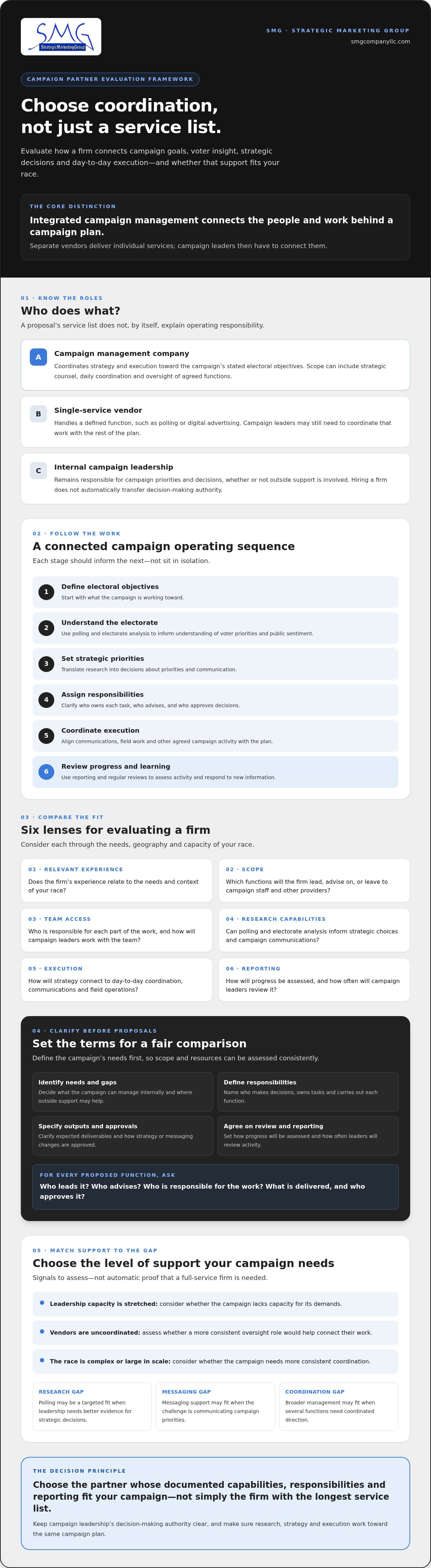
A campaign management company coordinates strategy and execution toward a campaign’s stated electoral objectives. Its role is to connect campaign goals with the people, resources, and activities needed to pursue them. Work may include strategic counsel and daily coordination, but hiring a firm does not automatically transfer the candidate’s or campaign leadership’s decision-making authority.
Political consulting can range from focused advice to broad strategic support. A single-service vendor typically handles a defined function, such as polling or digital advertising. Internal campaign leaders remain responsible for the organization’s priorities and decisions, whether or not outside support is involved. Understanding how campaigns combine structure and tactics, including the range of political campaign strategies, helps clarify why coordination matters.
Integrated campaign management connects the people and work behind a campaign plan; separate vendors deliver individual services that campaign leaders must coordinate. The distinction is about operating responsibility, not the number of services listed in a proposal. Scope varies by firm and race, so confirm who makes decisions, who carries out each task, and what deliverables and reporting the agreement includes.
Which campaign functions can a management firm oversee?
Depending on the agreed scope, campaign management may include budgeting, staffing, field operations, strategic counsel, and day-to-day coordination. Polling can help assess public opinion and test messages. Messaging can shape how the campaign communicates its priorities, while digital and mobile advertising can support broader outreach. These functions are most useful when findings and activity inform the same campaign plan instead of operating in isolation.
Don’t assume that a firm offering a service also manages it directly. Ask which functions the team leads, which it advises on, and which remain with campaign staff or other providers. For each function, clarify the responsible person, expected output, and approval process. The agreement should make those boundaries clear.
When should a candidate consider outside campaign management?
Outside management may be worth considering when the campaign lacks leadership capacity for its demands, vendors are working without coordination, or the scale and complexity of the race call for more consistent oversight. These are signals to assess, not proof that a campaign needs a full-service firm.
Identify the gap before choosing the level of support. If experienced campaign leadership is in place but needs better evidence for strategic decisions, polling may be the more targeted need. If the challenge is communicating campaign priorities, messaging support may be appropriate. A broader management role may fit when several functions need coordinated direction. Match the engagement to the campaign’s actual needs and clarify who retains final decision-making authority.
How an Effective Campaign Management Company Connects Strategy to Execution
Strong campaign management turns research into decisions, then decisions into coordinated activity. The work should follow a clear sequence: define the campaign’s electoral objectives, understand the electorate, set strategic priorities, assign responsibilities, and execute while reviewing what the campaign is learning. Each stage should inform the next. Otherwise, research can sit unused and outreach can drift from the campaign’s priorities.
A campaign management company can help connect these stages, but campaign leadership should agree on how the partnership will work. Clarify who has final decision-making authority, who approves changes to strategy or messaging, which team owns each task, and how often leaders review progress. A regular reporting cadence gives the candidate and team a chance to address new information before it becomes a larger coordination problem.
How voter intelligence can shape campaign decisions
Polling can help assess public sentiment and test whether a message is clear and relevant to voters. Electorate analysis can help the team understand which voter groups matter to the race and consider how campaign priorities may resonate across them. Together, these inputs can sharpen strategic choices, from which concerns to emphasize to where further listening may be useful. For a deeper look at the research, see electorate analysis.
Research informs judgment; it doesn’t replace it. Polling reflects the questions asked and the conditions at the time, while analysis needs to be interpreted in the context of the office, geography, and campaign. Treat findings as evidence to weigh alongside leadership experience and community knowledge, not as a prediction or guarantee of an electoral outcome.
How communications and field operations should work together
Voters should encounter a coherent account of the campaign’s priorities, whether they hear from a candidate, see digital advertising, or speak with campaign representatives. Field activity can surface questions and concerns that help leaders assess whether messages are landing. Communications can then reinforce the campaign’s chosen priorities across outreach channels. The goal isn’t to make every interaction identical; it’s to ensure each one fits the same strategic direction.
Clear ownership makes that connection practical. Agree who gathers field updates, who reviews them, and who can recommend a messaging adjustment. Regular campaign briefings can bring research, communications, and field perspectives into one discussion, with decisions and next steps recorded for the team. If developing a consistent message is a distinct need, explore political messaging services. To assess how research and execution could fit your race, review SMG’s campaign capabilities.
How to Compare Campaign Management Companies Before You Hire
A useful comparison goes beyond credentials and service lists. Assess how each firm’s experience, proposed responsibilities, and working process fit your race. A campaign management company should explain how its services connect, who will do the work, and how the campaign will know what has been completed.
Use the same criteria for every firm. Consistent questions make proposals easier to compare and can expose gaps that a polished presentation might obscure.
What experience and evidence should you ask a firm to provide?
Ask about comparable campaigns, the team’s specific roles, and how decisions moved from analysis to action. Request references or documented examples where available, then verify claims independently. Treat case studies and outcomes as claims to check, not proof by themselves. For a New Jersey race, ask how the firm would account for the campaign’s local or statewide context instead of assuming an approach from another race will transfer unchanged.
Listen for a clear process, not just names or broad claims. A useful answer explains what the team was responsible for, how it worked with campaign leadership, and what evidence informed its recommendations.
Which questions reveal whether the partnership will be accountable?
Clarify who leads the account, who performs each part of the work, and how an issue or decision is escalated. Ask how often you’ll receive updates, which deliverables to expect, and how priorities can be adjusted as campaign needs change. These details help distinguish an active working relationship from a proposal that leaves execution unclear.
Compare scope and accountability alongside the proposed budget. A lower proposal may cover fewer responsibilities or provide less access to the team, so assess what the campaign is receiving before judging fit. A long service list is not a strategy unless the firm can show how its work will be coordinated around your race.
What to Clarify About Scope, Budget, and Campaign Readiness
Before comparing proposals, establish what the campaign needs the firm to do. A disciplined process helps prevent gaps, duplicated work, and mismatched expectations after the engagement begins.
Define needs: Identify campaign priorities, deadlines, and the outcomes the team is working toward.
Identify gaps: Inventory internal capacity, existing providers, and responsibilities without a clear owner.
Set responsibilities: Decide which work belongs to campaign leadership, the management firm, and other providers.
Assess proposals: Compare each firm’s scope, staffing, deliverables, and approach against the same needs.
Confirm working terms: Document communications, approvals, reporting, and expectations during the campaign period.
Budget planning should follow this assessment. Discuss the resources required for the agreed scope, including which responsibilities the firm will manage and which remain with the campaign. A proposal that appears less expensive may cover less work, so compare what is included rather than relying on the headline figure. For a broader planning framework, see political campaign management.
How can a campaign determine the level of management it needs?
Start with an honest inventory of staff capacity, current providers, deadlines, and unresolved responsibilities. If campaign leaders can direct the operation but need a defined input, such as polling or digital advertising, a targeted engagement may be a better fit than ongoing management. If coordination and leadership capacity are the central gaps, broader support may be worth evaluating. The right scope depends on the race’s demands and available resources, not a standard package.
What should a campaign agree on before work begins?
Put the operating terms in writing. Confirm the management scope, points of contact, approval process, reporting expectations, and who is responsible for each deliverable. Ask how the firm will coordinate with campaign staff and other retained providers, and how the team will review or adjust priorities as circumstances change. Set expectations for workload and communication during the campaign rather than assuming both sides interpret them the same way.
Also define boundaries. If a question falls outside the firm’s stated services, including legal or compliance matters, consult qualified counsel rather than treating campaign management advice as a substitute.
Once your needs and responsibilities are clear, review SMG’s campaign management capabilities to assess whether its documented scope may fit your race.
Why Consider SMG as Your Campaign Management Company?
After defining what your race needs, compare those requirements with a firm’s documented capabilities. SMG is a public affairs and political consulting firm that provides campaign management, public opinion polling, electorate analysis, messaging, digital and mobile advertising, and voice and text broadcasting. Its campaign management work includes budgeting, staffing, field operations, and day-to-day strategy.
SMG reports experience in more than 40 states and has supported candidates running at local, state, and federal levels. That breadth can be relevant when assessing a firm’s background, but it doesn’t mean the same approach suits every race. Ask how the team would account for your office, geography, electorate, and campaign structure, and confirm which services it would directly manage under the proposed scope.
Campaign management and public opinion polling can bring operational planning and voter research into the same strategic conversation, helping campaign leaders weigh decisions with clearer context. Research can inform planning, but it doesn’t guarantee a particular outcome.
How SMG brings campaign management and research together
Public opinion polling is SMG’s primary service. It can help campaigns assess public sentiment and test messages, while electorate analysis offers a complementary view of the voters relevant to a race. Together, these capabilities can inform strategic decisions alongside campaign leadership’s judgment and local knowledge. Learn more about public opinion polling services.
The practical value depends on how research connects to the work being managed. Ask how findings may inform priorities, communications, or field operations, and who will interpret and act on them. Also clarify what the firm will deliver directly, what remains with campaign staff, and how the work will be reviewed as the race develops.
How to take the next step with SMG
Prepare a concise picture of the race before discussing fit: the office, geographic scope, timeline, existing staff or providers, and management responsibilities that need attention. Then ask how a proposed engagement would address those needs, including research, team roles, communication expectations, and decision-making. This gives both sides a grounded basis for discussing scope without assuming every campaign requires the same level of support.
If SMG’s documented capabilities align with your priorities, contact SMG to discuss your campaign requirements.
Choose a Partner Built Around Your Race
The right campaign management company is more than a list of services. It should fit your campaign’s needs, define responsibilities, and connect research and execution through accountable planning. Before you choose, confirm the firm understands your race and can explain how its work will support campaign leadership.
SMG reports experience in more than 40 states and has supported candidates at local, state, and federal levels. Its connected capabilities include campaign management, public opinion polling, electorate analysis, digital advertising, and messaging. These services can help campaign leaders bring voter research and operational decisions into the same strategic discussion, with scope shaped around the race.
Use the questions in this guide to identify priorities, assess proposals, and clarify working expectations. Then take the next step: discuss your campaign management needs with SMG. A well-defined partnership can give your team a stronger foundation for coordinated work and confident decisions throughout the campaign.
Frequently Asked Questions
What does a campaign management company do?
A campaign management company can coordinate campaign strategy and day-to-day execution across functions such as budgeting, staffing, field operations, and communications. Its exact responsibilities depend on the firm and the agreement. Some campaigns need broad management; others need focused support, such as polling or digital outreach. Before hiring, ask who owns each function, what the firm will deliver, and how it will report progress to campaign leadership.
How do I choose a campaign management company?
Start by defining your campaign’s objectives, internal capacity, and operational gaps. Then compare firms on relevant experience, proposed scope, access to the team, research capabilities, communications, and reporting. Ask how the firm links strategy to execution, and verify references or documented examples where possible. The best fit is the firm whose responsibilities and approach match your race, not necessarily the one with the longest service list or broadest claims.
When should a political campaign hire a management company?
A campaign may consider outside management if its team lacks capacity, several functions need coordination, or leaders want additional strategic support. The right timing depends on the race schedule and work already underway. First identify the most urgent gaps, then ask prospective firms what they can realistically take responsibility for. Clarify how onboarding, decision-making, and collaboration with existing staff would work before agreeing on a scope.
What should I ask a campaign management firm before hiring it?
Ask who will lead the work, which services are included, and how the firm will coordinate with campaign staff and other providers. Confirm deliverables, approval responsibilities, reporting frequency, and how priorities can change during the race. Request relevant references or examples and verify claims where possible. Also clarify which questions fall outside the firm’s services and should go to qualified legal or compliance counsel.
How much does a campaign management company charge?
Fees depend on the campaign’s scope, duration, staffing requirements, and included services, so there isn’t one figure that applies to every race. Request a proposal based on your campaign’s actual needs. Compare the responsibilities covered, who will perform the work, and how changes to scope are handled. Discuss the budget directly with each firm, and don’t compare headline amounts without checking what each proposal includes.
Can one campaign management company handle polling, digital advertising, and field operations?
Some firms offer multiple campaign capabilities, but confirm which work they perform directly and how each function is coordinated. Ask who leads each area, how research informs decisions, and how progress is reported. SMG describes campaign management, public opinion polling, electorate analysis, digital and mobile advertising, and field operations among its capabilities. Confirm the proposed scope and responsibilities for your campaign rather than assuming every capability is included.
Comments