
Handling Bad Polling Numbers: A Strategic Guide for 2026

What if a troubling poll is a reason to investigate, not an instruction to change course? When the numbers turn against a campaign, pressure builds to act quickly. But knowing what to do with bad polling numbers starts with a more disciplined question: does the result reveal a real weakness, or a problem with the data?
A single result can raise urgent questions about the message, the voters being reached, and whether the field plan is working. Reacting before understanding the cause can waste time and weaken a strategy that may need refinement, not replacement.
This guide explains how to assess a poll’s sample, field dates, question wording, and methodology, then look for patterns that clarify what may be driving the result. You’ll learn how to distinguish a meaningful warning from an unreliable snapshot and decide whether the evidence supports changing the message, audience focus, or voter outreach. The goal is a timely response grounded in voter feedback, with research serving as a guide to campaign decisions rather than a scorecard.
Table of Contents
What Bad Polling Numbers Signal, and What They Do Not
An unfavorable poll deserves attention, but it is not an automatic verdict on a campaign. It reports what a defined group of people said during a particular period, under particular research conditions. That snapshot can reveal a vulnerability or a change in voter sentiment. It cannot, by itself, establish what will happen on Election Day.
This distinction matters when deciding what to do with bad polling numbers. A campaign may see a candidate trailing, losing ground, or falling short of its internal goals. Each result raises a different question. Is support softening among voters who previously backed the candidate? Is a priority group less supportive than expected? Or is the poll measuring a different electorate from the one the campaign is trying to reach?
A single result should not trigger a wholesale rewrite of the message or campaign plan. A sudden change can confuse staff and voters while obscuring the issue the poll was meant to surface. The disciplined sequence is straightforward: validate the evidence, locate the problem, then choose a response that fits what the research shows.
What makes a poll result concerning for a campaign?
Concern may come from an unfavorable standing, a shift from earlier measurements, or a gap between the campaign’s expected support and what respondents report. None is automatically decisive. Interpretation depends on the contest, timing, electorate being measured, and research design. A result among registered voters, for example, may answer a different question from one focused on likely voters. The poll’s context determines what its findings can support.
Why one poll does not tell the whole story
One survey is a single measurement; a pattern across credible measurements can offer stronger evidence of a sustained trend. Differences in who was interviewed, when fieldwork took place, and how questions were asked can affect results. There is no universal threshold at which a poll becomes decisive. For background on how survey methods and potential biases shape findings, see Opinion polling on Wikipedia.
Field timing deserves particular attention. A poll conducted before a major debate, public announcement, or change in campaign activity may capture an earlier environment. That does not make the result irrelevant, but it affects how directly it reflects current opinion. Compare its timing and electorate with other available evidence before treating a difference as momentum or decline.
A lead or deficit is not the same as a forecast of the final outcome. The poll describes reported opinion at the time of measurement; turnout, later events, and changing voter judgments can alter conditions before Election Day. Research is most useful as a basis for strategic decisions, not a standalone scorecard. For more context on how polling informs campaign strategy, explore this public opinion polling services guide.
Practical takeaway: Treat an unfavorable number as a prompt to investigate, not an order to pivot. Establish what the poll measured, look for corroborating evidence, and identify the specific campaign question the result raises. Then decide whether the message, audience focus, or outreach plan needs a targeted adjustment.
How to Diagnose Bad Polling Numbers Before Changing Course
Before deciding what to do with bad polling numbers, examine how the result was produced and what it can reasonably tell you. A headline figure leaves out essential context. Review four elements: the sample, field dates, questionnaire wording, and consistency with other evidence. Together, they help distinguish a strategic warning from a result that needs further investigation.
Review who was surveyed and when
Start with the population the poll set out to measure. Was it registered voters, likely voters, or another defined group? Review how respondents were recruited and whether the reported composition reflects the electorate relevant to the campaign. A result based on a group that differs from the campaign’s target electorate may not answer the question leadership needs answered.
Next, note when interviews took place. Compare the field dates with debates, major announcements, local events, or changes in the information voters were receiving. A survey completed before a consequential development may capture a different campaign environment. Missing information about recruitment or respondent composition is a reason to seek clarification and weigh the finding carefully, not proof on its own that the poll is invalid.
Inspect the questionnaire and compare evidence
Review the exact wording of the question behind the headline result, the response options, and the order in which questions appeared. A question asked after a series of issue prompts may be interpreted differently from the same question asked on its own. Scrutinize that possibility, but don’t claim wording caused a result unless the evidence supports that conclusion.
Then compare the finding with prior campaign research and other relevant information, such as feedback gathered through surveys or focus groups. Look for agreement and differences, including whether the measurements used similar populations, timing, and methods. If two results diverge, record what changed before treating either one as definitive.
A poll is only as useful as its sample, questions, timing, and interpretation. Use that principle to organize the review:
Sample: Who was included, how were respondents reached, and does the group fit the electorate in question?
Field dates: When was the research conducted, and what campaign developments occurred during or after that period?
Questionnaire: What were the exact wording, available responses, and question sequence?
Consistency: Does the finding align with other research, or can differences in method explain the gap?
Document what the poll establishes, what remains uncertain, and what additional evidence could resolve the uncertainty. That short record gives campaign leadership and research staff a shared basis for the next decision, rather than a headline to interpret in competing ways. It also creates a clear handoff to the next step: deciding whether the evidence points to a message, audience, or field adjustment.
SMG provides polling and research services to help campaigns connect voter research with strategic decisions. Explore SMG polling and research services.
Which Response Fits the Evidence: Message, Audience, or Field?
Once the research identifies a weakness, decide where to intervene. A candidate trailing in a poll does not automatically have a message problem. Voters may understand the campaign’s position but know little about the candidate, or supporters may be disengaged and less likely to turn out. Those situations call for different responses. Match each campaign adjustment to the specific weakness the evidence identifies.
When the evidence points toward a message adjustment
Look for findings that explain why a theme is not working. Voters may misunderstand what a proposal means, fail to connect it to their concerns, or hear the words without finding them compelling. Surveys can identify broad response patterns; focus groups can add context about how people interpret language and where confusion arises. Use those insights to refine the explanation, not automatically discard the campaign’s core positioning.
A weak topline alone is not enough. If the poll shows a decline but doesn’t investigate voter understanding or response to the message, a major repositioning may be premature. First establish what voters heard and how they interpreted it.
When audience focus or outreach deserves attention
Audience differences can guide priorities, but interpret subgroup results with care. A striking result among a small or poorly matched group may be unstable. Look for a meaningful pattern supported by relevant evidence, then consider whether campaign engagement and outreach align with the priorities the research identifies. Electorate analysis and voter priorities can help frame this assessment.
Separate persuasion from participation. If voters are receptive but unaware or disconnected, targeted digital or mobile outreach and field contact may address an engagement gap. If they know the campaign but reject its central argument, increasing contact alone is unlikely to resolve the underlying issue.
Decision rule: Change the message when evidence identifies a communication weakness, shift audience emphasis when relevant voter groups show a credible difference, and adjust field activity when the gap concerns reach or participation. If the evidence doesn’t isolate the problem, gather more insight before making a broad change.
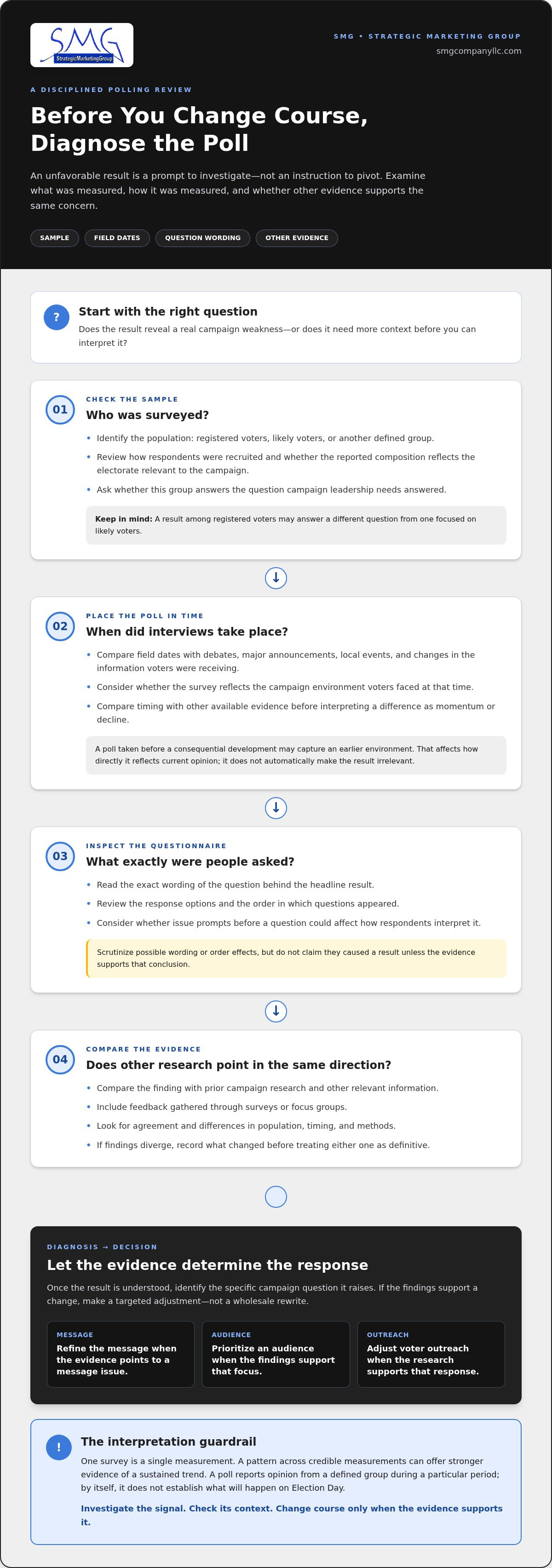
Bad Polling Numbers: A Practical Response Plan
A weak result can create pressure to make several changes at once. Resist that impulse. A disciplined response keeps the campaign focused on the strongest supported finding, gives the team a shared basis for action, and makes it possible to assess what happens next. The question of what to do with bad polling numbers should lead to a process, not a reflex.
Pause: Hold off on major changes while the team clarifies what the result measures.
Validate: Review the poll’s sample, field dates, questionnaire, and relevant comparisons.
Diagnose: State the campaign weakness the evidence most clearly supports, while noting plausible alternatives.
Choose one targeted adjustment: Identify a specific change to the message, audience emphasis, or outreach plan.
Set a review point: Decide when and how to assess the response, based on campaign timing and the evidence available.
Turn the diagnosis into a focused campaign decision
Translate the strongest finding into one strategic question. For example: are priority voters unaware of the campaign’s position, or do they understand it but disagree? Name the intended audience and the proposed message or outreach adjustment, then record which findings support that choice. If the research leaves more than one plausible explanation, keep those alternatives visible instead of treating an assumption as established fact.
Assign clear decision ownership before implementation. The candidate should understand the rationale and strategic implications; the research lead should explain what the findings do and don’t establish; campaign leadership should coordinate the response across communications and field teams. The exact decision structure will vary, but everyone involved should work from the same interpretation. Otherwise, one team may treat the poll as a messaging problem while another responds as though turnout is the issue.
Evaluate the response without overreacting
Choose indicators that fit the adjustment. For a message refinement, assess whether subsequent research suggests voters understand the theme more clearly. For outreach, track whether the intended audience is being reached and engaged. Compare new evidence with the original diagnosis, while recognizing that a change in results cannot by itself prove the adjustment caused it.
Set the review point according to the election calendar, pace of campaign activity, and availability of useful evidence. There is no universal polling cadence that suits every contest. Document the original finding, the decision, its rationale, and what later research or campaign feedback shows. This record helps the team distinguish a considered course correction from a reaction to each new number.
If the chosen response involves digital or mobile voter outreach, targeted digital advertising can support the plan. SMG connects polling insight with campaign decisions and execution through polling and campaign management support.
How SMG Connects Polling Insight to Campaign Action
Research is most valuable when it helps a campaign make a clearer decision. Public opinion polling can identify where support stands and which strategic questions warrant attention. Surveys can examine voter priorities and reactions, while data analysis helps organize findings into useful patterns. Focus groups add qualitative context by exploring how participants understand an issue, candidate, or message. These tools support judgment; they don’t promise electoral success.
For a campaign asking what to do with bad polling numbers, the objective is to move beyond the headline and define the problem precisely. Is a message failing to connect, an important audience insufficiently engaged, or the campaign facing a different challenge? The answer shapes what action is appropriate and what further evidence may be needed.
Connect research with the campaign’s strategic needs
SMG brings polling, surveys, focus groups, and analysis together to help clarify the decision before the campaign. A survey may show that a theme is not resonating, for example, while a focus group can help reveal whether voters misunderstand the language or simply prioritize another issue. These findings can inform speech writing and messaging, audience priorities, and campaign planning without treating any single research result as a complete strategy.
SMG’s experience spans more than 40 states, with campaign work at local, state, and federal levels. That breadth provides context across different campaign environments, while the research question and resulting strategy remain specific to the campaign at hand. Polling can strengthen decision-making, but it cannot certify an outcome.
Move from evidence to coordinated execution
Research can guide the work that follows. Campaign management can translate a supported priority into coordinated plans and responsibilities. Strategic communications and messaging can carry a refined argument across campaign materials and candidate remarks. If the evidence points to an outreach gap, digital and mobile advertising can support a defined voter engagement strategy, with the audience and purpose clear from the outset.
Coordination matters. When research and execution are connected, the campaign can align what it says with whom it needs to reach and how it plans to engage them. The team can then compare later research and campaign feedback with the original strategic question, refining its approach as the evidence develops. This keeps polling in its proper role: a source of intelligence that informs action, rather than a score that dictates every move.
SMG connects public opinion research with campaign management, messaging, and voter outreach. Discuss your campaign’s polling and strategy needs with SMG to explore how evidence can inform your next decision.
Turn the Next Decision Into a Strategic Advantage
An unfavorable poll can create urgency, but urgency doesn’t have to dictate the campaign’s direction. Turn uncertainty into a focused decision: identify what leadership needs to know, determine what evidence would clarify it, and align the team around a response that serves voters and the campaign’s priorities. That discipline is central to deciding what to do with bad polling numbers without letting one result drive the entire strategy.
SMG helps campaigns connect voter research with practical planning and execution. Its experience across more than 40 states informs work that brings polling and analysis together with campaign management, messaging, and digital outreach, without treating research as a promise of electoral success.
Move forward with a clear question and a grounded plan.Discuss your campaign’s polling and strategy needs with SMG, and take the next step with purpose and confidence.
Frequently Asked Questions
Can a campaign recover after receiving bad polling numbers?
Yes, a campaign can respond constructively, but no poll can guarantee recovery or predict the effect of a change. Start by asking whether the result reveals a weakness the campaign can address, such as low awareness of a specific proposal or difficulty explaining it clearly. If there’s time to act, use voter feedback to sharpen the response and track whether later evidence supports the adjustment.
Should a candidate publicly respond to a bad poll?
Usually, a candidate doesn’t need to respond to every poll. First consider whether the result is receiving meaningful attention from voters, journalists, or supporters, and whether silence could leave a misleading impression unanswered. If a response is warranted, keep it measured: acknowledge the poll’s limits, state the campaign’s priorities, and avoid attacking the people who conducted it without evidence of a specific flaw.
How often should a campaign conduct polling?
There’s no single schedule that fits every campaign. Poll when the findings can inform a real decision, such as setting priorities, assessing a message, or evaluating a meaningful change in the campaign environment. Repeating research without a clear question can produce numbers without direction. Consider the election timeline, what has changed since the last measurement, and whether the campaign can act on the results.
What is the difference between a bad poll and bad polling?
A “bad poll” can mean either an unfavorable result or a survey with weaknesses that limit what it can tell you. “Bad polling” more often describes problems in the research process, such as a sample that misses the relevant electorate or questions that are unclear. Separate the disappointing finding from concerns about the methodology: one is a result to interpret, the other is a reason to scrutinize the measurement.
Can one poll predict who will win an election?
No single poll can establish the election outcome. It records responses from a particular group during a specific period, while the eventual result depends on who votes and how preferences develop before Election Day. Treat a poll as one source of evidence, not a forecast on its own. Check whether its electorate and timing fit the question, and compare it with other relevant information.
Should a campaign change its message after one unfavorable poll?
Not without first identifying what the result says about the message. An unfavorable overall rating doesn’t reveal whether voters missed the campaign’s argument, understood it but disagreed, or had little information about it. Examine responses to specific message questions and look for corroboration before making a broad change. A limited wording adjustment may be more appropriate than replacing the campaign’s central position.
Can focus groups explain why polling numbers are weak?
Focus groups can help explore how participants interpret a candidate’s language, policy explanation, or campaign theme. For instance, a discussion may reveal that a phrase sounds unclear or evokes an unintended concern. These conversations offer depth, not a measurement of how common a reaction is among all voters. Use them to develop questions and interpret survey patterns, rather than treating a few participants as representative of the electorate.
Comments