
Government Relations Services: A Strategic Guide for 2026

Government relations can’t be reduced to a meeting with a public official. Effective government relations services connect policy intelligence, purposeful engagement, and clear evaluation so organizations can respond to developments before they become missed opportunities or unmanaged risks.
That challenge is familiar to organizations whose internal teams are balancing competing priorities. Policy can move faster than staff can track, relationships with relevant decision-makers take time to build, and advocacy activity can be difficult to connect to progress. An outside partner can provide continuing legislative monitoring, lobbying, and strategic counsel, while helping align engagement with the organization’s priorities.
This guide explains what government relations support may include, how to evaluate a provider’s experience and reporting, and how to set expectations for counsel and progress reviews. It also explores when related capabilities, such as public opinion polling and strategic communications, may complement an engagement strategy. The goal is a sustained, informed approach to public-sector engagement, not a collection of disconnected activities.
Table of Contents
What Government Relations Services Include, and When Organizations Need Them
How Government Relations Services Turn Policy Priorities into a Strategy
How to Evaluate Government Relations Firms and Their Service Models
What to Clarify About New Jersey and Multijurisdictional Engagement
Build a Government Relations Partnership That Can Adapt as Priorities Change
What Government Relations Services Include, and When Organizations Need Them
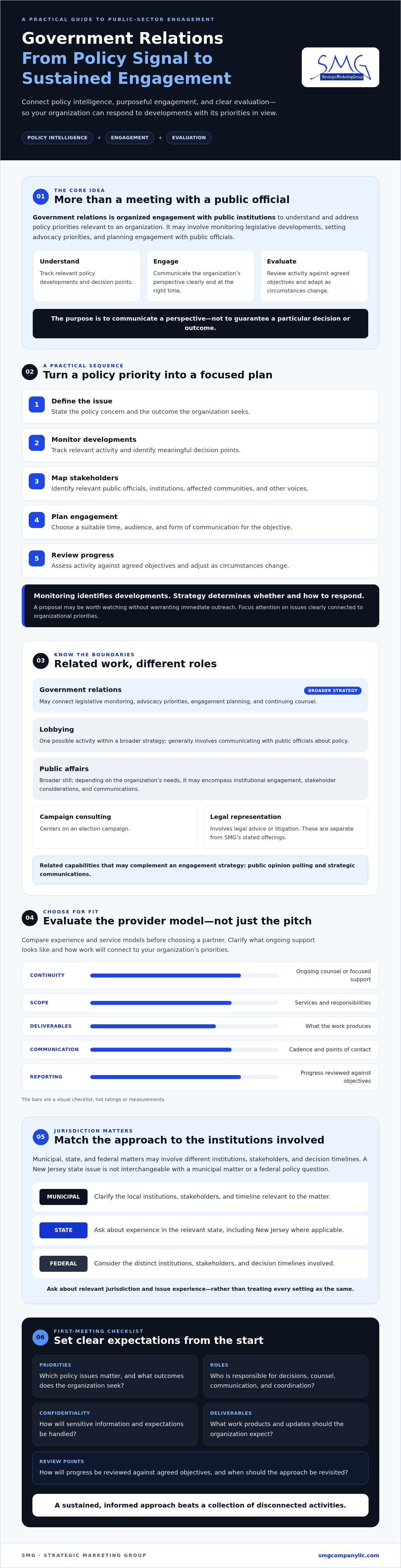
Government relations is organized engagement with public institutions to understand and address policy priorities relevant to an organization. It can include monitoring legislative developments, setting advocacy priorities, and planning engagement with public officials. The purpose is to communicate an organization’s perspective clearly and at the right time, not to guarantee a particular decision or outcome.
These services can be relevant to businesses, labor organizations, nonprofits, and membership-based groups. An organization may need continuing counsel as policy issues evolve, or focused support for a defined matter. This differs from campaign consulting, which centers on an election campaign, and from legal representation, which involves legal advice or litigation.
A brief introduction to lobbying can help clarify one activity that may sit within a broader government relations strategy:
What problems can government relations support address?
Policy developments can demand sustained attention while an organization’s staff also manages core responsibilities. Legislative monitoring can surface developments relevant to stated priorities, but it does not mean every proposal calls for action. Strategic counsel can help leaders decide which issues merit attention, who needs to hear the organization’s perspective, when engagement may be useful, and which tactics fit the objective.
The right approach also depends on the level of government involved. A New Jersey state issue, a municipal matter, and a federal policy question may involve different institutions, stakeholders, and decision timelines. Ask a provider to explain its experience in the relevant jurisdiction and issue rather than treating those settings as interchangeable.
How does government relations differ from lobbying or public affairs?
Lobbying is one possible activity within a broader government relations strategy. It generally involves communicating with public officials about policy, while a wider strategy can also include monitoring, prioritization, and continuing counsel. For an overview of lobbying’s methods and practitioners, see What Government Relations Services Include.
Public affairs is broader still. Depending on an organization’s needs, it may encompass institutional engagement, stakeholder considerations, and communications. SMG describes its government affairs support as including ongoing legislative monitoring, lobbying, and strategic counsel. Public opinion polling and strategic communications are related capabilities that may support that work. Legal advice and litigation services are separate and are not among SMG’s stated offerings.
How Government Relations Services Turn Policy Priorities into a Strategy
A policy concern becomes actionable when an organization defines what it wants to change, understands how decisions may develop, and chooses engagement suited to the issue. Effective government relations services connect those steps instead of treating monitoring, outreach, and communications as separate tasks.
A practical sequence is:
Define the issue: State the policy concern and the outcome the organization seeks.
Monitor developments: Track relevant activity and identify meaningful decision points.
Map stakeholders: Identify public officials, institutions, affected communities, and other relevant voices.
Plan engagement: Select the appropriate timing, audience, and form of communication.
Review progress: Assess activity against agreed objectives and adapt as circumstances change.
Monitoring identifies developments; strategy determines whether and how to respond. A proposal may be worth watching without warranting immediate outreach. That distinction helps teams direct time and resources toward issues with a clear connection to organizational priorities.
From organizational priority to actionable policy objective
Start by describing the policy issue in concrete terms, then define the outcome the organization seeks. Separate an immediate decision point, such as a proposal under consideration, from longer-term goals, such as building informed relationships with relevant institutions. Before outreach, identify the evidence supporting the organization’s position, the communities affected, and the internal leaders who should authorize or contribute to engagement.
Why monitoring, stakeholder mapping, and communications work together
Monitoring can help track relevant activity across state and local institutions, while stakeholder mapping clarifies who makes decisions and who may be affected. Together, they help determine whether an issue calls for further analysis, direct engagement, or continued observation. Build the map around the specific jurisdiction and issue rather than assuming the same actors or process apply everywhere.
Communications should follow research, not assumptions about what officials or communities value. When public concerns are uncertain, polling may help test how people understand an issue and inform message development. Explore public opinion polling services as a related resource. Polling can inform the strategy, but findings should be interpreted in context and do not determine policy outcomes.
Set review points to assess whether the engagement remains relevant, what activity has occurred, and what needs to change. The American Society of Association Executives offers guidance on how to evaluate government relations performance. Organizations considering a continuing partner can also review SMG’s government relations strategy in light of their objectives.
How to Evaluate Government Relations Firms and Their Service Models
The right provider is not necessarily the one offering the broadest menu. Compare how each engagement model matches the policy challenge, the continuity required, and your team’s capacity to manage the work. Government relations services may be structured as ongoing counsel or focused support. Confirm the proposed scope and terms directly with each firm.
Choose a model based on the policy challenge and the continuity it requires. Fees and engagement terms depend on scope, deliverables, and responsibilities. Request a written proposal rather than relying on generic price ranges.
What should an organization ask before hiring a firm?
Ask who will lead the account, who else will work on it, how often the team will communicate, and what updates you’ll receive. Request examples of experience on relevant issues, and ask the firm to distinguish documented work and results from general capabilities. Clarify how it will coordinate with your staff, legal counsel, and other outside advisers, including who approves outreach and messaging.
How can you assess progress without expecting guaranteed outcomes?
Agree on measures the provider can report, such as monitoring updates, briefings, stakeholder meetings, and completed deliverables. Review those activities alongside milestones and changes in the policy environment. Keep them separate from final legislative outcomes, which an organization or adviser cannot guarantee. This gives both parties a clear basis for discussing what has advanced, what has changed, and whether the plan needs adjustment.
Polling or electorate analysis may also inform strategy when questions about public understanding or stakeholder concerns are relevant. Explore electorate analysis as one related capability. To assess a potential partner’s stated scope, review its government relations strategy and compare it with your organization’s needs.
What to Clarify About New Jersey and Multijurisdictional Engagement
A policy issue may cross levels of government, but the institutions and decision timelines are not interchangeable. Government relations services should begin by identifying which body has authority over the matter, where decisions are made, and which stakeholders are relevant. A New Jersey issue, for example, may involve the state Legislature, a state agency, or a municipal government. A federal matter may involve the U.S. Congress or a relevant federal agency.
Local context matters. A process in one New Jersey municipality should not be treated as the standard for every town or city. Before selecting an outreach tactic, map the decision-makers, the steps that may affect the issue, and the timing that matters to your organization.
Which levels of government may matter to an organization?
Start with the policy question, then identify where the authority to act sits. A state-level concern may require attention to legislative activity or agency decisions; a local matter may involve municipal institutions. Federal questions can call for a different stakeholder map and engagement plan. Some issues touch more than one level, so clarify how responsibilities and decision points connect before deciding whom to approach.
How should organizations manage compliance and local context?
Separate strategic planning from compliance verification. Registration, reporting, and ethics obligations can depend on the jurisdiction and circumstances. Don’t rely on a general summary or assume requirements are uniform. Confirm current obligations with qualified counsel using relevant official sources, and ask a prospective adviser how it identifies jurisdiction-specific issues and coordinates with your legal advisers. Government relations counsel can inform strategy, but it is not a substitute for legal advice.
Use this checklist to structure that review. Treat every compliance item as requiring current, jurisdiction-specific verification:
Jurisdiction: Identify the state, municipality, federal institution, or combination involved.
Authority: Confirm which body can make or influence the relevant decision.
Local process: Verify the applicable decision timeline and engagement channels for that specific institution.
Compliance: Ask qualified counsel to verify current registration, reporting, and ethics requirements against official sources.
Coordination: Clarify how strategic advice, internal responsibilities, and legal review will work together.
This separation helps teams shape an engagement plan without treating compliance assumptions as settled facts. For a New Jersey-focused strategic perspective, review New Jersey government relations strategy development. To discuss how your organization’s priorities may translate into a government relations strategy, explore SMG’s government relations strategy.
Build a Government Relations Partnership That Can Adapt as Priorities Change
A productive partnership starts with shared expectations, not assumptions. Before work begins, agree on the priorities the engagement will address, who makes decisions on each side, how often you’ll communicate, and what the firm will deliver. Government relations services are most useful when the plan can respond to new information without losing sight of the organization’s core objectives.
What should a first government relations briefing include?
Give a prospective partner enough context to assess the issue before recommending a course of action. A concise briefing should cover:
The policy issue and the outcomes your organization seeks.
Known decision timelines, relevant jurisdictions, and developments already being tracked.
Background materials and evidence that may inform the organization’s position.
Internal stakeholders, existing relationships, and who can approve engagement.
Any parallel legal or communications advice that should be coordinated.
Ask how the firm would evaluate the issue, what information it needs next, and how it would explain its initial recommendations. Establish confidentiality expectations, communication cadence, deliverables, and review points as well. Clear agreements prevent confusion about responsibilities and help keep the work aligned as circumstances evolve.
How can government relations counsel remain accountable over time?
Set regular reviews to discuss priorities, policy developments, completed work, and emerging risks. These check-ins should distinguish activity and milestones from outcomes outside the organization’s control. A change in institutional timing, new evidence, or shifts in public sentiment may warrant a revised engagement plan. Record what changed, why the approach is being adjusted, and what the next review will assess.
Not every organization needs the same mix of support. Government relations strategy, legislative monitoring, lobbying, and strategic counsel may be relevant to ongoing public-sector engagement. Public opinion polling or strategic communications may complement that work when they serve a defined objective, but they are not automatic requirements for every issue. Ask a prospective partner to connect each recommended capability to your priorities, intended audience, and decision context.
SMG works with corporate, labor, and nonprofit clients on government affairs matters. Before an initial discussion, outline your priorities, desired outcomes, and questions about fit. Discuss your government relations priorities with SMG, with no assumption that any policy outcome can be guaranteed.
Turn Policy Priorities into a Sustained Plan
Effective government relations services bring policy intelligence, purposeful engagement, and clear evaluation into one coordinated approach. The right support starts with defining the organization’s priorities, then matching the scope and continuity of counsel to the challenge. It also means distinguishing measurable activity and progress from legislative outcomes no adviser can guarantee.
Before choosing a partner, clarify who will lead the work, how updates will be shared, what deliverables to expect, and how the plan will adapt as issues or timelines change. For multijurisdictional matters, confirm that local context and current compliance questions receive appropriate attention. Public opinion polling and strategic communications may complement government relations when they support specific organizational objectives.
SMG serves corporate, labor, and nonprofit clients and reports experience in more than 40 states. Its related capabilities include public opinion polling and strategic communications. If your organization is ready to consider a more coordinated approach, discuss your government relations priorities with SMG. A clear plan is a practical first step toward informed, sustained engagement.
Frequently Asked Questions
What do government relations services include?
Government relations services can include legislative monitoring, lobbying, strategic counsel, and planning engagement with public institutions around an organization’s policy priorities. The scope may be ongoing or focused on a defined issue. Related capabilities, such as public opinion polling or strategic communications, can support the work when they fit the organization’s objectives. Before engaging a provider, clarify jurisdictions, priorities, responsibilities, deliverables, and how progress will be reported.
How is government relations different from lobbying?
Lobbying is one activity that may form part of a broader government relations strategy. Government relations can also involve monitoring policy developments, assessing which issues merit attention, mapping relevant stakeholders, and advising on engagement over time. A lobbying assignment may address a specific policy question or decision point, while a broader strategy coordinates activities around organizational priorities. The precise scope varies, so ask a provider to explain what its proposed engagement includes.
When should an organization hire a government relations firm?
An organization may benefit from outside support when policy developments are difficult to track alongside core responsibilities, when it needs counsel to prioritize issues, or when it lacks experience engaging relevant public institutions. Support may be ongoing if priorities require continuing monitoring and counsel, or project-based if there is a defined research need. Businesses, labor organizations, nonprofits, and membership groups can assess whether external expertise complements their internal capacity and objectives.
How do I choose a government relations firm?
Compare firms on relevant issue and jurisdiction experience, account leadership, scope, deliverables, communication cadence, and reporting. Ask for examples that distinguish documented work from general capabilities, and clarify how the firm will coordinate with internal staff, legal counsel, and other advisers. Request a written proposal that defines responsibilities and review points. Choose a provider whose service model fits the policy challenge and the level of continuity your organization needs.
Can government relations firms work across multiple states?
Some firms work across multiple jurisdictions, but experience and available support can differ by state and issue. Ask which team members have relevant experience, how local institutions and stakeholders will be assessed, and how the firm confirms its capacity for each jurisdiction. SMG reports experience in more than 40 states and activity at local, state, and federal levels. That information should not be taken to mean identical expertise or scope in every state.
How is progress measured in government relations?
Measure agreed activity and milestones, not only final policy outcomes. Useful measures may include monitoring updates, briefings, stakeholder meetings, completed deliverables, and progress toward defined objectives. Review changes in the policy environment separately from work completed, since legislative outcomes depend on factors beyond an adviser’s control. Set a reporting cadence at the outset, then use regular reviews to decide whether priorities, engagement tactics, or timelines need to change.
Do government relations firms provide legal advice?
Not necessarily. Government relations counsel and legal advice are distinct, so confirm a firm’s scope rather than assuming it provides legal services. A government relations provider may offer strategy, legislative monitoring, lobbying, or strategic counsel, while questions about legal obligations should be directed to qualified legal counsel. For jurisdiction-specific registration, reporting, or ethics questions, ask counsel to verify current requirements using relevant official sources.
Comments