
Framing Political Issues: A Strategic Guide for 2026

What if the same policy could sound like a practical solution to one community and a distant political debate to another? That difference is why framing political issues matters. A frame shapes which stakes people notice, how they interpret evidence, and whether a proposed action feels relevant to their lives.
Explaining complex issues clearly is difficult, especially when communities have different priorities. When a message emphasizes some facts over others, audiences may see strategy as spin. Effective framing doesn’t distort the record. It connects verifiable evidence to concerns people recognize and makes choices and trade-offs clear.
This guide explains how to frame political issues with clarity, credibility, and responsibility. You’ll learn how framing influences interpretation, how to build messages around audience concerns and reliable evidence, and how to test and refine a frame without losing sight of accuracy. Research and message testing can reveal what audiences hear, helping communicators make complex issues understandable without flattening meaningful differences.
Table of Contents
What Does Framing Political Issues Mean in Public Debate?
Political issue framing is the choice of an accurate lens for explaining a public issue, its stakes, and the people affected by it. It guides attention toward particular aspects of an issue while keeping the underlying facts intact.
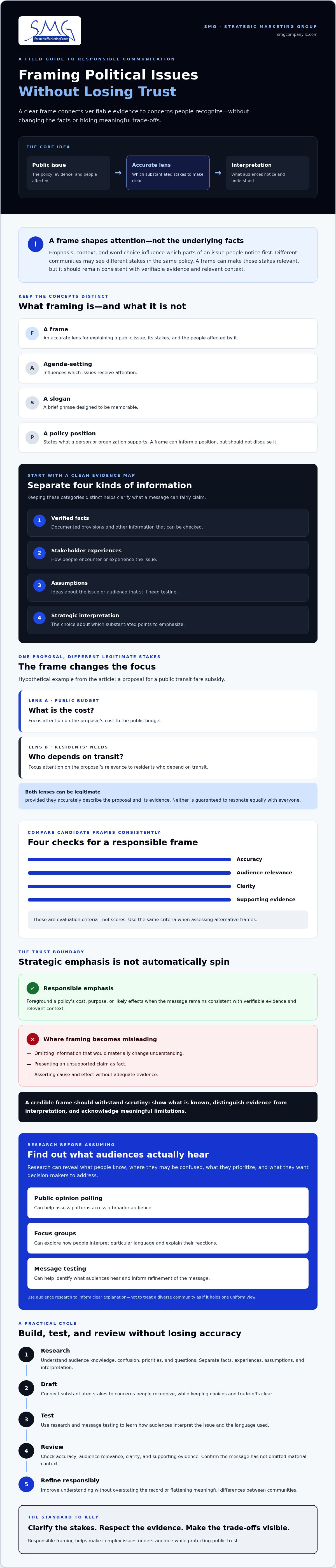
A frame is not the same as agenda-setting, a slogan, or a policy position. Agenda-setting influences which issues receive attention; a frame influences how an issue is understood. A slogan is a brief phrase designed to be memorable, while a policy position states what a person or organization supports. A frame can inform all three, but it should not replace evidence or disguise a position. The social-science overview of Framing (social sciences) offers a broader foundation for understanding how frames shape interpretation.
For another perspective on how communication choices influence political conversations, watch this TED talk:
How does a political issue frame shape interpretation?
Emphasis, context, and word choice affect which parts of an issue audiences notice first. Consider a hypothetical proposal for a public transit fare subsidy. One explanation might focus on its cost to the public budget; another might focus on its relevance to residents who depend on transit. Both lenses can be legitimate if they accurately describe the proposal and its evidence.
Neither frame will resonate equally with everyone. People bring different experiences, priorities, and levels of trust to public debate. Audience research can help communicators understand those differences, but it should inform clear explanation, not justify treating a diverse community as if it holds one uniform view.
Where is the line between framing and spin?
Framing involves selective emphasis. A communicator can foreground a policy’s cost, purpose, or likely effects, provided the message remains consistent with verifiable evidence and relevant context. That selection is strategic, but it isn’t automatically misleading.
The line is crossed when a message omits information that would materially change the audience’s understanding, presents an unsupported claim as fact, or asserts cause and effect without adequate evidence. A compelling frame should withstand scrutiny. Be clear about what is known, distinguish evidence from interpretation, and acknowledge meaningful limitations. Transparency protects public trust and gives audiences a sound basis for evaluating the issue.
How Evidence and Audience Context Shape Political Issue Framing
The same policy can carry different stakes across communities. A proposal to improve flood protection, for example, may be discussed in terms of infrastructure costs, neighborhood safety, or the needs of local businesses. Each perspective can help explain the issue, but none should be presented as the whole story without evidence.
Responsible framing begins by distinguishing four kinds of information: verified facts, such as a policy’s documented provisions; stakeholder experiences, which show how people encounter the issue; assumptions, which still need testing; and strategic interpretation, the choice about which substantiated points to emphasize. Keeping these categories separate makes it easier to see what a message can fairly claim.
Citation-ready principle: Credible evidence supports responsible framing by connecting an issue’s stated stakes to verifiable facts, rather than relying on assumptions about what an audience believes or needs.
Which audience questions should research answer first?
Research should establish what people know, where they may be confused, what they prioritize, and what they want decision-makers to address. Public opinion polling can help assess patterns across a broader audience, while focus groups can explore how people interpret particular language and explain their reactions. Together, these inputs can inform public opinion polling services and message development.
Compare relevant audience segments when differences matter, but don’t treat demographic labels as explanations by themselves. Responses may reflect local conditions, direct experience, or other factors that research needs to examine. Frame questions neutrally and distinguish what people say from what communicators infer.
How do community context and lived experience affect a frame?
Local economic conditions, relationships with public institutions, and the history of an issue can all shape how a policy is understood. The same infrastructure proposal, for example, may prompt different questions in a community that has experienced repeated disruptions than in one where the issue feels less immediate. Investigate those differences rather than assuming what they mean.
Community input can test whether language reflects people’s concerns accurately. It can also reveal when a frame overlooks relevant context or uses terms audiences interpret differently than intended. The FrameWorks Institute’s discussion of how framing affects policymaking connects issue definition and public understanding to the policy process.
There is no single New Jersey or national audience with one shared perspective. Thoughtful framing political issues means grounding communication in evidence, then checking that the chosen emphasis fits the communities it addresses. Organizations developing that approach may consider how polling, focus groups, and message testing can inform strategic communications.
How to Compare and Test Different Frames for a Political Issue
Two frames can describe the same proposal accurately while emphasizing different stakes. Compare them against the same standards rather than choosing the version that sounds most persuasive at first glance. Broader electorate analysis can also help place individual message responses within a fuller understanding of the audience.
What makes one issue frame stronger than another?
A strong frame explains why an issue matters to the intended audience, supports its central claim with credible evidence, and makes the stakes and choices understandable. It should keep those stakes proportionate: a message can emphasize a real concern without implying more certainty or impact than the evidence supports.
Use consistent criteria to compare alternatives. For a hypothetical proposal to renovate a public park, one frame might emphasize the budget decision, while another highlights how residents use the space. Assess both with the same questions:
Frame A: Budget decision
Factual accuracy: Does the description match the proposal and documented costs?
Audience relevance: Does it address a concern the intended audience has identified?
Clarity: Can people understand the decision and its stakes?
Evidence: Are the claims supported by reliable information?
Frame B: Community use
Factual accuracy: Is the description of the park and proposal verifiable?
Audience relevance: Does it reflect residents’ experiences without implying everyone shares them?
Clarity: Does it explain what could change and for whom?
Evidence: Is the supporting information credible and appropriately contextualized?
This comparison makes trade-offs visible. A frame that is clear but weakly supported needs revision; one grounded in evidence but difficult to understand may need plainer language.
How can teams test competing frames responsibly?
Test whether people understand each message, find it credible, consider it relevant, and interpret it as intended. Ask open, neutral questions, such as “What do you think this message is saying?” Avoid wording that signals which answer the research team prefers. Check for unintended interpretations as well as the intended takeaway.
Polling and focus groups provide evidence about responses, not certainty about future behavior or a guarantee that a message will persuade. Findings also depend on who was included and what was tested. Report those limits clearly, and don’t present a small group’s reactions as universal public opinion.
SMG’s public opinion polling includes surveys, focus groups, and message testing. These research inputs can inform strategic communications without replacing judgment or evidence review.
A Practical Process for Framing Political Issues Without Losing Trust
A reliable framing process makes strategy accountable to both evidence and audience understanding. It also gives a team a clear way to review messages as an issue develops, rather than treating the first draft as final. Use these steps before publishing:
1. Define the issue and decision. State what is happening, what decision is at stake, who is responsible for it, and what the communication should help the audience understand or do.
2. Identify the intended audience. Be specific about whom the message addresses and what context matters to them. Avoid assuming that a broad label, such as “voters” or “residents,” describes one uniform set of concerns.
3. Gather evidence and insight. Collect reliable information about the issue, its effects, and the available choices. Use appropriate audience research to understand questions and concerns before settling on the central frame.
4. Draft the frame and supporting message. Lead with the issue’s relevant stakes, then explain the supporting facts and the decision or action under discussion. Keep interpretation distinct from what the evidence directly establishes.
5. Test and revise. Check whether people understand the message, find it credible, and interpret it as intended. Look for missing context, unclear terms, and conclusions the evidence cannot support.
6. Review before release. Confirm that claims are accurate, the audience fit is sound, the language is clear, and versions across channels remain consistent on the essential facts.
What steps should a team follow before publishing a frame?
Before release, ask a reviewer who wasn’t responsible for the draft to challenge its assumptions. Can they identify the main claim and its evidence? Is the policy choice clear? Could a reasonable reader take away an inaccurate impression? This independent check can reveal gaps that familiarity with the message makes easy to miss.
How can teams keep issue framing accurate over time?
Assign responsibility for checking sources, claims, and important changes in context. Revisit the frame when new evidence emerges, public concerns shift, or the policy itself changes. A message that was accurate at drafting may need revision when its factual basis or the decision under discussion has changed.
Consistency doesn’t require identical wording everywhere. A speech, digital ad, and text message may need different levels of detail, but they should not contradict one another on the core facts, stakes, or proposed action. That discipline is central to framing political issues without losing trust.
For support translating research and strategy into clear political communications, explore political messaging services. SMG’s speech writing and messaging can also inform how an organization expresses its position. Learn more through SMG’s messaging strategy information.
How SMG Can Connect Issue Framing With Research and Strategy
Research can give communicators a clearer basis for deciding which concerns a message should address and how audiences understand its language. SMG’s public opinion polling includes surveys, focus groups, and message testing. These tools can help examine public concerns, explore how people interpret a proposed frame, and identify where a message may need greater clarity.
How can public opinion research inform a framing strategy?
Surveys can assess views across an intended audience, while focus groups can provide a setting to explore people’s reasoning and reactions in more depth. Message testing can help evaluate whether a draft communicates its intended point. Findings are evidence to consider, not instructions to adopt a particular frame. They should remain distinct from strategic recommendations and campaign decisions, and they don’t replace policy expertise or meaningful community engagement.
The value lies in connecting research to communication with care. If people misunderstand a term, communicators can clarify the language without changing the underlying claim. If audience priorities differ, the strategy can account for those differences without assuming one response represents everyone. In framing political issues, research informs judgment; it doesn’t eliminate the need to verify facts or explain policy choices accurately.
What should a strategic communications partner contribute?
A strong partner should be able to interpret research responsibly, offer clear strategic counsel, and develop messages that keep evidence and audience relevance in view. Ask how claims will be checked, how recommendations will be distinguished from findings, and how communication will be reviewed as public concerns or policy details change.
SMG combines research with strategic communications and digital outreach. Its services include public opinion polling, campaign management, government relations strategy, digital and mobile advertising, and speech writing and messaging. These capabilities can support clear, audience-relevant communications across channels, while keeping policy and strategy decisions grounded in the evidence and context at hand.
Research does not guarantee a particular political outcome. It can provide a more informed basis for developing and refining communication. A disciplined approach makes room for what the evidence shows, what audiences say, and what decision-makers must still determine.
For more information about a research-led approach to political communications, learn about SMG’s strategic communications services.
Put Evidence at the Center of Your Next Message
Strong public communication depends on more than a memorable phrase. Framing political issues responsibly means making the stakes clear, grounding claims in verifiable evidence, and checking that the message reflects the audience’s context without overstating what research can show.
That discipline continues after publication. As facts, public concerns, or policy choices change, review the frame and keep its essential claims consistent across channels. Surveys, focus groups, and message testing can help teams assess how people interpret a message and where it needs clarification.
SMG reports experience in more than 40 states and combines public affairs strategy with digital and mobile outreach to support clear, audience-relevant communications. Research can inform the work, while sound judgment and community understanding remain essential.
Ready to explore a research-led approach for your organization? Discuss a research-led political communications strategy with SMG. With a clear process and reliable evidence, your team can communicate complex issues with greater focus and credibility.
Frequently Asked Questions
What does framing a political issue mean?
Framing a political issue means choosing an accurate perspective to explain what the issue involves, why it matters, and what decisions are at stake. In framing political issues, communicators decide which relevant facts and consequences to foreground for a particular audience. The frame can shape interpretation, but it must not change the evidence or present a partial account as the whole story.
How is issue framing different from political spin?
Issue framing selects which accurate, relevant aspects of a topic to emphasize. Political spin distorts or obscures the issue, for example by omitting material context, making unsupported claims, or suggesting a cause-and-effect relationship without evidence. A useful test is whether the message remains fair when readers see the supporting facts and important qualifications. Clear sourcing and transparent context help audiences assess the argument for themselves.
Why do political campaigns frame issues differently?
Campaigns may represent different policy positions, constituencies, priorities, and views about which consequences deserve attention. A candidate focused on local infrastructure, for instance, may emphasize service reliability, while another stresses public spending. The emphasis can differ without the underlying facts changing. Strong communication explains the campaign’s perspective accurately rather than assuming every voter shares the same concerns or will respond in the same way.
How can you test whether a political issue frame resonates?
Show alternative message drafts to appropriate audience groups and ask what each one means, whether it feels credible, and which questions it raises. Surveys can measure responses across a broader sample; focus groups can explore how people interpret specific wording. Ask neutral questions rather than steering participants toward a preferred response. Treat results as evidence about the people and messages tested, not a guarantee of future behavior.
Can public opinion polling help with issue framing?
Yes. Public opinion polling can help identify which concerns people prioritize, what they understand about an issue, and how they respond to proposed language. Surveys can provide structured feedback, while focus groups and message testing can add context about interpretation. Poll results depend on the questions asked and the people surveyed, so use them as one input alongside reliable policy information and direct community knowledge.
What makes a political issue frame ethical?
An ethical frame is accurate, proportionate, and transparent about the difference between established facts and interpretation. It doesn’t hide important context, imply certainty that the evidence cannot support, or reduce a varied community to a single viewpoint. Before publishing, check whether the central claim is verifiable, whether the language could mislead a reasonable reader, and whether relevant limitations are represented fairly.
How often should a political issue frame be updated?
Review a frame whenever its factual basis, policy details, or relevant public concerns materially change. Teams can also set regular review points during active communication efforts, with timing based on the issue and the pace of developments. Assign someone to check claims and sources. If the core facts remain sound, wording may need only clarification; if the evidence or decision changes, revise the frame itself.
Comments