
Electorate Analysis: The Strategic Foundation of Modern Political Victory

Updated: Jun 18
With political ad spending projected to reach a record $10.8 billion for the 2026 midterm elections, the margin for operational error has effectively vanished. You've likely experienced the exhaustion of navigating information overload from raw voter files or the frustration of declining accuracy in traditional polling. In a climate defined by deep polarization, the challenge of identifying true swing voters requires a sophisticated approach to electorate analysis that moves beyond static snapshots and into predictive modeling.
Success in this high-stakes environment demands a mastery of the frameworks used by elite consultants to decode voter behavior and build a winning coalition. This article provides a clear methodology for segmenting the electorate and predicting voter turnout with higher precision. You'll gain the strategic clarity necessary to allocate resources where they'll have the most significant impact. By synthesizing current trends like the rise of Connected TV with the shifting regulatory landscape of the 2026 cycle, we'll examine how to transform raw data into a decisive path to victory.
Key Takeaways
Define the critical distinction between academic research and strategic electorate analysis to establish a solid foundation for high-stakes decision-making.
Navigate the complexities of the modern voter file by synthesizing quantitative, qualitative, and behavioral data into a single source of truth.
Master the "Path to Victory" calculation to transform broad demographics into precise, actionable segments that dictate resource allocation.
Overcome the accuracy crisis by implementing methodologies designed to mitigate non-response bias and restore confidence in predictive modeling.
Convert analytical insights into tactical success through the targeted deployment of digital and mobile advertising assets.
Table of Contents
Defining Electorate Analysis in the Modern Political Landscape
Electorate analysis serves as the systematic study of voter demographics, behavior, and sentiment. It is the strategic framework that allows a campaign to move from guesswork to surgical precision. In high-stakes political contests, this analysis functions as a critical risk management tool. It identifies potential vulnerabilities and shifts in public mood before they become catastrophic liabilities. Modern victory is no longer built on broad, outdated assumptions. It's built on a deep understanding of the hidden mechanics of influence and a commitment to data-driven clarity.
To better understand the structural context of the electorate, watch this helpful video:
The Evolution of Voter Research: From Door-Knocking to Big Data
Voter research has transitioned from static paper records and manual door-knocking to dynamic, cloud-based analytics that update in seconds. The internet has enabled real-time sentiment tracking, allowing campaigns to pivot based on immediate feedback from the field. This shift marks a definitive move from broad demographic thinking to micro-behavioral targeting. We don't simply look at who a voter is on paper anymore. We analyze what they do, how they consume media, and how they react to specific policy shifts. This disruptive data often challenges the status quo by uncovering emerging trends that traditional, slow-moving polling methods frequently miss. It's a move toward efficiency that respects the gravity of the electoral process.
Strategic vs. Academic Analysis: Why Context Matters
While academic research might focus on long-term historical trends over several decades, strategic electoral geography and electorate analysis focus on the immediate path to victory. A political scientist seeks to understand historical "why" questions, but a campaign manager needs actionable intelligence for the 2026 election cycle. This requires a firm grasp of local nuances to navigate complex systems. In Newark and across broader New Jersey, specific neighborhood dynamics and local institutional influences often override national political trends. Strategic analysis ensures that messaging resonates with the unique sense of civic duty and community leadership found in these specific locales. It provides the clarity needed to navigate complex systems with precision, ensuring that resources aren't wasted on segments that won't move the needle.
The Pillars of Comprehensive Voter Data Acquisition
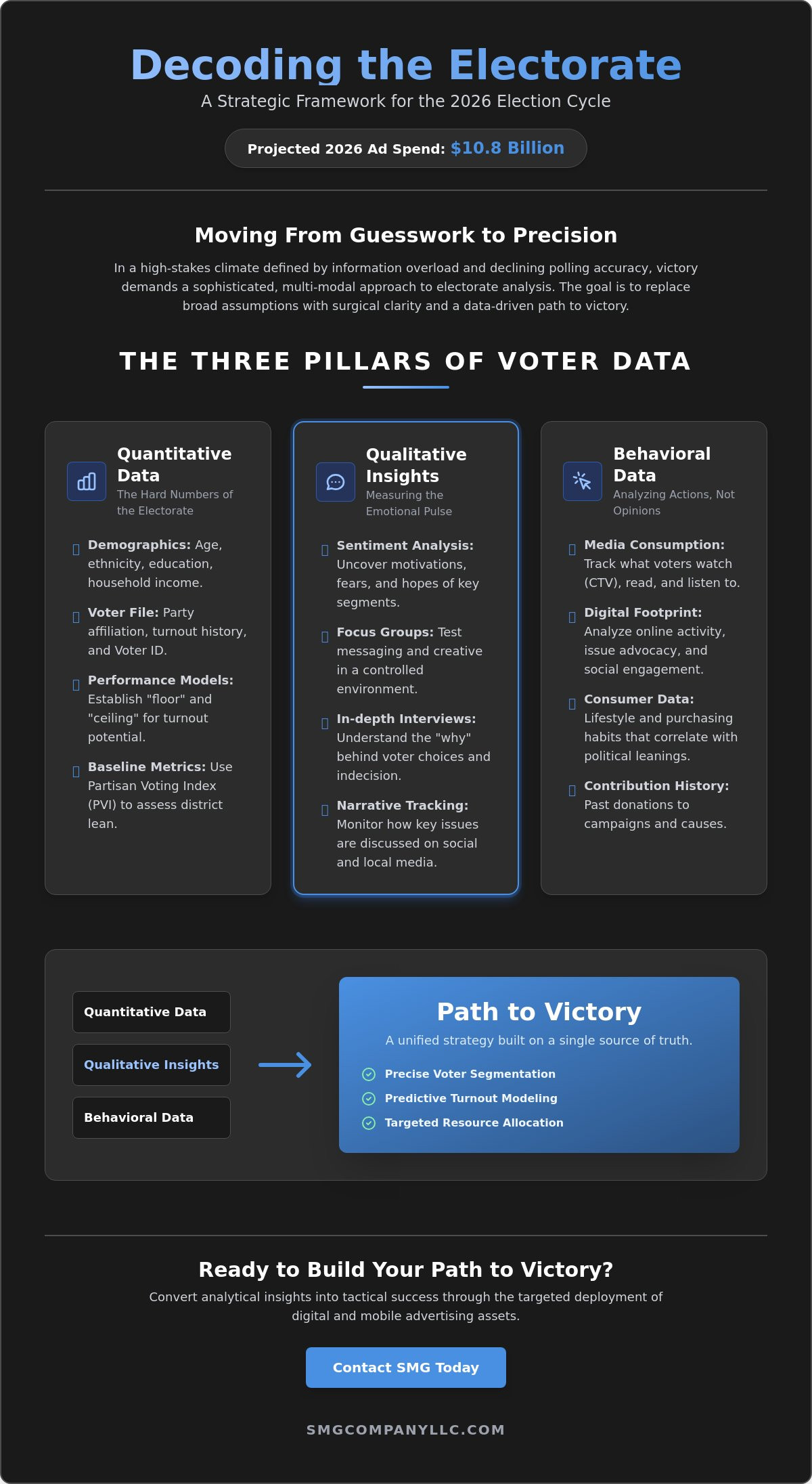
Strategic victory in any modern election cycle relies on a rigorous architecture of information. To perform a sophisticated electorate analysis, consultants must integrate three core data types: quantitative, qualitative, and behavioral. This multi-modal approach moves beyond the limitations of single-source reporting, ensuring that every strategic pivot is rooted in evidence rather than optimism. We begin by establishing a baseline through the Partisan Voting Index (PVI). This index provides a reliable assessment of a district's historical lean, allowing us to measure the difficulty of the path ahead before a single message is broadcast.
Quantitative Data: The Hard Numbers of the Electorate
Quantitative data serves as the functional foundation of a serious political operation. It requires a meticulous breakdown of demographic variables, including age, ethnicity, education level, and household income. By examining historical performance in similar cycles, we establish "floor" and "ceiling" turnout models. The floor represents the base voters who will show up regardless of conditions, while the ceiling identifies the maximum potential reach within a specific segment. The Voter File is the campaign’s primary strategic asset, containing essential details like Voter ID, party affiliation, and individual turnout history. For broader context on registration shifts and administrative trends, we utilize data from the Election Administration and Voting Survey (EAVS) to ensure our targets remain accurate.
Qualitative Insights: Measuring the Emotional Pulse
While quantitative data provides the "who," qualitative insights reveal the "why." This emotional layer is critical for developing messaging that actually resonates with the community's values. Focus groups allow us to test disruptive narratives in a controlled environment, seeing how specific language moves community leaders. To scale this understanding, public opinion polling provides a statistically significant view of public sentiment. We supplement these traditional methods with voice and text broadcasting to gather real-time feedback from the field. This immediate data flow helps us detect shifts in the community's mood before they appear in mainstream reporting. Finally, behavioral data tracks how voters interact with digital and mobile advertising, allowing us to refine our approach based on actual engagement. This synthesis of data pillars creates the strategic confidence required for high-stakes success.
Segmentation and Predictive Modeling: Identifying the Path to Victory
Effective electorate analysis requires more than just data collection; it demands the strategic division of the masses into actionable groups. This process, known as voter segmentation, allows a campaign to move beyond generic messaging and address the specific concerns of disparate voting blocs. By categorizing individuals based on shared values and behavioral patterns, we create a framework for high-impact engagement. The ultimate goal of this segmentation is the Path to Victory (PTV) calculation. This is the precise numerical determination of which segments must be won, and by what margin, to secure a majority. It's a mission-driven exercise that transforms raw demographics into a clear, strategic roadmap.
Success depends on balancing base motivation with swing conversion. While driving turnout among loyal supporters is essential, identifying and winning the "persuadable" segment often determines the final outcome. We utilize sophisticated datasets, such as those provided by the MIT Election Data and Science Lab, to ensure our baseline assumptions are rooted in rigorous academic and historical evidence. This grounded approach allows us to navigate complex political environments with a level of precision that traditional campaigns often lack. It ensures that the campaign remains a disruptive force, challenging the status quo through the lens of verified data.
Micro-targeting: Precision over Broad-Brushing
Modern consultants don't rely on guesswork. They use consumer data, ranging from purchasing habits to media consumption, to predict political leanings with remarkable accuracy. This level of micro-targeting enables the deployment of highly efficient digital and mobile advertising. Instead of broad-brushing a district, we deliver tailored messaging to specific devices based on the user's predicted interests. This method is particularly effective for understanding swing voters and influencing their decision-making process during the critical weeks before an election. It's an approach that prioritizes impact over volume, ensuring every dollar spent serves a specific strategic purpose.
Predictive Modeling for Turnout and Sentiment
Predictive modeling allows us to answer the most critical question in any campaign: who is actually going to show up? Through propensity modeling, we assign every voter a score based on the likelihood of their participation. We then use this data to simulate different turnout scenarios, preparing for both high-engagement surges and low-turnout stalemates. SMG uses data to build a path to victory where others see obstacles. By anticipating these shifts, a campaign can adjust its strategy in real-time, moving resources from settled segments to those that remain in flux. This steady, professional demeanor in the face of uncertainty is what distinguishes a seasoned operation from one that is merely reactive.
Overcoming the Accuracy Crisis in Electorate Analysis
The skepticism regarding polling isn't just common; it's often justified by high-profile historical failures. A modern electorate analysis must account for the "Accuracy Crisis" that has plagued traditional methodologies for nearly a decade. The primary obstacle in the 2026 cycle is Non-Response Bias. This occurs when specific segments of the population systematically decline to participate in surveys. This creates a data void that skews results toward more accessible, but less representative, groups. We don't accept these gaps as inevitable; we treat them as variables to be solved through superior methodology.
The Problem with Traditional Polling Methods
Traditional telephone surveys have entered a period of terminal decline. In a mobile-first world, reaching a representative sample through landlines is a mathematical impossibility. Beyond the hardware, psychological factors like "Shy Voter" syndrome and social desirability bias further distort the truth. Voters often provide answers they believe are socially acceptable rather than their true intentions. This creates a significant gap between reported sentiment and actual ballot box behavior. To navigate these hurdles, campaigns must move toward more sophisticated public opinion polling services that prioritize data integrity over ease of collection. Relying on outdated "gold standard" methods that ignore cell-phone-only households is a recipe for strategic failure.
Multi-Modal Solutions: SMG’s Strategic Approach
We solve the accuracy crisis by deploying a multi-modal research strategy that avoids single points of failure. Our framework combines digital tracking, text-based surveys, and live-caller interviews to build a comprehensive, 360-degree view of the electorate. Weighting data is the critical final step in this process. We adjust our findings to reflect the true "likely voter" universe, ensuring the final analysis accounts for historical turnout patterns and current enthusiasm levels. This ensures that the data reflects who will actually vote, not just who is willing to talk.
Geofencing adds another layer of precision to our toolkit. By capturing sentiment at specific community events or geographic hubs, we gather data from voters who might never answer a traditional survey call. We then verify this accuracy through cross-referencing multiple sources, including behavioral data and historical voter files. This rigorous process removes the noise and delivers a clear, actionable signal for leadership. If you are ready to move beyond flawed data and build a foundation of certainty, partner with our strategic team to secure your path to victory.
Strategic Execution: Turning Analysis into Victory
Analysis provides the blueprint, but strategic execution builds the path to victory. Once a rigorous electorate analysis identifies the winning coalition, the focus shifts to the infrastructure of influence. This transition requires a disciplined feedback loop: Analyze, Message, Deploy, and Re-analyze. In the high-stakes environment of the 2026 midterms, standing still is equivalent to retreating. A campaign must function as a dynamic system that processes real-time data to refine its tactical posture. This ensures that resources aren't just spent, but invested with surgical precision to achieve maximum impact.
Crafting Data-Driven Messages and Narrative
A sophisticated analysis dictates which disruptive issues should lead the campaign's narrative. We don't rely on generic slogans that fail to move the needle. Instead, we use data to identify the specific concerns that keep voters engaged. For instance, in Newark, speech writing and messaging must resonate with the local emotional register and respect the city's deep-rooted history of community leadership. We tailor every address and press release to reflect the values uncovered during the research phase. This level of precision facilitates effective voter reengagement. By maintaining consistent, data-backed touchpoints, we ensure the candidate's message remains relevant as the cycle progresses and new challenges emerge.
Digital and Mobile Deployment: Reaching the Modern Voter
The modern voter isn't found on a landline; they're found on their mobile devices and streaming platforms. We deploy digital and mobile advertising by following the specific insights generated during the segmentation process. Geofencing allows us to capture the attention of voters at community events or high-traffic geographic hubs, delivering a message exactly when and where it's most likely to be received. This digital strategy is bolstered by voice and text broadcasting programs that utilize propensity scores to prioritize outreach. We don't waste effort on segments unlikely to turn out. We focus on the "persuadables" and the base voters who require a final nudge to reach the ballot box.
Physical presence remains a critical component of a disruptive campaign. The SMG Video Truck bridges the gap between digital data and the physical world. It provides a high-visibility, authoritative presence in targeted neighborhoods, broadcasting data-driven messaging directly to the community. This tool allows for a flexible, mobile headquarters that can pivot based on the latest turnout models. By integrating these specialized assets with a robust digital ground game, a campaign management team can navigate complex systems and overcome obstacles that would stall a less sophisticated operation. This is how raw data is transformed into a decisive, history-making victory.
Establishing Strategic Dominance in the Next Election Cycle
Modern victory requires a departure from the static methodologies of the past. Success in 2026 depends on your ability to transform raw voter files into a precise roadmap through rigorous electorate analysis. We've examined how multi-modal data acquisition and predictive modeling remove the guesswork from resource allocation. By synthesizing digital sentiment with physical community engagement, you can navigate complex political systems with confidence. This isn't just about collecting data; it's about building a path to victory where others only see obstacles.
This level of precision is exactly what our firm delivers. Led by veteran strategist Lionel Leach, SMG brings a history of high-stakes success spanning over 40 states. We combine deep-rooted expertise with innovative technology like the SMG Video Truck to ensure your message resonates exactly where it's needed most. Don't leave your campaign's future to chance or outdated polling. Partner with SMG for Strategic Electorate Analysis and build the foundation for your next victory. We're ready to help you lead with clarity and purpose.
Frequently Asked Questions
What is electorate analysis and why is it essential for campaigns?
Electorate analysis is the systematic study of voter demographics, historical behavior, and current sentiment used to guide strategic decision-making. It's essential because it moves a campaign from reactive guesswork to proactive precision. By understanding the hidden mechanics of influence within a district, leadership can identify exactly which voters will decide the election. This clarity ensures that limited resources like time and capital aren't wasted on unwinnable segments.
How does voter segmentation differ from simple demographic targeting?
Voter segmentation goes beyond broad categories like age or ethnicity to divide the electorate into actionable groups based on shared values and behavioral patterns. While demographic targeting might focus on women over 50, segmentation identifies frequent voters who prioritize infrastructure and consume news via streaming. This allows for micro-targeting and the delivery of highly specific, disruptive messages that resonate on an emotional level. It's the difference between a broad-brush approach and surgical precision.
Why is electorate analysis considered the foundation of a campaign plan?
It's considered the foundation because every other tactical decision flows from these initial findings. The analysis dictates the strategic communications plan, the budget for digital advertising, and the deployment of physical assets like the SMG Video Truck. Without this data-driven foundation, a campaign lacks a coherent Path to Victory. A solid electorate analysis provides the stability needed to maintain momentum in a fast-moving environment.
How accurate is electorate analysis in local vs. national elections?
Accuracy remains high in both contexts, but local elections require a deeper understanding of geographic nuances. National analysis often relies on broad trends, while local analysis must account for specific neighborhood dynamics and community leadership. In smaller races, a few hundred votes often determine the outcome. This makes precise segmentation even more critical for identifying the specific clusters of voters who will provide the margin of victory.
What tools are used for modern voter data analysis?
Modern campaigns utilize sophisticated voter management platforms like NationBuilder or NGP VAN to organize raw data files. These are supplemented with propensity modeling software to predict turnout and multi-modal survey tools that combine text, voice, and digital tracking. These systems allow consultants to cross-reference multiple sources, ensuring the data remains accurate even as voter habits shift toward mobile-only consumption. This technology transforms raw information into actionable intelligence.
Can electorate analysis predict the outcome of a swing district?
While no tool can guarantee a specific result, it provides a statistically grounded prediction of potential outcomes under various turnout scenarios. It identifies the Path to Victory by calculating the exact margin needed within persuadable segments. By simulating high and low turnout environments, a campaign can prepare for shifts in momentum. This allows leadership to navigate obstacles and adjust their tactical posture in real-time.
How does SMG handle data privacy in electorate analysis?
SMG maintains a formal and mission-driven focus on data security and ethical standards. We utilize encrypted systems and follow all state and federal regulations regarding voter information. Our approach balances the need for strategic clarity with a profound respect for civic duty and community privacy. We ensure that data is used strictly for legitimate campaign management and public sentiment analysis, protecting the integrity of the electoral process at every step.
What happens if the electorate analysis contradicts the candidate’s intuition?
When data contradicts intuition, we prioritize the evidence provided by multi-modal research. A candidate's instincts are valuable, but they're often based on anecdotal evidence rather than broad public sentiment. We use focus groups to test intuitive assumptions against the reality of the 2026 electorate. This objective approach ensures the campaign remains grounded in facts, preventing costly strategic errors based on personal bias or outdated assumptions.
Comments