
Digital Advertising for Campaigns: A Strategic Guide to Voter Persuasion in 2026

Updated: Jun 18
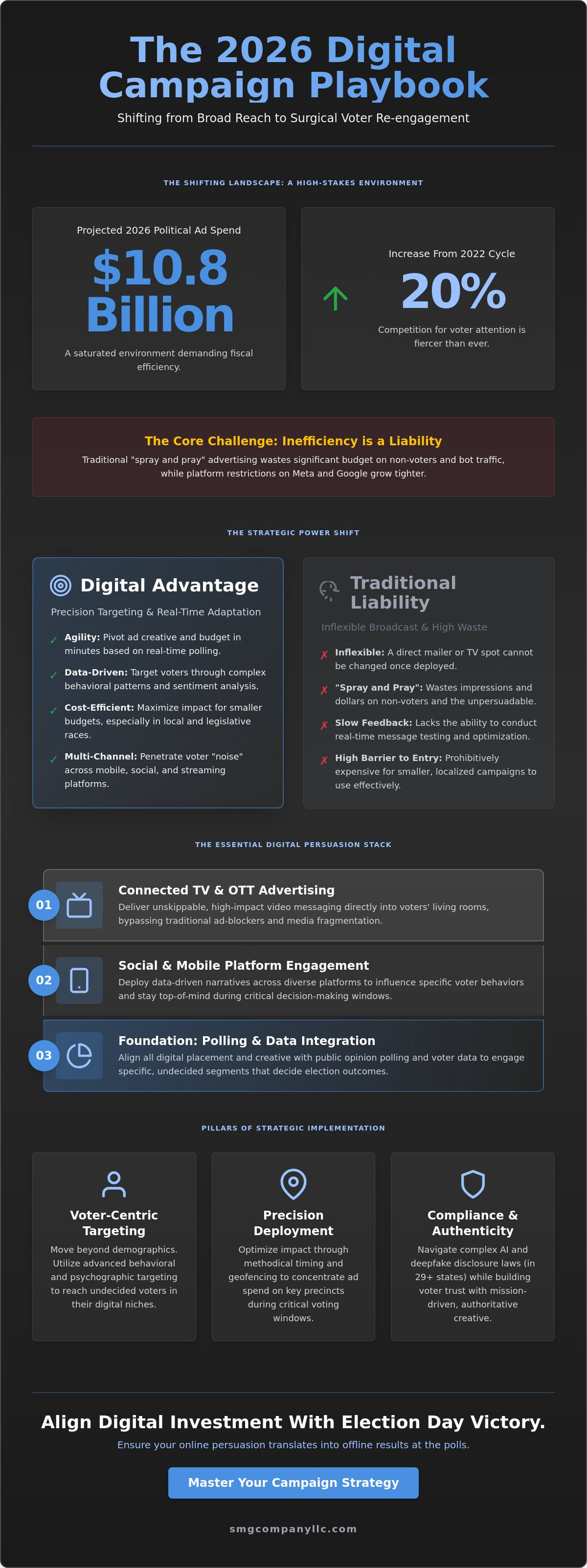
Political ad spending for the 2026 midterm elections is projected to reach a staggering $10.8 billion, marking a 20 percent increase from the 2022 cycle. In an environment this saturated, the traditional approach to digital advertising for campaigns is no longer just inefficient; it's a liability. You likely recognize the frustration of watching significant portions of your budget vanish into the void of non-voters or bot traffic while platform restrictions on Meta and Google become increasingly restrictive. Success in this cycle requires a shift from broad reach to surgical voter reengagement driven by data.
You understand that winning a race in 2026 demands more than just visibility; it requires a precise alignment between your polling data and your digital creative. This guide provides a clear roadmap to master the complex landscape of digital voter targeting and deploy high-impact advertising that translates into election-day victory. We will explore how to optimize your spend across Connected TV and social platforms, manage new AI disclosure requirements, and ensure your messaging resonates with the undecided voters who will ultimately decide the outcome in your key precincts.
Key Takeaways
Recognize the strategic necessity of transitioning from broad broadcast reach to precision-targeted digital advertising for campaigns to ensure fiscal efficiency and voter impact.
Identify the essential persuasion stack, focusing on the rise of Connected TV and OTT as primary vehicles for unskippable political messaging in a fragmented media environment.
Master the integration of public opinion polling with digital placement to engage specific voter segments through advanced behavioral and psychographic targeting.
Establish a methodical framework for deployment that optimizes timing, geofencing, and platform compliance for maximum geographic and legal impact.
Align your digital media investments with broader campaign management objectives to ensure it's translating online persuasion into offline results at the polls.
Table of Contents
The Evolution of Digital Advertising for Modern Political Campaigns
The 2026 political cycle represents a definitive break from legacy models of political communication. While Online advertising was once a supplemental tactic, it's now the foundational architecture of any viable campaign strategy. Digital advertising for campaigns in this era isn't merely about placing banners. It's the systematic deployment of data-driven narratives across fragmented platforms. This process influences specific voter behaviors in real time.
The era of the "spray and pray" broadcast buy is over. Modern campaigns prioritize micro-targeted voter persuasion over broad reach. This ensures every dollar spent contributes directly to the win number. The data doesn't lie. The "swing voter" no longer exists in a single geographic block. Instead, they're found in digital niches, identified through complex behavioral patterns and real-time sentiment analysis.
To better understand how these digital shifts impact modern strategy, watch this helpful video:
Voters are exhausted by the sheer volume of political noise. A multi-channel approach isn't just a recommendation; it's a necessity for survival. By diversifying across mobile, social, and streaming platforms, campaigns can bypass the mental filters that voters have built against traditional media. This ensures your message arrives with the authority and frequency required to penetrate the noise and stay top-of-mind during critical decision-making windows.
Digital vs. Traditional: The Strategic Power Shift
Digital advertising for campaigns offers an agility that traditional mediums like direct mail simply can't match. You can't change a postcard once it's at the post office, but you can pivot a digital ad in minutes. Campaigns can now conduct real-time message testing based on daily tracking polls. This allows for immediate budget reallocation if creative isn't moving the needle. Precision is the priority.
For local mayoral and legislative races, this cost-efficiency is transformative. Smaller budgets now wield the same sophisticated targeting tools once reserved for national candidates. With total political ad spending for 2026 projected at $10.8 billion, a 20 percent increase from 2022, the competition for attention is fierce. Digital's ability to pivot instantly is the only way to stay relevant in a fast-moving news cycle where narratives can shift in a single afternoon.
The 2026 Voter Mindset: Navigating Hyper-Saturation
Today's voter is cynical and hyper-aware of manipulation. Ad creative must be mission-driven and authoritative to build genuine trust. We've moved beyond "seasonal" advertising that only appears in October. Successful leaders now use digital channels for year-round engagement. This establishes a steady presence that builds community leadership long before the first ballot is cast. Trust is the currency. This consistent visibility creates a reservoir of goodwill that serves as a defensive shield during the heat of a campaign.
Authenticity is also a regulatory requirement. With 29 states now enacting laws to regulate deepfakes in political messaging, the margin for error is zero. Campaigns must prioritize transparency and high-level messaging that respects the gravity of the office. Building this trust requires a grounded focus on civic duty and community leadership, rather than the frantic, hype-driven marketing of the past. The results are clear.
The Persuasion Stack: Essential Digital Ad Formats for Voter Outreach
Modern voter persuasion isn't a monolith. It's a coordinated stack of strategic strikes designed to penetrate a hyper-saturated media environment. Digital advertising for campaigns must utilize unskippable formats to ensure the message isn't just delivered but actually consumed. Research from the Brookings Institution highlights the future for political advertising as one where digital dominance is absolute. Campaigns that fail to adapt their format mix risk being silenced by the noise of a cycle projected to see $10.8 billion in total spending.
While digital screens are vital, the physical environment offers a unique opportunity for high-visibility impact. The SMG (Strategic Marketing Group) Video Truck serves as a mobile billboard that bridges the gap between digital impressions and physical presence. In competitive urban hubs like Newark, these trucks provide a disruptive force that can't be ignored or blocked by an algorithm. They turn major thoroughfares into campaign battlegrounds, delivering high-definition messaging directly to the community. This physical-digital hybrid ensures your branding is unavoidable during the final, critical days of the cycle.
Mobile Advertising and Electorate Reengagement
Reaching younger and diverse demographics requires a mobile-first philosophy. Utilizing mobile advertising for voters allows campaigns to reengage the electorate through the devices they carry in their pockets. High-urgency tools like voice and text broadcasting provide the last-minute surge needed for effective Get Out The Vote (GOTV) efforts. These tactics move voters from passive interest to active participation at the polls. It's about creating a sense of immediate civic duty that translates digital leads into physical turnout. Strategic leaders often integrate these tools into a comprehensive campaign management plan to ensure no voter is left behind.
Connected TV (CTV): The New Political Air War
Connected TV has redefined the political air war. Unlike traditional broadcast television, CTV allows you to target households based on specific voter file data rather than broad zip codes. This precision ensures your candidate storytelling reaches the exact households that determine the outcome of a race. Spending on CTV is projected to reach $2.5 billion in 2026 because it combines the prestige of the big screen with the targeting of digital media. This format creates a powerful "halo effect," significantly boosting engagement across your search and social media channels. It's an essential tool for building the deep narrative required for long-term voter persuasion.
Data-Driven Targeting: Reaching the Unreachable Voter
Precision in the 2026 cycle isn't optional. While commercial advertisers often focus on generic consumer lifestyles, digital advertising for campaigns must penetrate the specific psychographic barriers that prevent a voter from crossing the line. We move beyond basic age and gender demographics to analyze behavioral triggers. This approach identifies the hidden mechanics of influence within a community. By leveraging public opinion polling services, SMG (Strategic Marketing Group) transforms raw sentiment into a surgical digital strike. This intelligence allows us to see paths to victory where others see only obstacles.
Effective electorate segmentation divides the digital battlefield into two distinct fronts: base mobilization and the persuasion of undecideds. A mobilization ad for a loyal supporter requires a different emotional register than a persuasion piece for a skeptical swing voter. The Role of Digital Marketing in Political Campaigns has evolved from simple visibility to high-stakes behavioral science. SMG (Strategic Marketing Group) utilizes deep-rooted data to map these segments, ensuring that your resources aren't wasted on non-voters or those whose minds are already made up. We prioritize efficiency to protect your budget.
Voter File Integration in Programmatic Buying
Programmatic buying now allows for the direct matching of physical voter rolls to digital IDs. This 1:1 targeting ensures your message reaches the exact individual listed on the precinct roster. Lookalike modeling further expands this reach by identifying potential supporters who share the behavioral traits of your existing base. Voter segmentation is the strategic architect’s most powerful tool for 2026, allowing for a level of precision that was previously impossible in local governance. It's the difference between a broad broadcast and a private conversation with a constituent.
Real-Time Message Testing
Static messaging is a relic of the past. We utilize aggressive A/B testing on social platforms to refine speech writing and messaging before the candidate ever takes the stage. If a specific phrase or policy point fails to resonate in the digital space, it's discarded or reworked immediately. This methodical approach ensures that the candidate’s voice carries a seasoned authority that establishes immediate credibility. Tracking sentiment shifts in real time allows for the reallocation of ad spend in the final 72 hours. This agility ensures that digital advertising for campaigns remains responsive to the pulse of the community until the last ballot is cast.
Strategic Implementation: Timing, Compliance, and Geofencing
Implementation is the bridge where data-driven theory meets the reality of the ballot box. For digital advertising for campaigns, success relies on a methodical 5-step framework. It begins with establishing clear, mission-driven objectives: Awareness, Persuasion, and Turnout. Every impression must serve one of these pillars. Awareness builds the candidate's profile early in the cycle. Persuasion shifts the undecided middle through narrative. Turnout, the final phase, ensures the base reaches the polls. Without this structure, even the largest budget will fail to produce a victory.
Geofencing provides a layer of geographic precision that traditional media cannot replicate. By creating digital perimeters around polling places, community centers, and legislative buildings, campaigns deliver hyper-relevant messaging to voters in real time. This tactic is particularly effective for mobile reengagement during early voting windows. It turns physical locations into digital capture points, ensuring your message is the last thing a voter sees before casting their ballot. Effective digital advertising for campaigns requires this level of surgical placement to maximize impact in competitive districts.
The Campaign Countdown: Ad Spend Timing
Strategic timing relies on a "Flighting" strategy. You don't want to exhaust your budget too early, yet you cannot afford to be silent when the opposition is loud. The data dictates when to go dark to save resources and when to saturate the market for maximum influence. Allocating your war chest across primary and general phases requires a high-level strategic outlook. As of May 2026, political ad spending is projected to reach $10.8 billion. This massive influx of capital causes a surge in digital ad costs during the final 60 days. You must secure your inventory early to avoid being priced out of the market by late-entry national spending.
Compliance and Transparency
Compliance isn't an obstacle; it's a requirement for institutional credibility. Navigating the landscape of NJ and federal political ad disclosures is complex. Both Google and Meta require authorized advertisers to complete identity verification and include "Paid for by" disclaimers on all creative. Additionally, Google requires disclosure for any AI-generated content. With 29 states now regulating deepfakes in political messaging, maintaining an archive for public inspection is essential for accountability. To ensure your implementation aligns with a broader path to victory, consult with our team on strategic campaign management.
Beyond the Click: Integrating Digital Media with Strategic Campaign Management
Success in the 2026 cycle isn't measured by click-through rates or social media impressions. These are vanity metrics if they don't lead to a ballot being cast. Digital advertising for campaigns is only as effective as the broader campaign management strategy it supports. A high-impact video ad might build awareness, but without a plan to close the loop, that momentum dissipates. SMG (Strategic Marketing Group) integrates digital outreach with field operations to ensure every lead translates into a ground game victory. This transition from digital impression to physical turnout is where the margin of victory is found.
SMG (Strategic Marketing Group) operates as a seasoned insider, looking at data and social trends through a lens that challenges the status quo. We understand the hidden mechanics of influence and how to navigate the obstacles that derail less experienced teams. Our approach ensures your digital media spend isn't an isolated expense but a coordinated strike within a larger mission. Partnering with a firm that understands these complexities is the difference between a high-spending campaign and a winning one.
A Full-Service Approach to Victory
A sophisticated digital strategy must align with government relations strategy and public affairs goals. Legislative advocacy and corporate reputation management often require the same surgical precision as a candidate race. By leveraging digital ads to influence public sentiment, we create the favorable environment necessary for policy success. The history of SMG (Strategic Marketing Group) in high-stakes engagement across over 40 states provides a unique perspective on local engagement. We know how to build a path to victory where others see only complexity. This deep-rooted expertise allows us to handle multifaceted challenges with precision and steady confidence.
Building Your Path to Victory in 2026
The role of the strategic architect in modern digital warfare is to maintain a high-level strategic outlook while executing grounded, effective tactics. As you prepare for the upcoming cycle, your checklist should include verifying polling accuracy, securing digital inventory early, and ensuring total alignment between your messaging and your data. The 2026 cycle will be the most expensive and fragmented in history. Don't leave your outcome to chance or uncoordinated digital spend. It's time to secure your position. Consult with SMG (Strategic Marketing Group) for your 2026 digital strategy to ensure your campaign is built for victory from the ground up.
Commanding the 2026 Digital Battlefield
The 2026 cycle demands a level of precision that legacy strategies simply can't provide. We've moved beyond simple impressions to a reality where digital advertising for campaigns acts as a surgical tool for electorate reengagement. Success requires a methodical alignment of public opinion polling with high-impact formats such as Connected TV and mobile geofencing. By closing the loop between digital leads and ground-game operations, you ensure that every dollar spent translates into a physical vote on election day. It's about building a narrative that resonates with the community's pulse while maintaining a high-level strategic outlook.
SMG brings a history of high-stakes success across more than 40 states. Our team of New Jersey operatives understands the local engagement necessary to win in complex environments. We combine this deep experience with innovative tools like the SMG Video Truck to build a path to victory where others see only obstacles. Don't leave your outcome to chance in a hyper-saturated market. Secure your 2026 campaign victory with SMG’s strategic digital advertising. Your campaign deserves a partner that understands the hidden mechanics of influence and the gravity of civic leadership.
Frequently Asked Questions
How much should a political campaign spend on digital advertising?
Budget allocation depends on your specific win number and the competitive landscape of your district. Most sophisticated operations now allocate between 30 percent and 50 percent of their total paid media budget toward digital channels. This ensures sufficient frequency to penetrate voter cynicism. Your spend should be guided by real-time polling to ensure you're investing enough to reach undecided voters multiple times before they cast a ballot.
Can I target specific voters by name with digital ads?
Yes, through a process known as voter file onboarding, we match physical voter rolls to digital IDs. This allows for 1:1 targeting, ensuring your digital advertising for campaigns reaches the exact individuals on your precinct list. While some platforms have restricted certain demographic categories, programmatic buying still enables campaigns to deliver surgical messaging to known households. This precision eliminates the waste associated with broad broadcast buys.
What are the rules for political advertising on social media in 2026?
Regulations are platform-specific and prioritize transparency. Meta and Google require identity verification and clearly visible "Paid for by" disclaimers on all creative. TikTok maintains a standing ban on paid political content, while X requires certification for candidate accounts. It's also vital to note that 29 states now regulate AI-generated deepfakes. Campaigns must maintain a public ad archive to comply with federal and state transparency mandates.
How does geofencing work for political rallies and events?
Geofencing creates a virtual perimeter around a physical location, such as a town hall or a legislative building. When a voter enters this area with a mobile device, they're added to a specific audience segment for immediate or future ad delivery. This tactic is highly effective for capturing the attention of engaged citizens at community events. It allows a campaign to bridge the gap between a physical handshake and a sustained digital narrative.
What is the difference between digital persuasion and GOTV ads?
Persuasion ads are designed to shift a voter's opinion through long-form storytelling and authoritative messaging over several months. They target the undecided middle of the electorate. Get Out The Vote (GOTV) ads are high-urgency strikes deployed in the final days of a race. GOTV messaging focuses on polling locations and deadlines rather than candidate platform details. Both are essential, but they require different creative registers and targeting goals.
How long does it take to see results from a digital campaign?
Engagement metrics like click-through rates are available within hours, but true voter persuasion is a cumulative process. It typically takes 21 to 30 days of consistent messaging to see a statistically significant shift in tracking polls. While digital advertising for campaigns allows for real-time creative pivots, the goal is sustained influence rather than instant gratification. Frequency is the primary driver of message retention among skeptical voters.
Is Connected TV (CTV) effective for local municipal elections?
CTV is exceptionally effective for local races because it provides the authority of a television presence without the wasted reach of traditional broadcast. You can target specific households within a single ward or council district, ensuring your budget is only spent on your actual constituents. This makes high-definition storytelling accessible for municipal candidates who need to establish community leadership. It's a strategic tool for dominating the local narrative.
What metrics should a campaign manager prioritize in digital reporting?
Prioritize "Frequency of Reach" within your target voter segments over vanity metrics like total impressions. You need to know if your win-number voters are seeing your message often enough to remember it. Track "Halo Effect" metrics, such as increases in organic search volume or website traffic, during active ad flights. Ultimately, the most critical data point is the correlation between digital saturation in a precinct and the movement in your internal polling numbers.
Comments