
Conjoint Analysis for Messaging: A Guide for Campaigns

What if the message your campaign team prefers isn’t the one voters choose when they have to weigh competing priorities? Conjoint analysis for messaging helps answer that question by testing how audiences respond to combinations of message elements, rather than asking them to judge each idea in isolation. It can show which themes, evidence, and calls to action matter most when people make trade-offs.
A poll or A/B test can identify a preferred position or creative version, but may not show how people balance several parts of a campaign narrative at once. Conjoint analysis gives campaign teams a structured way to examine those trade-offs before settling on a central message.
This guide explains what conjoint measures in a messaging context, when it can offer more insight than a simple poll or A/B test, and how to use results in a communications strategy. SMG conducts polling, specialized surveys, and focus groups to assess message effectiveness and inform campaign decisions. Findings can support strategic judgment, but should be considered alongside political context and the communities a campaign serves.
Table of Contents
What conjoint analysis for messaging reveals about audience choices
Conjoint analysis for messaging estimates how people value combinations of message attributes by asking them to choose among alternatives. That matters in campaigns because audiences rarely assess one claim in isolation. They may weigh an issue priority against the evidence offered, who delivers the message, and what action is proposed, all at once.
Definition: Message conjoint is a survey-based research method that estimates the relative appeal of combinations of message elements. General opinion polling measures views or reported preferences, but does not necessarily test how people trade off those elements together.
The method builds on a broader family of techniques described in Conjoint analysis. In a messaging study, its value is structured comparison. Rather than asking only whether people like a statement, researchers can examine which components influence choices as other components change.
What does conjoint analysis measure in a message?
Researchers define attributes as the dimensions that could vary, such as issue emphasis, supporting evidence, messenger, or proposed action. Levels are the specific alternatives within each dimension. For example, an illustrative study about a local transportation proposal might vary whether a message emphasizes commute times or road maintenance, presents budget data or resident testimony, and calls for a public meeting or a vote.
Respondents evaluate combinations of these levels. Across their choices, analysis estimates relative preference patterns: which elements tend to strengthen or weaken an option, and how combinations compare. These estimates reflect the study and are not a guaranteed ranking for every individual.
When is conjoint analysis useful for political messaging?
Use it when a campaign, public affairs team, or advocacy organization needs to prioritize among several plausible message components. It can inform early narrative development by showing which combinations merit further consideration before the campaign settles on a central message.
That differs from testing a nearly finished advertisement. If the question is which draft performs better, a direct comparison or A/B test may be more suitable. Conjoint is most useful when the strategic question concerns trade-offs among multiple elements, not whether one polished execution wins.
Interpret results with care. Choices made in a survey estimate preferences under the conditions presented. They cannot establish with certainty how people will act in a live political environment. Audience knowledge, campaign objectives, and political context remain essential to deciding what the findings mean and how to use them.
How conjoint message testing works, from attributes to audience choices
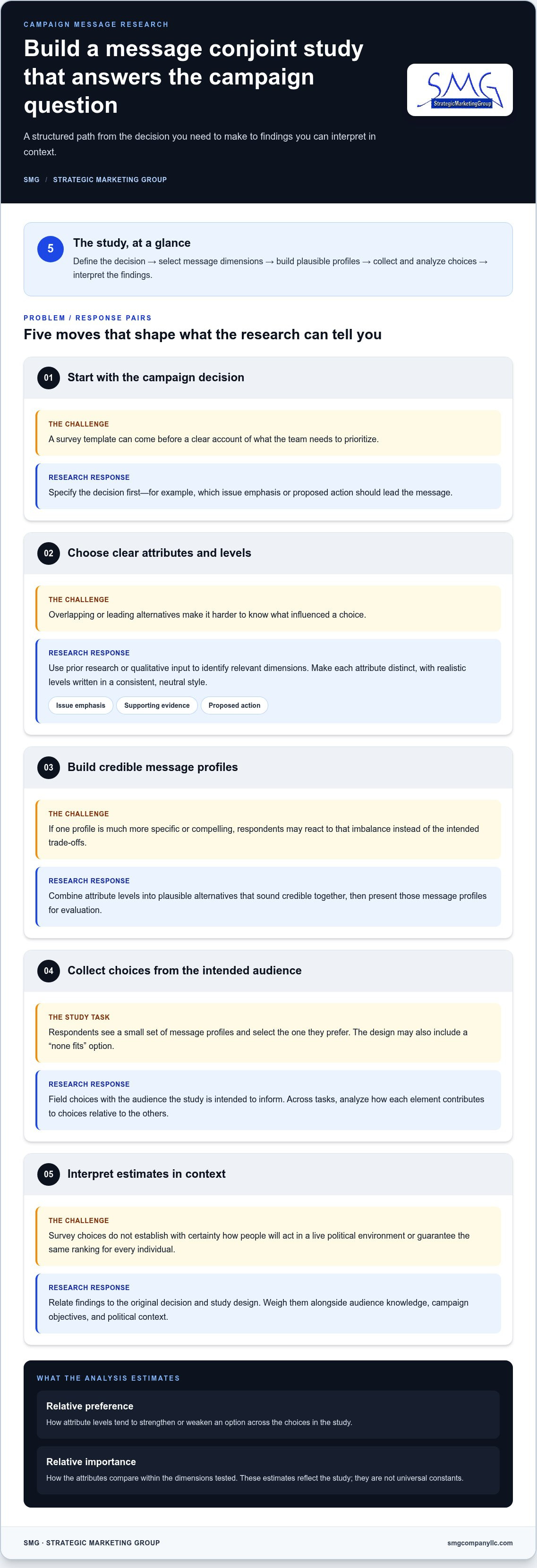
A sound study begins with the decision it needs to inform, not with a survey template. The team then identifies message dimensions, develops credible alternatives, presents combinations to an audience, analyzes the choices, and interprets the results in context. Each step shapes what the research can tell campaign leaders.
Define the decision: Specify what the team needs to prioritize, such as which issue emphasis or proposed action should lead a public affairs message.
Select attributes and levels: Identify distinct message dimensions and realistic alternatives for each.
Build message profiles: Combine levels into plausible alternatives for respondents to evaluate.
Field and analyze: Collect choices from the intended audience and estimate the contribution of each element.
Interpret: Relate the findings to the original decision, study design, and campaign context.
In a message conjoint study, respondents evaluate combinations of message elements, allowing researchers to estimate how those elements shape choices relative to one another rather than in isolation. This approach reflects the broader idea of learning how customers value different components through trade-offs, adapted here to campaign communications.
How should a team define message attributes and levels?
Start with the strategic question, then use prior research or qualitative input, such as focus groups, to identify a manageable set of relevant dimensions. Attributes might include the issue emphasized, the evidence cited, or the proposed action. Levels should be distinct alternatives within each dimension and written in a consistent, neutral style. Overlapping or leading options make it harder to know what drove a choice.
Illustrative example, not a client result: A campaign studying a workforce proposal might vary whether a message emphasizes local job access or employer needs, cites program details or community perspectives, and proposes a training initiative or expanded career guidance. The combinations should sound plausible together. If one profile is clearly more specific or compelling than the rest, respondents may react to that imbalance instead of the intended trade-offs.
How are message combinations tested and analyzed?
In each choice task, respondents see a small set of message profiles and select the one they prefer, or indicate that none fits if the design includes that option. Across tasks, the model estimates utility, the relative preference associated with an attribute level, and relative importance within the attributes tested. These estimates are not universal constants. Results depend on the audience, options, task burden, sample design, and model assumptions.
Careful design and interpretation make conjoint analysis for messaging a decision-support tool, not a substitute for political judgment. SMG’s polling and message research can help connect audience choices to broader campaign strategy. Explore SMG’s public opinion research.
Conjoint analysis vs. message polls and A/B tests: choose the right tool
The right method depends on the decision a campaign needs to make. A direct poll measures stated opinion on defined questions. An A/B test compares complete creative versions under particular exposure conditions. Conjoint analysis for messaging examines how audiences weigh combinations of message elements. Each method answers a different question, so choose one based on the information the team needs.
When does conjoint add more than a direct message poll?
Conjoint is useful when the strategic question concerns the relative value of several attributes. For instance, a team might want to know whether an audience responds more to an issue emphasis, a type of evidence, or a proposed action when these appear in different combinations. A direct poll is a better fit when the team needs a focused measure of stated support or preference for a defined question.
Neither method automatically predicts turnout, persuasion, or vote choice. They measure responses within their study conditions. Interpretation should account for what was asked, who was included, and how the findings relate to the campaign’s broader objectives.
When is an A/B test the better fit?
Choose A/B testing when the team has complete creative alternatives and wants to compare them in a defined exposure environment. The result reflects the audience reached, how exposure is delivered, and the outcome measured, as well as the creative itself. It answers which version performed better under those conditions, not necessarily why each component worked.
Methods can be combined when each serves a distinct purpose: conjoint can help prioritize message elements, direct polling can assess stated support, and an A/B test can compare finished executions. A disciplined research plan avoids collecting overlapping evidence that does not resolve a clear strategic decision.
Design a credible conjoint study for campaign messaging
A study is only as useful as the choices it puts in front of respondents. In conjoint analysis for messaging, weak attributes, biased wording, or implausible combinations can produce estimates that look precise but lead campaign teams toward the wrong strategic conclusion. A poorly designed conjoint study can generate precise-looking estimates that are strategically misleading.
Use this checklist to assess the design before fielding:
Define the decision. State what campaign or public affairs choice the research must inform.
Select the audience. Recruit respondents relevant to that decision, and make the intended population clear.
Review attributes and alternatives. Check that dimensions are distinct, relevant, and not missing meaningful options.
Write neutral wording. Present alternatives in balanced language without signaling which message the sponsor favors.
Build plausible combinations. Ensure each profile could credibly appear in real campaign communication.
Check task burden. Review how many choices respondents face and whether each task is understandable.
Pretest the questionnaire. Test comprehension and respondent effort before launching the full survey.
Plan analysis and interpretation. Document sample design, model assumptions, and how uncertainty will be considered.
How can researchers reduce bias in message-conjoint questions?
Keep alternatives comparable in tone, length, and specificity. For example, don’t pair a measured policy description with an emotionally charged accusation, since respondents may be reacting to the language rather than the intended attribute. Review combinations for overlap and realism, too. Pretesting can reveal confusing wording, repetitive tasks, or implausible profiles before those issues affect the data.
What should teams check before trusting the results?
Assess whether the sample reflects the audience relevant to the decision, and review data-quality procedures and weighting choices where applicable. Ask how the model handles uncertainty and whether the study design supports subgroup estimates. Sample size and modeling choices need study-specific justification. There is no universal threshold that makes every conjoint study reliable.
Keep the boundary between evidence and inference clear. The results describe choices observed under the study conditions. They do not, by themselves, establish how people will respond to a campaign in the future or how political behavior will change. Use findings alongside audience knowledge, campaign objectives, and the wider political context.
SMG’s polling, survey, and data analysis expertise can help connect research design and interpretation to campaign decisions. Discuss campaign message research with SMG.
Turn conjoint findings into a stronger messaging strategy with SMG
Conjoint results become valuable when they help a campaign make a clearer communications decision. Treat preference estimates as evidence for prioritization, not as a ready-made script. A message element that performs well in a study may merit further consideration, but it still needs to fit the campaign’s objectives, audience, political context, and communication channels.
A practical next step is to translate findings into a creative brief. Identify the tested elements that appear most relevant, describe the evidence and caveats behind that conclusion, then give creative teams direction to develop and test executions. Research can help clarify what a message should emphasize. It does not dictate exact language or guarantee how an audience will respond. For broader strategic context, see SMG’s political messaging services guide.
How should a campaign translate preference estimates into message choices?
Start by asking which findings address the original decision. Consider whether the leading elements align with campaign priorities and make sense for the audiences and channels involved. If an attribute’s relative appeal varies across relevant groups, that may call for tailored creative or further testing rather than one broad message. Public opinion polling services can provide a wider view of the attitudes and issues informing those choices.
Conjoint analysis for messaging should sit within a broader evidence base. Pairing preference estimates with public opinion research and audience knowledge can help teams distinguish a promising message component from a strategic priority. Findings should inform judgment, not replace it.
How can conjoint findings fit into broader audience analysis?
Consider message preferences alongside audience segments and wider public opinion to understand where perspectives align or differ. That context helps campaign teams assess whether a message direction is relevant to the people they need to reach and consistent with campaign objectives. SMG’s electorate analysis offers further perspective on connecting audience understanding to political strategy.
SMG conducts polling, surveys, focus groups, and data analysis to test message effectiveness and support strategic communications. For teams weighing a research question or planning a message test, SMG can help connect polling and messaging research to the campaign’s next decision.
Put audience insight to work in your next campaign
Conjoint analysis for messaging helps campaigns understand how audiences weigh message elements together, giving teams evidence to prioritize themes before shaping communications. Its value depends on a disciplined study: the right audience, neutral and plausible message options, and interpretation that reflects the study’s limits.
Choose the method that fits the decision. Conjoint can illuminate trade-offs among message components, while direct polling measures stated views on defined questions and A/B testing compares complete creative versions in a specific setting. None should stand alone as a prediction of political behavior. Research is most useful when considered alongside campaign objectives, audience knowledge, and political context.
SMG conducts public opinion polling, surveys, and focus groups, and tests message effectiveness to inform campaign and public relations strategy. With experience across more than 40 states, the firm brings research into a broader understanding of public affairs and communications decisions.
Ready to ground your message strategy in audience insight? Discuss polling and message research with SMG. Bring SMG your campaign’s research question to discuss how polling and message testing can inform your next decision.
Frequently Asked Questions
What is conjoint analysis for messaging?
Conjoint analysis for messaging is a survey method that estimates how people value combinations of message elements. Respondents choose between message profiles that vary across attributes, such as issue emphasis, evidence, messenger, or proposed action. Researchers analyze those choices to estimate relative preferences among the elements tested. The results describe responses within the study design, not certain reactions from every audience member or guaranteed behavior outside the survey.
How does conjoint analysis help improve a campaign message?
It helps a campaign identify which tested message elements deserve further consideration when audiences weigh them together. For example, a study might compare different issue priorities and proposed actions to see which combinations tend to be preferred. Teams can use that evidence to shape creative briefs and decide what to test next. Findings support strategic judgment. They do not dictate final wording or guarantee that a message will persuade voters.
When should a campaign use conjoint analysis instead of a poll?
Use conjoint when the team needs to understand how people trade off several message attributes, such as issue emphasis, supporting evidence, and a proposed action. Use a direct poll when the objective is to measure stated opinion on a defined question, such as support for a policy position. The distinction is the research question: conjoint examines choices among combinations, while a conventional poll can measure an overall stated view.
Is conjoint analysis better than A/B testing for political messages?
Neither method is universally better. Conjoint helps estimate the relative appeal of combinations of message components, which is useful during message development. A/B testing compares complete creative versions in a particular live or controlled exposure setting. The result depends on who saw each version, how it was delivered, and what outcome was measured. Select the method that answers the campaign’s immediate question, or combine them when each has a distinct role.
What attributes can be tested in a messaging conjoint study?
Attributes are the message dimensions that vary across alternatives. A study might test issue emphasis, evidence or proof points, messenger, tone, or proposed action. Each attribute needs clearly defined levels, such as alternative issue frames or calls to action. The selection should reflect the decision the campaign needs to make. Too many overlapping or implausible attributes can make choices harder to interpret, so careful design and pretesting matter.
How many respondents are needed for a conjoint messaging study?
There’s no universal respondent count that fits every conjoint study. The appropriate sample depends on factors such as the audience being studied, the number and complexity of attributes, the choice-task design, the model, and whether the team needs to compare subgroups. Researchers should justify sample size against the study’s objectives and desired precision. A larger sample alone can’t correct weak question design, poor audience selection, or unsuitable modeling choices.
Can conjoint analysis predict which campaign message will win votes?
No. Conjoint analysis estimates preferences among the message combinations presented under the study conditions. It doesn’t establish that a particular message will change votes, increase turnout, or determine an election outcome. Real-world responses also depend on factors beyond the tested message, including political context, campaign objectives, and how communications reach an audience. Treat the findings as one input to strategy, alongside public opinion research, audience knowledge, and informed political judgment.
Comments