
Coalition Building for Public Policy: A Practical Guide

A coalition can bring more voices to the table and still lose focus, trust, or momentum. Effective coalition building for public policy depends on aligning distinct interests around a clear, measurable goal, not simply gathering organizations under one banner. The challenge is turning shared concern into coordinated action without asking members to give up the priorities they represent.
If you’re weighing how to engage partners with different constituencies, clarify who decides what, and keep meetings tied to policy progress, those concerns are well founded. A coalition needs enough structure to act with purpose and enough openness for members to trust the process. Public opinion research can help assess the environment, while legislative monitoring can keep strategy responsive as policy opportunities shift.
This guide explains how to identify aligned partners and complementary roles, set a focused agenda, and establish practical decision-making responsibilities. It also covers how to measure progress and communicate a shared position while respecting member perspectives. The goal is a disciplined partnership with activity connected to outcomes.
Table of Contents
Why coalition building for public policy starts with a shared purpose
A public-policy coalition is a group of organizations or individuals coordinating around a shared policy objective. Members don’t need identical missions or positions on every issue. They do need a clear point of agreement to guide joint action. A useful definition is: A policy coalition is a coordinated partnership pursuing a shared policy objective while its members retain their distinct perspectives and identities.
That distinction matters. A broad alliance may bring people together around a general concern, but without a defined policy purpose it can struggle to set priorities or decide what progress looks like. Coalition building for public policy becomes valuable when coordination can do something separate efforts cannot: connect complementary expertise, broaden representation, or present a more informed case to decision-makers. For example, a local service organization may contribute direct community insight while a research group assesses public understanding.
For a general overview of coalition formation and use in political contexts, see Understanding Coalitions in Public Policy. The practical test is whether partners can name a specific shared objective and explain why they should pursue it together.
For a perspective on leadership and coalition work, watch this video:
When a coalition is the right approach
A coalition makes sense when partners share an interest in a policy change and bring different strengths to the effort. One organization may have trusted relationships with affected communities; another may offer subject expertise or direct knowledge of the policy process. Coordinating their contributions can make the case more representative and reduce duplicated work.
Not every shared concern needs a permanent coalition. If the objective is narrow and time-bound, a partnership focused on a specific proposal or decision point may be more practical. The structure should serve the work, not become a goal in itself.
What members should expect from the outset
Coalition participation takes sustained attention. Policy timelines can shift, decision-makers may weigh competing priorities, and collective advocacy can inform debate without controlling its outcome. Set expectations early for the objective, member contributions, communication, and how progress will be assessed.
Members don’t have to agree on every policy question or adopt a single organizational identity. They can coordinate around a defined shared position while continuing to speak and act independently on other matters. Clear boundaries protect trust and prevent the coalition’s agenda from being mistaken for each member’s full platform.
A focused purpose also gives the group a basis for deciding what belongs in joint work and what should remain with individual members. Public opinion research can help partners understand the public environment, while strategic communications can express common ground without erasing differences. The result is not uniformity; it is disciplined cooperation around an objective members have chosen to advance together.
How policy coalitions turn stakeholder participation into coordinated influence
A coalition’s influence depends not only on who joins, but on how member contributions connect to the policy objective. Effective coalition building for public policy starts by mapping what each participant knows, whom they represent, and what they can contribute. This reveals where efforts reinforce one another, where perspectives are missing, and which responsibilities need clear ownership.
Map stakeholders by interest, expertise, and constituency
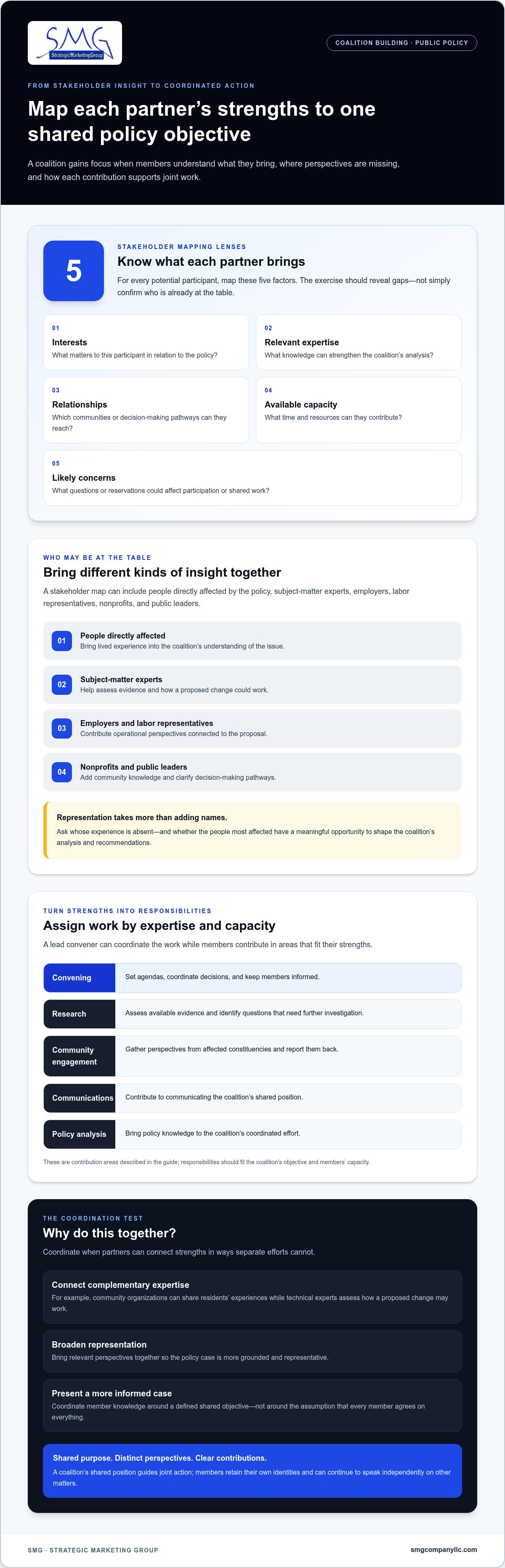
Begin with a stakeholder map that includes people directly affected by the policy, subject-matter experts, employers, labor representatives, nonprofits, and public leaders. For each potential participant, record their interests, relevant expertise, relationships, available capacity, and likely concerns. The exercise should reveal gaps, not simply confirm the partners already at the table.
Consider a proposal that affects access to a public service. Community organizations may understand barriers residents encounter; technical experts can assess how a proposed change would work; employers or labor groups may contribute operational perspectives; and public leaders can clarify decision-making pathways. These contributions are not interchangeable. Together, they can make the policy case more grounded and representative.
Before finalizing membership, ask whose experience is absent and whether current partners can speak credibly to the communities most affected. Representation is not achieved by adding names to a list. Members need meaningful opportunities to shape the coalition’s analysis and recommendations.
Assign roles that make participation meaningful
Translate the stakeholder map into responsibilities. Assign work according to expertise and capacity, not organizational status. A lead convener might coordinate meetings and decisions, while other members contribute research, community engagement, communications, or policy analysis. Define each contribution and how it supports the shared objective.
Convening: Set agendas, coordinate decisions, and keep members informed.
Research: Assess available evidence and identify questions that need further investigation.
Community engagement: Gather perspectives from affected constituencies and report them back accurately.
Communications: Explain the coalition’s shared position while preserving members’ distinct voices.
Policy analysis: Track proposals and assess how they relate to the coalition’s objective.
Public opinion polling can test assumptions about public concerns instead of allowing partners to treat their own experience as the whole picture. Surveys, focus groups, and data analysis can help a coalition assess sentiment and refine messages. SMG conducts this research through its public opinion polling services.
Complementary roles strengthen collective policy work by combining distinct expertise and relationships without requiring every member to speak or act in the same way. This principle also distinguishes coalition coordination from independent advocacy. Members can align on shared statements, research, or joint actions while retaining control of their own communications and advocacy priorities. Make clear which positions represent the group and which belong to individual members.
For coalitions working through legislative processes, government relations strategy can connect coordinated participation with ongoing policy engagement.
Which coalition structure and policy agenda fit your goals?
The right structure depends on the policy challenge, the time available, and members’ capacity to act together. A coalition built for a single decision may need little permanence; partners working across connected policy questions may need ongoing coordination. Choose a format that supports the work without adding governance the group cannot sustain.
Choose a structure that matches the policy challenge
Use an issue-specific coalition when the objective is limited and partners can define what success means. An ongoing alliance is more appropriate when the work spans related proposals or requires continuing coordination. A campaign-based partnership is organized around a specific opportunity, such as advancing a proposal during a defined policy window. Each model depends on member capacity, the coalition’s scope, and who has authority to make shared decisions.
Before selecting a format, consider how much coordination the work requires. A narrow agenda with a small group of committed partners may not need a permanent structure. A broader effort involving multiple constituencies may require formal decision rules and regular communication. Keep governance proportionate: too little clarity invites confusion, while unnecessary process can take time away from policy work.
Build an agenda members can support
Put the shared objective in specific, understandable terms. State the policy change the coalition seeks, why it matters, and what evidence or rationale supports it. Then define boundaries: identify secondary issues that members may care about but that won’t be represented as coalition priorities. This prevents the common purpose from expanding until it becomes difficult to act on.
Agree on decision rules before public advocacy begins. Specify how the coalition approves statements, who can speak for the group, how members can register dissent, and whether participation in a particular action is optional. These rules protect trust by distinguishing a coalition position from the views of every member organization.
Use public opinion research and legislative monitoring to keep the agenda grounded in public understanding and policy developments. These inputs help members assess whether their rationale resonates and whether the focus needs adjustment. For sustained policy engagement, government relations strategy can connect coalition priorities with developments in the policy process.
A practical agenda is focused enough to guide decisions and flexible enough to respond to new information. Review it when the policy context changes, but don’t broaden it by default. In coalition building for public policy, disciplined scope helps members coordinate without asking them to surrender priorities beyond the work they agreed to pursue.
How to build and manage a public-policy coalition step by step
A coalition needs more than a compelling cause. It needs a repeatable process for moving from an identified policy problem to coordinated work, with clear commitments and regular opportunities to adjust. Use these steps to establish the partnership and keep its operations connected to the policy objective.
Define the issue and desired change. Describe the policy problem, who is affected, and what specific change the coalition seeks. Keep the objective clear enough that prospective members can quickly assess their interest and relevance.
Identify potential partners and contributions. Map organizations and individuals with relevant expertise, community relationships, research capacity, or policy knowledge. Consider which perspectives are missing before settling the initial membership.
Make specific, purposeful outreach. Explain the issue, why you believe it may connect with the prospective partner’s interests, and what first contribution you’re proposing. A focused invitation, such as reviewing a draft policy brief or sharing community insight, gives people a concrete basis for responding.
Agree on how the coalition will work. Document the shared objective, member roles, decision process, communications expectations, and how the group will represent its position. Clarify how members can raise concerns or withhold support for a specific action without confusing their individual views with the coalition’s agreed position.
Launch, track, and review. Set an initial work plan with owners, milestones, and a review date. At each review, assess completed actions, participation, emerging policy developments, and whether the original plan still fits.
Launch with clear commitments and working practices
Keep the operating rhythm simple. Schedule meetings around decisions or coordinated actions, circulate concise updates between meetings, and maintain a shared record of assignments, owners, and due dates. Close each discussion by confirming what was decided, who is responsible, and when the group will review progress. This reduces ambiguity and makes participation more practical for members with limited capacity.
Set expectations for public communications before the coalition launches. Agree who can speak for the group, how shared statements are approved, and how the coalition will describe differences among members. A clear process allows joint communication without implying that every organization has adopted the coalition’s entire policy platform.
Maintain momentum and address participation challenges
Participation can become uneven as workloads and policy priorities shift. Revisit assignments rather than allowing unspoken expectations to accumulate. Ask whether responsibilities still match each member’s capacity and whether the coalition’s composition continues to reflect the perspectives relevant to its objective.
Legislative developments can also change the timing or relevance of planned actions. Ongoing monitoring helps the coalition adapt its work plan to policy activity, while government relations strategy supports sustained engagement. Keep updates tied to decisions and next steps, not simply meeting frequency.
Activity measures show what a coalition has done; evidence of policy progress shows whether those actions are advancing its objective. Track each separately. Meetings held and materials distributed demonstrate activity, while policy milestones indicate movement in the external process. Neither should be presented as a guaranteed result. SMG’s government relations strategy support connects coalition activity with policy engagement.
Sustain Coalition Progress and Connect Strategy to Policy
A coalition needs a review process that distinguishes effort from movement in the policy environment. A full calendar may show participation, but it won’t establish whether members completed agreed actions, reached relevant audiences, improved public understanding, or advanced a policy milestone. Track these measures separately so leaders can see what is working and where the strategy needs adjustment.
Evaluate progress without confusing activity with impact
Build a simple dashboard around the coalition’s objective. Record participation, such as which members contributed to agreed work; completed actions, such as briefings or public communications; evidence of public understanding; and policy milestones, such as a proposal advancing through a decision process. Define each measure before tracking begins, and use consistent records so changes over time can be interpreted accurately.
Review evidence and assumptions at planned intervals. If outreach is reaching people but public understanding remains limited, the coalition may need to refine its explanation or learn more about concerns. If a policy milestone shifts, members may need to revisit timing, responsibilities, or the next strategic step. Document the reasoning behind each adjustment, including what evidence prompted it. That record preserves institutional knowledge and helps members understand why the plan changed.
Policy outcomes depend on factors beyond a coalition’s control, including decision-makers’ choices, competing priorities, and changes in the broader policy environment. A coalition can assess its contribution by documenting actions taken, relationships engaged, information brought into the debate, and milestones observed. It should not claim sole credit for outcomes with multiple causes or promise that coordinated work will secure a particular result.
Apply SMG capabilities to coalition strategy
Research can help members test assumptions rather than rely only on internal impressions. Public opinion polling and focus groups can surface public perspectives, assess understanding of an issue, and inform message choices. Electorate analysis can also inform coalition planning with insights into voter behavior and public perspectives. These findings give members a stronger basis for deciding what to emphasize and which questions need further attention.
As policy activity evolves, legislative monitoring and government relations counsel can help a coalition interpret developments and align engagement with the changing context. Strategic communications can then convey the shared agenda clearly while leaving member organizations room to express their own perspectives. These functions work best when they support the coalition’s agreed objective and draw on evidence, not simply on the volume of activity.
Strong coalition building for public policy is sustained through disciplined review: measure distinct forms of progress, explain what the evidence can and cannot show, and adapt while maintaining members’ trust. SMG supports coalition strategy with public opinion polling, policy monitoring, and strategic communications.
Put Your Coalition’s Next Policy Decision in Focus
The next step is to identify the decision or policy moment your coalition needs to prepare for. Use it to focus immediate planning: what information is missing, whose perspective should shape the approach, and what action can partners take together? A clear near-term priority gives members a practical way to move from shared intent to sustained engagement, while leaving room to adapt as circumstances change.
Coalition work also benefits from a perspective grounded in different policy environments. SMG has experience in more than 40 states, bringing broad public-affairs context to the strategic questions that shape coalition efforts.
SMG’s public opinion polling, government relations strategy, and strategic communications can support coalition planning and engagement. With disciplined planning and a clear sense of purpose, coalition building for public policy can help partners make their collective voice more coherent and their participation more meaningful.
Frequently Asked Questions
Can organizations with different priorities join the same policy coalition?
Yes, if they can work toward a specific shared objective while retaining their separate priorities. For example, organizations might agree on one change to a public program even if they differ on other reforms. Define what the coalition will address and what remains outside its scope. Also agree how members can raise disagreement and whether they may communicate separate positions, so joint action doesn’t imply total agreement.
How many members should a public-policy coalition have?
There’s no universally effective number. The right size depends on the objective, the perspectives needed, and the group’s ability to coordinate. A small coalition may make decisions efficiently, while a wider membership can bring additional expertise or community representation. For example, a group assessing a local service proposal might prioritize partners with direct knowledge of affected residents. Assess whether each member adds a meaningful contribution instead of treating growth as a measure of strength.
What happens if a coalition member disagrees with the shared position?
Follow the process members agreed to before public advocacy began. Depending on those rules, a member might support the coalition’s defined position, sit out a particular action, or communicate a distinct view in its own name. For example, members could approve a joint statement while allowing organizations with unresolved concerns not to endorse it. Make attribution clear by distinguishing the coalition’s approved position from the views of every individual member.
How can a small nonprofit start building a policy coalition?
Start with a specific policy change and identify community leaders or organizations with a direct connection to the issue. In an initial approach, explain why the change matters, where interests may align, and suggest a manageable first contribution, such as reviewing a short issue brief. Ask what level of participation is feasible. Before inviting more partners, agree on basic follow-up, communication, and decision practices so early interest can become coordinated work.
How do you measure whether a policy coalition is making progress?
Track several forms of evidence, not just the number of meetings or public statements. Record who participated, whether assigned actions were completed, which audiences the coalition reached, and whether defined policy milestones changed. For example, note whether a planned briefing occurred separately from any response it received. Review these records at agreed intervals and adjust the plan based on what they show. Document a coalition’s contribution even when other factors also shape the outcome.
Can a policy coalition work without every member appearing publicly?
Yes. Public visibility is only one way to contribute. A member may provide research, subject expertise, community insight, or convening support without being named in a public statement. For instance, an organization could share feedback from its constituency while another partner presents the coalition’s position. Establish who may speak for the group and how statements are approved. This helps ensure public representation is accurate and respects members’ institutional responsibilities.
How is coalition building different from lobbying?
Coalition building for public policy brings multiple stakeholders into a coordinated effort with shared priorities and working arrangements. Lobbying is one possible activity within a broader policy strategy, but it doesn’t by itself establish collective membership, decision rules, or a shared agenda. A coalition might coordinate research, public communications, and direct engagement with decision-makers, choosing activities that fit its objective and members’ roles. The distinction is between organizing the partnership and carrying out a particular form of advocacy.
Discuss a public-policy strategy with SMG to explore how polling, government relations, and strategic communications can support your coalition’s goals.
Comments