
Ballot Initiative Polling: 2026 Strategic Intelligence
- lionelleach
- 3 days ago
- 12 min read

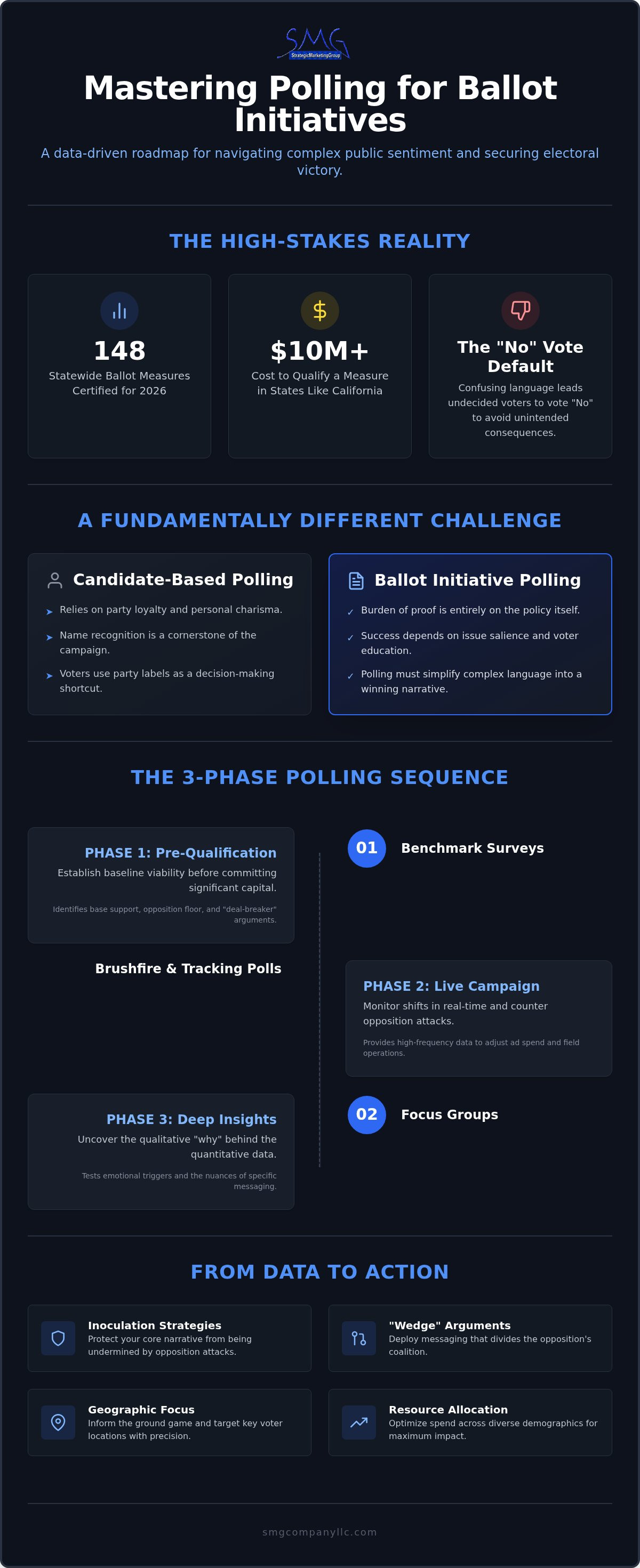
With 148 statewide ballot measures already certified across 39 states for the 2026 cycle, the competition for voter attention has reached a fever pitch. In high-stakes environments like California, organizations often spend upwards of $10 million just to qualify a measure, only to see it fail because they relied on surface-level data. Winning requires more than just knowing where the public stands; it demands a deep dive into the linguistic triggers and cognitive biases that drive the undecided voter.
You understand that a ballot initiative is a complex navigation of public sentiment, where a single confusing phrase can lead to a "no" vote by default. This article provides a strategic roadmap to master polling for ballot initiatives, ensuring your campaign moves from guesswork to data-driven certainty. You'll learn how to identify the exact swing demographics for your specific issue and develop a rigorous message-testing framework that cuts through the noise. We will also examine how to accurately predict turnout in a volatile political climate, giving you the intelligence needed to allocate resources with surgical precision and secure a decisive electoral victory.
Table of Contents
The Strategic Importance of Polling for Ballot Initiatives
Winning a ballot measure requires a different level of strategic rigor than a standard candidate race. Candidates often benefit from lifelong party loyalty or personal charisma. In contrast, Initiatives and referendums in the United States place the burden of proof entirely on the policy itself. This makes the process inherently more volatile. Public opinion can shift overnight as opposition groups frame the measure through a lens of fear or fiscal responsibility. Without a person to defend the idea, the language of the initiative must stand on its own.
Effective polling for ballot initiatives serves as a vital insurance policy against expensive failure. By testing viability during the pre-qualification phase, organizations avoid the trap of spending millions on signature gathering for an issue that has no clear path to victory. Research shows that placing a measure on the ballot in states like California can cost more than $10 million. Strategic polling identifies your "natural" base, those who will support the measure regardless of the opposition, and your "opposition floor," those who will never be moved. The space between these two groups is where the campaign is won or lost. Identifying these numbers early prevents wasted ad spend on un-winnable issues.
Issue-Based vs. Candidate-Based Polling
Voters lack the shortcut of a party label when facing a ballot question. This absence changes their psychology. Name recognition, a cornerstone of candidate races, is replaced by issue salience. You aren't selling a person; you're selling a concept. This presents a unique challenge: voter education. Polling must diagnose whether voters actually understand the technical or legal language of the measure. If the language is too complex, voters often default to a "no" vote to avoid unintended consequences. Polling helps simplify this complexity into a winning narrative.
The 2026 Electorate: Navigating Shifting Social Trends
The 2026 cycle presents a specific set of challenges. Without a presidential anchor to drive turnout, mid-term cycles often see a more ideological and older electorate. In states like New Jersey, local nuances play a significant role. Our analysis suggests that economic sentiment will be the primary driver for tax-related ballot questions in 2026. Polling must account for these shifting demographics to ensure that your message reaches the right audience at the right time. Utilizing polling for ballot initiatives allows campaigns to adjust their strategy based on real-time data rather than historical assumptions that may no longer apply in a disruptive political environment.
Methodology: Types of Surveys for Ballot Measure Success
Effective polling for ballot initiatives isn't a monolithic exercise; it's a tiered sequence of intelligence gathering designed to eliminate uncertainty. While public archives often list final outcomes, they rarely reveal the sophisticated Quinnipiac University Poll methodology standards required to build a winning coalition. Success depends on selecting the right instrument for the specific phase of the campaign, moving from broad baseline research to high-frequency tracking.
Benchmark polling serves as the strategic bedrock. Before an initiative qualifies for the ballot, this research establishes the baseline of public awareness and sentiment. It allows campaign architects to test multiple versions of ballot language to find the phrasing that resonates most with the median voter. In the 2026 cycle, tax-related measures in New Jersey might hinge on whether the language emphasizes "revenue for infrastructure" versus "community investment." Identifying "deal-breaker" arguments during this phase allows the campaign to pivot before significant capital is committed to signature gathering.
Once the campaign is live, the tempo shifts to brushfire and tracking polls. Brushfire polls are deployed to measure the impact of opposition attacks in real-time. If an interest group launches a digital campaign targeting a specific demographic, a brushfire poll determines if that message is gaining traction. As the election approaches, tracking polls monitor momentum during the final 30 days. These surveys provide the high-frequency data needed to adjust ad spend and field operations with surgical precision. To supplement this quantitative data, focus groups dive into the qualitative "why" behind the numbers, testing the emotional triggers and nuances of speech writing before broad distribution.
The Benchmark Poll: Your Strategic Foundation
A rigorous benchmark poll defines the electorate analysis needed before launching an initiative. It isn't enough to know if people support an idea; you must know if that support is "soft" or "hard." By testing various legal and technical phrasings, we identify which versions of the measure are most resistant to opposition messaging. This phase is also critical for identifying the specific arguments that act as deal-breakers for swing voters, ensuring the campaign doesn't inadvertently trigger a "no" vote through poor messaging choices. For those seeking to establish this foundation, professional public opinion polling services provide the necessary clarity to proceed with confidence.
Diagnostic and Persuasion Polling
Persuasion polling identifies "persuadable" segments by testing which specific facts or arguments move a voter from undecided to supportive. Persuasion polling is a tool for mapping the path from neutrality to advocacy. We utilize split-sample testing to evaluate the effectiveness of competing narratives, presenting different arguments to separate groups to see which one produces a statistically significant shift in support. This diagnostic approach ensures that every dollar spent on digital and mobile advertising is backed by data-driven confidence.
Message Testing: Decoding Voter Sentiment
Message testing moves beyond simple approval ratings to decode the underlying psychology of the voter. While state guidelines often suggest that ballot language should be neutral, seasoned strategists understand that every word carries significant weight. Modern theory of campaign message testing demonstrates that emotional resonance often outweighs technical accuracy. In the context of polling for ballot initiatives, the objective is to identify "wedge" arguments that can successfully peel away segments of the opposition. It's also about "inoculation" testing, which allows us to measure how effectively a preemptive narrative can neutralize anticipated attacks before they gain traction.
Linguistic nuance is a decisive factor in electoral outcomes. For instance, voters may support a "dedicated funding stream" while rejecting a "new tax," even if the fiscal result is identical. Our research focuses on measuring the intensity of these sentiments. We distinguish between "soft" support, which is susceptible to opposition messaging, and "hard" opposition, which is typically immovable. This data dictates where we should invest in persuasion versus where we should simply aim for neutralization. Understanding these gradients of intensity ensures that the campaign doesn't waste resources on voters whose minds are already made up.
Voter Segmentation Analysis
Effective campaigns break down the electorate far beyond traditional partisan labels. By integrating polling for ballot initiatives with a comprehensive electorate analysis, we achieve precision targeting that identifies unlikely allies. We look for shared values that bridge ideological divides. A conservation measure might gain support from both rural hunters and urban environmentalists, provided the messaging is tailored to their specific motivations. This level of detail ensures that your digital and mobile advertising reaches the most receptive audiences, regardless of their party affiliation.
Testing the Opposition Narrative
You can't win a ballot measure in a vacuum. We must rigorously poll the "No" campaign's potential arguments to understand their most potent attacks. This intelligence allows us to stay ahead of the opposition's messaging cycle. Data-driven testing also helps us choose the most credible messenger for the rebuttal. In many cases, the messenger is as important as the message itself. Testing whether a narrative is more persuasive coming from a local teacher, a first responder, or a small business owner provides the strategic edge needed to maintain control of the public conversation throughout the cycle.
From Data to Action: Executing the Ground Game
Raw data provides the map, but strategic execution provides the engine. The transition from gathering intelligence to deploying resources is where most campaigns falter. Successful organizations don't treat research as a static report; they use it as a dynamic GPS for their field operations. By integrating professional public opinion polling services with on-the-ground activity, campaigns ensure that every door knock and phone call is backed by empirical evidence. This integration allows for the surgical allocation of resources, moving beyond broad outreach to high-impact engagement in the precincts that matter most.
Effective polling for ballot initiatives dictates the geography of the "Ground Game." If the data shows a cluster of persuadable voters in a specific Newark neighborhood, that becomes the priority zone for field teams. This survey data also informs the specific vocabulary used in voice and text broadcasting. When polling reveals that a specific demographic responds better to "community safety" than "law enforcement," that terminology is immediately baked into the outreach scripts. Similarly, we allocate digital advertising for campaigns by matching poll-tested creative content with the specific demographics most likely to move from neutral to supportive.
Precision Targeting with Digital and Mobile Assets
Modern campaigns require a disruptive approach to visibility. We deploy the SMG Video Truck into high-impact zones identified by the latest survey data, ensuring that visual messaging reaches voters where they live and work. This physical presence is reinforced by geofencing key voting precincts, allowing us to deliver poll-tested messaging directly to mobile devices within those specific geographic boundaries. This creates a powerful synergy between political campaign management and real-time data, ensuring that the campaign's digital footprint reflects the current state of public sentiment. To see how these assets can be deployed for your specific initiative, contact our strategy team today.
The 5-Step Process for a Poll-Driven Initiative Campaign
Step 1: Conduct the Benchmark Poll to define the battlefield and identify the core base of support versus the opposition floor.
Step 2: Execute deep-dive focus groups for message refinement, testing the psychological weight of specific words and phrases.
Step 3: Launch targeted digital and mobile ads based on voter segments, ensuring the right message reaches the right device.
Step 4: Use tracking polls to adjust the narrative mid-stream, responding to opposition attacks or shifts in economic sentiment.
Step 5: Execute high-intensity GOTV (Get Out The Vote) operations based on turnout modeling to secure the final victory.
The SMG Advantage: Strategic Polling for High-Stakes Initiatives
Data alone is insufficient. While many firms can generate a spreadsheet of voter percentages, victory in a high-stakes environment requires an architect who understands the hidden mechanics of influence. We approach polling for ballot initiatives through a disruptive lens that challenges the status quo. We don't just report on public sentiment; we analyze social trends to identify where the current political landscape is vulnerable to change. This methodology allows our clients to navigate complex institutional systems that would otherwise act as insurmountable obstacles.
Our firm brings a seasoned, journalistic perspective to every project. We provide the rich context necessary to understand why a specific Newark neighborhood or a New Jersey demographic is shifting. This local expertise is vital. A ballot measure in 2026 will live or die based on a campaign's ability to respect the gravity of the community's concerns while maintaining a high-level strategic outlook. SMG has a documented history of success in over 40 states, proving our ability to manage multifaceted challenges with precision and steady momentum.
Seasoned Authority in Public Affairs
Led by strategic insiders like Lionel Leach, the SMG team leverages deep-rooted expertise to serve as a full-service partner for our clients. Our approach is formal and mission-driven. We view every engagement through a lens of civic duty and community leadership. This commitment to precision is what sets us apart in high-stakes political environments. We understand that in a mid-term cycle, the margins for error are razor-thin. Our team provides the strategic confidence needed to make bold decisions when the pressure is highest.
Building Your Path to Victory
SMG is the partner of choice for organizations facing the most difficult political challenges. We integrate sophisticated electorate analysis with innovative tools designed for the modern age. Whether it is deploying the SMG Video Truck to dominate the visual landscape or utilizing geofencing for mobile advertising, we ensure your message is inescapable and effective. We move beyond the passive historical records found elsewhere to provide an active, insider perspective on winning. If you're ready to secure a decisive outcome, it's time to Partner with SMG for your 2026 ballot initiative strategy. We know how to build a path to victory where others only see obstacles. Our firm remains deeply connected to the pulse of the community, ensuring your campaign is both intellectually formidable and socially rooted.
Architecting Your Path to 2026 Victory
The 2026 electoral landscape will reward those who prioritize precision over volume. Victory requires a shift from passive data collection to active, diagnostic intelligence that uncovers the hidden triggers of the undecided voter. By mastering message testing and integrating these insights directly into your digital and mobile assets, you transform raw numbers into a decisive ground game. You don't have to guess where your support lies when you can map it with empirical certainty.
Success in this field isn't accidental. It's the result of rigorous polling for ballot initiatives that identifies un-winnable issues early and optimizes resources for maximum impact. With experience in over 40 states and the leadership of veteran strategist Lionel Leach, SMG provides the seasoned authority necessary to navigate complex institutional barriers. We utilize disruptive tools like the SMG Video Truck to ensure your message isn't just heard but felt within the heart of the community.
The path to electoral triumph is built on a foundation of data and strategic confidence. You have the vision to lead. We have the architecture to ensure that vision becomes a reality on election night. Secure Strategic Polling Intelligence for Your 2026 Initiative. Your community is waiting for leadership that delivers results.
Strategic Intelligence: Frequently Asked Questions
What is the most common mistake in polling for ballot initiatives?
The most common mistake is failing to test the strength of the opposition narrative during the initial research phase. Many campaigns focus exclusively on their own positive messaging. This creates a false sense of security that quickly evaporates once the "No" campaign begins its attacks. Effective research must include a stress test of your policy against the most potent arguments your opponents will likely deploy during the cycle.
How many voters do you need to survey for an accurate ballot measure poll?
A standard sample size for a statewide measure usually ranges between 400 and 800 likely voters to achieve a reliable margin of error. While larger samples provide more granular data for specific sub-groups, the strategic value depends on the accuracy of the likely voter screen. In a mid-term cycle, identifying who will actually show up is more critical than the raw number of people surveyed.
Can polling help in drafting the actual ballot language?
Polling is the primary tool for optimizing the actual ballot language before it is submitted for certification. Testing various iterations of the title and summary helps identify which legal phrasing is most resistant to opposition framing. Small linguistic shifts can significantly impact voter comprehension. We use data to ensure the final language minimizes confusion and maximizes the potential for a favorable outcome on election day.
How often should we conduct tracking polls during an initiative campaign?
Tracking frequency should mirror the intensity of the campaign cycle and the volume of media spending. Early phases may only require quarterly updates to monitor the baseline. However, the final six weeks often demand weekly tracking to ensure that polling for ballot initiatives remains responsive to the opposition's late-stage advertising. This high-frequency data allows for real-time adjustments to your messaging and resource allocation.
What is the difference between a benchmark poll and a brushfire poll?
A benchmark poll is a comprehensive survey that establishes the campaign's strategic foundation by mapping the entire electorate. In contrast, a brushfire poll is a shorter, tactical survey deployed to measure the immediate impact of a specific news event or an opponent's advertising blitz. While the benchmark provides the map, the brushfire poll allows you to navigate sudden obstacles and adjust your course mid-stream with confidence.
How do you accurately poll undecided voters on complex issues?
We accurately poll undecided voters by utilizing a split-sample methodology that provides different levels of information to separate groups. By measuring how support shifts after voters hear specific arguments, we can predict how the undecided segment will break once the full campaign reaches them. This diagnostic approach identifies which facts are most persuasive and which narratives fail to move the needle with neutral segments of the electorate.
Why do ballot measures often lose support as Election Day approaches?
Ballot measures often lose support because the burden of proof rests entirely on the "Yes" campaign. When voters are faced with complex technical language or conflicting arguments, their natural psychological default is to vote "No" to avoid risk. The "No" campaign only needs to create doubt. Without a clear and consistent message, soft support often dissolves into a default status-quo vote as the deadline nears.
How does SMG integrate polling data with digital advertising?
SMG integrates data by using survey results to dictate the creative direction and geographic targeting of digital and mobile advertising. This ensures that the messages delivered via our digital assets and the SMG Video Truck are those that have been empirically proven to move voters. By geofencing specific precincts identified by our polling, we deliver the right message to the right device at the right time for maximum impact.
Comments