
Avoiding Common Campaign Mistakes: A Strategic Blueprint for 2026 Victory

With a record-breaking $11.6 billion projected for 2026 political advertising, why do so many well-funded campaigns still fail at the finish line? It's a harsh reality that capital alone cannot buy victory if the underlying strategy is flawed. We recognize the frustration of watching limited funds vanish into ineffective outreach or seeing a hard-won narrative slip away due to inaccurate data. Masterfully avoiding common campaign mistakes requires more than just effort; it demands a sophisticated understanding of the hidden mechanics of influence and a commitment to data-driven precision.
You'll discover the critical strategic, data, and operational errors that frequently sink even the most promising runs. This article provides the expert frameworks needed to protect your resources and sharpen your competitive edge. We'll outline a clear checklist of pitfalls to avoid and provide a blueprint for a more efficient allocation of your 2026 resources, ensuring your path to leadership is built on a foundation of strategic confidence and institutional influence.
Table of Contents
Beyond the Ballot: Why High-Stakes Campaigns Fail Before Election Day
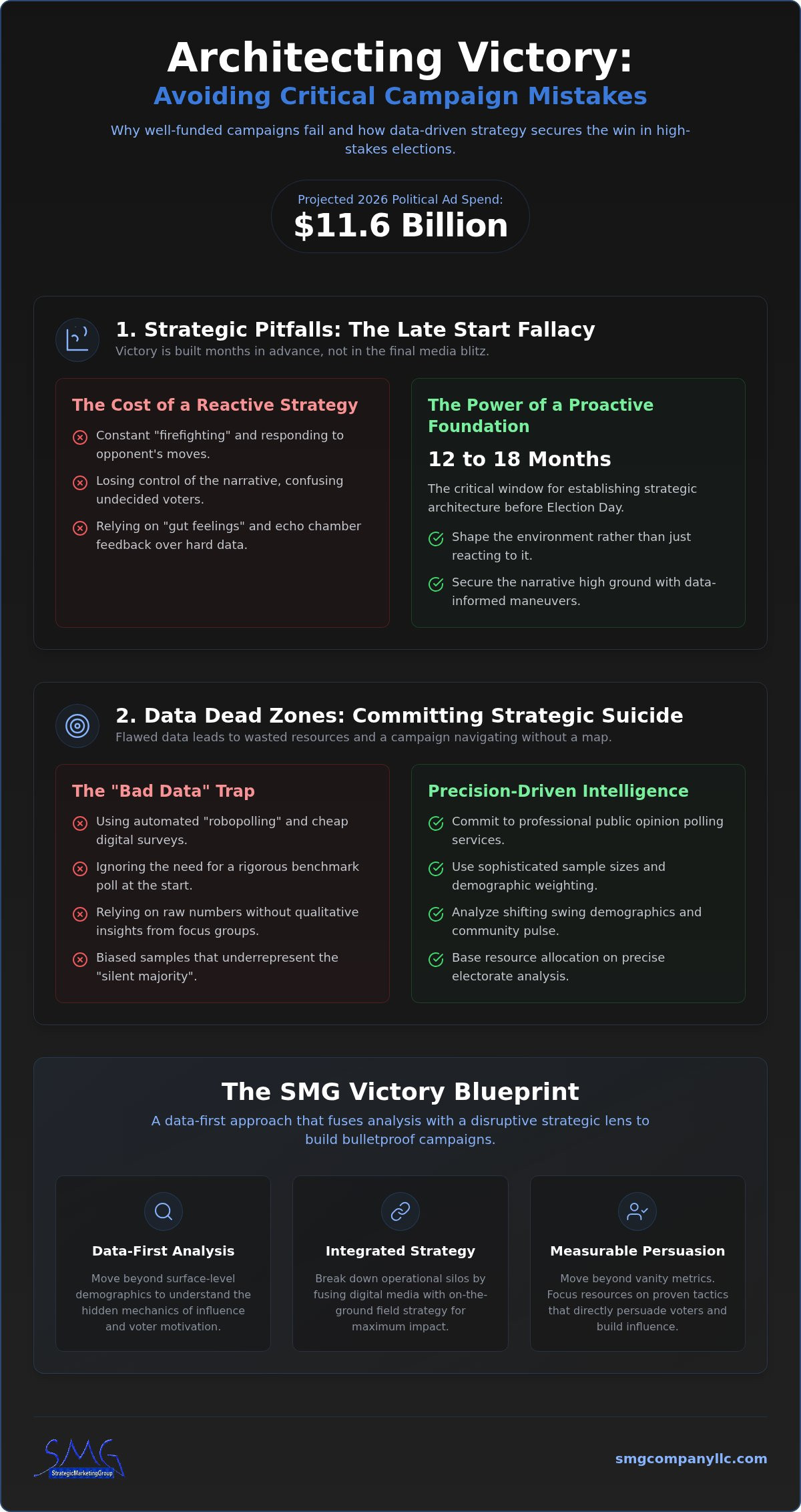
Victory in a high-stakes election isn't won in the final weeks of a media blitz. It's built during the quiet months of foundational preparation. Many candidates fall victim to the "late start" fallacy, believing that campaign activity only begins when the public starts paying attention. In reality, the strategic architecture of a winning run must be established 12 to 18 months before voters head to the polls. This early window is critical for avoiding common campaign mistakes that lead to irreversible resource depletion later in the cycle. Without this lead time, campaigns are forced into a defensive posture, reacting to the environment rather than shaping it.
Relying on staff intuition or "echo chamber" feedback is another frequent path to failure. Strategy should never be a matter of gut feeling; it must be a reflection of hard data and institutional influence. In complex regions like New Jersey, local campaigns often overlook the multifaceted nature of Newark’s diverse electorate. Assuming that a single, broad message will resonate across every ward is a strategic oversight that ignores the shifting sentiment of modern voters.
The Cost of Reactive Strategy
When a campaign lacks a comprehensive political campaign management plan, it enters a state of constant "firefighting." Instead of executing a vision, the team spends every hour responding to the opponent's latest move or the news cycle's whims. This reactive stance hands control of the narrative to the opposition, leaving undecided voters confused about the candidate's true platform. Often, these desperate campaigns pivot toward understanding negative campaigning as a primary tool, which can backfire and alienate the very demographics needed for a majority. In the 2026 election cycle, a strategic initiative is a proactive, data-informed maneuver designed to secure the narrative high ground before opposition forces can define the candidate’s public identity.
Underestimating Electorate Analysis
Assuming that voter behavior is static is a fatal error in a rapidly evolving social landscape. Political trends and public sentiment are in constant motion, requiring a sophisticated approach to electorate analysis to identify where the real battlegrounds lie. SMG leverages deep-rooted expertise to navigate these complex environments, moving beyond surface-level demographics to understand the hidden mechanics of influence. By focusing on shifting swing demographics and the pulse of the community, we ensure that campaign resources are directed toward persuasion rather than shouting into the void. This data-first lens allows us to build a path to victory where others only see obstacles.
Data Dead Zones: Avoiding Critical Polling and Research Errors
Precision is the currency of a successful campaign. When candidates rely on flawed data, they aren't just making a mistake; they're committing strategic suicide. The "Bad Data" trap often begins with a failure to conduct a rigorous benchmark poll at the very start of the election cycle. Without this baseline, you're navigating without a map, unable to measure the effectiveness of your messaging or the movement of your opponent. Avoiding common campaign mistakes in the data realm requires a commitment to methodological integrity over convenience. Relying on raw survey numbers while ignoring qualitative insights from focus groups creates a hollow strategy that fails to capture the nuance of voter motivation.
Relying on Low-Quality Polling Data
The market is flooded with automated "robopolling" and cheap digital surveys that promise quick results at a fraction of the cost. However, these tools lack the demographic weighting and sophisticated sample sizes necessary for accuracy in high-stakes environments. Professional public opinion polling services provide the depth required to understand a complex electorate. A common objection from smaller campaigns is that they can use online polls for free. This is a dangerous path. Free data is often biased toward the most vocal or technologically active segments, leaving the silent majority unrepresented in your strategic planning. True authority comes from data that reflects the reality of the streets, not just the activity on a screen.
Misinterpreting Voter Sentiment
It's easy to mistake social media noise for actual electorate sentiment. A handful of loud voices on X or Facebook doesn't constitute a mandate. Effective campaigns use persuasion polling to test which specific messages actually move the needle with undecided voters. This is critical because research from the Wharton School indicates how messaging can backfire when it focuses exclusively on firing up the base at the expense of the middle. In Newark and surrounding New Jersey regions, sentiment analysis must be localized to account for specific ward dynamics and community-level concerns. For instance, what resonates in the North Ward may fall flat in the South Ward. Avoiding common campaign mistakes requires an uncompromising focus on data quality. Ignoring the "undecideds" is a common path to defeat that seasoned architects avoid by integrating qualitative and quantitative research into a single Victory Blueprint. Our team specializes in transforming complex data into actionable wins; consider how strategic polling could redefine your 2026 outlook.
Narrative Collapse: Messaging Mistakes That Alienate the Electorate
A candidate's narrative is their most fragile asset. When messaging becomes a collection of vague platitudes designed to please everyone, it effectively says nothing to anyone. This "Everything to Everyone" error is a hallmark of undisciplined campaigns. It dilutes the candidate's brand and creates an opening for opponents to define the narrative. Masterfully avoiding common campaign mistakes in messaging requires a commitment to clarity and a refusal to hide behind "consultant-speak." Authenticity isn't just a buzzword; it's a strategic necessity. Voters in Newark and throughout New Jersey are sophisticated. They quickly identify when a candidate's policy positions feel disconnected from their daily lives. If a platform doesn't address local realities with a community-rooted voice, it won't gain the momentum needed for a 2026 victory.
The gap between policy and people is often filled with jargon that fails to resonate. For a campaign to succeed, it must translate complex governance goals into the tangible impacts they have on families and neighborhoods. This transition from abstract concepts to grounded leadership is what separates a disruptive force from a standard politician.
Developing a Disciplined Strategic Narrative
Success requires a story that is both compelling and consistent across every platform. Utilizing professional political messaging services ensures that your core identity remains intact while adapting to different demographic segments. We advocate for a "Three Pillars" approach to candidate identity. First, a clear Vision for the future. Second, a defensible Record of achievement or character. Third, a sharp Contrast with the opposition. Speech writing must do more than just relay facts. It must reflect the candidate’s unique voice while relentlessly driving these strategic pillars home. A speech that sounds like it was written by a committee will never inspire leadership or civic duty.
Neglecting Crisis Communications Preparedness
The political arena is inherently volatile. One unforced error or a coordinated attack can end a campaign in hours if a plan isn't already in place. The "wait and see" approach is the most dangerous response to a brewing scandal. It allows the opposition to occupy the information vacuum and set the terms of the debate. Avoiding common campaign mistakes means having a rapid-response team and pre-vetted messaging ready before the first shot is fired. This level of preparedness transforms a potential disaster into a manageable event. SMG approaches high-stakes contests with a focus on strategic communications that protect our clients' reputations. We don't just react to the news cycle; we anticipate it, ensuring our candidates maintain their institutional influence even under pressure.
Operational friction is the silent killer of political momentum. Many organizations suffer from the "Digital Silo," where digital media teams and field directors work in isolation. This separation prevents the seamless flow of intelligence that is necessary for avoiding common campaign mistakes. When digital ads don't inform the ground game, you risk canvassing neighborhoods that have already been saturated or, worse, ignored. Wasting precious donor funds on "Vanity Metrics" like follower counts or post likes is a strategic error. These figures provide a false sense of security but do nothing to move the needle on Election Day. True victory is found in voter persuasion and a disciplined Get Out The Vote (GOTV) operation.
Optimizing Digital and Mobile Advertising
Strategic digital advertising for campaigns requires moving beyond the "Broad Match" trap that populates your ads for irrelevant search terms. Instead, we focus on high-precision mobile advertising and geofencing to reach specific voter segments with surgical accuracy. Standard social media banners are easily ignored in the high-noise 2026 cycle. The SMG Video Truck serves as a high-visibility catalyst for community engagement, providing a mobile billboard that captures attention in Newark’s busiest wards and residential corridors. This asset allows a campaign to deliver dynamic video content directly to the demographics that matter most, bridging the gap between digital messaging and physical presence.
Bridging the Gap Between Digital and Ground Game
A unified narrative is essential for establishing institutional influence. Your text-based communication and voice broadcasts must align perfectly with the door-knocking scripts used by your field teams. When a voter hears the same message on their phone and at their front door, it creates a sense of stability and purpose. Inefficient field operations often rely on the outdated tactic of "canvassing everywhere," which dilutes your impact. We utilize sophisticated electorate analysis to generate targeted lists, ensuring that every volunteer hour is spent on high-probability swing voters or base mobilization. Real-time data analysis allows us to pivot operations mid-campaign, responding to shifts in public sentiment before the opposition can react. In the complex New Jersey political environment, this level of precision is the only way to ensure a more efficient allocation of campaign resources. If you're ready to build a path to victory, contact SMG to secure your operational strategy.
The Strategic Solution: How SMG Builds Bulletproof Campaigns
Victory in the 2026 cycle is not an accident of timing; it's the result of a meticulously crafted Victory Blueprint. Many campaigns falter because they treat data, messaging, and execution as separate silos. At SMG, we act as the strategic architect, fusing these elements into a single, unstoppable force. Avoiding common campaign mistakes is not just about a checklist; it's about adopting a disruptive, data-first lens that anticipates obstacles before they manifest. We pride ourselves on navigating the hidden mechanics of influence to build a path to victory where others see only complexity. Our approach replaces fragmented efforts with a steady, professional demeanor that suggests deep-rooted expertise and a history of high-stakes success.
The transition from a candidate to a leader requires more than just a winning vote count; it requires the establishment of long-term institutional influence. We don't rely on breathless hype or frantic energy. Instead, we maintain a calm, ongoing momentum that suggests stability in a fast-moving environment. This methodical rhythm ensures that every assertion of identity is backed by specific evidence of activity, providing a sense of continuous presence that voters and stakeholders respect.
The Full-Service Advantage in New Jersey
The efficiency of a full-service partner cannot be overstated. Managing a dozen disconnected vendors leads to message dilution and wasted resources, which often results in the very operational friction we discussed earlier. By centralizing your operations, you ensure that your government relations strategy development is perfectly synchronized with your field and digital efforts. We combine our deep Newark roots with a national perspective gained from working in over 40 states. This allows us to offer a formal, mission-driven approach that respects the pulse of the community while maintaining a high-level strategic outlook. Our firm understands that local engagement is the foundation of national influence.
Getting Started with SMG
Our firm has a proven history of success, having been instrumental in electing officials ranging from local mayors to members of Congress. We understand that leadership is a serious responsibility, and we treat every contest with the gravity it deserves. To ensure your 2026 strategy is bulletproof, contact SMG for a comprehensive campaign audit. Let's evaluate your current trajectory and refine your path toward institutional influence. We'll help you navigate complex systems with precision and ensure your campaign is built on a foundation of stability. Together, we can uphold the values of civic duty and community leadership with the professional precision that modern politics demands.
Architecting Your Path to 2026 Leadership
Success in the 2026 election cycle requires a transition from reactive tactics to a unified, data-first strategy. By establishing foundational messaging 12 to 18 months out and integrating digital outreach with a disciplined ground game, you ensure that every resource is utilized with maximum efficiency. Masterfully avoiding common campaign mistakes means prioritizing methodological integrity over gut feeling and focusing on voter persuasion rather than vanity metrics. This strategic foresight is what separates a disruptive force from a standard political run.
Led by prominent strategist Lionel Leach, SMG offers the seasoned authority and deep-rooted expertise necessary for victory in over 40 states. We provide the specialized assets, including the SMG Video Truck, needed to capture attention and influence diverse demographics. Our firm understands the hidden mechanics of influence and is committed to helping you build a legacy of community leadership and institutional influence. Secure your path to victory with SMG’s strategic campaign management.
The challenges of the next cycle are formidable, but with a clear blueprint and a dedicated partner, your path to the finish line is secure.
Frequently Asked Questions
What is the most common mistake first-time candidates make?
The most common error is waiting too long to establish a strategic foundation. First-time candidates often delay their launch until the election year, missing the critical window for benchmarking and electorate analysis. This delay forces a reactive posture that hands narrative control to the opposition. Success requires a proactive approach that begins at least 12 to 18 months before Election Day to ensure a stable path to victory.
How much of a campaign budget should be allocated to polling?
Polling should be viewed as a foundational investment rather than a peripheral expense. While specific allocations vary based on the scale of the race, a robust strategy typically requires enough funding to cover a benchmark poll, periodic tracking, and persuasion research. This ensures that resource allocation is driven by accurate data rather than guesswork, which is essential for avoiding common campaign mistakes that lead to wasted funds.
Why do political campaigns fail even with a lot of money?
Campaigns fail despite significant funding when they lack a unified Victory Blueprint. High-capital operations often suffer from operational friction; digital, field, and messaging teams work in silos. Without a strategic architect to integrate these functions, money is frequently spent on vanity metrics that don't translate to voter persuasion. Capital is a tool, but it cannot replace a disciplined, data-driven strategy.
How can I tell if my campaign messaging is actually working?
You can determine messaging effectiveness through rigorous persuasion polling and tracking movement among undecided voters. Standard metrics like social media engagement are often misleading and don't reflect actual electorate sentiment. Real success is measured by how well your core pillars; Vision, Record, and Contrast; resonate with specific demographics and move the needle in internal tracking polls during the final months of the cycle.
What is the difference between digital ads and mobile voter outreach?
Digital ads typically involve broad-based targeting on platforms like Google or Meta to build brand awareness. Mobile voter outreach is a more surgical approach that utilizes geofencing and text broadcasting to reach specific voters directly on their devices. While digital ads cast a wide net, mobile outreach ensures your message reaches the right households with precision, bridging the gap between high-level messaging and the ground game.
Can a public affairs firm help with government relations after the election?
A full-service firm provides continuity by transitioning campaign momentum into a long-term government relations strategy. Winning the election is only the first step; the subsequent challenge is navigating complex systems to achieve legislative goals. This ongoing partnership ensures that the promises made during the campaign are translated into institutional influence, allowing newly elected officials to maintain their pulse on the community while governing effectively.
How does electorate analysis differ from standard market research?
Electorate analysis focuses on civic duty and voting behavior, which is fundamentally different from the consumer motivations studied in market research. It involves understanding the hidden mechanics of influence and how public sentiment shifts in response to policy and governance. While market research looks at purchasing habits, electorate analysis examines the deeper social trends and ward-level dynamics that determine who takes leadership in a high-stakes environment.
What role does the SMG Video Truck play in a modern campaign?
The SMG Video Truck serves as a mobile catalyst for high-visibility community engagement. It bypasses the noise of traditional media by delivering dynamic video content directly into the neighborhoods where voters live and work. This asset is a critical tool for avoiding common campaign mistakes like failing to reach demographics that are disconnected from digital platforms, ensuring your narrative is physically present in the community.
Comments