
Voter Reengagement Programs: A Strategic Guide to Activating Lapsed Electorates

Updated: Jun 24
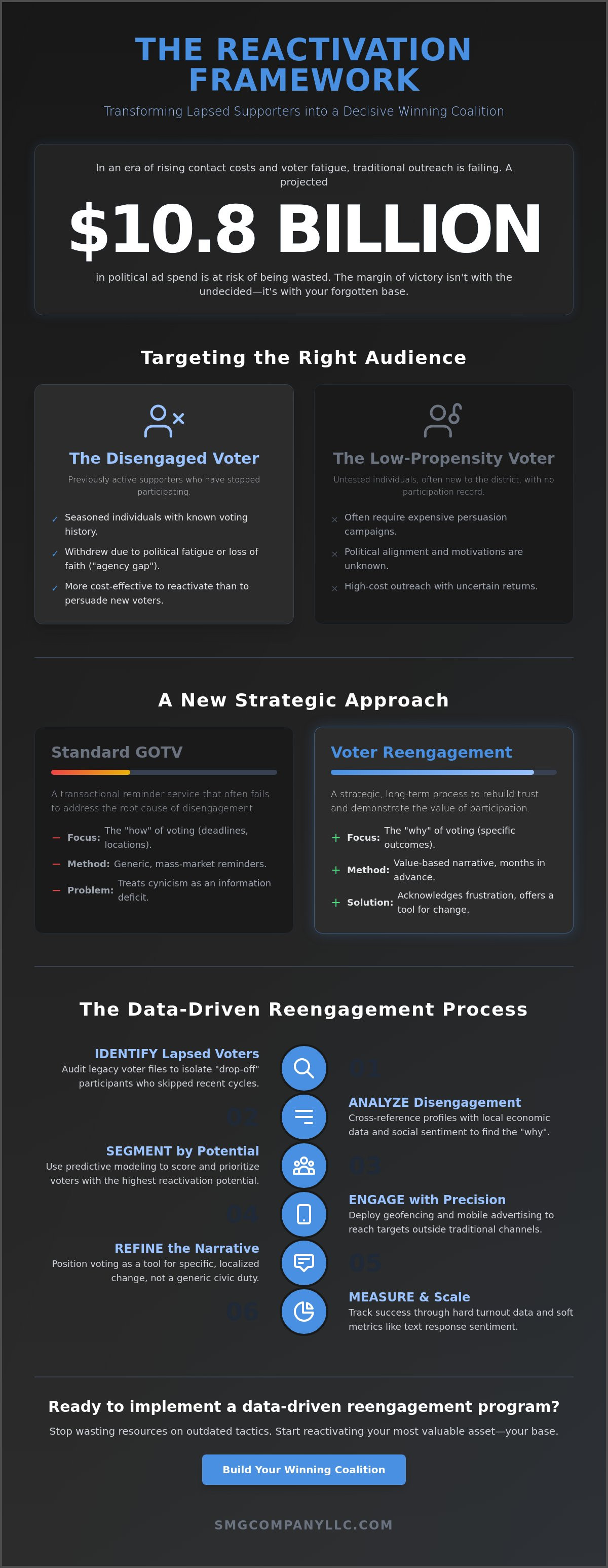
What if the margin of victory in your next race isn't hidden in the undecided middle, but buried within the segment of your own base that simply stopped showing up? In an era where political ad spending is projected to exceed $10.8 billion, many campaigns fail because they ignore the decaying voter files right in front of them. Implementing precise voter reengagement programs is no longer an optional tactic; it's a strategic necessity for any organization facing high voter fatigue and rising contact costs.
You understand that traditional outreach often hits a wall of cynicism, leading to wasted spend and missed opportunities. This guide provides a professional path forward. You'll learn how to deploy data-driven initiatives that transform low-propensity citizens into a decisive winning coalition. We will outline a scalable framework for voter reactivation designed to lower the cost of GOTV efforts and secure a margin of victory in the most competitive races by restoring a sense of agency to the lapsed electorate.
Table of Contents
Understanding Voter Reengagement: Strategy vs. Reminders
Voter reengagement is the strategic process of reactivating citizens who were previously active participants in the democratic process but have since lapsed into non-participation. Unlike a standard voter registration campaign that seeks to bring new names into the system, voter reengagement programs focus on individuals who already exist within your data files but have skipped the last two or three cycles. This distinction is vital for campaign efficiency. While "low-propensity" voters are often untested or new to the district, "disengaged" voters are seasoned individuals who have consciously or subconsciously withdrawn from the process.
To better understand the broader context of civic participation and the federal perspective on mobilization, watch this helpful video from the U.S. Election Assistance Commission:
The 2026 political landscape demands a sophisticated shift in resource allocation. With political ad spending projected to exceed $10.8 billion, the cost of persuading undecided voters has reached a point of diminishing returns. Reengaging a lapsed voter who already aligns with your platform's core values is significantly more cost-effective than attempting to flip a hostile or truly independent citizen. This approach addresses the "agency gap," a psychological state where the voter believes their participation no longer influences the outcome. Traditional Get-Out-The-Vote (GOTV) tactics fail here because they treat the problem as a lack of information rather than a loss of belief. By focusing on those who have already participated in the past, campaigns can leverage historical data to rebuild that lost trust and momentum.
The Psychology of the Disengaged Voter
Political fatigue is a measurable deterrent. When voters perceive a "broken promise" from previous administrations or candidates, they don't just become undecided; they withdraw entirely. Reactivating these individuals requires more than a reminder of the election date. It demands emotional triggers that acknowledge their specific frustrations and demonstrate a clear path toward tangible change. You aren't asking them to perform a duty. You are offering them a tool to resolve a localized grievance through strategic participation.
Reengagement vs. Standard GOTV
Standard GOTV messaging is transactional. It focuses on the "how" of voting, such as polling locations and deadlines. For disengaged audiences, this is insufficient. Effective voter reengagement programs utilize a "long-tail" cycle that builds a value-based narrative months before the election. This shifts the conversation from a request for a vote to a partnership in a broader mission. Instead of a checklist, the communication focuses on the impact a restored coalition can have on specific community outcomes.
Data-Driven Segmentation: Identifying the Reactivation Target
Identifying the right targets within your data infrastructure is the difference between a high-impact campaign and a wasted budget. A successful audit of existing voter files isolates "drop-off" voters, specifically those who participated in the 2020 or 2022 cycles but remained absent in more recent local contests. This provides a baseline for voter reengagement programs. By cross-referencing these files with local economic data and social sentiment, campaigns can pinpoint the exact reasons for withdrawal. This isn't just about demographics; it's about understanding the specific pressures, such as inflation or housing costs, that correlate with political disengagement in certain precincts.
Sophisticated campaigns utilize electorate analysis to move beyond static lists. This predictive modeling allows you to score voters based on their reactivation potential. By analyzing past behavior alongside current public sentiment, you can prioritize segments where the activation cost is low but the electoral impact is high. This ensures that every dollar spent on outreach is directed toward the voters most likely to return to the polls when presented with the right narrative.
Behavioral Modeling for Voter Archetypes
Effective segmentation requires categorizing voters into actionable archetypes. "The disillusioned regular" is a high-priority target. These are individuals who have a consistent history of voting but skipped only the most recent election due to specific fatigue or lack of interest in the candidates. Conversely, "the single-issue absentee" only engages when a particular topic, such as a local bond measure or a specific legislative change, is on the ballot. Mapping these behaviors to geographic clusters allows field operations to focus their mobile outreach on areas with the highest density of reactivatable voters.
Refining the Voter File
Precision requires constant data hygiene. You must remove "ghost" voters who have moved or passed away to ensure your resources aren't spent on undeliverable contacts. Integrating consumer data can also provide insight into the lifestyle drivers of your target segments, such as their media consumption habits or professional affiliations. This level of detail allows for a more personalized approach. Implementing real-time feedback loops from Public Opinion Polling ensures that your segments remain dynamic, adjusting to shifts in the political climate as the election cycle progresses.
Executing Multi-Channel Reengagement Programs
Once your data audit has identified the specific segments of the lapsed electorate, the focus must shift to tactical deployment. Strategic voter reengagement programs succeed by meeting the voter where they already exist, rather than expecting them to seek out campaign information. A synchronized multi-channel approach is necessary to penetrate the layers of cynicism that often characterize the disengaged. Relying on a single medium is a strategic vulnerability. Instead, successful campaigns coordinate digital, mobile, and physical assets to create a persistent and credible presence.
Leveraging digital advertising for campaigns allows your team to bypass traditional media fatigue and deliver highly specific narratives directly to a voter's device. This is most effective when integrated with hyper-local geofencing, which targets high-density, low-turnout neighborhoods with surgical precision. By focusing on the areas where your "drop-off" voters live and work, you ensure that every impression serves a strategic purpose in the broader reactivation effort.
Mobile and Digital Disruption
Geofencing provides a context-aware layer to digital outreach. It isn't merely about location; it's about establishing a narrative presence in the voter's daily environment. In these digital efforts, the balance between frequency and reach is critical. High frequency is required to move a voter from apathy to action, yet it must be managed carefully to avoid the annoyance that leads to further disengagement. Mobile-optimized video content is the primary vehicle for this disruption. Short, punchy video assets that address localized pains can cut through the noise of digital algorithms more effectively than static imagery or text-heavy posts.
High-Impact Physical Outreach
Physical presence validates digital messaging, particularly in skeptical communities where trust in institutional systems has eroded. The SMG Video Truck acts as a mobile rallying point, providing high-impact visual disruption that cannot be ignored or blocked by an app. This physical asset brings the campaign's message into the community's shared spaces, serving as a powerful reinforcement of the digital ads voters see on their phones. This visibility is essential for restoring the "agency" mentioned earlier in this guide.
Crafting the Reactivation Narrative: Beyond "Go Vote"
The primary barrier for the disengaged voter is rarely a lack of information. Most individuals in your lapsed files already know where their polling place is located and how to request a ballot. They simply don't believe the effort is worth the outcome. Successful voter reengagement programs must pivot from the traditional "voting is a duty" appeal to a more potent "voting is a tool" strategy. This shift in perspective addresses the agency gap by framing the ballot as a mechanism for specific, tangible change rather than a repetitive civic ritual. When you treat the voter as a strategic partner in a mission, you replace apathy with a sense of purpose.
By utilizing sophisticated political messaging services, you can move away from broad platitudes and align your communication with the localized pains of your audience. Whether the grievance is rising utility costs or a specific zoning dispute, the narrative must show that the current "status quo" is a direct result of their absence. You must also integrate "proof of impact" stories. These narratives demonstrate past instances where a small, determined coalition successfully altered a policy outcome. This counters the corrosive belief that "nothing ever changes" and provides the necessary evidence that their participation has a high return on investment.
The Anatomy of a Reengagement Message
Precision messaging begins with identifying the core grievance of your target segment. Through public opinion polling, you can uncover the specific issues that caused a voter to withdraw. Once identified, your message should clearly define the "cost of inaction." For example, a single sentence might state: "If this coalition remains silent, the proposed 12% property tax hike will pass without a challenge." This creates a clear contrast between the current trajectory and a tangible, voter-driven alternative. While social pressure messaging can be effective, it must be used with extreme care. Skeptical voters often react negatively to being "shamed" for their past absence, so focus on the future opportunity rather than past failures.
Testing and Iterating the Message
A narrative is only as strong as its resonance with the target audience. Utilize A/B testing on digital ads to identify which "reactivation" hook generates the highest engagement. You might test a message focused on economic relief against one focused on community safety to see which trigger actually moves the needle. Furthermore, conducting focus groups specifically with lapsed voters can uncover hidden objections that standard polling might miss. As you approach Election Day, adjust your tone from persuasive narrative building to urgent, tactical instructions. This ensures that the momentum you've built translates into a physical presence at the polls. To ensure your campaign has the seasoned authority needed to execute these shifts, consider professional Campaign Management for your next cycle.
Measuring Success and Scaling the Program
Quantifying the impact of voter reengagement programs requires a shift from binary win-loss outcomes to sophisticated data modeling. While the final vote count is the ultimate metric, strategic architects must establish Key Performance Indicators (KPIs) that track the progression of the lapsed electorate throughout the cycle. You should prioritize the "Reactivation Rate," which is the percentage of targeted lapsed voters who actually return to the polls. This metric, when integrated back into a central political campaign management plan, allows for real-time resource reallocation based on which segments are responding to the narrative shifts discussed earlier.
Beyond hard turnout data, tracking "soft" metrics provides the strategic intelligence needed to refine outreach. Monitoring email open rates and text response sentiment allows you to gauge the emotional temperature of the disengaged base. Similarly, geofencing dwell time at community events offers a proxy for interest levels that digital clicks cannot capture. These data points ensure your campaign remains agile, responding to the subtle movements of the electorate before the final ballots are cast.
The ROI of Reengagement
The financial logic of reactivation is clear. Persuading a hostile or undecided voter is a high-cost endeavor with a low probability of success. In contrast, the cost-per-vote of reengagement is significantly lower because you are targeting individuals who already share a foundational alignment with your goals. There is also a distinct multiplier effect. A re-engaged voter often acts as a catalyst within their own social circle, leveraging relational organizing to bring other disengaged peers back into the fold. This creates a long-term benefit for future cycles, as a reactivated voter is far more likely to remain a consistent participant than a first-time or untested voter.
This focus on high-yield targets mirrors the way modern enterprises use AI to identify prospects with the highest conversion potential; to explore these methodologies further, check out Global AI Reps for a strategic look at capturing high-intent leads.
Scaling from Local to Statewide
Moving from a local pilot to a statewide operation requires a robust infrastructure and a multi-year blueprint. You can't rely on a single-cycle burst of activity; voter interest must be sustained through a consistent government relations strategy that keeps the electorate connected to legislative outcomes between elections. A statewide roadmap involves identifying geographic clusters of disengagement across diverse districts and deploying mobile assets to validate digital messaging on a larger scale. By treating voter reengagement as a continuous organizational function rather than a seasonal tactic, you build a resilient winning coalition that can withstand the volatility of modern politics.
Securing the Strategic Edge in 2026
Victory in a competitive political landscape requires more than just high-volume outreach. It demands a sophisticated understanding of why voters withdraw and a data-driven framework to bring them back. By shifting from generic reminders to specific narrative agency and utilizing multi-channel disruption, your organization can effectively activate the segments of the electorate that others have abandoned. Successful voter reengagement programs are the foundation of a resilient, winning coalition capable of withstanding the noise of modern digital algorithms.
SMG (Strategic Marketing Group) brings a history of high-stakes success to every partnership. Led by veteran strategists like Lionel Leach, our firm has delivered results in over 40 states. We combine deep-rooted expertise with proprietary technology, such as the SMG Video Truck, to ensure your message is seen and felt in the communities that matter most. Contact SMG (Strategic Marketing Group) to build your 2026 voter reengagement strategy and transform your lapsed data into a decisive electoral force. The path to victory is defined by precision. Build yours with a partner that understands the mechanics of influence.
Frequently Asked Questions
What is the difference between voter engagement and voter reengagement?
Voter engagement is a broad category of outreach designed to inform and mobilize the general public, often focusing on registration for new or untested voters. In contrast, voter reengagement specifically targets individuals who have a documented history of participation but have skipped recent election cycles. It is a restorative strategy that uses historical data to reactivate known participants who have lapsed into non-participation.
Why do voters become disengaged in the first place?
Disengagement is usually a response to a perceived lack of agency or the belief that the political system no longer yields tangible results. This "agency gap" often stems from a "broken promise" narrative where voters feel their past participation didn't lead to meaningful change. It's a conscious withdrawal driven by political fatigue rather than a simple lack of information about polling dates or locations.
How much does a professional voter reengagement program cost?
The investment for these initiatives depends heavily on the geographic scale of the race and the specific multi-channel tools required for success. While traditional outreach often carries a high cost-per-contact for low-propensity segments, voter reengagement programs optimize spend by focusing on high-yield, previously active voters. You should evaluate your budget based on the specific margin of victory required and the depth of the data audit needed to isolate your target segments.
Can digital advertising alone reengage lapsed voters?
Digital advertising is a critical component, but it's rarely sufficient to reactivate deeply cynical or fatigued voters on its own. A multi-channel strategy that includes physical disruption, such as mobile video trucks, is necessary to validate digital messaging. Combining digital reach with physical presence and relational organizing helps penetrate the layers of skepticism that cause voters to skip the polls.
How do you identify disengaged voters in a voter file?
You identify these individuals by auditing voter files to isolate "drop-off" patterns from the last two or three election cycles. The focus is on voters who participated in high-stakes general elections but remained absent during subsequent midterms or local contests. This behavioral data provides a more accurate predictor of reactivation potential than demographic profiling alone.
What messaging is most effective for voters who feel their vote doesn’t count?
Effective messaging pivots from civic duty to the "cost of inaction," showing voters exactly how their absence impacts their daily lives. Providing "proof of impact" stories that highlight past victories by small, determined coalitions can help counter the belief that participation is futile. The goal is to frame the ballot as a strategic tool for resolving localized grievances rather than a symbolic gesture.
How far in advance of an election should a reengagement program start?
A successful program should ideally launch six to nine months before Election Day to allow for a "long-tail" narrative building cycle. This timeframe is necessary to move a voter from a state of apathy back to a state of active participation. Early engagement ensures that your final GOTV efforts are reaching a base that has already been primed to believe in the value of their vote.
What role does geofencing play in voter reengagement?
Geofencing provides a context-aware layer to digital outreach by targeting high-density, low-turnout neighborhoods with surgical precision. It allows a campaign to deliver specific, localized narratives to voters' devices while they're in their own communities. This ensures that your resources are concentrated on the geographic clusters where your lapsed segments are most likely to live and work, reducing wasted impressions.
Comments